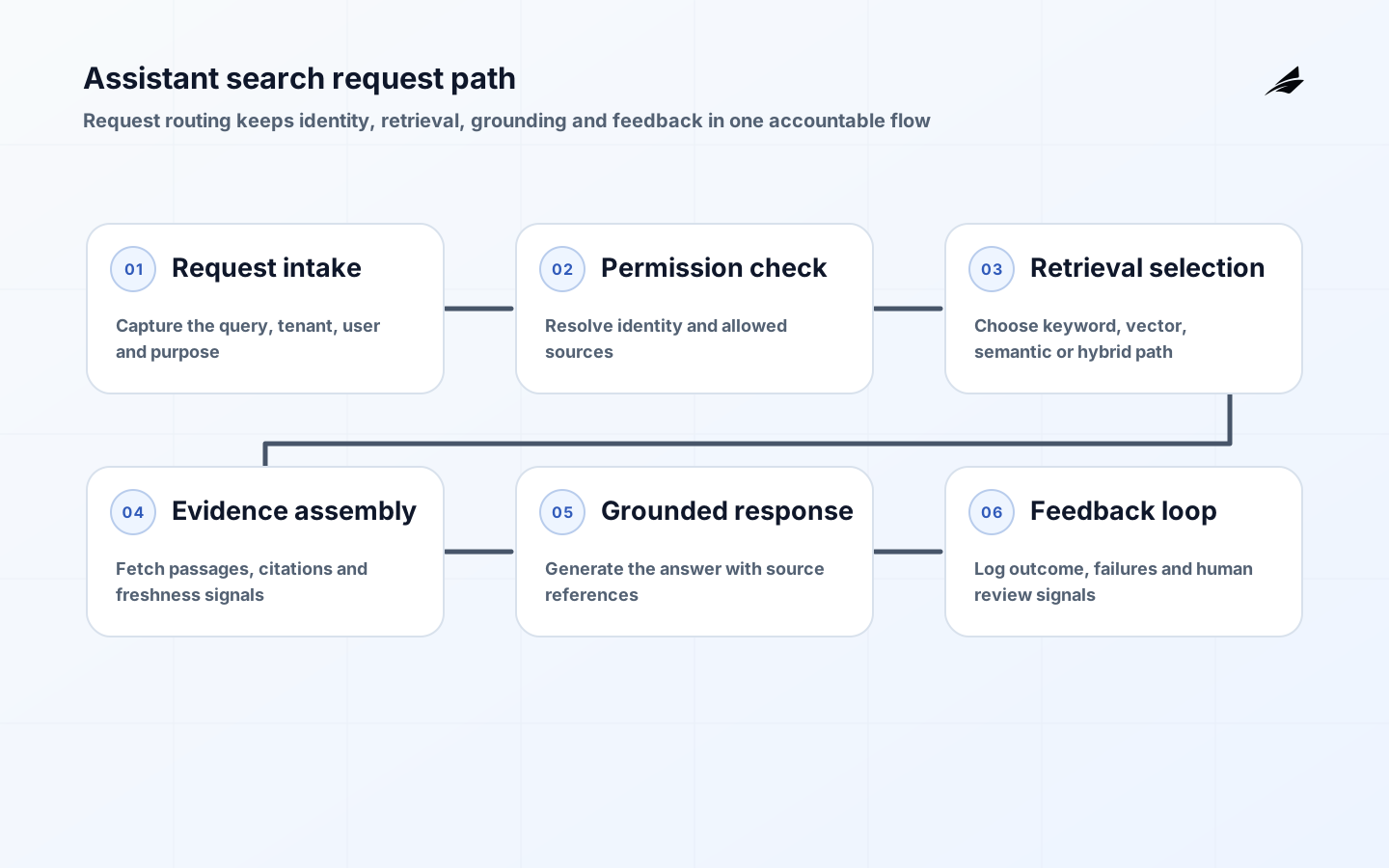
AI assistant search solutions are useful only when they answer a real work question with the right permission, the right source and a defensible fallback when evidence is weak. The goal is not to make a model sound confident. It is to let a team search company records, policies, tickets and curated documents without collapsing access control, source freshness or operational accountability. That requires decisions about corpus scope, retrieval pattern, ranking, answer format, logging, review and rollout before a pilot turns into a product.
This guide treats the solution as an operating capability. The buyer still owns the question, the data boundary and the acceptable risk. The platform team still owns reliability, privacy and cost. The implementation team still needs evidence that the assistant can stay grounded when the corpus changes, when permissions differ or when the model should refuse to answer. Those are the questions that determine whether AI assistant search solutions become a dependable service or a noisy interface.
Define the assistant search boundary
Start with one narrow class of questions and one authoritative corpus. A support team may ask policy and troubleshooting questions. A product team may ask architecture and release questions. An operations team may ask runbook and incident questions. In each case, the solution must say which sources it can use, what freshness it requires, which users may see which records and how it behaves when it has no trustworthy answer. A wide corpus with vague authority creates more risk than value because it encourages the assistant to return something instead of the right thing.
Write the boundary in operational language. Name the user, the question, the records in scope, the result the assistant may produce and the escalation path when the answer is uncertain. A good boundary also states what the assistant will not do: make a policy decision, overwrite source data, expose another team's records or imply certainty where the evidence is incomplete. That clarity keeps the product team from quietly expanding the scope every time a new document collection or workflow appears.
| Design decision | What to decide | If vague |
|---|---|---|
| Corpus | Which systems and document sets the assistant may search | The model will mix stale, duplicate or irrelevant content |
| User scope | Which roles, teams or tenants may query which records | Search answers can reveal material a user should not see |
| Answer form | Whether the assistant drafts, summarizes, recommends or refuses | Users may mistake a suggestion for an approved decision |
| Authority | Which system remains the source of truth for each fact | The assistant can compete with the real record |
| Escalation | How unresolved questions reach a human owner | No one can tell when the answer should stop |
Choose the retrieval pattern and source system
The retrieval layer should match the question, not the fashionable architecture. Keyword search works when users know the exact term, identifier or title. Vector search helps when meaning matters more than an exact phrase. Hybrid search combines the two when the team needs both recall and precision. Semantic ranking can improve the order of results after the first retrieval pass. Curated source lists and pinned documents are still valuable when the corpus is small or the workflow demands very high certainty.
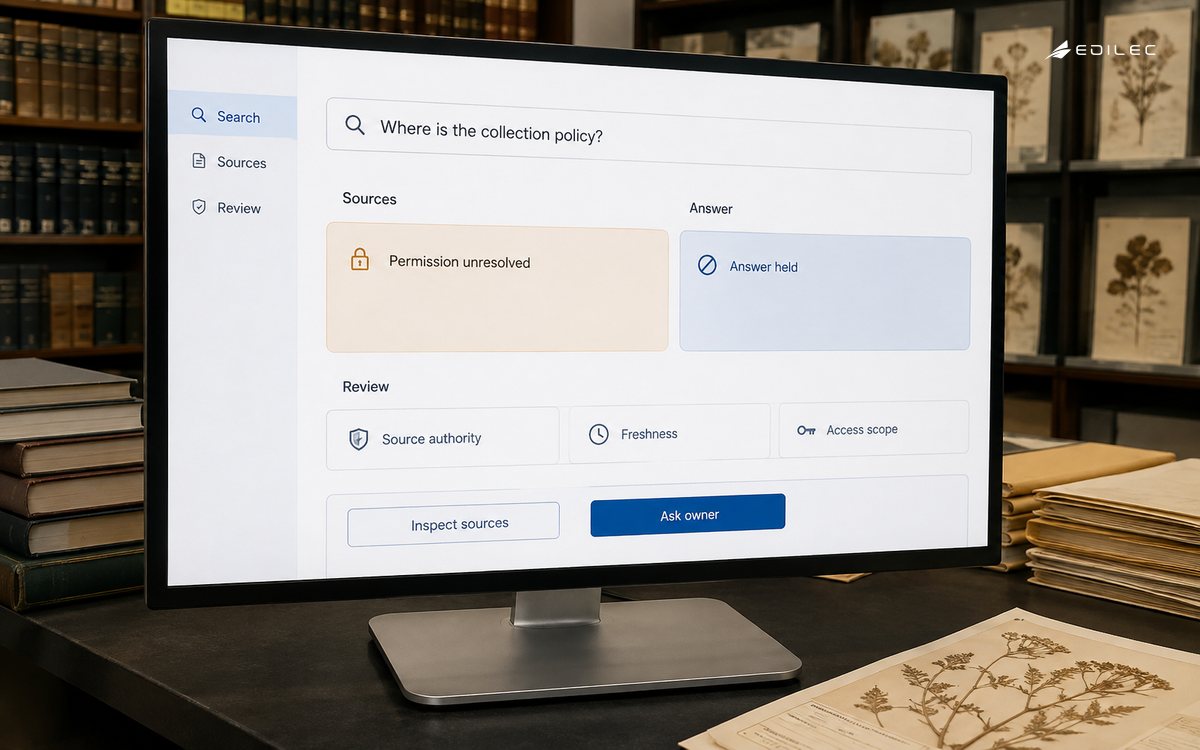
The right pattern depends on freshness, recall and explanation. A policy answer often needs exact language from a controlled source. A support assistant often needs both the exact error string and the relevant conceptually similar fix. A product assistant may need a mix of release notes, design decisions and task records. The architecture should be able to show why a passage was retrieved, why a result was ranked and why a source was excluded. If the team cannot explain those steps, it will struggle to debug retrieval quality later.
| Pattern | Best use | Risk if overused |
|---|---|---|
| Keyword search | Exact names, IDs, error codes and policy titles | Misses language that is conceptually related but not identical |
| Vector search | Conceptual matches across varied phrasing | Can surface nearby but wrong passages without further control |
| Hybrid search | Balanced recall and precision across mixed corpora | Adds tuning work if scoring and ranking are not reviewed |
| Semantic ranking | Reranking candidates for clearer relevance | Can look magical if the candidate set is weak |
| Curated retrieval | Small controlled corpora with strict answer rules | Does not scale when the content set grows fast |
Design permissions and grounding together
Permissions are not a post-processing filter. They are part of the retrieval path. The assistant should filter candidate sources by identity, role, tenant or document scope before the model sees them. If a document should be invisible in the search UI, it should not become visible in a prompt, a citation or a cache entry. The same rule applies to exports, snippets and summaries. Grounded answers should cite the source passages that actually supported the answer and should refuse when the evidence is thin or contradictory.
Prompt injection and data exfiltration are practical risks in AI assistant search solutions. Treat retrieved text as untrusted input. Keep system instructions separate from content, limit what the model can do with retrieved text and test whether a malicious document can cause the assistant to ignore policy or leak hidden records. A useful control set includes source filtering, document-level ACLs, citation rules, refusal thresholds, output validation and a human review path for sensitive actions or ambiguous answers.
| Control area | Implementation | Validation |
|---|---|---|
| Identity | Resolve the user or service identity before retrieval | A denied user never sees a prohibited passage |
| Scope | Apply role, tenant or document filters to candidate sources | Cross-scope tests return no hidden content |
| Grounding | Require citations from the passages used in the answer | The answer can be traced back to specific evidence |
| Refusal | Set a threshold for weak, conflicting or absent evidence | The assistant stops instead of inventing detail |
| Review | Route sensitive or ambiguous results to a human owner | Escalation is documented and repeatable |
Estimate build and run cost realistically
Cost comes from more than model tokens. The team will pay for corpus cleanup, chunking, metadata design, embeddings, indexing, reindexing, reranking, query latency, human review, feedback loops and support. Permission synchronization, logging, storage and environment parity are also real cost drivers. A small proof can look inexpensive until the team discovers that document updates must be reprocessed, access rules must be mirrored from several systems or quality review requires ongoing subject matter time.
Model the cost structure in layers. One layer is data preparation, which includes deduplication, chunk sizing, taxonomy and refresh policy. A second layer is retrieval, ranking and generation, which includes query routing, prompt assembly and model calls. A third layer is operation, which includes monitoring, support, evaluation and governance. The cheapest solution on paper is often the one with the highest hidden operating burden because no one priced the human work required to keep the corpus trustworthy.
| Cost driver | How to contain it | Hidden risk |
|---|---|---|
| Corpus preparation | Limit scope and normalize document metadata early | Messy source data multiplies every later task |
| Embeddings and indexing | Refresh only what changed and track source versions | Full reprocessing can create avoidable churn |
| Query path | Use the simplest retrieval chain that meets the use case | Extra reranks add latency and tuning overhead |
| Human review | Reserve review for high-impact or uncertain cases | Review becomes too expensive if everything is manual |
| Support and governance | Assign one owner for feedback, incidents and changes | No owner means no learning loop |
Stage the delivery plan
A delivery plan should retire uncertainty in order of consequence. Begin with discovery: what questions matter, what content exists, what permissions apply and what users will judge as useful. Move to a bounded proof that can demonstrate retrieval quality and permission behavior on representative content. Then run a pilot with a narrow user group, explicit support coverage and a rollback path. Only after those gates should the assistant expand to more users or more content types.
The practical rule is simple: the assistant must prove that it can be wrong safely before it is allowed to be broadly useful. That means the team should test a denied query, a weakly supported answer, a stale document, a conflicting source and a question that should be escalated. It also means the team should know how to pause updates, revert a prompt or disable a source set without losing the ability to serve users from the remaining trusted corpus.
| Stage | Exit evidence | Stop signal |
|---|---|---|
| Discovery | Named users, corpus, permissions and success criteria | No clear owner or source of truth |
| Prototype | Retrieval and answer flow on representative questions | Cannot explain why answers were chosen |
| Pilot | Controlled user group with review and rollback | Permission leaks or unbounded support burden |
| Release | Telemetry, support and governance operate as planned | Quality depends on manual heroics |
| Scale | Refresh, cost and review remain within planned limits | Corpus growth breaks relevance or control |
Measure quality and governance
Metrics should tell the team whether the assistant is useful, grounded and safe to operate. Relevant signals include answer relevance, citation coverage, permission violations, refusal correctness, handoff quality, query latency, user adoption and the rate at which the assistant escalates to a human. A single vanity metric, such as total queries, can hide failure if users stop trusting the result. A single safety metric can hide poor usefulness if the assistant refuses everything.
Governance needs a review cadence, an owner and a decision rule. The owner should know which corpus changes trigger retesting, which incidents trigger rollback and which results must be reviewed before the next release. For a growing product, the most important habit is not endless experimentation. It is a disciplined loop that converts search errors, access misses and user feedback into better retrieval, better prompts and better content hygiene.
| Metric | Why it matters | How to react |
|---|---|---|
| Citation coverage | Shows whether answers are anchored in evidence | Improve retrieval or lower the refusal threshold |
| Permission violations | Shows whether access control is actually holding | Block release and retest source filtering |
| Refusal correctness | Shows whether the assistant stops when it should | Tune fallback and escalation rules |
| Latency | Affects user trust and completion rate | Simplify the retrieval chain or cache safely |
| Escalation rate | Shows how often humans must finish the job | Review corpus quality and decision boundaries |
Key takeaways
- Scope the assistant around one real user question, one authoritative corpus and one accountable owner.
- Choose retrieval patterns for the job at hand, then prove that the assistant can explain its answer path.
- Treat permissions as part of retrieval, not as a filter bolted on after generation.
- Price corpus work, reindexing, review and support as part of the real operating cost.
- Use staged rollout, measured feedback and human escalation to keep the system useful and safe.
Frequently asked questions
Is assistant search the same as RAG?
RAG is one implementation pattern for assistant search, but the product question is broader. A search assistant may use retrieval, semantic ranking, direct lookup, pinned sources or human review. The right pattern is the one that answers the business question safely and with traceable evidence.
Do we need vector search from day one?
Not always. If the corpus is small, the terms are exact and the workflow is strict, a simpler retrieval path may be enough. Vector search becomes more valuable when phrasing varies and exact keyword matching misses relevant evidence.
How do permissions work with shared answers?
The assistant can share an answer only from sources the user is allowed to see. If a useful result depends on a restricted passage, the system should either suppress that passage, produce a narrower answer or route the question to a human owner. Shared answers do not override source access.
What proves the assistant is ready?
It is ready when representative users can get grounded answers from the right corpus, denied content stays denied, weak evidence triggers refusal or escalation, and the team can operate the refresh, review and rollback process without improvisation.
Conclusion
Strong AI assistant search solutions do not aim to answer everything. They answer the right work questions, from the right corpus, with permission-aware retrieval and a clear path to escalation. If the team can explain why a result was returned, what was excluded and how to improve it after release, then the service can earn trust. If not, it should stay a bounded internal tool until the evidence improves.