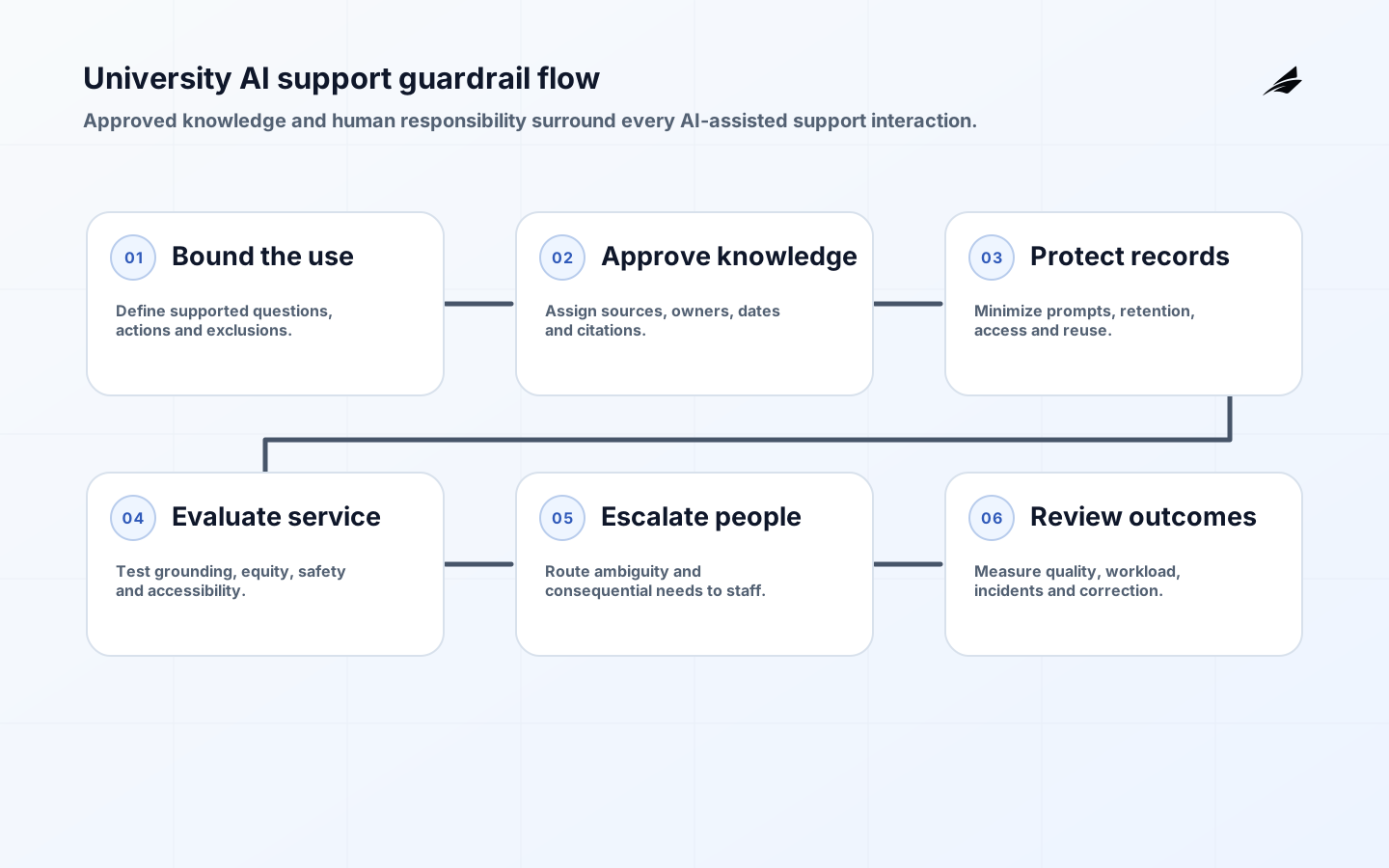
University support with AI can help students and staff navigate policies, services, forms and routine questions, but it must not become an unaccountable gatekeeper to education. The strongest use cases retrieve approved information, classify requests, assist staff drafting and route people to qualified humans. High-impact decisions about admission, grading, discipline, financial aid, disability accommodations or safety need separate legal, academic and human review. This FAQ explains how to scope, evaluate and operate AI-enabled university support. It complements Edilec's university AI scope and cost plan, implementation checklist and support automation checklist.
Key takeaways
- Begin with a bounded support journey and a named service owner.
- Use approved knowledge, citations and human escalation for consequential or ambiguous requests.
- Keep student records and sensitive prompts out of systems without a justified data path.
- Evaluate answer quality, equity, accessibility, security and service outcomes before scale.
- Publish limitations and preserve a non-AI route to essential university support.
Which university support uses are appropriate for AI?
Good early candidates are high-volume, low-consequence tasks with authoritative source material: locating office hours, explaining a published process, checking whether a form is complete, classifying a ticket or drafting a response for staff review. Define the user, question types, approved sources, action boundary and escalation path. Do not call a system a general student adviser when it only covers a limited knowledge set. A narrow promise is easier to test and safer for students to interpret.

Separate informational assistance from decisions and professional judgment. A model may help organize material for an authorized adviser, but it should not independently determine eligibility, misconduct, academic progression, crisis response or accommodations. UNESCO's guidance for generative AI in education and research advocates a human-centred approach, privacy protection, ethical validation and capacity building. Universities should map each use to policy, qualified oversight and a route for correction or appeal.
| Use | AI role | Required boundary |
|---|---|---|
| Policy navigation | Retrieve and summarize approved material | Cite source and escalate conflicts |
| Ticket intake | Classify and collect missing fields | User confirms category and facts |
| Staff drafting | Prepare response for review | Authorized staff remains sender |
| Record or eligibility decision | No autonomous decision | Qualified process, notice and appeal |
How should knowledge and student data be handled?
Create an approved knowledge collection with owners, effective dates, audience, jurisdiction and supersession rules. Retrieval should preserve source identity and expose a useful citation or link so users can verify important guidance. Test conflicting policies, expired pages, local exceptions and questions that lack an answer. When confidence or coverage is insufficient, say so and route the request. Do not let generated fluency conceal a missing authoritative basis. Measure unsupported statements and stale-source use as operational defects.
Inventory every data flow: prompt, conversation, account attributes, uploaded files, retrieved content, model-provider logs, analytics, staff review and retention. The U.S. Department of Education's FERPA resource explains the federal law protecting education-record privacy; institutions must obtain their own legal analysis for the exact system and jurisdiction. Minimize identifiable data, configure retention deliberately, restrict administrative access, prohibit unapproved secondary use and give users a safe way to avoid entering sensitive information.
How should university AI risk be governed?
Use the NIST AI Risk Management Framework to organize governance, context mapping, measurement and management across the lifecycle. Maintain an inventory of models, providers, versions, data, owners, intended uses and affected populations. For each use, record foreseeable harms such as misleading advice, exclusion, privacy loss, overreliance, inaccessible interaction, security abuse and reduced service for people who choose not to use AI. Define who can pause the system and how affected users obtain help.
The NIST Generative AI Profile identifies risks that generative systems can intensify and suggests actions aligned to the AI RMF. Translate governance into controls: source grounding, tool permissions, prompt and output protection, abuse monitoring, rate limits, review queues, incident handling and versioned evaluations. Guard against prompt injection in retrieved content and uploaded documents. Never let a support assistant execute account or record changes solely because a user's natural-language request appears plausible.
| Evaluation dimension | Example test | Failure response |
|---|---|---|
| Grounding | Question with conflicting policy versions | Use current authority or escalate |
| Privacy | Prompt containing an education record | Prevent unnecessary exposure and log safely |
| Equity | Equivalent requests in varied language | Investigate material outcome differences |
| Accessibility | Keyboard and screen-reader journey | Remediate before public release |
| Escalation | Safety or high-impact request | Reach qualified human with context |
What should evaluation cover before launch?
Build an evaluation set from real, de-identified support demand and deliberately difficult cases. Include ambiguous language, multilingual questions, policy conflicts, outdated assumptions, distressed users, accessibility needs and attempts to obtain restricted information. Score factual support, citation accuracy, completeness, appropriate refusal, escalation, tone and consistency. Review outcomes by relevant population and channel without inferring sensitive traits casually. Averages can hide a severe failure in a small but important group.
Test the complete service, not just model responses. The U.S. Department of Education's AI integration toolkit emphasizes safe, ethical and equitable integration, transparency and consideration of federal obligations. Apply WCAG 2.2 to the interface, including keyboard use, focus, clear errors and accessible authentication. Verify the human handoff, ticket context, wait-time message and non-AI channel. Confirm staff can correct the knowledge source rather than repeatedly editing individual outputs.
How should university AI support be rolled out and measured?
Pilot with one service owner and a limited audience. Publish scope, limitations, data notice and escalation. Run staff-assisted mode before unattended responses where risk warrants it, and compare against baseline resolution time, transfers, repeat contacts and satisfaction. Observe whether automation merely moves work downstream or disadvantages people with complex cases. Prepare rollback, provider outage and model-change procedures. A model update is a service change and should trigger targeted regression tests before broad exposure.
Operate through a joint review involving the service owner, student representatives, accessibility, security, privacy, academic or professional experts and technology teams. Review unsupported-answer rate, citation failures, escalation quality, complaints, incidents, knowledge freshness, response latency, cost and human workload. The AI automation ROI checklist can help evaluate value, but savings should not be claimed by counting contacts deflected when students abandon the service or seek help elsewhere.
Staff readiness is a control, not a communications task. Advisers and service agents need to know what the assistant can see, how it formed an answer, which information must not be entered, how to take over a conversation and where to report a recurring defect. Give knowledge owners a workflow to approve, date and retire material, with targeted re-evaluation after a policy change. Support teams should be able to distinguish a model error from a missing source, retrieval failure, integration fault or ambiguous university policy. That diagnosis determines whether to correct content, configuration, code, supplier behavior or the underlying process. Include refresher training after material model, policy or interface changes and verify that escalation contacts remain current across academic breaks.
Procurement must preserve institutional control. Require documentation of model and hosting providers, data retention and training settings, administrative access, security testing, incident notice, availability, version change, export and deletion. Define whether conversations become education records or service records under institutional policy and how access requests are handled. Avoid contract language that permits broad reuse of prompts or uploaded documents. Establish an exit plan that removes integrations and credentials, returns required records, deletes supplier copies and keeps essential support available during transition. A low introductory price can be misleading if the university cannot inspect quality, move knowledge or continue service without the supplier. Universities should also plan for multilingual and international support. Translation quality, local policy, time zones and campus-specific services cannot be inferred safely from an English master answer. Use approved localized knowledge and qualified review for consequential guidance, then evaluate equivalent questions across supported languages. When a language is not supported, state the limitation and provide a reachable alternative instead of returning an apparently confident answer. Track handoff success and wait time for that alternative. Include student employees and temporary staff in role design, training and access reviews because support operations often rely on changing workforces. Terminate access promptly, separate coaching data from student records and prevent copied conversations from becoming an unmanaged shadow knowledge base.
Frequently asked questions
Should a university build or buy its AI support system?
Choose based on data control, integration, evaluation and operating capacity, not novelty. Buying can speed delivery but still requires university-owned policy, knowledge, testing and oversight. Building offers control but creates a substantial security and maintenance obligation.
Can an AI assistant answer from the public website alone?
Public pages are a useful starting source, but they may conflict, lack effective dates or omit local exceptions. Curate approved material with owners and test retrieval. Public availability does not mean every page is reliable enough for individualized guidance.
Must every answer be reviewed by a person?
Not necessarily. Review intensity should follow impact and uncertainty. Low-risk navigation can be automated after evidence, while ambiguous, sensitive or consequential requests should reach qualified staff. Sample routine outputs continuously to detect drift.
What should happen when the model changes?
Record the version and provider change, rerun the relevant evaluation set, inspect safety and accessibility behavior, and release through a monitored cohort. Preserve the ability to revert or disable the affected capability.
Conclusion
University support with AI should widen access to reliable help, not insert an opaque barrier between people and institutional responsibility. Scope the assistant narrowly, ground responses in owned knowledge, minimize student data, preserve human and non-AI routes, and test difficult cases with affected communities. Operate the system as a changing service with visible limitations and measurable correction. The university remains accountable for the support experience even when a model or supplier produces the words. That accountability should remain visible in every release and service review.