This enterprise AI services FAQ addresses a decision that portfolio dashboards often avoid: when should an AI initiative continue, pause, narrow its scope or stop? Stopping is not automatically a failure, and continuing is not automatically evidence of conviction. A responsible decision compares the use case's current evidence with its intended outcome, risk tolerance, legal duties and realistic cost of reaching an acceptable service. The answer may be to fix data and controls, return to a smaller assisted workflow, change the supplier, or retire a system whose residual risk or economics cannot be justified.
Teams making the decision should read the initiative's scope and delivery plan and implementation checklist alongside operating evidence, not rely on a demonstration or sponsor narrative. The questions below create explicit gates for business value, model performance, human impact, security, compliance and operability. They do not replace legal advice or sector-specific safety review, but they do make the evidence and decision authority visible.
What does stopping an enterprise AI service mean?
A stop can occur at several levels. A team may stop discovery because the proposed decision should not be automated; stop a pilot because representative evaluation fails; suspend production while an incident is contained; disable one feature while retaining a safer workflow; or retire the entire service after value declines. Define the object and duration of the stop. Otherwise one group may think a model endpoint is disabled while another continues using cached outputs, embedded recommendations or exported records.
Every stop state needs an owner, effective time, technical enforcement method, communication plan and rule for retained data. Temporary pauses also require re-entry criteria. Permanent retirement adds contract closure, record retention, access removal, dependency cleanup and confirmation that users have a supported alternative. A kill switch is useful only if it actually prevents the relevant action and has been tested under realistic permissions and failure conditions.
Which evidence should govern the continue-or-stop decision?
Evaluate the whole sociotechnical service, not model accuracy alone. The NIST AI Risk Management Framework organizes work around Govern, Map, Measure and Manage, making governance continuous rather than a final approval. For the specific use case, review outcome movement, subgroup and edge-case behavior, override quality, incident history, user reliance, data rights, latency, availability, unit cost and the effort required to keep evidence current after models, prompts, data and surrounding software change.
Set thresholds before enthusiasm or sunk cost can distort the decision. A threshold might concern a safety event, prohibited data use, unacceptably unequal error, inability to reproduce a decision, repeated override, service cost per completed case or unresolved critical vulnerability. Some thresholds trigger immediate suspension; others trigger investigation or a bounded remediation period. Record who can invoke each threshold and who can authorize resumption.
| Signal | Evidence to inspect | Likely decision |
|---|---|---|
| Outcome is improving | Controlled comparison, quality review and adoption evidence | Continue with scheduled review |
| Useful but too broad | Failure clusters concentrated in roles, regions or task types | Narrow scope and retest |
| Control failure | Unlogged access, missing provenance or ineffective human review | Pause until control evidence passes |
| Material harm or illegality | Confirmed incident, prohibited practice or unmitigable rights impact | Suspend immediately and escalate |
| No credible economics | Total operating cost exceeds measurable benefit after a fair trial | Retire or replace |
| Supplier cannot support assurance | Missing change notice, evaluation access or exit capability | Freeze expansion and plan transition |
When do risk and compliance require an immediate pause?
Immediate pause conditions should cover credible threats to life or safety, unlawful processing, loss of access control, sensitive-data disclosure, manipulation of a consequential decision, inability to meet a mandatory human-oversight duty, and evidence that the deployed system is materially different from the approved one. The European Commission's AI Act overview illustrates why classification and role matter: obligations vary by prohibited, high, transparency and lower-risk uses, and by whether an organization is a provider or deployer. Assess applicable law rather than treating one framework as universal.
A pause should protect affected people as well as infrastructure. Preserve logs and relevant versions, stop new adverse actions, identify decisions that may need review, notify privacy, security, legal and business owners, and provide a human route for urgent cases. Do not silently route the same risky output through a different interface. The incident team should establish facts, limit further impact and decide whether notification, correction or redress is required.
How should performance and human oversight be judged?
Performance must match the decision context. Aggregate accuracy can conceal failures for rare but costly events, specific populations, languages or operating conditions. Define a representative evaluation set, expected uncertainty behavior, abstention rules and a baseline against the existing process. For generative systems, the NIST Generative AI Profile calls attention to risks such as confabulation, harmful bias, data privacy, information integrity and value-chain dependencies. Test the risks that can affect the actual workflow rather than selecting a generic leaderboard score.
Human oversight is effective only when reviewers have time, authority, context and an alternative action. Measure how often people accept, reject or modify output; whether they notice seeded errors; and whether workload or interface design promotes automation bias. A nominal approval click is not a safeguard. If reviewers cannot understand the relevant basis, challenge the output or prevent downstream execution, the service should be redesigned or limited to a non-consequential support role.
When is poor ROI a valid reason to stop?
Poor economics is a valid stop reason when measured over a fair, bounded test. Count model and platform consumption, integration, data preparation, evaluation, security, legal review, support, human verification, incident response, supplier minimums and replacement of legacy work. Compare that total with attributable changes in cycle time, error cost, conversion, capacity, customer outcome or risk. Hours theoretically saved are not realized value if demand, staffing or quality does not change.
Avoid letting a prototype's low usage cost stand in for production economics. Volume can increase inference and review expense; stronger assurance can add substantial evaluation and monitoring work; and a provider's pricing or model retirement can alter the case. Conversely, do not stop a promising service merely because the first release exposes necessary foundation work. Decide in advance how much time and money the organization will invest to resolve specific uncertainties, then enforce that learning budget.
| Cost or value area | Question for the gate | Decision metric |
|---|---|---|
| Business outcome | Did the target process improve against a credible baseline? | Net outcome change and confidence |
| Human work | Did verification, correction or escalation offset automation? | Minutes and rework per completed case |
| Technology | Are model, data, integration and observability costs stable? | Fully loaded cost per successful outcome |
| Risk treatment | Can material risks be reduced within tolerance? | Open exposure, owner and remediation date |
| Change burden | How often do upstream or model changes force revalidation? | Evaluation effort per release |
| Exit | Can records, prompts, configurations and dependencies move safely? | Tested transition time and residual cost |
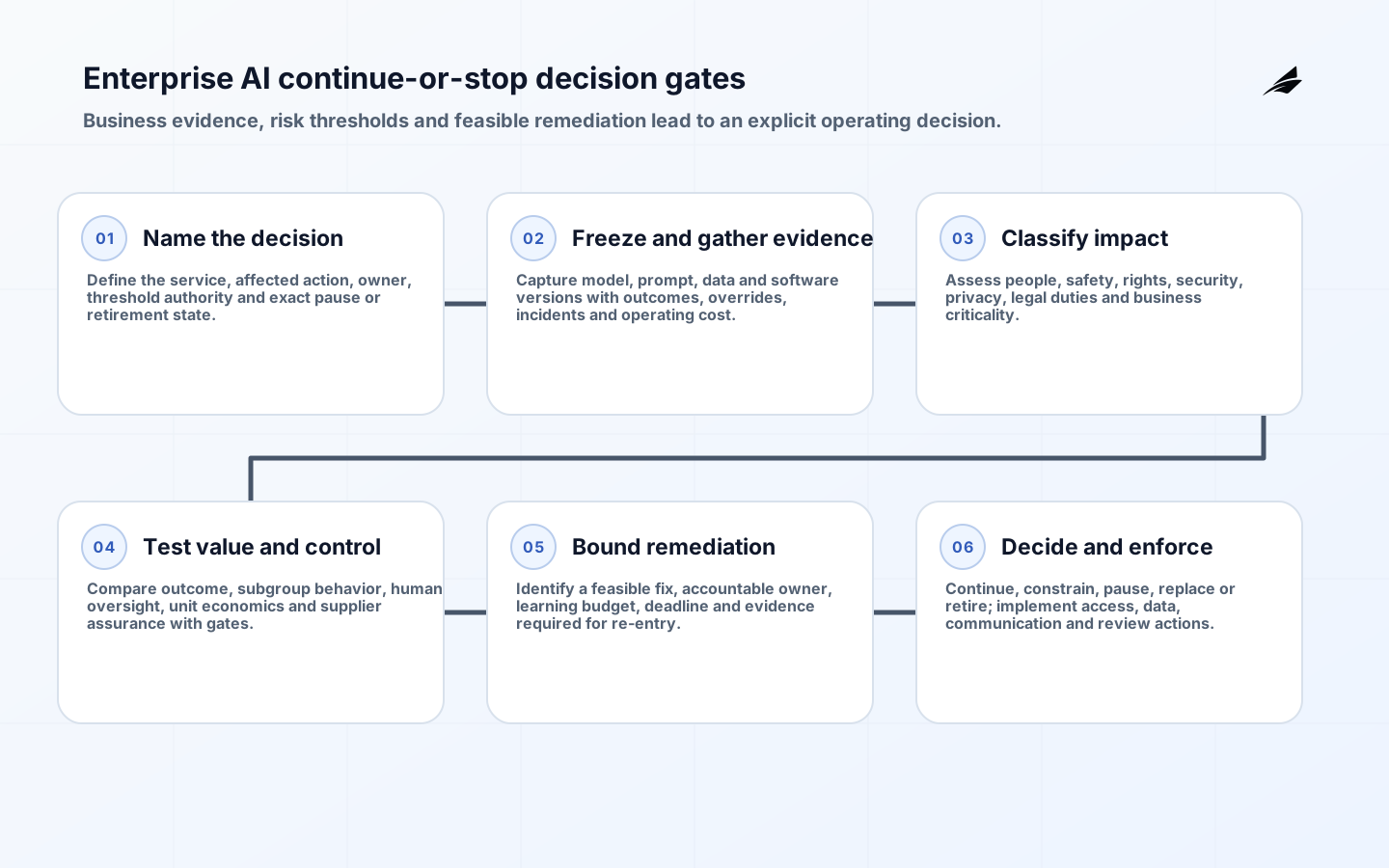
Use a six-stage enterprise AI decision roadmap
Begin by naming the decision and accountable owner, then freeze the relevant version and gather operating evidence. Classify legal and business criticality, compare measured value with total cost, and test whether remediation is both feasible and bounded. The final gate chooses continue, constrain, pause, replace or retire. This sequence prevents a technical score from overruling a safety duty and prevents a vague risk concern from obscuring a fixable engineering problem.

Document dissent and assumptions. The OECD accountability principle emphasizes traceability and systematic risk management through the lifecycle. A concise decision record should identify evidence reviewed, affected stakeholders, thresholds crossed, unresolved uncertainty, conditions attached to approval and the next review event. A restart requires fresh evidence against explicit re-entry criteria, not merely a new model name or supplier assurance.
How should an AI service be retired safely?
Retirement is an engineered change. Inventory entry points, scheduled jobs, agents, APIs, browser extensions, data pipelines, decision rules, user bookmarks and reports that depend on output. Replace or disable them in a controlled order, preserving business continuity. Revoke service identities and tokens, remove elevated permissions, stop data transfers, settle record-retention requirements and verify that billing has ended. Keep only the artifacts needed for audit, incident response, legal hold or reproducibility under an approved retention rule.
Treat custom code and integrations as software assets. The NIST Secure Software Development Framework provides practices for protecting software, producing well-secured software and responding to vulnerabilities; those concerns continue during decommissioning. Scan for abandoned endpoints and secrets, update threat models and support material, and confirm downstream teams no longer infer that stale recommendations are current. Close with a review of what the portfolio learned and which reusable controls should improve future initiatives.
Enterprise AI stop-decision takeaways
- Define pause, constraint and retirement states precisely.
- Set evidence thresholds and decision authority before a crisis.
- Judge the complete service, including people, data, suppliers and operating cost.
- Suspend quickly when material harm, illegality or loss of control is credible.
- Require tested re-entry criteria after remediation.
- Engineer retirement so access, data, dependencies and records are closed deliberately.
Frequently asked questions
Is a failed pilot a reason to stop all enterprise AI work? No. It is evidence about a use case, design and operating context; capture the learning before deciding about the wider portfolio. Can a sponsor override a stop threshold? Only through an explicit, authorized risk-acceptance process where law permits, never by informal pressure. Should low user adoption trigger retirement? Investigate whether the problem is weak value, poor workflow fit, inadequate training, distrust or access friction, then apply the pre-agreed remediation window.
How often should production AI be reviewed? At a cadence proportional to impact and change, plus event-driven reviews after incidents, model or data changes, drift, supplier changes and new legal requirements. Can human review make any AI use acceptable? No. Reviewers may lack time, information or authority, and some uses may remain prohibited or disproportionate. Who owns the final stop decision? A named business risk owner, with mandatory input from the technical, security, privacy, legal and affected operational roles appropriate to the use case.
Conclusion
An enterprise AI service deserves continued investment only while evidence supports its value, controllability and fit with the organization's duties. Clear thresholds turn stopping from a political drama into routine governance. Measure the real service, act quickly on material harm, give remediable problems a bounded path, and retire dependencies cleanly when the case no longer holds. That discipline protects people and capital while preserving room for better AI uses to progress.