A university AI support implementation checklist must account for education, welfare, rights and institutional operations at the same time. A campus assistant may answer routine questions, help staff triage cases or support learning, but it can also expose student records, provide confident misinformation or widen access gaps. The implementation unit is therefore a defined support workflow with human ownership, not a general-purpose model placed in front of every university system.
Begin with the program framing in University Support with AI: Scope, Cost, Risks and a Responsible Delivery Plan and use University Support with AI FAQ for stakeholder questions. UNESCO’s guidance advocates a human-centered approach, privacy protection, human capacity and ethical and pedagogical validation. Those ideas should appear in the project gates, not only in an acceptable-use statement.
1. Establish campus governance and use boundaries
Create a cross-functional sponsor group with student services, academic leadership, IT, information security, privacy or legal, accessibility, procurement, faculty and student representation. Assign one accountable service owner for the scoped workflow. Record applicable laws, accreditation duties, institutional policy, collective agreements and records obligations. The governance body should approve impact tiers, prohibited uses, model and vendor standards, exception routes and the authority to pause a service.
Do not deploy AI as the final decision maker for admission, discipline, grading, financial aid, disability accommodation, wellbeing intervention or other consequential outcomes without a rigorous legal, ethical and educational basis. State whether the system retrieves, drafts, recommends, classifies or acts. Require a meaningful human decision where rights or material opportunities are affected. Publish a correction and appeal route that does not require students to understand the model.
| Campus use | Potential value | Primary risk | Required boundary |
|---|---|---|---|
| Routine service navigation | Faster access to office and process information | Outdated or fabricated instructions | Approved sources, citations and staff escalation |
| Case summarization | Reduced staff review time | Sensitive data leakage or omitted context | Authorized workspace and human verification |
| Course support | Practice, feedback and explanation | Pedagogical mismatch or academic-integrity confusion | Instructor design and transparent course policy |
| Risk prioritization | Earlier attention to possible support needs | Bias, stigma and false inference | Impact review, constrained factors and human outreach |
| Administrative drafting | Faster correspondence and knowledge work | Incorrect commitments or records | Template controls and accountable approval |
2. Select one support need and baseline it
Observe the current journey with students and staff. Define the question or case types, channels, languages, peak periods, service standard, handoffs and known barriers. Measure resolution, wait time, repeat contact, staff effort, accessibility and student satisfaction. Choose a narrow use case where approved information exists and errors can be caught. Test process, content and search improvements as alternatives before adding a generative layer.
Write an outcome hypothesis with guardrails. For example: increase correct first-contact routing for common registration questions while maintaining accessibility, protecting records and keeping severe misinformation below an agreed threshold. Do not use deflection alone as success; a student who stops asking after a poor answer is not a resolved case. Identify groups that may experience different language, device, disability or digital-literacy conditions.
3. Map records, knowledge and privacy
Inventory the data the system receives, retrieves, generates and logs. Separate public policy content from authenticated student records. Under FERPA in the United States, education records require careful handling; institutions in other jurisdictions must map their own obligations. Define permitted purpose, role-based access, retention, deletion, disclosure, vendor processing and incident notification. Minimize what reaches the model and prevent production records from entering unapproved public tools.
Establish content owners and review dates for policies, deadlines, fees, contacts and course material. Retrieval should preserve document version, effective date and audience. Exclude draft or superseded content. For personalized support, authorize access before retrieval and filter at the record level. Prompts, embeddings and conversation logs can themselves be sensitive records; classify and protect them accordingly. Use the NIST Privacy Framework to connect data processing to governance and individual risk.
4. Assess models, vendors and accessibility
Evaluate model capability on representative campus language and documents, including local abbreviations and multilingual requests. Ask vendors about input retention, training use, subprocessors, location, security controls, accessibility conformance, model updates, safety testing, uptime, export, deletion and termination. Prevent silent model changes for consequential workflows or require regression evidence and an opt-out. Confirm that the institution can retrieve logs and source references needed for investigation.
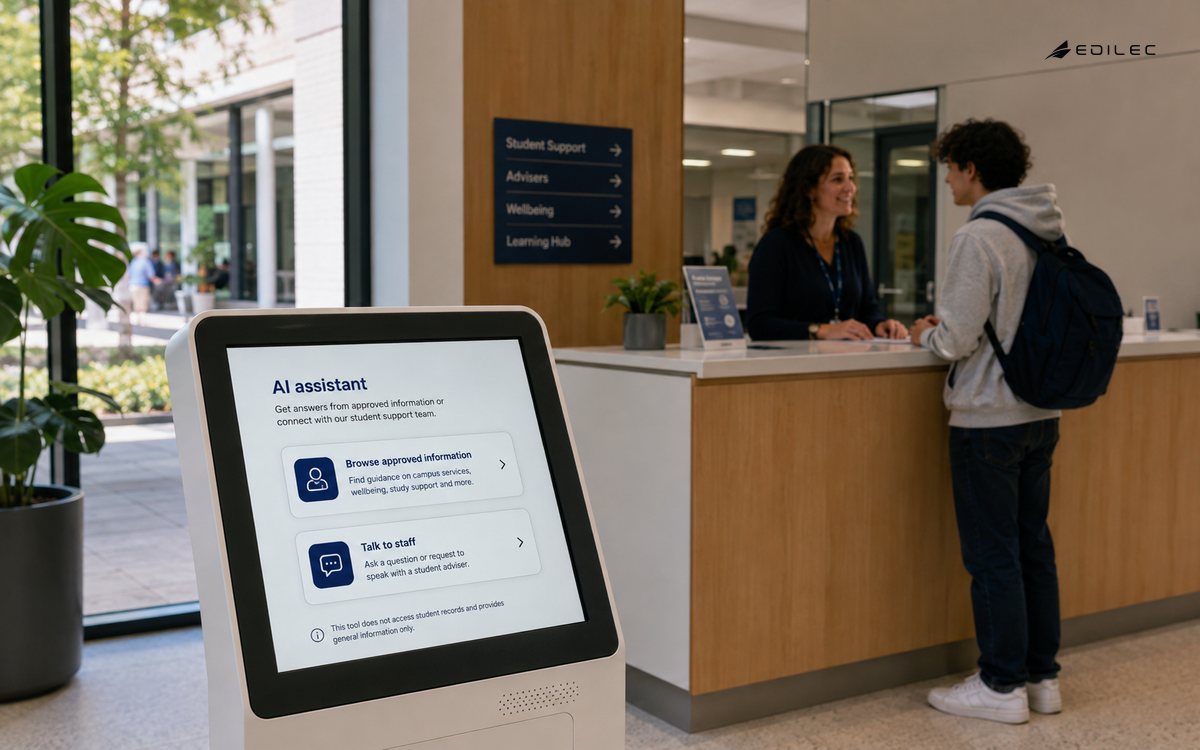
Test the complete interface with keyboard, screen reader, zoom, contrast and plain-language needs. Provide an obvious route to a person without forcing repeated AI interaction. Do not use AI voice or persona design to imply human authority or care the system cannot provide. The Department of Education’s guidance emphasizes keeping humans in the loop and designing for trust; clear disclosure, limitations and escalation are part of service quality.
| Review area | Evidence before pilot | Ongoing evidence |
|---|---|---|
| Educational or service value | Baseline and user-tested hypothesis | Resolution, learning or staff outcome by group |
| Accuracy | Versioned scenarios and severe-error threshold | Sample review, corrections and stale-source rate |
| Privacy | Data flow, purpose, access and vendor terms | Access review, deletion and incident records |
| Equity and access | Accessibility and group impact testing | Usage, escalation and outcome differences |
| Operations | Owner, runbook, fallback and budget | Availability, latency, unit cost and support load |
5. Evaluate with students, staff and adversarial cases
Build a test set from approved historical patterns, synthetic edge cases and stakeholder input. Score correct resolution, source support, completeness, tone, language, accessibility, refusal, privacy and escalation. Include misleading premises, crisis language, requests outside policy, prompt injection in retrieved documents and attempts to obtain another student’s information. Test human reviewers too: can they recognize and correct an error under realistic workload?
Compare the AI workflow with the existing service and a simpler search or rules option. Review results by language, program, mode of study and accessibility need where lawful and meaningful. Protect evaluation data and avoid turning student participation into coerced data collection. Document limitations in terms staff can use. NIST AI RMF’s Govern, Map, Measure and Manage functions provide a practical structure for retaining this evidence across the lifecycle.
6. Pilot with explicit stop and escalation rules
Start with a bounded audience, content set and period. Display that the user is interacting with AI, link to sources, collect specific feedback and make human help easy. Train staff on limitations, escalation, records handling and incident reporting. Monitor severe misinformation, privacy events, unanswered questions, escalation quality, latency and cost daily at first. Establish out-of-hours handling and a non-AI fallback.
Preauthorize who can disable the feature, remove a source, change a prompt or notify affected users. Set stop thresholds for privacy, safety, discrimination, security, severe accuracy and operational instability. Do not expand because aggregate satisfaction is positive if a protected or vulnerable group faces material failure. Pilot review should decide expand, revise, restrict or end, with reasons published internally and, where appropriate, to the campus community.
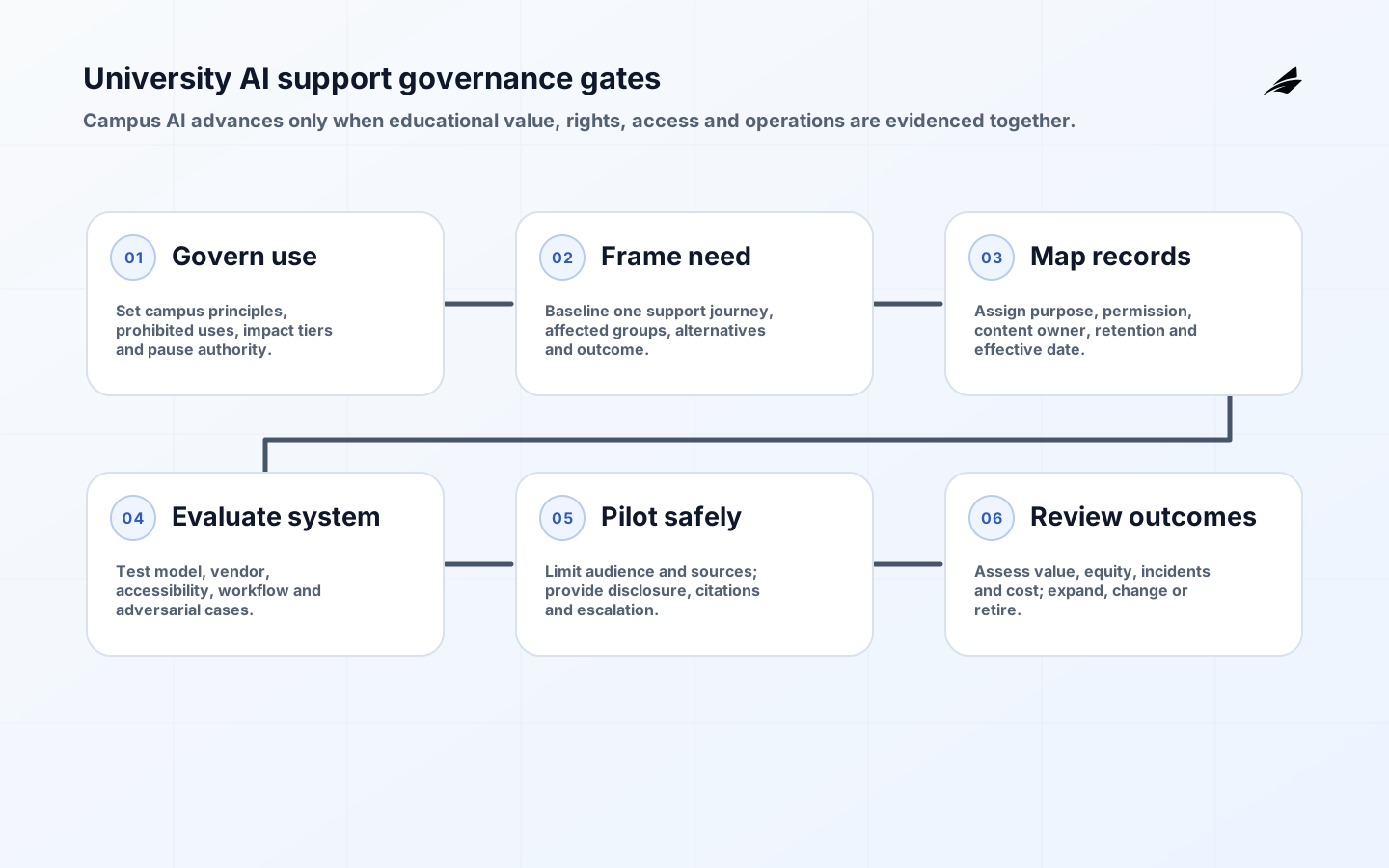
Use six gates from need to accountable operation
- Govern the use with student, faculty, service, privacy, security and accessibility participation.
- Frame one support need, baseline, affected groups, alternatives and accountable outcome.
- Map knowledge and records to purpose, permission, owner, retention and effective date.
- Evaluate model, vendor, interface and workflow against realistic and adversarial cases.
- Pilot a bounded service with disclosure, citations, human escalation and stop thresholds.
- Review outcomes and equity, then expand, modify, restrict or retire with recorded evidence.
For back-office automation that shares similar case-handling patterns, AI Business Process Automation for Support Teams provides an additional implementation reference. University deployments should retain their stronger educational, records and shared-governance requirements.
Operate support content, staff capability and campus feedback
Assign service-desk and content operations after the pilot. Staff need a queue for disputed answers, stale sources, accessibility barriers, privacy concerns and safety escalation, with severity and response targets. Content owners should receive evidence about questions their pages do not answer and review changes before publication. Track when the assistant hands off, whether the receiving office resolves the need and whether students must repeat information. The system should improve the support network rather than hide fragmented services behind fluent text.
Offer role-specific learning for faculty, advisers, support staff, technologists and students. Training should include appropriate use, verification, records handling, bias, disclosure and how to report harm. Maintain a campus feedback channel outside the AI interface and publish material service changes. Periodically reassess whether students can obtain an equivalent non-AI route. Procurement savings should not be achieved by making human assistance inaccessible to people who need it most. Research uses need separate ethics, consent, data-management and publication review rather than automatic reuse of support conversations.
Key takeaways
- Implement a bounded support workflow, not an unrestricted campus AI layer.
- Keep humans responsible for consequential educational and student decisions.
- Treat prompts, retrieval indexes and logs as potentially sensitive records.
- Evaluate accessibility, group outcomes, source support and escalation together.
- Pilot with enforceable stop conditions and transparent evidence for expansion.
Frequently asked questions
Should one AI policy cover every course and service?
Use institution-wide principles and minimum controls, then allow documented local rules that reflect pedagogy, discipline, risk and law. Students need clear expectations at the point of use. Local flexibility should not weaken privacy, accessibility, security or appeal rights.
Must every AI-assisted interaction be disclosed?
Disclosure should be clear whenever it affects trust, data use or a person’s ability to challenge an outcome. A student-facing assistant should identify itself. For internal drafting, require accountable review and records handling; disclosure requirements may also come from law, policy or professional duties.
Conclusion
University AI support is credible when it improves a defined educational or service outcome without obscuring rights and responsibility. Govern with the campus community, protect records, validate content and accessibility, pilot narrowly and make human recourse real. Expansion should follow evidence of value and equity, not excitement about model capability.