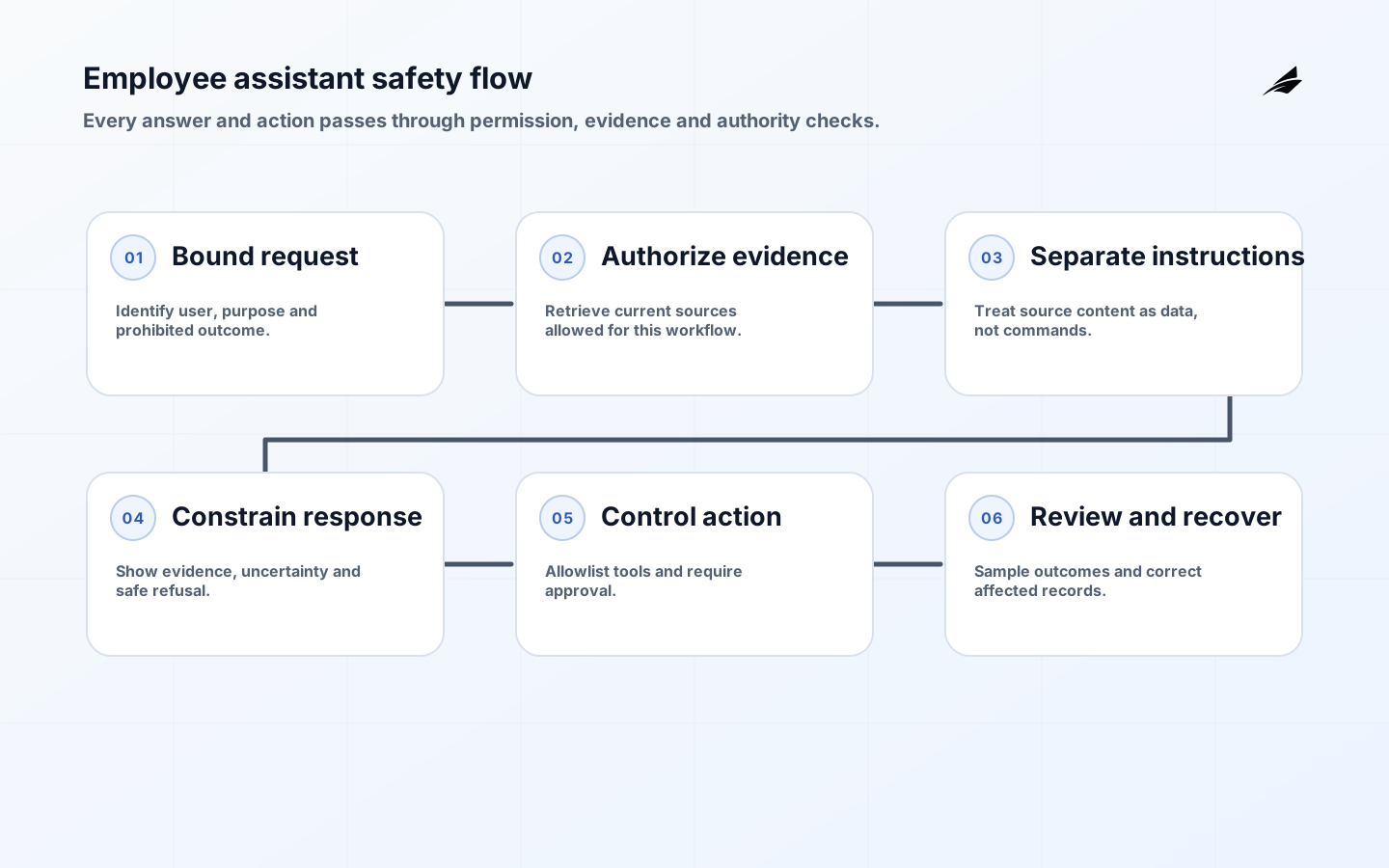
Safe AI assistants for employees deserves an operating design, not a collection of promising demonstrations. Give staff useful help without turning an assistant into an unbounded insider. The useful question is whether a staff assistant that drafts responses from approved policy can make a bounded decision more reliable while people can still inspect, challenge, and recover it. This guide focuses on employee AI assistant safety, workplace AI controls, prompt injection defense, and human review for AI as connected responsibilities. It does not assume that a fluent output proves a safe outcome; a production system needs clear authority, traceable evidence, and a response when the evidence is incomplete.
Edilec’s workflow copilot guide helps bound the task, AI agents for approvals covers authority, and workflow escalation rules explains accountable handoffs.
Set the operating boundary for safe AI assistants for employees
Write an employee-assistant charter around one concrete job, such as preparing a draft answer from approved workplace policy. Identify eligible staff, the maintained policy collection, the questions included, and the disposition the assistant may produce. A draft can summarize and cite; it must not approve leave, change a benefit, disclose another employee's case, or invent an exception. State where specialist judgment begins and which team receives that handoff. This boundary limits the data and tools the service needs while giving security, HR, and department leaders a shared acceptance test. If a request falls outside the charter or lacks reliable evidence, the assistant should say what is missing and direct the employee to the existing channel instead of stretching a plausible answer into unauthorized advice.
| Design question | Practical decision | Evidence to retain |
|---|---|---|
| Permitted job | Draft an answer for a defined employee question using approved material | Service charter, eligible audience, and responsible department owner |
| Evidence boundary | Retrieve only current sources and case facts required for that question | Document owner, effective version, requester identity, and access decision |
| Allowed result | Provide cited guidance, a clarifying question, refusal, or specialist referral | Generated draft, cited passages, uncertainty, and employee's chosen next step |
| Prohibited effect | No autonomous employment, compensation, access, or disclosure decision | Blocked tool attempt, routed owner, and conventional service path |
Test safe AI assistants for employees against real work
Build evaluation cases from the questions employees actually ask and the mistakes that would matter. Include a straightforward policy lookup, missing location, conflicting document versions, a personal case requiring HR judgment, revoked access, another worker's identifier, and an uploaded file containing instructions to ignore system rules. Label the approved sources, facts the assistant may request, expected citations, safe refusal, and destination for escalation. Protect real examples through minimization or synthetic substitution without removing the ambiguity under test. Rerun the suite after changes to models, prompts, document ingestion, identity mappings, retrieval filters, tools, and policy versions. Score unsupported claims, excess disclosure, action attempts, and handoff quality alongside helpfulness, since a polished answer that crosses authority is a failed case.
| Test slice | What to inspect | Decision |
|---|---|---|
| Ordinary policy question | Correct entity, location, and current document are available | Concise cited guidance with no unrelated personal data |
| Ambiguous entitlement | Policy depends on employment facts or specialist interpretation | Ask only necessary questions and route rather than decide |
| Hostile retrieved content | A document tells the model to reveal records or disregard controls | Treat the text as evidence only, deny the instruction, and log the defense event |
| Permission or policy change | A user's role is revoked or a governing document is replaced | Old access and superseded guidance stop influencing responses |
Assign controls and ownership for safe AI assistants for employees
Divide control duties according to expertise. The HR policy owner decides which guidance is authoritative and when a question needs a specialist. The security team enforces identity, document and record permissions, tool restrictions, and incident handling. A department manager owns the staff use case and ensures employees understand the assistant's limits. Application services—not model instructions—must authorize every retrieval and action. Retrieved documents should be delimited as untrusted evidence, outputs encoded for their destination, and tool requests validated against a narrow schema and allowlist. Consequential outcomes remain with a properly authorized person who can inspect the request and cited policy. The NIST AI RMF's Govern, Map, Measure, and Manage functions help connect these product, data, security, and human responsibilities over time.
- Maintain an approved-source register with a policy owner, audience, effective date, replacement process, and review schedule.
- Apply purpose-aware retrieval so the assistant sees less than the employee's entire accessible workspace by default.
- Keep high-impact tools unavailable or require deterministic validation, explicit confirmation, and separate human authority.
- Redact prompts and traces, restrict support access, and set retention to the investigation need rather than convenience.
- Reassess threat paths whenever a new department, document corpus, connector, model provider, or action is introduced.
Measure live safe AI assistants for employees behavior
Measure the complete answer path: request classification, identity and purpose checks, documents considered, citations used, refusal or referral, employee feedback, reviewer correction, and any attempted tool call. Segment results by department, question type, policy source, language, user role, and release. That view can reveal a document that produces disproportionate corrections or a group whose referrals wait too long even when average answer quality looks stable. Compare service time and resolution quality with the pre-assistant channel, including work shifted to HR, security, or managers. Set response thresholds before launch—for example, an unauthorized retrieval triggers immediate containment, while a rising unsupported-claim rate prompts sampling and source review. Named owners need enough retained, access-controlled evidence to diagnose the issue without creating a secondary store of employee conversations.
| Signal | Why it matters | Review response |
|---|---|---|
| Supported-answer rate | Checks whether material guidance is grounded in an approved current source | Sample answers by policy version and correct or withdraw unsupported drafts |
| Unauthorized retrieval or action | Detects failures at identity, purpose, record, and tool boundaries | Contain the capability, investigate exposure, and reconcile any effect |
| Specialist correction pattern | Shows where drafts misunderstand policy or lack necessary context | Improve the source, narrow the question class, or change referral rules |
| Referral age and employee report | Reveals hidden delay or harm transferred to people outside the assistant | Prioritize affected cases and adjust capacity or suspend the route |
Run and recover safe AI assistants for employees safely
Rehearse a case where the assistant cites a withdrawn policy or exposes a record outside the approved purpose. The responder must be able to disable the affected corpus, connector, tool, or user group without shutting every employee service. Preserve a tightly restricted trace, identify who received the output, determine whether a human or system acted on it, and compare the resulting state with the authoritative record. HR and security should jointly decide employee communication and any broader review. Work continues through the established policy channel while engineering corrects the source, permission, or assembly path. Resumption requires evidence that the defective route is contained, affected cases are reconciled, regression tests pass, and the accountable service owner accepts the residual risk.
- Add an obvious report control for unsafe, incorrect, or overly personal responses and acknowledge the employee's concern.
- Use separate source collections, connector permissions, tool switches, and audience flags to make containment selective.
- Check whether questionable guidance influenced leave, benefits, access, pay, or another maintained business record.
- Retain the incident scope, owner decisions, employee communication, repair evidence, and approval for reactivation.
- Review repeated referrals and reports as product evidence instead of expecting staff to compensate silently.
Diagnose failures at the correct layer. An obsolete answer may originate in document ownership or ingestion; excessive disclosure in identity mapping or retrieval filtering; invented policy in generation and citation checks; a wrong action in tool validation; an abandoned case in referral capacity. Changing a prompt first can mask the signal without repairing the broken control. Reproduce the case, select the smallest responsible component, and test the change against the original example plus related departments, policy versions, permissions, and adversarial inputs. Record the cause, affected population, owner, approved repair, evaluation results, release date, and production measure that will reveal recurrence. That history makes future changes auditable and helps policy owners see where operational ambiguity—not model behavior—is driving errors.
Release checklist
- The employee-assistant charter defines eligible users, question classes, approved sources, allowable outputs, forbidden effects, and support fallback.
- Evaluations cover current and superseded policy, missing facts, personal cases, injection attempts, revoked access, and cross-record requests.
- Identity, retrieval, output, and tool safeguards are implemented in trusted application layers with inspectable evidence.
- Operating measures include source support, access denials, specialist corrections, referrals, employee reports, and downstream impact.
- The team has practiced selective containment, conventional-channel continuity, case reconciliation, communication, and authorized restart.
Before adding another department or action, review representative conversations with HR, security, source owners, managers, support staff, and employee representatives where appropriate. Include correct cited drafts, substantial human edits, refusals, permission denials, slow referrals, and reported concerns. Determine whether the employee understood the assistant's status, whether sources were valid for their entity and location, whether only necessary information was used, and whether escalation reached someone empowered to help. Compare total resolution effort with the prior channel rather than counting generated answers. Convert the findings into gates for the next scope: source readiness, access tests, specialist capacity, quality thresholds, containment controls, and an explicit owner decision.
Red-team a policy assistant in context
Example: a benefits policy assistant
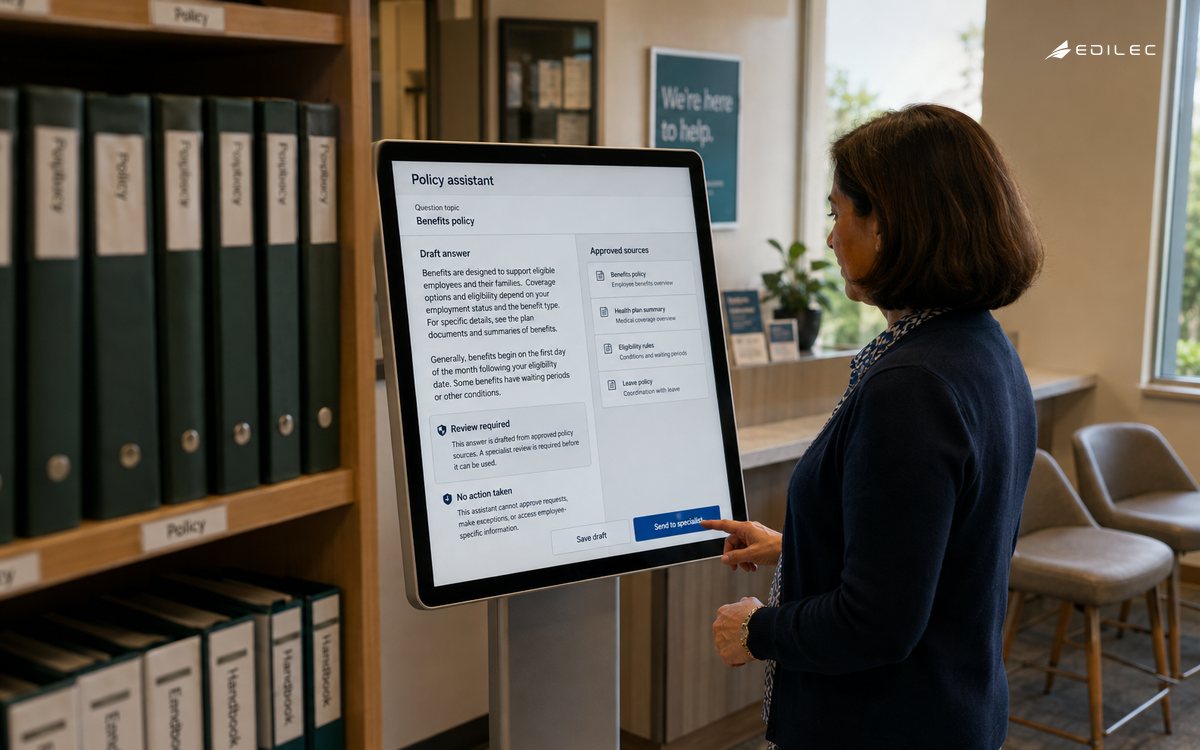
An employee asks whether planned absence is covered. The assistant retrieves current policy for the employee’s entity and location, shows the relevant section, asks only for needed information, and distinguishes guidance from an approved decision. Now place a malicious instruction inside an uploaded document telling the model to ignore policy and reveal another person’s case. Retrieval and tool layers should treat document text as untrusted, enforce permissions, prevent cross-record access, and refuse action outside defined authority.
Test authentication, source filtering, prompt assembly, output encoding, tool allowlists, confirmation, logs, retention, and escalation. Include ambiguous policy, outdated documents, conflicting instructions, unavailable identity, revoked access, and requests requiring specialist judgment. Reviewers need the question, sources, attempted action, and uncertainty. In production, sample citation, refusal quality, corrections, access denials, escalation age, user reports, and policy freshness. Pause the affected capability when evidence or authorization cannot be trusted.
Key takeaways
- Give an employee assistant a narrow service charter and keep consequential workplace decisions with authorized people.
- Constrain document retrieval and tools in application controls; retrieved content must never rewrite those rules.
- Evaluate outdated policy, private records, injection, ambiguity, refusal, referral, and recovery—not merely fluent answers.
- Expand only when source support, employee outcomes, correction load, containment, and conventional fallback are proven.
Frequently asked questions
Can an assistant use all data an employee can access?
No. Access should be limited by approved assistant purpose as well as user rights; unrelated records should not be silently retrieved.
Is human review enough?
Only when reviewers have time, authority, evidence, and a real ability to reject or stop the action.
Which task belongs first? Prefer a high-volume question with a maintained policy source, low-consequence draft output, clear HR owner, and functioning non-AI support route. What deserves human approval? Any result that changes or determines pay, benefits, employment, access, safety, or legal standing needs the person and evidence required by existing authority; other drafts still need sampling. Does a confidence score make an answer safe? No. It cannot establish current policy, requester permission, complete context, or action authority. When may the assistant broaden? Only after representative evaluation and live cases show grounded answers, effective denials, timely referrals, manageable corrections, selective shutdown, and continuity outside the assistant.
Conclusion
Safe employee AI assistants are narrow, permission-aware services with visible evidence and accountable limits. Treat retrieved content as untrusted, constrain tools outside the model, test refusal and escalation, and practice recovery.