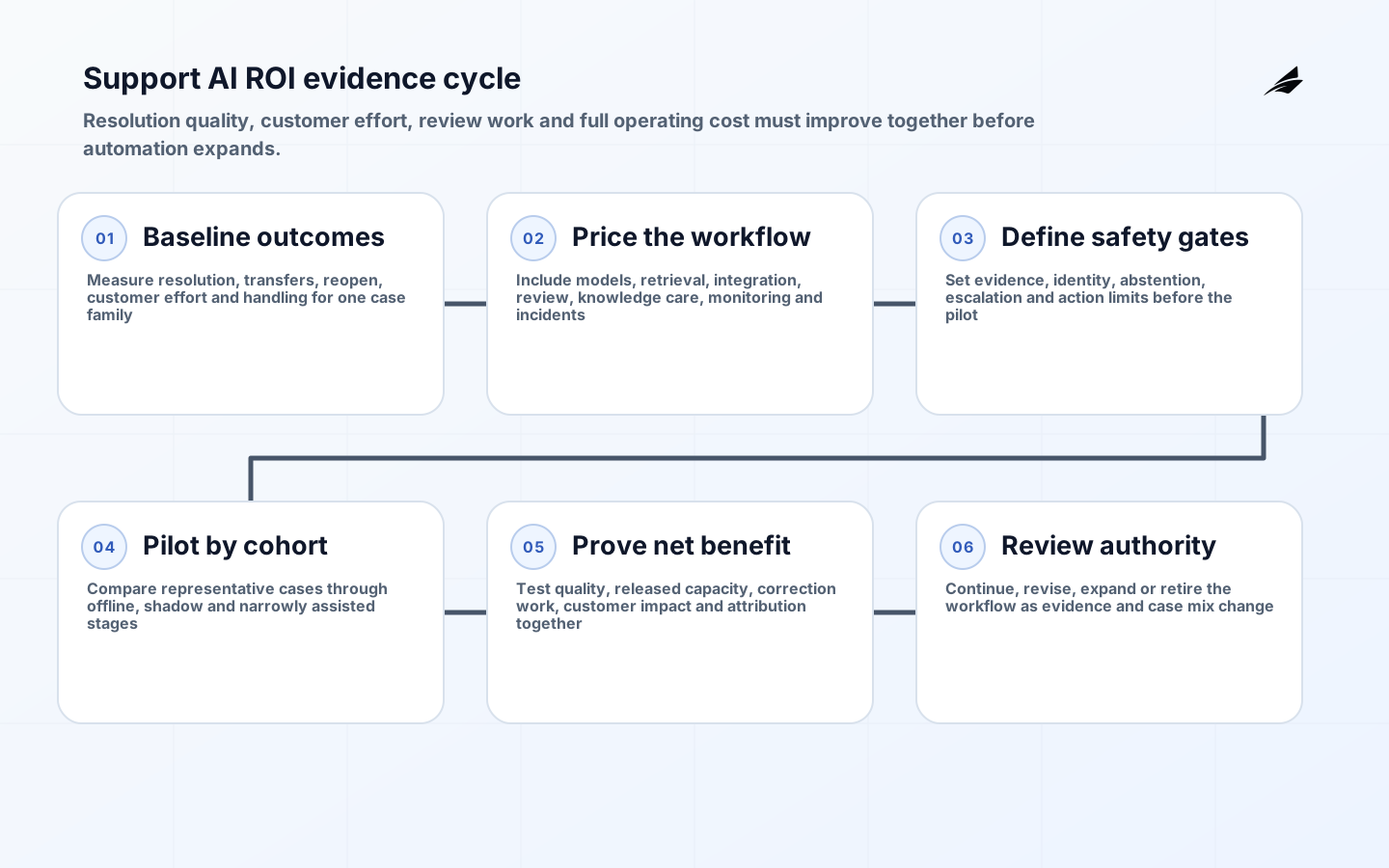
AI automation ROI planning for support teams should measure completed customer outcomes, not the number of generated replies. A lower handling time is valuable only if answers remain correct, customers do not reopen cases, agents can recover from errors and automation does not move work into complaints or engineering escalations. The implementation checklist links one bounded support use case to a baseline, controlled release, full cost model and benefit evidence that operations and finance can inspect.
Begin with the support-team ROI delivery plan and use the support ROI FAQ for leadership questions. The general AI automation ROI checklist helps compare other workflows. This article assumes the team will preserve human authority for consequential account, financial, security and policy decisions.
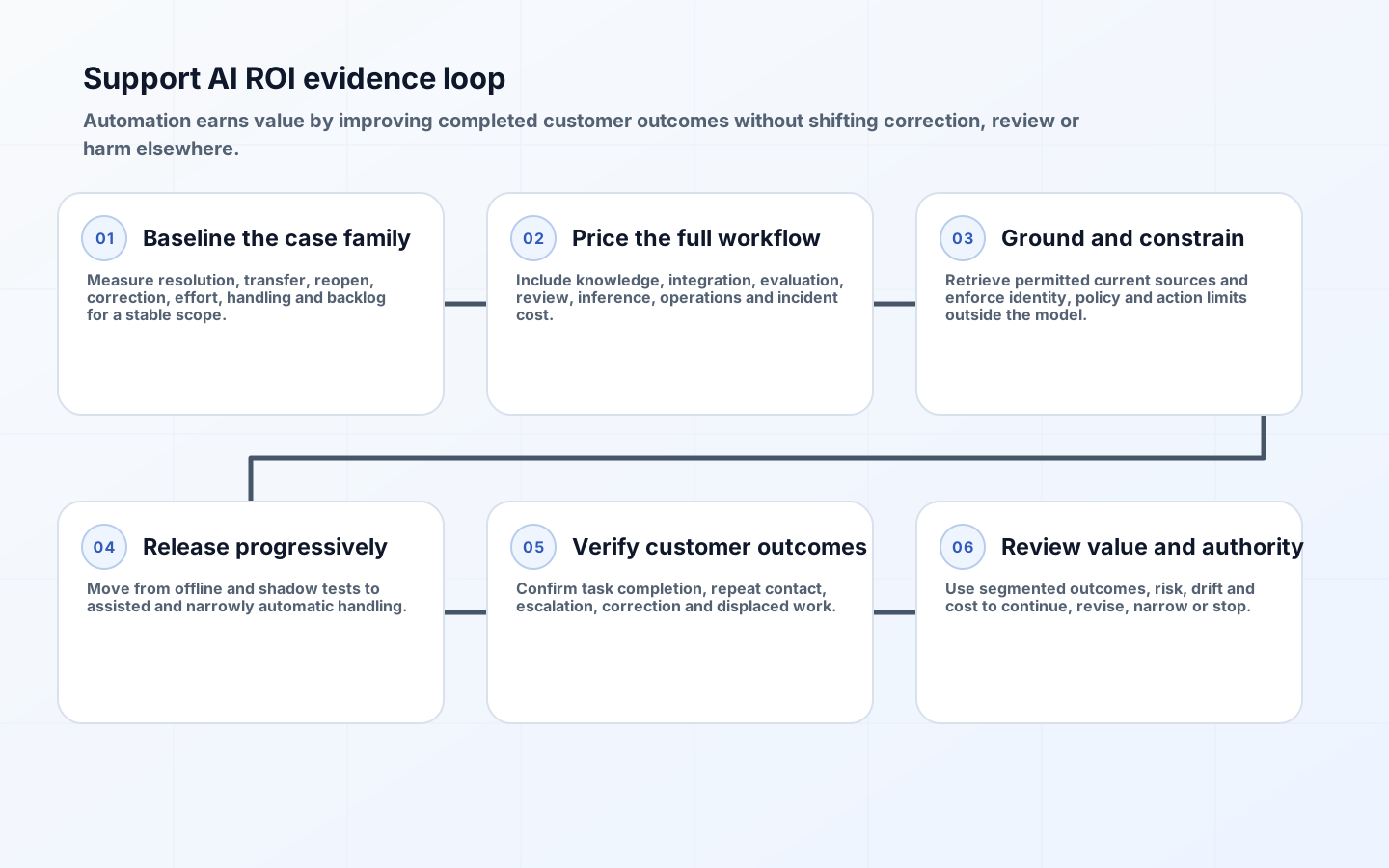
Baseline a customer outcome before automating
Choose a case family with stable definitions and enough volume. Measure arrival, first qualified response, resolution, transfers, reopen, escalation, correction, customer effort and agent handling time. Segment by channel, language, product, customer tier and complexity. Review samples to understand why the numbers look as they do. An average can hide a queue of difficult cases that automation will route incorrectly.

Define the completed outcome. For password access it may be verified recovery without security compromise; for billing it may be an explained and reconciled charge; for a technical issue it may be a confirmed workaround or owned escalation with evidence. Set the baseline period and concurrent-change log before the pilot. Do not count automated closure as resolution unless customer and downstream signals support it.
| Use case | Primary value measure | Guardrail |
|---|---|---|
| Case summarization | Review time saved with factual completeness | Correction rate and omitted critical facts |
| Intent routing | Time to qualified owner | Wrong-queue transfer and aging |
| Response drafting | Time to useful response | Accuracy, citation and agent edit burden |
| Self-service answer | Verified task completion | Repeat contact, abandonment and harmful advice |
| Account action | Resolution time after approval | Authorization, duplicate action and reversal rate |
Price the entire support workflow
Include model and retrieval costs, integration, knowledge cleanup, evaluation, agent interface, review time, observability, security, training and incident handling. Measure prompts, context, retries and tool calls by workflow rather than using one average. Add the cost of maintaining source permissions and freshness. A model that drafts quickly can still increase expense when agents spend longer checking unsupported claims.
Value released capacity conservatively. Time saved is not automatically cash saved; it may reduce backlog, improve service, absorb growth or allow specialists to focus on harder cases. State which effect the business expects and how it will be observed. Include the cost of false resolution, complaint, churn, refund, security event and engineering interruption. Use a range for adoption, review rate and quality rather than one optimistic payback point.
Build controls around knowledge and action
Retrieve only sources authorized for the customer, agent and case purpose. Version knowledge, expose citations and show freshness. Treat customer text and retrieved documents as untrusted instructions. Validate model output structure and policy outside the model. Account changes, refunds, cancellations and security steps require current identity, entitlement, amount, reason and approval checks. Use scoped connectors with idempotency and an attributable action record.
Provide abstention and escalation. When evidence conflicts, permissions fail or confidence is insufficient, preserve the case packet and route it to an owner. Do not hide refusal behind a generic answer. NIST guidance emphasizes governance and measurement across the lifecycle; OWASP highlights prompt injection, sensitive information disclosure and excessive agency. Translate those risks into test cases and operating alerts for the exact support workflow.
Run a staged pilot with consequence-weighted evaluation
Construct an evaluation set from representative historical cases and designed edge cases. Remove or protect personal data. Include outdated knowledge, ambiguous identity, hostile instructions, unavailable tools, policy exceptions and requests the system must refuse. Score facts, citations, routing, tone, action parameters and safe escalation. Weight material errors more heavily than stylistic differences. Record reviewer agreement and adjudicate disputed cases.
Move from offline tests to shadow mode, agent-visible assistance and then narrowly approved automatic handling. Compare with a matched baseline where possible. Freeze release thresholds and rollback triggers in advance. Sample successful automation because silent errors may not create immediate complaints. Give agents a fast correction and reporting path; override data is valuable evidence, not resistance to automation.
| ROI input | How to measure | Misleading shortcut |
|---|---|---|
| Agent capacity | Minutes per completed case and queue outcome | Tokens or drafts generated |
| Customer outcome | Resolution, repeat contact and effort | Automated closure rate |
| Quality | Material correction and harmful-error rate | Average satisfaction alone |
| Review burden | Time and expertise by case consequence | Assuming every suggestion is accepted |
| Operating cost | Full workflow, knowledge and incident cost | Provider invoice alone |
Prove benefit without shifting work or harm
Track resolution time, useful first response, transfer, reopen, escalation, correction, customer effort, agent handling, backlog age and cost per completed outcome. Segment by case and customer characteristics. Check whether engineering, trust and safety, or complaints teams receive extra work. Review cases where automation performed well to confirm the customer actually completed the task. Compare benefits with quality and risk thresholds in the same report.
Use controlled rollout or phased cohorts to improve attribution. Note product releases, staffing, policy and seasonality. Finance should approve the method for valuing time, retained revenue or avoided cost. If the main benefit is service quality or growth capacity, say so rather than converting every minute into a fictional saving. Recalculate when case mix or provider pricing changes.
Keep ROI and authority under recurring review
Assign owners for knowledge, model configuration, policy, integrations, incidents and benefit reporting. Monitor source freshness, retrieval failure, unsafe outputs, tool errors, review queues and drift. Review complaints and subgroup outcomes. Pause or narrow authority when evidence degrades. Preserve release and case traces sufficient for investigation while applying retention and access controls.
Hold a monthly review during expansion. Decide whether to continue, revise, broaden or retire the workflow. Remove permissions and data that are no longer needed. Update evaluation cases from incidents and corrected outputs. An ROI process is healthy when it can stop an attractive automation that no longer produces trustworthy customer outcomes.
Separate knowledge improvement from model improvement. Many support failures come from conflicting policies, missing product state or inaccessible ownership rather than weak generation. Track which corrections require a source update, workflow change, permission fix, prompt change or different model. Assign each category to the appropriate owner. This prevents expensive model tuning from masking a documentation or product defect and makes ROI investment more targeted.
Include workforce effects in the decision. Automation may reduce repetitive reading while increasing review of complex cases. Measure cognitive load, queue switching, training needs and whether agents retain enough practice to handle fallback. Invite agents to review evaluation cases and escalation design. A credible benefit plan supports better work and service continuity; it should not depend on removing human capacity before the automated path has survived representative failures.
Customer trust is also an economic outcome. Monitor complaints about unexplained responses, repeated verification, inaccessible handoffs and inability to reach a person. Define when disclosure is appropriate and make correction straightforward. A small speed gain can be outweighed by churn or regulatory exposure if customers cannot challenge a consequential result. Include those signals in the same review as inference cost and handling time.
Forecast scale by case mix, not ticket count alone. Growth may add simple questions, enterprise configurations, new languages or higher-consequence requests in different proportions. Estimate retrieval size, model route, review share and integration calls for each family. Capacity and cost alerts should use those drivers. When a new product launch changes the mix, update both the benefit forecast and evaluation set before assuming the existing automation will absorb demand safely.
Agree how experiments are approved. Changes to prompt, model, retrieval ranking or action policy can affect customers even when application code is unchanged. Require versioning, representative evaluation, privacy and security review where material, progressive exposure and rollback. Connect production outcomes to the experiment version. This makes learning faster because the team can identify which change improved resolution rather than relying on anecdotal agent feedback. Exclude high-consequence cases from experiments unless a risk owner approves the design and monitoring. Preserve a stable control cohort long enough to interpret the result. Record why an experiment ends and who approved closure. Archive the decision with evidence.
Key takeaways
- Baseline completed support outcomes before measuring automation.
- Price knowledge, review, integration and incident work alongside inference.
- Keep retrieval permissions, policy and consequential action checks outside the model.
- Release through offline, shadow, assisted and limited automatic stages.
- Report customer, quality, risk and financial evidence together.
Frequently asked questions
| Question | Answer |
|---|---|
| Is ticket deflection a valid ROI metric? | It is an intermediate signal; confirm that customers completed the task without repeat contact, abandonment or hidden harm. |
| How should agent edits be measured? | Capture material corrections and review time, not raw character change, because concise expert edits can carry high consequence. |
| Can ROI be positive without headcount reduction? | Yes. Reduced backlog, faster growth, better consistency and more specialist capacity can be real value when measured honestly. |
| When can actions be automated? | Only after identity, policy, current-state, limits, approval and idempotency are enforced outside the model and failure is recoverable. |
| What stops expansion? | Material harmful errors, weak attribution, rising review burden, stale knowledge, unresolved security risk or no sustained outcome improvement. |
Conclusion
AI automation ROI planning for support teams is credible when savings and service gains survive quality, safety and full-cost review. Choose one case family, establish the customer outcome, control knowledge and actions, release authority gradually and inspect displaced work. The strongest business case is not the largest automation percentage; it is a repeatable improvement customers and operators can verify.