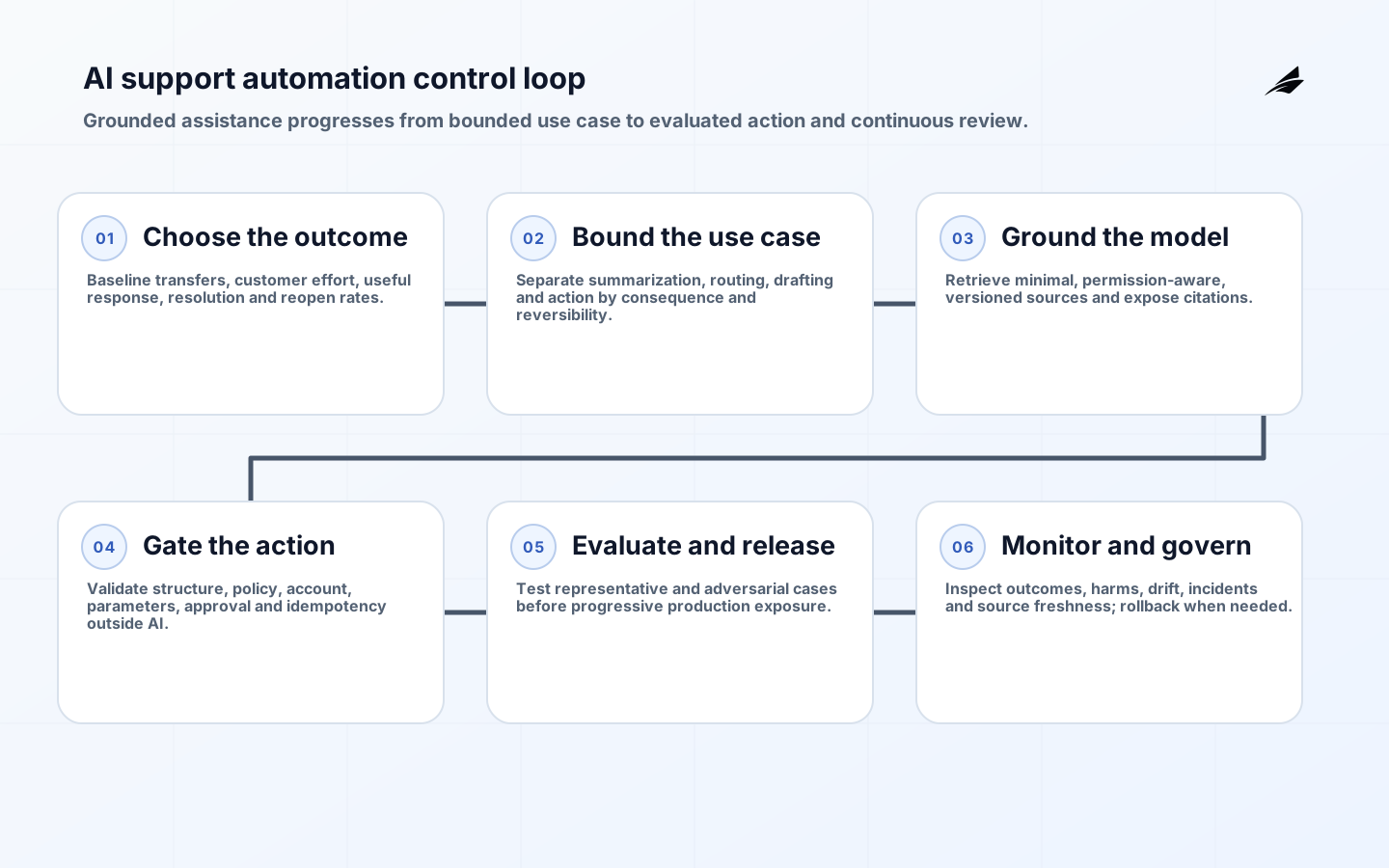
AI business process automation for support teams can shorten triage, retrieve relevant knowledge, summarize conversations and prepare responses. It can also amplify wrong account matches, outdated policy, unsafe actions and convincing but unsupported explanations. A production implementation therefore needs more than a prompt and help-desk integration. It needs a defined support outcome, governed data, bounded model role, human authority, evaluation evidence and a fallback that keeps customer work moving.
Use this checklist with the support AI scope and cost guide, the support automation FAQ and the broader AI process automation readiness guide. Start with one workflow where errors can be reviewed and reversed.
Set the service outcome and baseline
Choose a customer outcome such as reaching the correct owner faster, reducing repeated information requests or improving the accuracy of resolution summaries. Measure the current distribution of first useful response, transfers, reopen rate, resolution time, customer effort and quality-review findings. Do not use ticket deflection as the only goal; a hidden unresolved problem is not a successful automation.
Map the support process from intake through closure and appeal. Identify account verification, severity, entitlements, knowledge sources, actions, approvals and handoffs. Document difficult cases and policy exceptions. Name the product owner, support owner, AI system owner, data owner, security contact and incident decision maker. The NIST AI RMF makes governance a cross-cutting function rather than a launch checklist.
Select use cases by consequence and reversibility
Separate assistive, communicative and action-taking uses. Summarizing an internal thread is lower risk than sending a customer answer; suggesting a refund is lower risk than executing one. Begin with classification, retrieval or drafting where an agent can inspect the result. Define what the system must refuse, such as changing identity, disclosing another tenant's data or making legal and security commitments.

| Use case | Initial mode | Required control |
|---|---|---|
| Conversation summary | Agent-visible draft | Link claims to source messages and show missing context. |
| Ticket classification | Recommendation | Protected queues enforced by deterministic rules. |
| Knowledge retrieval | Suggested sources | Permission-aware, versioned and cited results. |
| Customer response | Human-approved draft | Factual support, policy checks and safe tone. |
| Account action | Tool proposal only | Independent authorization, parameter validation and audit. |
Prepare support data and grounded retrieval
Inventory knowledge bases, product documentation, incident notices, policies and case histories. Assign owners, effective dates, audience and review cadence. Remove contradictory or obsolete content before connecting retrieval. Segment sources by tenant, product, region and permission. A model should not receive all customer history when one verified record answers the question.
Design retrieval to return source identifiers and versions with each passage. Test access filters independently from generation. Treat customer messages and attachments as untrusted content that may contain instructions aimed at the model. The OWASP LLM application guidance highlights prompt injection, sensitive information disclosure and excessive agency; address these risks in architecture, not only wording.
Constrain model output and separate actions
Require a structured output schema for classification, evidence references, uncertainty and proposed next action. Validate fields and allowed values outside the model. Use deterministic services for entitlement, policy, monetary limits and authorization. Never execute a tool call directly because generated text resembles a command. The action service must verify authenticated actor, account, case, parameters, policy, approval and idempotency.
Version models, prompts, retrieval configuration, tools and policies. Provide an unknown or escalate outcome. Limit tool scope, calls, cost and elapsed time. Store enough trace data to reproduce a disputed decision without retaining unnecessary sensitive text. Apply the NIST Privacy Framework to collection, processing, retention and effects on customers and agents.
| Risk | Preventive control | Detection and recovery |
|---|---|---|
| Unsupported answer | Grounded sources and required citations | Sample factuality; retract and correct affected replies. |
| Wrong tenant | Permission-aware retrieval and object authorization | Access logs, canary tests and incident response. |
| Prompt injection | Untrusted-content separation and tool allowlists | Trace review, blocked-attempt metrics and prompt rollback. |
| Unsafe action | Independent policy and human approval | Action reconciliation and reversible command path. |
| Model drift | Versioned evaluation gates | Outcome monitoring and rollback to approved version. |
Design an effective agent and customer experience
Show agents the proposed result, supporting sources, account context, uncertainty and consequence of the next action. Keep editing and rejection easy. Do not hide automation behind a typing animation or imply a human reviewed a message when none did. Define when customers are told they are interacting with automation and provide access to a person for unresolved or consequential issues.
Train agents on limitations, privacy and escalation. Avoid measuring adoption by acceptance rate alone; pressure to accept drafts turns human review into ceremony. Capture correction categories and investigate repeated problems. Protect workers from excessive surveillance by limiting performance analysis to measures needed for service improvement and by making use transparent.
Build evaluations before integration
Create a representative test set across products, languages, severities, customer types and channels. Include ambiguous, malicious, outdated, missing-data and policy-exception cases. Score routing consequence, source support, answer completeness, policy compliance, privacy, tone and action safety. Have qualified reviewers calibrate on examples. Set release thresholds by use case, not one blended score.
Test the whole workflow, including identity, retrieval, model, policy, interface, approval and action. Measure latency and cost under realistic load. Conduct red-team and abuse testing proportional to risk; MITRE ATLAS can help structure adversarial scenarios. Re-run evaluations after any material component changes and retain comparative results.
Pilot with shadow mode and progressive authority
Begin in shadow mode or with internal suggestions. Compare recommendations with actual agent decisions without exposing customers to unverified output. Then enable a small cohort, queue or use case. Keep an explicit stop control and daily review of severe failures. Expand authority separately from traffic: a system can serve more agents while remaining draft-only.
Define launch gates for evaluation, security, privacy, accessibility, operating readiness and customer communication. Record accepted limitations. Monitor queue age, agent edits, unsupported claims, escalation, reopen rate, customer satisfaction and harmful incidents. Segment by use case and group to detect uneven performance. A lower handling time is not valuable if customers return with the same problem.
Operate the AI workflow as a changeable system
Maintain dashboards for model and service behavior, but keep trace-level inspection. Alert on permission failures, tool errors, unusual refusal or acceptance shifts, queue backlog and source freshness. Provide runbooks for provider outage, bad retrieval, leaked data, harmful response and wrong bulk action. Preserve pending cases and deterministic/manual fallback during model unavailability.
Review models, policies, sources, incidents and outcomes with support, product, engineering, security and privacy owners. Retire prompts, tools and permissions that are no longer used. Reassess the system when customer population, product, law or support policy changes. The NIST Generative AI Profile treats risk management as ongoing; operational evidence should determine whether authority expands, contracts or stops.
Test a realistic account-access case before launch
Use a scenario in which a customer says an administrator left the company and asks support to transfer ownership. A model can identify the request type, summarize the account history and retrieve the approved recovery policy. It must not treat claims in the email as verified identity or call an administration tool. The workflow should show which authenticated evidence is missing, route the case to a trained identity-recovery queue and prepare a neutral response that does not reveal protected account details. The agent verifies the requester through the approved channel, records the policy version and obtains any required second approval before a separate service performs the ownership change.
Evaluate more than whether the drafted response sounds helpful. Check that retrieval excludes other tenants, the model does not invent recovery options, the severity is appropriate, the action remains unavailable before authorization and the case retains every decision. Test variants: the former administrator disputes the request, the account has a legal hold, the requester uses a forwarding address, or the identity provider is unavailable. Confirm that the workflow can pause safely and that the customer receives a truthful next step. This kind of scenario reveals harmful shortcuts early and provides a stable regression test after model, prompt, policy or tool changes.
Key takeaways
- Choose a support outcome and baseline before choosing an AI feature.
- Increase authority according to consequence, reversibility and evaluation evidence.
- Ground responses in permission-aware, versioned sources.
- Keep policy and account actions outside model control.
- Monitor customer resolution and harm, not only productivity or draft acceptance.
Frequently asked questions
How much ticket deflection should a team target?
There is no safe universal target. Measure whether customers complete the intended task, how often they reopen or seek another channel, and whether complex or vulnerable users are disproportionately blocked. Set a target only after observing a bounded workflow. Preserve an easy handoff when automation cannot resolve the issue.
Should the model receive the customer's full support history?
Usually not. Retrieve the minimum records relevant to the case and allowed by purpose and permissions. Older conversations may contain obsolete facts, secrets or data from another account context. Summaries can help, but they need provenance and a correction path. Define retention and access independently from model convenience.
Conclusion
AI support automation is strongest when it helps people find evidence, make consistent decisions and complete bounded work. Define the service outcome, constrain data and actions, evaluate the complete workflow and increase authority gradually. That creates faster support without making customers or agents absorb the cost of an opaque system.