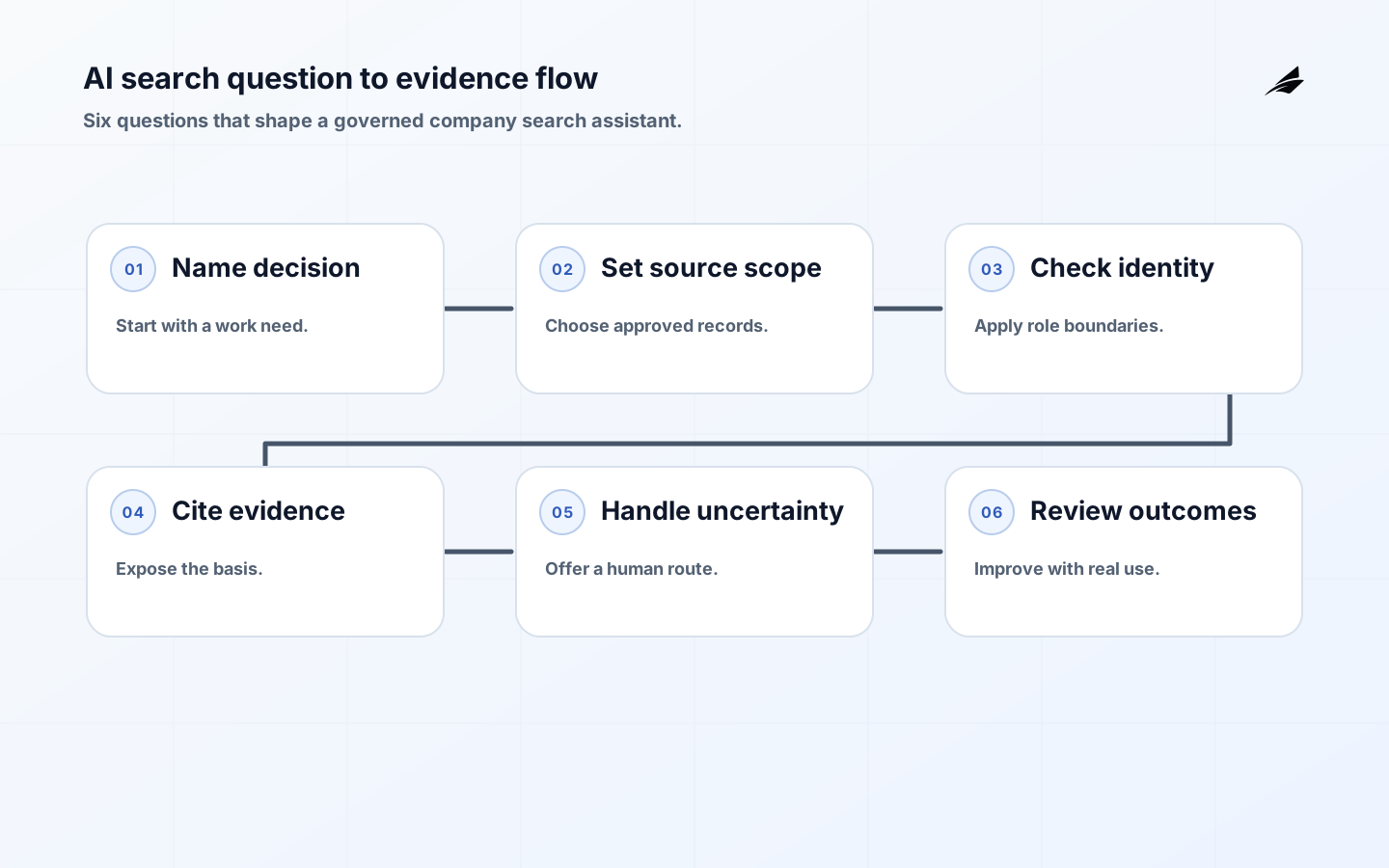
Teams asking about AI assistant search solutions are usually deciding whether an assistant can reduce search effort without creating a new path for misinformation or unauthorized access. The answer depends less on the interface than on the information it will touch and the consequence of a wrong answer. A private assistant for locating meeting notes has a different risk profile from one that guides customer support, procurement, HR, or clinical operations. Start by writing the decision the user is trying to make and the harm of a wrong or missing answer. That keeps the discussion grounded in work rather than in vendor claims. NIST's AI Risk Management Framework provides a useful vocabulary for mapping benefits, risks, and accountable owners. For this part of the system, name the accountable owner, supporting evidence, exception route, and next measurable check.
What should an assistant search solution do first?
Choose a bounded question set that has repeat demand, identifiable source material, and a real human escalation route. Examples include finding the current product setup procedure, summarizing a documented account history for an authorized support employee, or locating an approved clause for a sales team. Avoid beginning with a promise to answer anything about the company. That scope is impossible to evaluate and makes ownership vague. For the first release, state which collections are in scope, who owns them, which audiences may use them, and which questions remain outside the assistant. The best initial success criterion is often that users can reach a verified answer faster while knowing when to consult the underlying record. Within this part of the system, name the accountable owner, supporting evidence, exception route, and next measurable check.

| Question | Practical answer | Design implication |
|---|---|---|
| Who may use it? | Only roles with a justified work need. | Connect identity to collection permissions. |
| What may it answer? | Questions supported by approved evidence. | Show source and effective context. |
| When should it refuse? | When evidence, access, or certainty is inadequate. | Provide a named next step. |
| Who corrects it? | The owner of the source or service. | Create a visible correction workflow. |
Why do citations and confidence matter?
A citation is not decoration. It lets the user inspect whether the source is current, applicable, and complete enough for their situation. Link answers to the relevant record, passage, or policy section, while respecting the same access rules as the answer itself. Do not replace an unavailable citation with a generic confidence label. A model can sound certain when it has weak evidence, and a numerical score can obscure why the response is uncertain. Instead, use plain language: say which information was found, identify conditions or conflicts, and offer a route to an owner when the question needs judgment. The NIST Generative AI Profile highlights confabulation and information integrity as risks that need context-specific treatment. When implementing this part of the system, name the accountable owner, supporting evidence, exception route, and next measurable check.
Can the assistant respect existing permissions?
It can only do so when authorization is designed into the retrieval and display path. The assistant should know the authenticated user, retrieve only content available to that role, and apply the same restrictions to citations, snippets, conversation history, downloads, and connected tools. Shared accounts, copied exports, and broad service credentials can undo an otherwise careful design. Test negative cases deliberately: ask an authorized person for material from another team, ask a recently deprovisioned user to search, and examine whether a denied result leaks a title or metadata. Keep a clear data-retention rule for conversations, especially when users may paste personal, contractual, or customer information. Before releasing this part of the system, name the accountable owner, supporting evidence, exception route, and next measurable check.
| Boundary | Check before launch | Ongoing signal |
|---|---|---|
| Identity | Single sign-on and role mapping are verified. | Unexpected authorization failures. |
| Source access | Connector enforces source-side permissions. | Denied result and metadata leakage tests. |
| Conversation data | Retention and review access are documented. | Sensitive-data reports or deletions. |
| Tool actions | Each action has narrow authority and confirmation. | Rejected parameters and approval events. |
How should quality be evaluated?
Use a curated set of real questions with expected evidence and a documented review method. Include questions with one clear answer, conflicting policies, outdated wording, incomplete documents, restricted sources, and requests that should receive no answer. Evaluate retrieval before evaluating the generated response: a graceful summary cannot rescue the wrong source. Then judge factual support, completeness, appropriate uncertainty, citation usefulness, and user effort. Segment the results by department or content type because average scores can hide a serious problem in a high-consequence workflow. Change one element at a time where possible, such as source preparation or ranking, so the team can learn what changed. This mirrors the disciplined release practice encouraged by the NIST SSDF. While operating this evaluation, name the accountable owner, supporting evidence, exception route, and next measurable check.
What about prompt injection and tools?
- Treat instructions found in documents, web pages, and messages as content, not authority for the assistant.
- Limit tools to the minimum data and action scope required for the use case.
- Validate parameters and require a confirmation or approval before consequential actions.
- Separate the authority to search from the authority to change a record or send a message.
- Review assistant behavior against adversarial and accidental misuse cases, guided by OWASP's prompt injection advice.
The most dependable pattern is to begin with read-only assistance. It lets users assess whether the system finds the right evidence before it can change a ticket, update a customer record, or send an email. When an action is justified, make it narrow and reversible where possible. Show the user the selected target and proposed effect, preserve an audit event, and ensure the downstream system enforces its own authorization. Do not assume that a natural-language instruction is a sufficient approval. A human review point may be essential for commitments, payments, access changes, or anything where context cannot be safely encoded as a simple rule. When changing this part of the system, name the accountable owner, supporting evidence, exception route, and next measurable check.
What makes adoption durable?
People adopt an assistant when it fits a known moment of work and behaves predictably. Train them on its scope, sources, and escalation path rather than presenting it as an all-knowing colleague. Give content owners reports on unanswered questions and stale material so feedback improves the knowledge base, not just the prompt. Give service owners traces that connect a request to retrieval, answer, and any tool event. Establish a response plan for incorrect or sensitive output, including who can disable a collection and who informs users if a source was withdrawn. The related safe AI assistants guide covers the wider operating boundaries that make that trust sustainable. During support for this part of the system, name the accountable owner, supporting evidence, exception route, and next measurable check.
How can teams keep answers accountable?
Set a review cadence that follows the volatility and consequence of the knowledge, not an arbitrary calendar. A product release note may need rapid review; a stable onboarding guide may not. Include the people who own the source material, the people who operate the assistant, and a representative user who can describe the work decision at stake. Review sampled answers alongside their citations and access context. Look for patterns rather than isolated awkward sentences: a recurring missing exception, a collection that produces stale material, or a user group that cannot reach the evidence it needs. Those patterns tell the team whether to improve content, retrieval, or workflow design. To validate this part of the system, name the accountable owner, supporting evidence, exception route, and next measurable check.
Keep a change log for collections, access rules, answer behavior, and connected tools. It gives support staff a way to investigate a report without guessing what configuration was active. It also prevents a well-meant content update from silently changing how a sensitive answer is delivered. A service that can show its evidence, handle uncertainty, and correct itself in public earns more durable trust than one that appears confident until the first difficult question. To govern this part of the system, name the accountable owner, supporting evidence, exception route, and next measurable check.
Key takeaways
- Start with a recurring, bounded decision and named source owners.
- Use citations to expose evidence, context, and appropriate uncertainty.
- Enforce access before retrieval and test denied paths as carefully as successful ones.
- Measure evidence selection and answer behavior separately with realistic questions.
- Add actions slowly, with narrow authority, validation, and accountable review.
Frequently asked questions
Is a vector database enough to build enterprise search? No. It is one implementation component; source preparation, permissions, evaluation, and operating ownership determine whether the service is trustworthy. Can users rely on a summary without opening the source? For low-consequence orientation, perhaps, but important decisions should keep the original evidence close at hand. Does an assistant need to answer every question? No. Clear boundaries and a useful handoff are signs of a mature service. Can it be launched to everyone at once? A staged release is usually safer because it exposes access, content, and workflow problems before they affect a wider audience. When explaining this part of the system, name the accountable owner, supporting evidence, exception route, and next measurable check.
Conclusion
An AI search assistant earns trust by making the right knowledge easier to find while preserving the reasons it can be trusted. Design for evidence, permissions, correction, and escalation from the outset. The companion AI search migration checklist offers a useful next step when those decisions involve moving or consolidating source systems. For this part of the system, test one expected case, one ambiguous case, and one failure with a documented recovery action.
An operating note for this decision
For the search-assistant FAQ audience, a useful readiness check is whether a new manager can explain the assistant's source boundaries and correction route after a short briefing. If they cannot, the design is too dependent on invisible expertise. Ask users to distinguish an answer that is helpful for orientation from one that is sufficient for a binding decision. That conversation reveals where citations, access checks, or human escalation need to be stronger. It also makes adoption more honest: the assistant is a route to governed knowledge, not a substitute for accountable judgment.