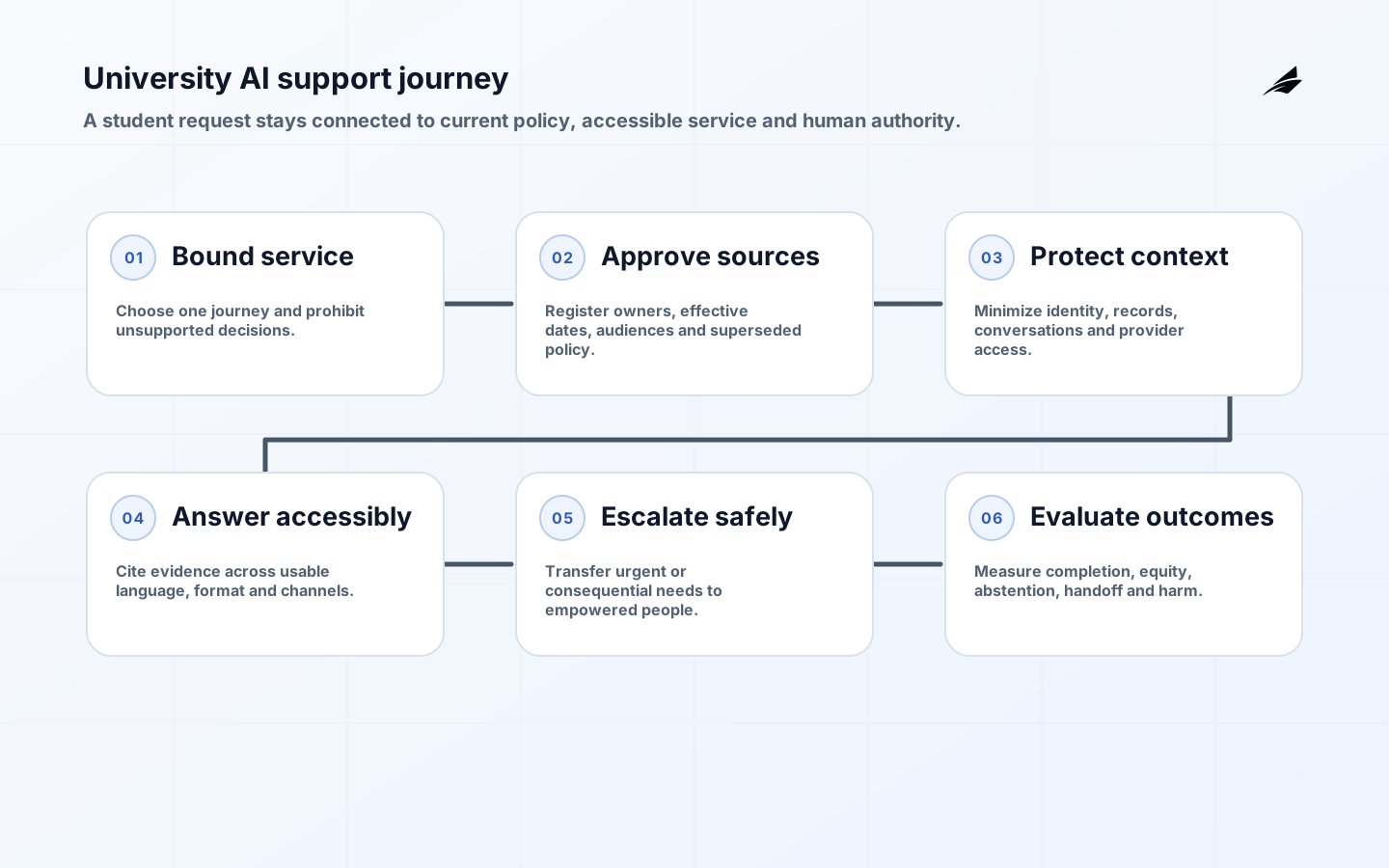
University support with AI can make approved information easier to find, route routine requests and extend service availability, but it should not become an unaccountable layer between students and consequential decisions. The design must preserve access to people, accommodate disability and language needs, protect education records, distinguish guidance from official determinations and work during high-pressure periods such as enrollment, assessment and financial-aid deadlines.
UNESCO’s guidance calls for a human-centered approach to generative AI in education and research, including privacy protection, policy and capacity building. The US Department of Education has likewise emphasized keeping humans in the loop and aligning AI with educational goals. This plan turns those principles into a bounded support service. Teams ready to execute can follow the university AI implementation checklist and use the university support FAQ for stakeholder review.
Define a support outcome and a hard service boundary
Start with a specific journey: finding a published deadline, understanding how to submit a form, locating disability support or routing an IT request. Map the student’s starting context, authoritative sources, expected answer, escalation team and measurable outcome. Do not begin with a campus-wide assistant. Broad scope mixes policies with different owners, freshness, privacy and consequences, making evaluation and accountability difficult.
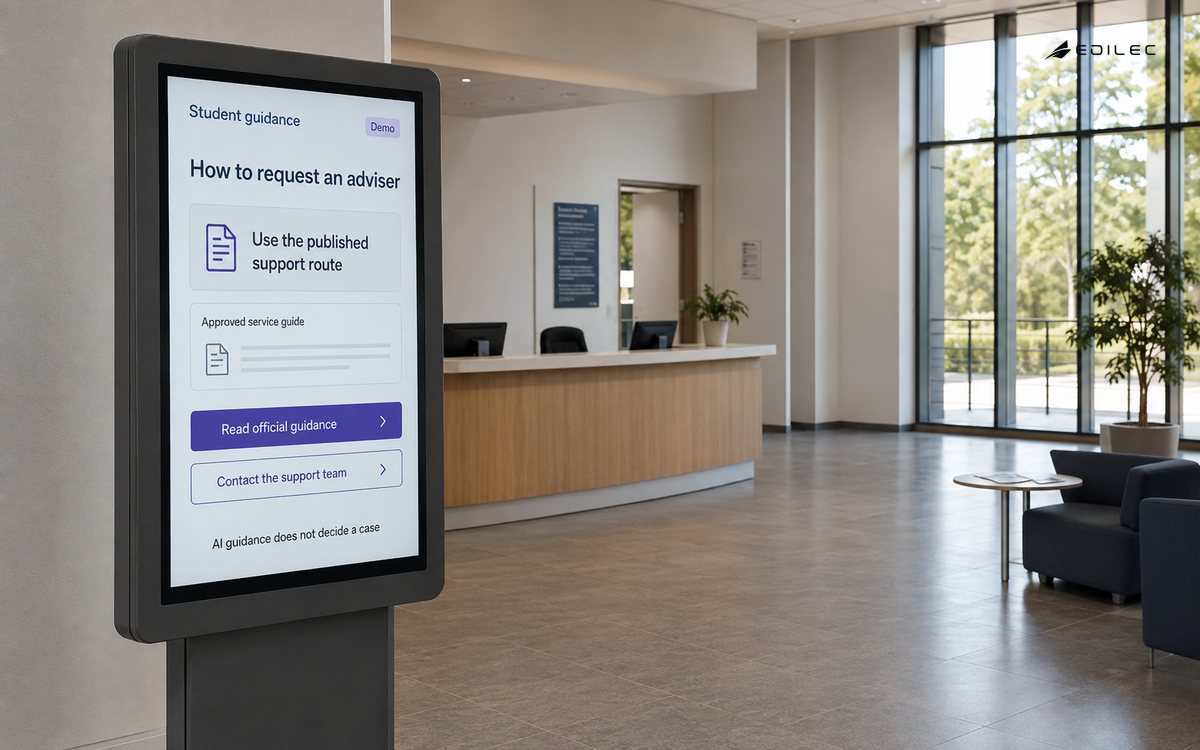
Separate informational support from decisions. An assistant may explain the published appeals process; it should not decide an appeal. It may collect a request for an adviser; it should not diagnose a mental-health condition. Admissions, grading, discipline, financial aid, immigration, safeguarding and accommodation decisions need domain-specific authority, review and legal analysis. Clearly disclose that the user is interacting with AI and identify the official record or human route.
| Candidate use case | Initial boundary | Mandatory escalation |
|---|---|---|
| Policy and deadline navigation | Answer only from approved current pages with citations | Missing, conflicting or expired source |
| Service triage | Classify topic and create a ticket with user confirmation | Urgent safety, welfare or discrimination concern |
| IT self-service | Guide documented low-risk troubleshooting | Identity, security incident or destructive action |
| Advising preparation | Help students organize questions and options | Academic determination or personal-case interpretation |
| Case status | Retrieve minimum authorized status after authentication | Record correction, appeal or unexpected disclosure |
Build an approved knowledge and ownership model
Create a source register with document owner, jurisdiction, audience, effective date, expiry, review cadence and superseded versions. Retrieval should prefer authoritative content and return citations that a student can inspect. The assistant should abstain when sources conflict or evidence is absent. A language model’s general knowledge is not an official university policy source, and a correct answer from last term may be harmful this term.
Give policy owners a simple publishing workflow that updates the source of truth rather than a separate AI-only copy. Test indexing delay and cache invalidation before relying on urgent changes. Preserve the source version used for consequential interactions so a complaint can be reconstructed. Do not expose internal notes or draft policy merely because the search system can access them. Access control must apply before retrieval, not only after text generation.
Protect student privacy and minimize data
Determine which conversations and generated records are education records under applicable law and institutional policy. In the United States, FERPA protects access to and disclosure of personally identifiable information from education records and applies to covered postsecondary institutions. Other jurisdictions have different rules. Map purpose, legal basis, consent where relevant, access, retention, correction, disclosure, deletion and vendor terms before connecting student systems.
Use anonymous public guidance where identity is unnecessary. For authenticated services, retrieve only attributes required for that transaction and separate conversation logs from official records unless there is a defined purpose. Avoid sending free-text histories to a model by default. Students may disclose health, immigration, financial or safeguarding information unexpectedly, so detect and route sensitive topics without expanding collection. Test whether logs, analytics, support consoles and model providers receive the same data.
| Risk | Design control | Evidence before launch |
|---|---|---|
| Outdated policy answer | Owned source register, citations and abstention | Time-based tests across current and expired policies |
| Unequal service quality | Segmented evaluation and human alternative | Results by language, disability journey and student group |
| Private record exposure | Authorization before retrieval and minimum attributes | Cross-account and role-boundary security tests |
| Inaccessible interaction | WCAG 2.2 testing and non-chat channel | Keyboard, screen reader, zoom and error-recovery review |
| Missed urgent need | Conservative escalation rules and staffed handoff | Scenario rehearsal with welfare and safety owners |
Design for accessibility, language and real human choice
Conformance is more than adding alternative text to a chat widget. WCAG 2.2 covers perceivable, operable, understandable and robust experiences. Test keyboard operation, focus, screen readers, magnification, contrast, reflow, time limits, status announcements, authentication and error recovery. Generated text should use clear structure, and citations or controls must remain usable when content length changes. Offer an equivalent route that does not require conversation with AI.
Evaluate supported languages with native or qualified reviewers, including campus terminology and policy nuance. Do not claim parity because the base model can translate. Let users request a person without proving that the AI failed. Handoffs should transfer a concise, user-confirmed summary and source references, not force students to repeat sensitive circumstances. State service hours and expected response times honestly.
Choose architecture and controls proportionate to consequence
A typical bounded design includes the student channel, identity layer where needed, policy and safety routing, retrieval over approved sources, model service, citation and response validation, case integration, telemetry and an administrative review surface. Separate public knowledge from authenticated records. Restrict model tools to allowlisted read or create actions; any change to a student record should use a deterministic workflow, explicit confirmation and normal authorization.
Log enough to diagnose failures while honoring data minimization. Useful events include source IDs, policy route, refusal or escalation reason, latency, tool result and user feedback. Avoid making raw conversations broadly searchable. Encrypt data, use role-based support access, audit privileged viewing and define incident procedures with the provider. Test prompt injection in source documents and user messages, as well as data leakage between sessions.
Estimate cost and capacity realistically
Include discovery, policy cleanup, accessibility, privacy and security review, integration, evaluation, licenses or model usage, retrieval infrastructure, observability, support staffing, training and ongoing source ownership. Model cost per resolved journey rather than per message. A low token bill can hide expensive escalations or repeated conversations. Forecast peaks around known academic events and agree rate limits and degraded modes that do not block essential service.
Budget for continuous evaluation and vendor change. Models, safety behavior, prices and terms evolve; policies change each term. Preserve a benchmark set and portable source register so the university can compare providers or operate a simpler search service. Contract for data export, deletion, incident notification, subprocessor changes, accessibility support and termination. Record the cost of parallel operation during migration or exit.
Deliver through a six-stage evidence plan
- Select one support journey, baseline its demand and outcomes, and define prohibited decisions and mandatory escalations.
- Register authoritative sources and owners; resolve contradictory, inaccessible or expired content before model work.
- Complete privacy, security, accessibility and legal reviews for the data, provider, identity and support design.
- Build a bounded prototype and evaluate accuracy, citations, abstention, access control, accessibility and urgent scenarios.
- Pilot with representative students and staff, maintain a staffed alternative, monitor outcomes and correct failures quickly.
- Approve, expand or stop based on evidence; publish service ownership and continuously review sources, models, cost and impact.
Measure student outcomes and institutional impact
Track successful journey completion, correct routing, citation support, abstention, handoff completion, repeat contact, time to resolution and student-reported usefulness. Review results by relevant groups and channels to detect unequal quality, while applying privacy safeguards to analysis. Do not optimize deflection alone: fewer human contacts may mean resolved needs, abandoned students or inaccessible service. Sample conversations lawfully and have domain owners classify failure modes.
Create stop conditions for harmful disclosure, repeated unsupported advice, security compromise, inaccessible critical journeys or unmanageable escalation load. Report incidents through university processes and notify affected people where required. A post-launch council should review evidence and authorize material expansions, but day-to-day service ownership must remain with a named operational team rather than a committee with no response duty.
Key takeaways
- Begin with one bounded support journey and keep official decisions with authorized people and processes.
- Use owned, current sources with inspectable citations and abstain when evidence is missing.
- Minimize identity and conversation data across the complete provider and support path.
- Test accessibility, language, privacy, security and escalation as core service behavior.
- Measure resolved student needs and equity of service, not chatbot volume or deflection alone.
Frequently asked questions
Should AI answer questions about grades or admissions decisions?
It can explain a published process or retrieve a securely authorized status, but personal interpretation, correction, appeal and determination should route to the responsible office. Never let generated wording silently become the official decision or record.
Does a 24/7 assistant replace after-hours support?
No. It can provide approved information at any time, but urgent welfare, safety, security and deadline-sensitive cases need a clearly staffed route. Publish what is monitored, expected response times and emergency alternatives. Do not imply a human is watching an unmonitored conversation.
Can student conversations be used to improve the model?
Only after purpose, authority, notice, vendor terms, retention and privacy risks are assessed under applicable law and policy. Prefer minimized, de-identified and reviewed evaluation data where appropriate. De-identification must consider whether free text or combinations of facts can still identify a student.
Conclusion
Responsible university support with AI is a service design and governance program, not a chatbot installation. Bounded authority, current knowledge, student privacy, accessible human choice and measurable outcomes create the conditions for useful automation. The conversational AI support delivery plan adds channel design detail, while the business process solutions plan helps modernize the workflows behind the answers.