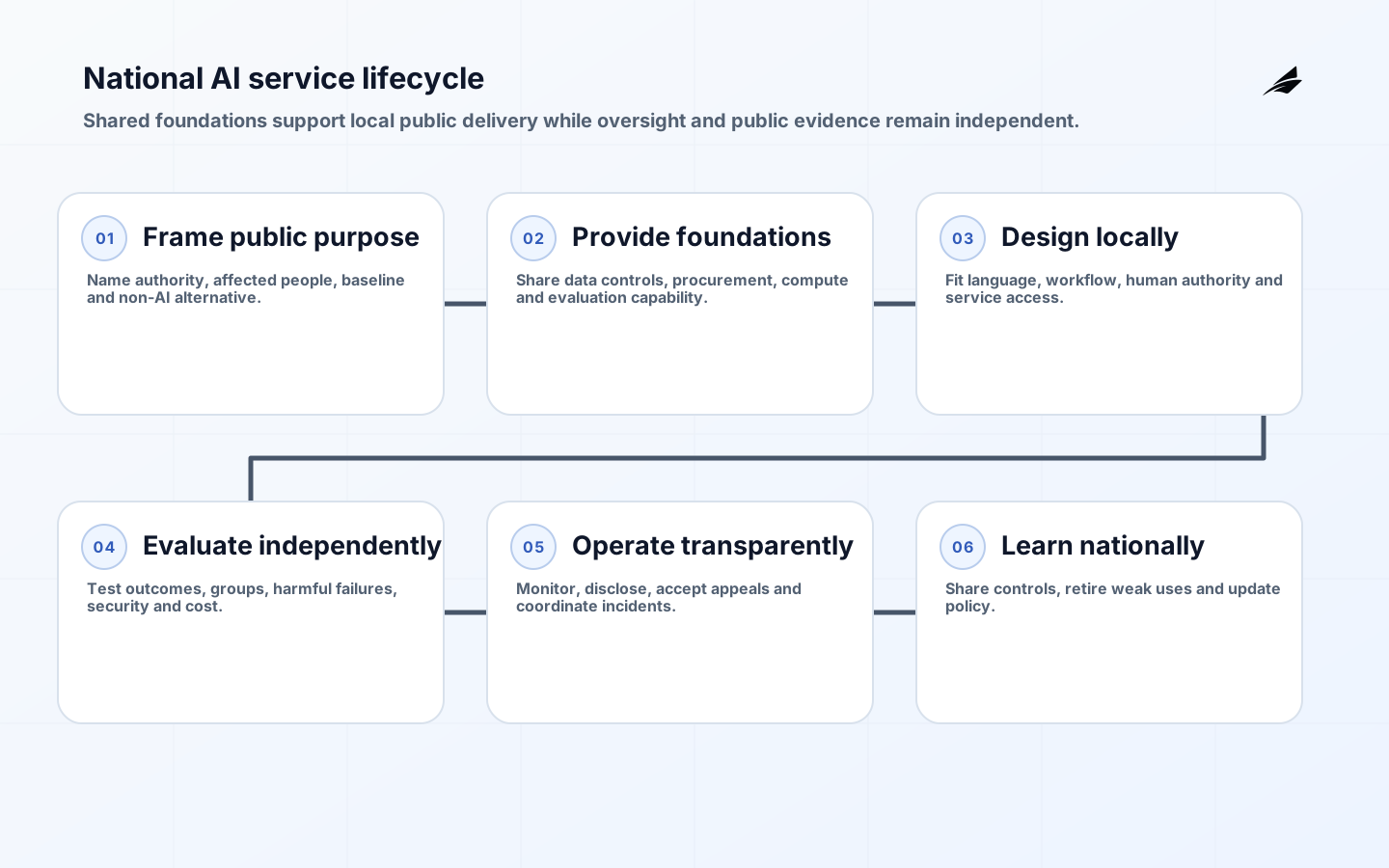
National AI services are shared policies, capabilities and operating mechanisms that help public institutions use artificial intelligence for public outcomes. They may include evaluation facilities, secure data access, compute, model catalogs, procurement frameworks, assurance, skills and reusable service components. They are not one national model or a license to automate every decision. The design must fit constitutional, legal, linguistic, economic and administrative conditions.
This national AI services FAQ complements Edilec's scope, cost and delivery plan, implementation checklist and AI workflow automation checklist. OECD's AI Principles, updated in 2024, emphasize inclusive growth, human rights, transparency, robustness and accountability; UNESCO's recommendation grounds national action in human dignity and lifecycle governance.
What should a national AI service accomplish?
It should make valuable, lawful and trustworthy adoption easier across institutions while preventing duplicated infrastructure and inconsistent safeguards. Start from public problems such as translation, document routing, agricultural advice, fraud investigation support or service accessibility. Define affected people, current baseline, accountable authority and non-AI alternative. Fund AI only where probabilistic capability improves the outcome relative to rules, process reform or ordinary software.
| Shared capability | National value | Local responsibility |
|---|---|---|
| Use-case register | Visibility and coordination | Purpose, authority and outcome owner |
| Evaluation facility | Comparable technical and social evidence | Representative domain cases |
| Secure data access | Reusable governance and controls | Lawful source and data quality |
| Compute or model catalog | Procurement leverage and standards | Workload fit and cost control |
| Transparency mechanism | Public understanding and scrutiny | Accurate service-specific record |
| Incident coordination | Cross-government learning | Immediate service response |
How should governance be organized?
Separate policy, enablement, deployment and independent oversight so one body does not approve its own consequential use. Give a central function responsibility for baseline controls, interoperability, shared procurement and incident learning; keep service owners accountable for purpose, lawfulness, users and outcomes. Establish risk tiers and prohibited or presumptively unsuitable uses through national law and policy. Provide routes for regulators, auditors, civil society, domain experts and affected communities to contribute.
Use a lifecycle gate: propose, assess, design, evaluate, authorize, monitor, change and retire. NIST AI RMF offers Govern, Map, Measure and Manage functions that can structure evidence without replacing legal duties. Require an inventory with owner, purpose, model and data dependencies, risk, evaluation status and operational state. Reassess after material model, data, population or policy changes.
What data and infrastructure are needed?
National capability depends on trustworthy digital public infrastructure before it depends on model scale. Clarify authoritative registries, interoperability, consent or legal authority, access control, quality, retention and grievance. Build secure research and evaluation environments for sensitive data. Support local languages and contexts with documented provenance and community participation. Avoid centralizing every dataset; federated or controlled-access approaches may reduce concentration while enabling approved analysis.
Compute strategy should compare commercial services, sovereign or public infrastructure and research capacity by workload, confidentiality, resilience, competition, energy, skill and total cost. Require usage metering and workload ownership. Portability matters most for state, data and evaluation assets; attempting to abstract every model feature can reduce capability. Plan continuity if a provider, model or cross-border route becomes unavailable.
How should governments procure AI services?
Procure a bounded outcome and evidence, not an undefined AI platform. Require model and version identification, data-use terms, security, evaluation access, accessibility, incident notice, subcontractors, location, rate limits, deprecation, export and deletion. Distinguish configuration, retrieval, fine-tuning and training because they create different data and intellectual-property concerns. Keep public records and business state outside opaque provider conversation stores.
Use staged competition and pilots with representative cases. Suppliers should disclose material limitations and support independent testing without claiming trade secrecy over every decision. Contract change notification and the right to suspend. Price the full workflow: integration, data preparation, evaluation, human review, corrections, compute, support and exit. Low per-call price can hide an expensive unreliable service.
How should national AI services be evaluated?
Evaluate the complete task across relevant languages, regions and user groups. Compare with the current service and a non-AI baseline. Measure usefulness, error type, harmful failure, abstention, appeal, latency, accessibility, security and cost. For generative systems, test groundedness, fabricated claims, unsafe content, prompt injection and data leakage. Domain experts must judge consequence; a generic model score cannot decide whether an error is acceptable in health, benefits or justice.

| Evidence | Question | Decision |
|---|---|---|
| Offline task set | Can the version handle representative cases? | Proceed, redesign or reject |
| Adversarial test | How does it fail under misuse or hostile input? | Strengthen controls and limits |
| Pilot comparison | Does the workflow improve the public outcome? | Authorize bounded use |
| Group analysis | Are harms or access unequal? | Mitigate, narrow or stop |
| Production sample | Has behavior changed in real use? | Continue, rollback or review |
| Incident record | Can failures be explained and learned from? | Correct system and governance |
What transparency and human review are required?
Tell people when AI materially supports a service, what it does, what information it uses, who is accountable and how to question an outcome. The UK's Algorithmic Transparency Recording Standard demonstrates a structured public record; other jurisdictions need their own lawful mechanism. Transparency must be understandable without exposing exploitable security detail or personal data. Publish evaluation summaries and known limitations for consequential systems.
Human review must have time, authority, evidence and an alternative action. A person who can only accept a model recommendation is not meaningful oversight. Route low-confidence, novel and high-consequence cases to trained reviewers. Preserve the inputs, model and policy version, output, action and correction needed to explain material decisions. Provide accessible appeal and remedy where outcomes affect rights or services.
How are security and systemic risk managed?
Follow secure-by-design guidance across model design, development, deployment and operation. Threat-model training and retrieval data, model artifacts, prompts, tools, identities, supply chain and monitoring. Treat retrieved text and model output as untrusted. Allowlist tools, validate typed outputs in deterministic code and require authorization at execution. Use rate, step and spend limits. Coordinate vulnerabilities and incidents nationally where shared suppliers or components create correlated risk.
National concentration can improve assurance while increasing blast radius. Avoid a mandatory single model for unrelated services. Segment tenants and data, test regional and provider failure, maintain manual routes and rehearse revocation of a compromised component. Election, emergency, critical-infrastructure and security uses need heightened threat intelligence and communication plans.
What is a practical delivery sequence?
- Establish mandate, principles, legal map and independent oversight.
- Inventory public problems, existing AI uses, data and institutional capability.
- Select bounded use cases and publish outcome and risk criteria.
- Build shared evaluation, procurement, transparency and incident mechanisms.
- Pilot with representative communities and preserve non-AI access.
- Scale only after observed value, safeguards, skills and cost are sustainable.
Build institutional capability and participation
Invest in multidisciplinary public teams able to challenge suppliers and operate services: domain professionals, user researchers, data stewards, security engineers, evaluators, procurement specialists, lawyers and social scientists. Training should cover when not to use AI, automation bias and incident reporting. Shared expert teams can support smaller agencies, but should transfer knowledge rather than become an opaque bottleneck.
Engage affected communities before requirements harden and compensate participation where appropriate. Include minority-language users, disabled people and communities subject to the service's decisions. Publish what changed through consultation and where disagreement remains. Participation does not replace rights or technical assurance, but it reveals harms and access barriers that a benchmark cannot represent.
Create a national learning mechanism for evaluation artifacts, incidents, appeals, supplier changes and retired systems. Share sanitized tests and reusable controls across institutions. Track whether shared capability shortens responsible delivery without creating mandatory dependence. Periodically review the portfolio and stop uses whose value, evidence or legitimacy no longer supports their cost and risk.
Key takeaways
- Build national AI services as governed public capabilities, not one model.
- Keep service owners accountable while sharing evaluation and infrastructure.
- Test complete public outcomes across languages, groups and harmful failures.
- Make transparency, human authority, appeal and incident learning operational.
- Manage supplier and infrastructure concentration with continuity and exit paths.
Frequently asked questions
Does national AI require a sovereign foundation model?
No. Some countries may invest for language, research, resilience or strategic reasons, but many outcomes can use commercial, open or specialized models with controlled data and evaluation. Sovereignty is also governance, skill, infrastructure, procurement power and the ability to change providers.
Should government AI be open source?
Openness can support inspection, competition and local adaptation, but licenses, weights and code do not guarantee safety or operability. Decide component by component and retain testing, secure deployment, update and accountability regardless of licensing model.
How should national success be measured?
Measure public outcomes, inclusion, service quality, institutional capability, domestic research and economic value alongside incidents, appeals, unequal harms, energy and total cost. Model adoption or compute purchased is not success by itself.
Plan suspension and retirement
Every approved service needs triggers for suspension: legal change, harmful disparity, security incident, model withdrawal, unacceptable drift or loss of accountable staff. Preserve a manual or deterministic route, communicate to affected people and finish or transfer queued cases safely. Retirement should revoke tools and credentials, export required evidence, delete data under policy and retain enough version history to explain past decisions.
A public register should also show when a service is paused or retired, not only when it launches. This keeps institutional memory and public accountability intact after technology changes.
Conclusion
National AI services should make careful public use easier and unsafe use harder. Begin with institutions, rights and public problems; share the costly foundations of evaluation, procurement and incident learning; and scale only from observed evidence. Durable national capability is the ability to choose, govern, operate and stop AI systems in the public interest.