To align AI solutions with business goals, start with a decision or workflow that needs to improve, not a model capability seeking a home. Alignment means the user, outcome, baseline, authority, risk, data, operating owner and investment threshold are explicit before a pilot. It also means evidence can stop or redirect the work. A technically impressive demonstration is not aligned if it cannot change a measurable business result within responsible constraints.
This FAQ helps executives, product, operations, data and risk teams govern an AI portfolio. Use the AI alignment scope and delivery plan and AI alignment implementation checklist to move into delivery. The business process solutions guide is useful when the underlying problem may not require AI.
What should be aligned before selecting AI?
Name the business decision, the person accountable for it and the current workflow. Record volume, cycle time, error, cost, quality, customer or employee impact and exception rate where available. Identify why the problem exists. Poor policy, fragmented ownership or missing system integration may not improve with a model. Define the desired behavior in operational language, such as reducing review delay while preserving false-negative and appeal controls.
Set outcome and guardrail measures, a pilot cohort, decision date and stop rule. Include who may act on model output and what evidence they need. NIST AI RMF treats context mapping as part of risk management; that is especially important because the same model can carry different risk in drafting an internal summary and making a customer eligibility recommendation. Alignment is use-case specific, not a property of the model alone.
| Alignment question | Useful answer | Weak answer |
|---|---|---|
| What improves? | Named workflow and accountable decision | Productivity in general |
| How is value measured? | Baseline, outcome and guardrails | Number of users or prompts |
| Why AI? | Variable inference adds tested advantage | Competitors announced AI |
| Who controls action? | Named authority and bounded permissions | The agent handles it |
| When does work stop? | Predefined harm, cost or value threshold | After the budget is spent |
How should AI use cases be prioritized?
Score value, feasibility, risk, evidence quality and adoption together. Value includes revenue, cost, service, risk reduction or strategic option, but should identify the mechanism. Feasibility covers data access, integration, evaluation and workflow change, not merely model availability. Risk includes consequence, affected people, reversibility, security, privacy, legal obligations and dependence on third parties. Adoption asks whether users have authority and incentive to change behavior.
Favor bounded, frequent tasks with reviewable output and clear fallback for early pilots. A low-frequency executive decision may be valuable but difficult to evaluate quickly. Avoid prioritizing only by estimated hours saved; automation can shift work into verification, exception handling and correction. Compare an AI option with rules, search, analytics, process redesign and no change. The simplest effective intervention is often the most aligned.
What does data readiness mean?
Data readiness means the organization can lawfully and reliably obtain representative inputs, labels or reference answers, protect them, trace provenance and maintain them as the workflow changes. Inventory source owners, purpose, quality, missingness, timeliness, access, retention, sensitive attributes and licensing. Distinguish data used to train or fine-tune, retrieve context, evaluate, operate and monitor. Each has different risks and lifecycle.
Create a reviewed evaluation set before choosing a model. Sample normal cases, edge cases, affected groups, languages and known failures in proportion to business consequence, not only frequency. Keep release cases separate from prompt or model development. If reliable ground truth is unavailable, define structured human review and disagreement resolution. Synthetic data can supplement coverage but does not prove performance on real operational conditions.
How should risk determine the delivery path?
Classify use cases by consequence, autonomy, data sensitivity, scale, reversibility and external impact. Low-risk assistance may need local review and privacy controls. Recommendations that shape access, employment, finance, health, safety or legal interests require stronger authority, validation, appeal, monitoring and qualified regulatory review. Tool-using systems need permissions constrained independently from the model and explicit approval before consequential actions.
NIST AI RMF organizes activity into Govern, Map, Measure and Manage, with governance across the lifecycle. The NIST Playbook offers suggested actions rather than a universal checklist. GAO's accountability framework groups practices around governance, data, performance and monitoring. Use these structures to define evidence and ownership, then map jurisdiction and sector obligations separately. A framework label does not demonstrate that a particular system is responsible or compliant.
How should business and model evaluation connect?
Evaluate the component and the workflow. Component measures may include precision, recall, ranking, extraction accuracy, groundedness, calibration, abstention, robustness and latency. Workflow measures include completion, error correction, cycle time, user reliance, escalation, appeal, customer impact and total cost. Weight failures by consequence. A model can improve an average benchmark while worsening the cases the business most needs to protect.
Compare against the current process and a simpler baseline. Run offline tests, adversarial and security tests, then shadow operation before influencing live decisions. Define release thresholds and confidence behavior in advance. Review qualitative cases behind aggregate scores. For generative AI, NIST's profile identifies risks that can be novel or amplified, including confabulation, privacy, information integrity and value-chain dependencies; select mitigations based on the actual use.
| Evidence layer | Example measure | Decision |
|---|---|---|
| Model behavior | Consequence-weighted error and abstention | Is the component fit for bounded use? |
| Workflow quality | Task success and correction work | Does it improve the real job? |
| Human factors | Reliance, disagreement and override patterns | Is review meaningful? |
| Risk | Harm, privacy, security and appeal signals | Are controls sufficient? |
| Economics | Total cost per successful outcome | Does value justify operation? |
| Operations | Incidents, drift and recovery time | Can the owner sustain it? |
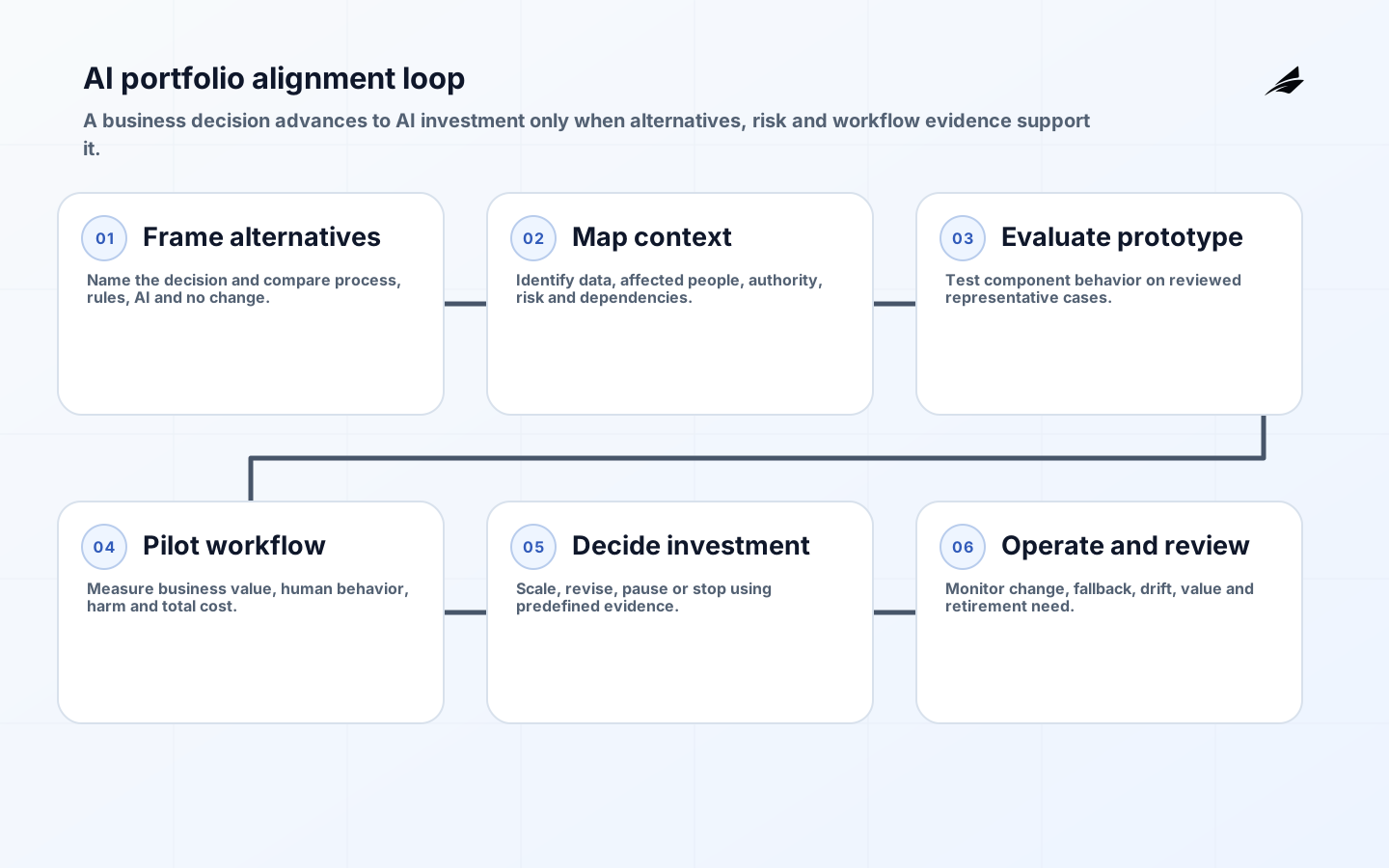
How does the AI alignment portfolio loop work?
- Frame the business decision, baseline, owner and constraints.
- Compare AI with process, rules, analytics and no-change alternatives.
- Map data, affected people, authority, risk and operating dependencies.
- Build a bounded prototype and evaluate component behavior offline.
- Run shadow and assisted pilots against business and harm guardrails.
- Decide to scale, revise, pause or stop using predefined evidence.
- Monitor production, retire weak systems and reuse validated capabilities.

Portfolio governance should occur at two levels. A central function sets policy, risk tiers, shared evaluation and approved platform capabilities. Use-case owners remain accountable for business behavior, data and monitoring. Require a compact proposal that identifies outcome, alternatives, data, authority, affected stakeholders, risk tier, expected cost and evidence plan. Fund discovery separately from scale so uncertain ideas do not gain permanent status through infrastructure spend.
Review the portfolio for duplication. Several teams may need document extraction, retrieval, evaluation or human review; shared capabilities can reduce risk and cost when their contracts are clear. Do not force every use case onto one model or vendor if requirements differ. Track dependencies and exit paths so a provider change does not disable unrelated business processes.
Who owns an AI solution after launch?
Name a business owner, product or service owner, model and data responsibilities, security contact, risk approver, support path and supplier contact. Define release authority, incident severity, user communication, fallback, appeal and retirement. Monitor input and output drift, error cohorts, overrides, tool use, data quality, cost and business outcome. Privacy-preserving telemetry should answer operational questions without retaining unnecessary content.
Change control must cover model, prompt, retrieval source, tool, policy, data pipeline and user experience. Re-run the relevant evaluation set before release and canary material changes. Keep a known safe fallback and exercise it. Periodically confirm that the business need, user behavior and total cost still justify operation; a once-useful system can become misaligned as policy and workflows evolve.
How should cost and value be compared?
Include discovery, data preparation, evaluation, integration, user experience, model usage, retrieval, review, security, monitoring, support and change management. Measure total cost per successful outcome, not token or seat cost alone. Verification and exception work often move rather than disappear. Model volume, growth, provider pricing and fallback scenarios, then compare with the current process and non-AI options.
Benefits should be attributable and time-bound. Use controlled cohorts or staged comparisons where practical, and inspect unintended effects such as lower quality, delayed escalation or reduced user skill. Strategic value may include learning or reusable capability, but name the option it creates and the evidence needed. Avoid converting speculative future revenue into precise present return.
Key takeaways
- Start with an accountable business decision, baseline and stop rule.
- Compare AI with simpler technical and process alternatives.
- Prioritize value, feasibility, risk, evidence and adoption together.
- Evaluate model behavior and end-to-end workflow outcomes separately.
- Fund operating ownership, monitoring, fallback and retirement from the start.
Frequently asked questions
Should an organization create an AI strategy first?
Create enough strategy to define principles, risk appetite, platform direction and investment governance, then test it through real use cases. A long technology roadmap without workflow evidence ages quickly. Strategy and delivery should inform each other through portfolio review.
How many AI pilots should run at once?
Only as many as the organization can evaluate, govern and support with distinct decision value. A large pilot count can hide weak ownership and shared dependencies. Limit work in progress, reuse capabilities and require explicit scale or stop decisions.
Should vendor model benchmarks drive selection?
No. Benchmarks can inform screening, but selection needs the organization's data, workflow, consequence-weighted evaluation, security requirements, operating constraints and cost. Verify exact model and service configurations because provider offerings change.
Conclusion
AI alignment is a portfolio discipline that connects models to accountable work. Define the decision, compare alternatives, govern data and authority, evaluate real outcomes and keep scale contingent on evidence. Organizations gain more from a small set of operated, reviewable solutions than from a crowded pilot catalog with no stopping logic or business owner.