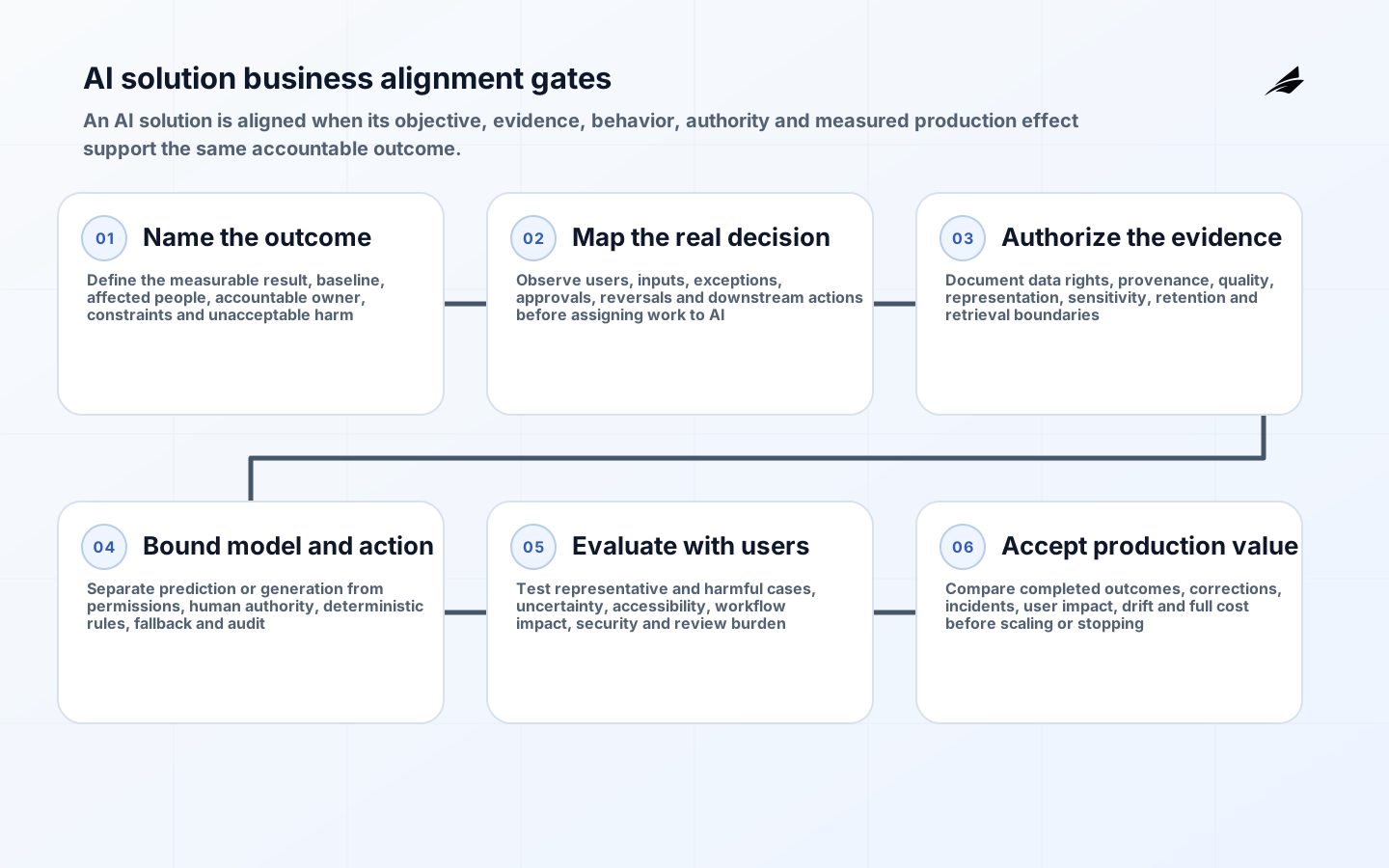
AI alignment in an enterprise has a practical meaning: the system's purpose, behavior, authority and operating evidence must remain connected to the organization's objectives and obligations. A portfolio can be technically sophisticated yet misaligned if it optimizes a proxy, excludes affected users, invents new risk or cannot be owned after launch. Alignment is therefore an implementation discipline, not a strategy workshop artifact.
This AI solutions align implementation checklist converts the scope, cost and delivery plan into gates and complements the AI alignment FAQ. Apply additional domain, legal and safety review to consequential uses. The steps cover predictive and generative systems, purchased products and internally developed workflows.
1. Translate strategy into an owned outcome
Start with a business or public outcome and its baseline, not a model capability. Name the sponsor, workflow owner, users, affected people and decision deadline. Describe how current work succeeds and fails, including effort, delays, appeals and downstream consequences. Set a measurable target and disconfirming evidence. If nobody can change the surrounding process, the AI team cannot own the promised outcome.
Record strategic rationale and exclusions. A revenue objective does not justify every form of personalization; an efficiency target does not authorize removing human recourse. Link the initiative to approved risk tolerance, data strategy and service roadmap. Revisit alignment when market, policy or organizational goals change. A system can drift from purpose even when its statistical distribution remains stable.
2. Define the workflow and model authority

Map trigger, input, source authority, model task, user decision, action, communication, correction and fallback. State whether the model summarizes, classifies, recommends, ranks or acts. Keep permissions, eligibility, financial calculation and irreversible transaction rules deterministic unless explicit evidence supports another design. Define prohibited uses, populations and actions, plus the conditions that require abstention or specialist review.
NIST's AI RMF 1.0 frames risk management through Govern, Map, Measure and Manage and treats AI as sociotechnical. Use that perspective to examine people, process and context, not only the component model. Include labor impact, accessibility and the experience of people whose data or opportunities the workflow influences.
| Alignment layer | Question | Required artifact |
|---|---|---|
| Strategy | Which measurable outcome and constraint matter? | Outcome charter and baseline |
| Workflow | Where may AI influence or act? | Decision and authority map |
| System | Which data, model, policy and tool versions run? | Traceable architecture record |
| Operation | Which evidence triggers change or stop? | Monitoring and response thresholds |
3. Align data with purpose and affected populations
Create a data contract for training, retrieval, evaluation and operation. Record purpose, source authority, rights, sensitivity, lineage, representativeness, freshness, quality, retention and owner. Separate data available from data appropriate to use. Identify historical policies or selection effects embedded in labels. Consult domain experts and affected groups where consequence warrants it; data completeness is not the same as legitimate representation.
For retrieval, enforce source permissions and preserve provenance. For purchased AI, determine what prompts, outputs and feedback the supplier retains or uses. Use synthetic or approved test data in development. Establish correction and deletion paths across derived indexes and logs. The NIST AI RMF Playbook provides contextual suggested actions, including stakeholder and third-party considerations, which teams can select for their use case.
4. Design an architecture that enforces alignment
Separate model inference from authorization and business action. Validate structured outputs, tool arguments, target permissions and transaction invariants. Restrict credentials by task and resource. Treat user and retrieved content as untrusted instructions, cap autonomous steps and retain a non-AI fallback. Capture the model, prompt, retrieval, policy, code and data versions associated with each consequential output.
Build through protected repositories, reviewed dependencies and reproducible deployment following applicable practices from NIST's SSDF. Instrument source freshness, validation failure, denied tools, latency, cost, reviewer change and downstream result. The architecture should make a prohibited action impossible or visible; a policy document that the model can simply ignore is not an enforced boundary.
5. Evaluate the complete claim
Build a versioned test set from routine, boundary, rare, adversarial and historically harmful cases. Score task quality, severe errors, abstention, groundedness where relevant, security, privacy, latency and cost. Report meaningful segments separately and compare with the existing process and a simpler alternative. Evaluate the human-AI configuration: whether users notice errors, understand evidence and can correct the final decision.
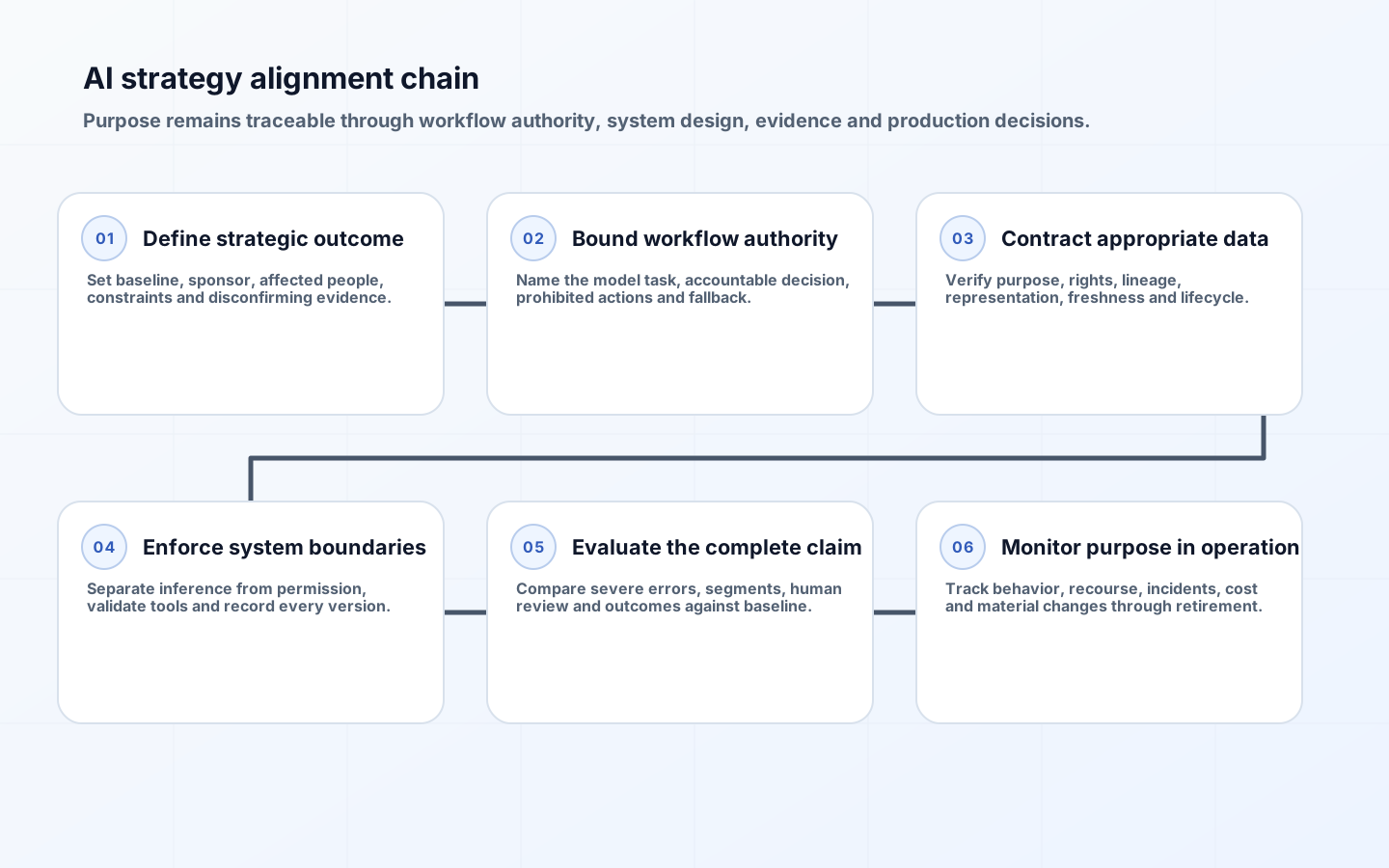
GAO's artificial intelligence accountability resources organize accountability around governance, data, performance and monitoring. Use independent challenge for high-consequence claims and document unmeasured risks. Define thresholds before seeing results. Progress through offline, shadow, assisted and bounded production stages. Every gate needs an approver, residual-risk record and a concrete action when evidence fails.
6. Make governance executable
Maintain an inventory with purpose, owner, model and provider, data, authority, risk tier, evaluation, approval, incidents and retirement. Route low-risk assistive uses through a lighter process while reserving multidisciplinary review for consequential systems. Governance must have service times and decision rights; an undefined committee that meets after delivery becomes delay, while uncontrolled self-assessment becomes unmanaged risk.
Set procurement requirements for data use, model changes, evaluation access, security, incident notice, continuity, export and deletion. Define material change for models, prompts, retrieval, policy and context. Time-limit exceptions and track remediation. Give affected users an explanation and recourse proportionate to impact. Document who accepts residual risk and why, rather than converting every ethical question into a technical metric.
| Release gate | Alignment evidence | Decision owner |
|---|---|---|
| Concept | Outcome, authority, affected groups and prohibited use | Sponsor and workflow owner |
| Build | Data contract, architecture controls and threat model | Data, engineering and security owners |
| Pilot | Segmented evaluation, human factors and fallback | Product and risk authority |
| Scale | Outcome trend, incidents, unit cost and operating capacity | Service owner and sponsor |
7. Monitor alignment in production
Monitor input and output shifts, task quality samples, severe errors, source freshness, overrides, appeals, incidents, latency, cost and downstream outcome. Align alert thresholds to action. Preserve privacy and avoid excessive worker surveillance. Review whether users adapt around the system or whether automation moves effort to another team. A stable model metric can hide a worsening business result or inequitable burden.
For generative systems, use the NIST Generative AI Profile to consider amplified risks and relevant actions. Exercise provider outage, rollback and recovery. Re-evaluate after material change or incident. Retire the system when its purpose ends, removing tools, indexes, credentials and retained data while preserving required decision records.
Align incentives and portfolio funding too. A team rewarded only for launching use cases will underinvest in evaluation, recourse and retirement. Fund shared evaluation infrastructure, data stewardship and incident capability while making each initiative own workflow integration and ongoing review. Report stopped and narrowed uses as governance outcomes, not failures, when evidence shows weak value or excessive risk. This makes escalation intellectually honest and protects teams from defending sunk cost.
Review interactions among AI systems. A generated summary may feed a ranking model, a decision tool or another agent, amplifying uncertainty and obscuring provenance. Register downstream consumers, validate interfaces and prevent outputs from acquiring authority merely because another automated system accepted them. Test compound failure and maintain one accountable owner for the final business action. Portfolio alignment is lost when every component passes alone but the chain produces an unreviewed consequence.
For external communications, describe capability and limitations in language users can act on. Avoid claims that exceed evaluation context, and update notices after material change. Give operators a known channel to report unexpected behavior and protect those reports from performance pressure. Qualitative incidents, appeals and near misses can reveal strategic misalignment earlier than aggregate model metrics, especially for rare but serious outcomes.
Keep an explicit link between each production metric and its decision. When nobody can say what threshold changes release, staffing, model choice or workflow authority, the metric is observational clutter. Retire such measures or redesign the governance action. A smaller set of decision-bearing indicators makes drift and strategic misalignment visible sooner.
AI alignment takeaways
- Trace every initiative from a measurable outcome to an owned workflow.
- Bound model authority and enforce policy outside probabilistic output.
- Use data appropriate to purpose, with lineage and affected-group analysis.
- Evaluate severe errors, segments, human review and downstream results.
- Monitor purpose, behavior, incidents and operating economics through retirement.
Frequently asked questions
Is AI alignment the same as model safety research? Here it means enterprise traceability and control across objectives, workflow, system and operation; it can incorporate model-safety work but is broader. Who owns alignment? Several roles contribute, but the workflow owner and sponsor remain accountable for purpose and use. Can a vendor's responsible AI statement replace assessment? No. Evaluate the configured use and local data.
How often should alignment be reviewed? At material change, incident and a risk-based cadence, plus when strategy or policy shifts. Must every use have the same governance? No. Tier by consequence and authority. What is the strongest alignment evidence? A traceable chain from outcome and affected people through enforced architecture, representative evaluation, accountable approval and monitored real-world results.
Conclusion
Aligned AI is not produced by a principle list alone. It emerges when teams make purpose, data, authority, evaluation and response concrete in the working service. Start with one consequential claim, trace it through the complete workflow and refuse release until evidence and ownership meet. That discipline supports innovation because teams know what they may change, what they must protect and when they should stop.