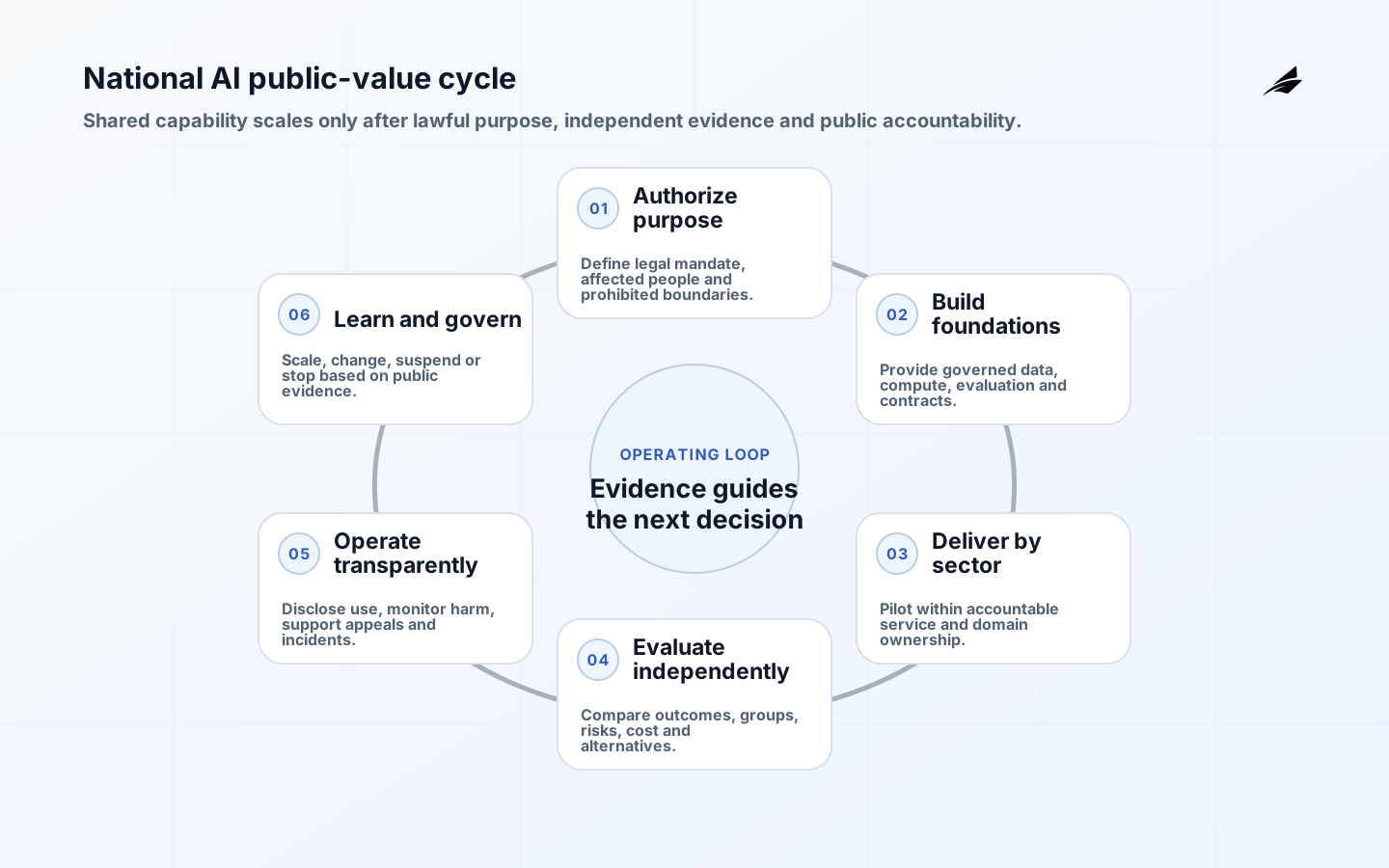
National AI services are shared capabilities, institutions and delivery programs that help public bodies use AI for legitimate public purposes. They may include secure compute, data access, model evaluation, procurement frameworks, reusable components, specialist support and transparency mechanisms. They should not become a centralized mandate to automate every public decision. National law, constitutional duties, human rights and sector rules define the boundary. This guide is a delivery framework, not a substitute for democratic policy or legal analysis.
Use it with the national AI implementation checklist, the national AI services FAQ and the AI services delivery plan. NIST notes that AI RMF 1.0 is being revised, so programs should track changes rather than freezing a 2023 framework into permanent procurement language.
Define public purpose and prohibited boundaries
Start with national problems and service outcomes, not a model portfolio. Identify affected communities, legal authority, existing service failures, non-AI alternatives and distribution of benefit and harm. Create explicit exclusions for uses incompatible with rights, due process or institutional mandate. Require heightened authorization for law enforcement, welfare, immigration, health, employment, education and other consequential domains. UNESCO's recommendation centers human dignity, rights, oversight, impact assessment and redress.
Maintain a public use-case register with purpose, agency, owner, legal basis, affected population, system role, provider, data categories, impact tier, evaluation, deployment state and contact route. Some security details may be protected, but secrecy should be justified narrowly. Give an independent body authority to inspect high-impact systems and investigate harm. Public consultation must occur before irreversible procurement and should include people with practical access barriers, not only technical experts.
| Layer | National responsibility | Local or sector responsibility |
|---|---|---|
| Policy | Rights, baseline rules and prohibited uses | Apply sector law and service mandate |
| Foundation | Shared identity, compute, evaluation and contracts | Select and configure approved capability |
| Data | Interoperability and stewardship standards | Lawful collection, quality and context |
| Delivery | Methods, skills and assurance support | Own workflow and accountable decision |
| Oversight | Audit powers, transparency and redress baseline | Monitor outcomes and remedy cases |
Build shared foundations without centralizing every decision
Shared infrastructure can reduce duplication: secure sandboxes, approved model gateways, identity, logging, evaluation harnesses, red-team support, data-sharing patterns, procurement clauses and incident coordination. Design these as optional or mandated according to law and risk, with service levels, capacity, cost allocation and exit. Keep agency accountability for purpose and outcomes. A central platform team cannot know whether an eligibility workflow is lawful or clinically appropriate.
Invest in public data quality, documentation, interoperability and controlled access before large model programs. Define authoritative sources, permitted uses, provenance, retention, correction and community rights. Support privacy-preserving analysis where appropriate, but do not use technical measures to bypass purpose limitation. Create national compute policy around demand, energy, resilience, sovereignty, supplier concentration and access for research and smaller institutions. Capacity allocation needs transparent criteria and appeals.
Fund a portfolio and model whole-life cost
Use staged funding: discovery, controlled pilot, independent evaluation, limited service and scale. Each gate should have evidence and a stop decision. Cost includes data preparation, compute, model access, integration, service redesign, accessibility, security, evaluation, oversight, staff, public communication, appeals, incident response and exit. Variable inference can make a cheap pilot expensive nationally; model low, expected and high demand plus provider price and currency exposure.
Measure public value with service completion, timeliness, quality, accessibility, staff workload, error, appeal, distributional impact and total cost. Efficiency is not sufficient if a system shifts burden to citizens or creates harder appeals. Fund independent research and civil-society participation, not only deployment. Publish portfolio-level spend and outcomes using a consistent method. Stop weak use cases and reallocate capability; scale should be earned.
Require independent, context-specific evaluation
Apply a lifecycle such as NIST AI RMF's govern, map, measure and manage functions, tailored to national law. Evaluate data relevance, task performance, subgroup behavior, robustness, security, privacy, human factors, accessibility and operational failure. Compare with the current service and a non-AI alternative. Independent evaluators need access to evidence, competence and freedom from delivery incentives. A vendor benchmark or general model card cannot establish fitness for a public workflow.

Test in realistic conditions with representative users and adversarial scenarios. Define thresholds, uncertainty, required human review, fallback and suspension triggers before deployment. Monitor model, data and workflow changes. Re-evaluate after significant change or evidence of harm. For generative systems, examine fabrication, harmful content, prompt injection, data leakage, automation bias and source attribution. Preserve evaluation datasets under lawful governance and protect against test contamination.
| Gate | Question | Evidence |
|---|---|---|
| Purpose | Is AI lawful and better than alternatives? | Impact assessment and option comparison |
| Pilot | Does it work for representative groups? | Independent protocol and results |
| Limited service | Can staff, appeals and fallback operate? | Observed service and incident exercise |
| Scale | Are outcomes equitable and affordable? | Distributional and unit-cost review |
| Continuation | Does current evidence still justify use? | Periodic public review and decision |
Procure transparency, control and exit
Contracts should cover permitted use, data rights, model and service changes, documentation, evaluation access, logs, incident notification, vulnerabilities, subcontractors, location, accessibility, intellectual property, service levels, pricing, portability and termination. Preserve the public body's ability to explain decisions and respond to complaints. Prohibit provider use of sensitive public data for unrelated training without lawful explicit approval. Require notice and evaluation before material model changes.
Reduce concentration by using open interfaces, exportable records and tested replacement where material. Sovereignty is not achieved by a local contract if critical dependencies remain opaque and uncontrollable. Build internal capability to challenge suppliers and operate services. Publish reusable clauses and assessment evidence where lawful. Procurement speed must not bypass impact review; framework agreements should standardize foundations while preserving use-case scrutiny.
Operate transparency, incident response and redress
Tell people when AI materially shapes a service, what role it plays, what data is used, its limitations and how to reach a human or challenge an outcome. Communication must be accessible and available through non-digital routes where needed. Log system version, input provenance, recommendation, human action and outcome proportionately. Avoid retaining sensitive prompts or creating surveillance data without necessity.
Create national incident taxonomy and coordination for safety, rights, security and service failures. Agencies need authority to pause systems and activate manual continuity. Notify affected people and oversight bodies according to law. Investigate root causes across data, model, interface, policy, staffing and incentives. Remedies must address individual harm and systemic correction. Publish aggregated incidents and corrective actions where possible so public institutions can learn collectively.
A ten-step national service delivery procedure
Apply this sequence to each use case while national institutions build shared capability in parallel. High-impact services need deeper consultation, legal review and independent oversight than low-risk internal assistance. Every gate should produce a documented decision to stop, revise, limit or proceed; continued spending must not become the default simply because a pilot exists.
- Publish the public problem, baseline, legal mandate, affected groups, non-AI alternatives and proposed decision owner.
- Conduct rights, privacy, equality, accessibility, security, environmental and service impact assessment with meaningful public participation.
- Classify impact and confirm the use is not prohibited; define human authority, appeal, remedy and suspension triggers.
- Select shared data, compute, identity, model, evaluation and procurement foundations without transferring sector accountability.
- Estimate whole-life cost across data, compute, integration, workforce, evaluation, oversight, incidents, appeals and supplier exit.
- Procure documentation, evaluation access, change notice, logs, incident duties, pricing, portability and protection against unrelated data use.
- Run a controlled pilot against predefined thresholds and compare it with the current service and a non-AI option.
- Obtain independent technical and social evaluation, publish an accessible summary and resolve material subgroup or workflow harms.
- Release to a limited population with monitoring, human fallback, contestability, incident coordination and authority to pause.
- Review public value, distribution, cost and harm periodically, then scale, modify, suspend or retire through a transparent decision.
Key takeaways
- Anchor national AI services to lawful public purpose and explicit prohibited boundaries.
- Share infrastructure and assurance while keeping sector agencies accountable for outcomes.
- Fund in stages and include oversight, appeals, operations and exit in whole-life cost.
- Require independent evaluation against current service and non-AI alternatives.
- Make transparency, contestability, incident response and remedy part of service design.
Frequently asked questions
Should a country build one national model?
Not by default. Shared models may help selected languages or public tasks, but requirements differ. Compare adapting, buying and building against purpose, evidence, cost, sovereignty and exit.
Should all public AI be centralized?
Shared foundations and baseline governance can be central, while lawful purpose, domain evidence and accountable service decisions usually remain with the responsible sector institution.
How is national AI success measured?
Through public-service outcomes, rights, inclusion, error and appeal, resilience, workforce effects and whole-life cost. Model adoption or compute consumed is not public value.
Develop the national workforce as an institution, not a short course. Public leaders need enough AI, data, procurement and rights literacy to make accountable decisions; delivery teams need evaluation, security, service design and domain capability; oversight bodies need technical access and independent expertise. Create career paths and communities of practice across regions and sectors. Retain decision authority in public institutions even when scarce specialists or infrastructure are contracted.
Design for linguistic and regional inclusion. Evaluate performance, access and user experience across languages, scripts, connectivity levels, disabilities and local administrative contexts. National averages can hide severe failure for smaller groups. Fund data stewardship and evaluation with affected communities, document where coverage is weak and preserve non-AI service routes. Do not deploy a lower-quality system to a group merely because its data is scarce.
Conclusion
National AI services need more than strategy and infrastructure. They require lawful purpose, shared but bounded foundations, staged investment, independent evaluation, controllable procurement, transparent operation and effective redress. Scaling only what earns evidence allows a country to build capability without turning citizens into involuntary test subjects or agencies into passive model consumers.