Automation services and digital transformation are related but not interchangeable. Automation changes how a task executes; transformation changes the operating model, information flow, roles, controls and customer experience around it. Buying automation services without making those broader decisions often creates faster local steps and slower end-to-end work. This practical FAQ answers questions sponsors, operators and technology leaders should settle before scaling. It uses the NIST AI Risk Management Framework where AI is involved and the Secure Software Development Framework for dependable delivery. The core principle is to automate a measurable outcome, preserve an owned exception path and fund the service after launch.
This FAQ is for leaders evaluating operating-model choices across legacy and cloud systems. Teams seeking implementation support can review Edilec’s enterprise process automation service. The FAQ extends the automation scope and delivery plan and the automation implementation checklist. The central design rule is to preserve human authority where judgment, rights or material consequences require it, while making routine validation and routing consistent. When AI is introduced, NIST’s govern, map, measure and manage functions provide a lifecycle structure; ordinary rules-based automation still needs comparable ownership, testing and monitoring.
Which processes are good automation candidates?
Choose work with a clear trigger, repeatable inputs, observable completion and enough volume or consequence to justify change. Map variants rather than documenting only the happy path. Count rework, transfers, waiting, exceptions and manual reconciliation. A process that appears repetitive may conceal expert judgment or missing source data. Interview the people who perform and receive the work, inspect representative cases and separate policy-required steps from habits created by old system limitations. Improvement can include removing the step, changing policy or fixing data instead of automating it.
Prioritize with an evidence matrix: customer or employee outcome, baseline effort, error consequence, process stability, data readiness, integration feasibility and change ownership. High volume alone is weak justification. A low-volume regulatory control may merit automation because consistent evidence matters; a volatile high-volume process may be a poor first candidate. Define the smallest end-to-end outcome, such as validating and posting an approved supplier change, rather than automating an isolated screen interaction that leaves downstream reconciliation untouched.
How do teams choose between workflow, RPA, integration and AI?
Use direct APIs or events for stable system-to-system exchange, workflow engines for explicit state and human tasks, rules for deterministic policy and robotic process automation when a necessary interface lacks a supported integration. RPA is often tactical because user interfaces change and bots inherit screen timing, session and accessibility assumptions. Document that dependency and an exit path. AI is appropriate for bounded classification, extraction, summarization or recommendation where probabilistic output can be measured and safely reviewed; it should not silently replace authoritative policy or transaction logic.

Compose patterns instead of forcing one platform to do everything. A document service may extract fields, deterministic validation may compare them with master data, workflow may request missing evidence, and an API may post the approved transaction. Give every component a typed input, output, error contract and idempotency rule. Preserve the source document and the exact derived values used for a decision. This design makes uncertainty visible and allows a weak component to be replaced without rewriting the complete business process.
| Pattern | Use when | Primary risk |
|---|---|---|
| API or event | Systems expose stable contracts | Semantic mismatch or duplicate delivery |
| Workflow | State, deadlines and human tasks must be explicit | Hidden exception queues |
| RPA | A required legacy interface has no supported API | Fragile screen dependency |
| AI assistance | Probabilistic interpretation adds value | Unsupported or drifting output |
How should exceptions and human review work?
Model exceptions before the normal path. Identify missing inputs, conflicting records, duplicate requests, unavailable dependencies, policy ambiguity, suspected fraud, authorization failure and deadline breach. Each exception needs a queue, owner, priority, evidence and safe terminal state. A generic “manual review” queue becomes a hidden process with poor controls. Route by required expertise and consequence, expose why the item arrived, and prevent the automation from repeatedly retrying a nonrecoverable case or creating duplicate transactions.
Human review should change the decision, not merely decorate it. Present source evidence, automation output, confidence or validation failures, applicable policy and available actions. Require stronger review for high-impact cases and sample apparently successful low-risk cases to detect silent drift. Capture the reviewer’s decision and reason in structured form. Do not measure reviewers only on speed; this encourages superficial approval. Track disagreement, correction and escalation to improve rules, models, training and upstream data.
What security controls belong in automation?
Treat bots, orchestrators and integration services as privileged identities. Assign a unique workload identity, minimum permissions, managed secrets, network boundaries and an accountable owner. Do not embed personal credentials or allow one bot account to perform incompatible duties. Validate every external input, constrain file types and destinations, and protect command or prompt boundaries when AI handles untrusted content. Transaction limits, approved recipients and server-side policy should remain outside the model or bot script.
Log consequential state changes with request identity, source, policy or model version, authorization result and downstream confirmation. Avoid copying sensitive payloads into diagnostic tools by default. Apply secure development practices to workflow definitions and low-code assets: version control, peer review, dependency inventory, separated environments and reproducible promotion. Vendor-hosted automation adds data location, subcontractor, retention, incident notification and export questions. Procurement approval does not replace technical threat modeling of the implemented flow.
How should automation be tested and released?
Build a scenario set from production evidence: common cases, rare high-consequence cases, malformed data, duplicates, partial failures, time boundaries, retries and concurrent updates. Test business invariants, not only whether a bot completes steps. For example, one approved invoice must create at most one payable entry, and a failed response must not imply that posting failed. Use synthetic or governed test data and verify access separation. Performance tests should include downstream rate limits and queue recovery after an outage.
Release to a controlled cohort with feature flags, volume caps and explicit stop conditions. Run in observation or recommendation mode where feasible, comparing intended actions before granting execution authority. Rehearse rollback, but account for irreversible external transactions; compensation and reconciliation may be safer than attempting to erase history. Support teams need dashboards, replay tools, business escalation and authority to pause the flow. A launch is incomplete until operations can diagnose both technical failure and incorrect business outcomes.
| Release evidence | Question answered | Example stop condition |
|---|---|---|
| Scenario tests | Does the process preserve business invariants? | Duplicate posting |
| Access tests | Can the identity exceed its narrow purpose? | Cross-tenant access |
| Cohort monitoring | Are outcomes correct under real variation? | Correction exceeds threshold |
| Reconciliation | Did downstream state match intent? | Unresolved transaction gap |
How is automation value measured honestly?
Set a baseline for end-to-end elapsed time, active labor, completion quality, rework, abandonment, control evidence and customer outcome. Measure the same population after release. Do not convert every saved minute into cash unless capacity actually changes or is redeployed. Include license, platform, integration, review, exception, monitoring, change and support costs. An automation may be worthwhile because it reduces risk or improves service consistency even when headcount remains constant; state that value directly rather than inventing labor savings.
Segment results by case type and channel. Averages can hide that easy cases improved while complex customers wait longer. Track straight-through completion only alongside correctness and confirmed downstream outcome. Benefits should have a business owner who can verify realization, while technical owners report availability and cost. Review whether demand grows after service improves and adjust the baseline transparently. Stop or redesign flows whose exception burden, vendor cost or control weakness exceeds their benefit.
Who owns automation after the project?
Assign a business process owner, technical service owner, data owners and control owners. The process owner decides policy and acceptable outcomes; the technical owner maintains execution and reliability; data owners govern meaning and quality; control owners verify obligations. A central automation team can provide platforms, reusable components and standards, but domain teams must remain able to explain and operate their workflows. Define on-call paths, maintenance windows and funding before implementation closes.
Keep an inventory of automations, identities, dependencies, data handled, business criticality, versions and review dates. Link incidents and changes to that inventory. Monitor process signals such as queue age, exception mix and reconciliation alongside infrastructure signals. Revalidate when policies, forms, source systems, models or user populations change. Retirement matters: revoke identities, remove schedules, archive evidence and confirm that no downstream process still relies on the flow.
How should leaders govern an automation portfolio?
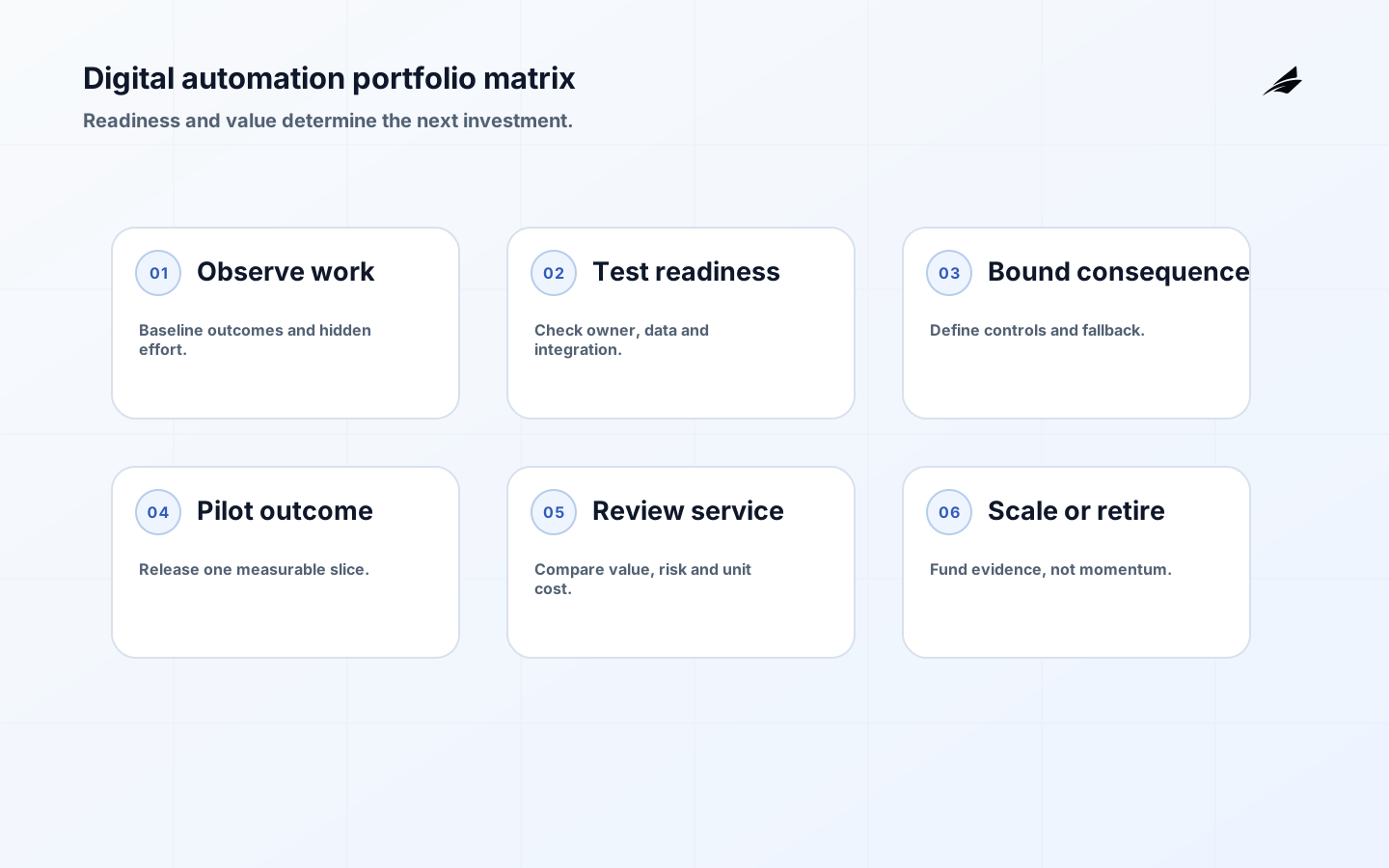
Use one portfolio view that compares value, readiness, consequence and operating burden. Value should describe a customer or employee outcome, not hours theoretically eliminated. Readiness covers process stability, data authority, integration access and owner capacity. Consequence asks what a wrong, late or unavailable result could do. Operating burden includes review queues, provider cost, support, control testing and change management. The scope and delivery plan frames investment, the digital automation checklist turns it into release evidence, and the AI workflow checklist handles model-influenced paths.
A portfolio council should stop, reshape and retire work as readily as it approves pilots. Review completed outcomes, exception age, corrections, adoption, control incidents and lifecycle cost. A high-volume invoice classifier may deserve investment when it improves routing and preserves reviewer capacity; an executive-summary generator may remain a convenience if it changes no decision. Use NIST’s AI RMF Core to assign governance, context mapping, measurement and risk treatment. Keep funding in small evidence-backed increments so weak assumptions remain inexpensive to reverse.
| Portfolio quadrant | Typical evidence | Decision |
|---|---|---|
| High value, high readiness | Owned process, clean source, measurable baseline | Pilot a vertical slice |
| High value, low readiness | Large pain, weak records or unclear authority | Repair process and data first |
| Low value, high readiness | Easy demo, marginal outcome | Limit or decline |
| Low value, low readiness | No owner, no baseline, material uncertainty | Stop |
| Live but deteriorating | Rising exceptions, cost or control failures | Pause, redesign or retire |
Key takeaways
- Simplify and stabilize the process before automating it.
- Use deterministic rules for authority and AI only where measurable uncertainty is acceptable.
- Design exceptions, reconciliation and pause authority before launch.
- Measure complete outcomes and full operating cost.
- Keep business, technical, data and control ownership active throughout the lifecycle.
Frequently asked questions
Is robotic process automation obsolete?
No. It remains useful when a necessary legacy system lacks a supported interface and replacement is not immediate. Treat the screen dependency as explicit technical debt, monitor breakage, constrain credentials and plan migration to a stable contract when feasible.
Can generative AI approve transactions?
It can help summarize evidence or recommend a route, but material approval should be enforced by authoritative policy and an accountable person or deterministic service. Never let generated text define permission, value limits or the target of an irreversible action.
What is a sensible first automation?
Choose a bounded, measurable process with reliable inputs, representative volume, a willing owner and reversible actions. Include at least one real integration and exception path so the pilot proves the operating model rather than only a demonstration.
Conclusion
Digital transformation becomes credible when automation investments are governed as operating services, not counted as demonstrations. Select work from outcomes, expose assumptions, design exceptions and measure the whole journey. Leaders should expect some ideas to be simplified or stopped; that is evidence of portfolio discipline. The durable result is the organization’s ability to change work safely, learn from real use and retire services that no longer justify cost or risk.
A sound investment decision compares automation with process removal, policy change, direct integration and product redesign. Select the least complex pattern that meets the outcome, test it against real variation and fund continuing ownership. That discipline produces faster, safer work without turning yesterday’s manual workaround into tomorrow’s invisible machine dependency.