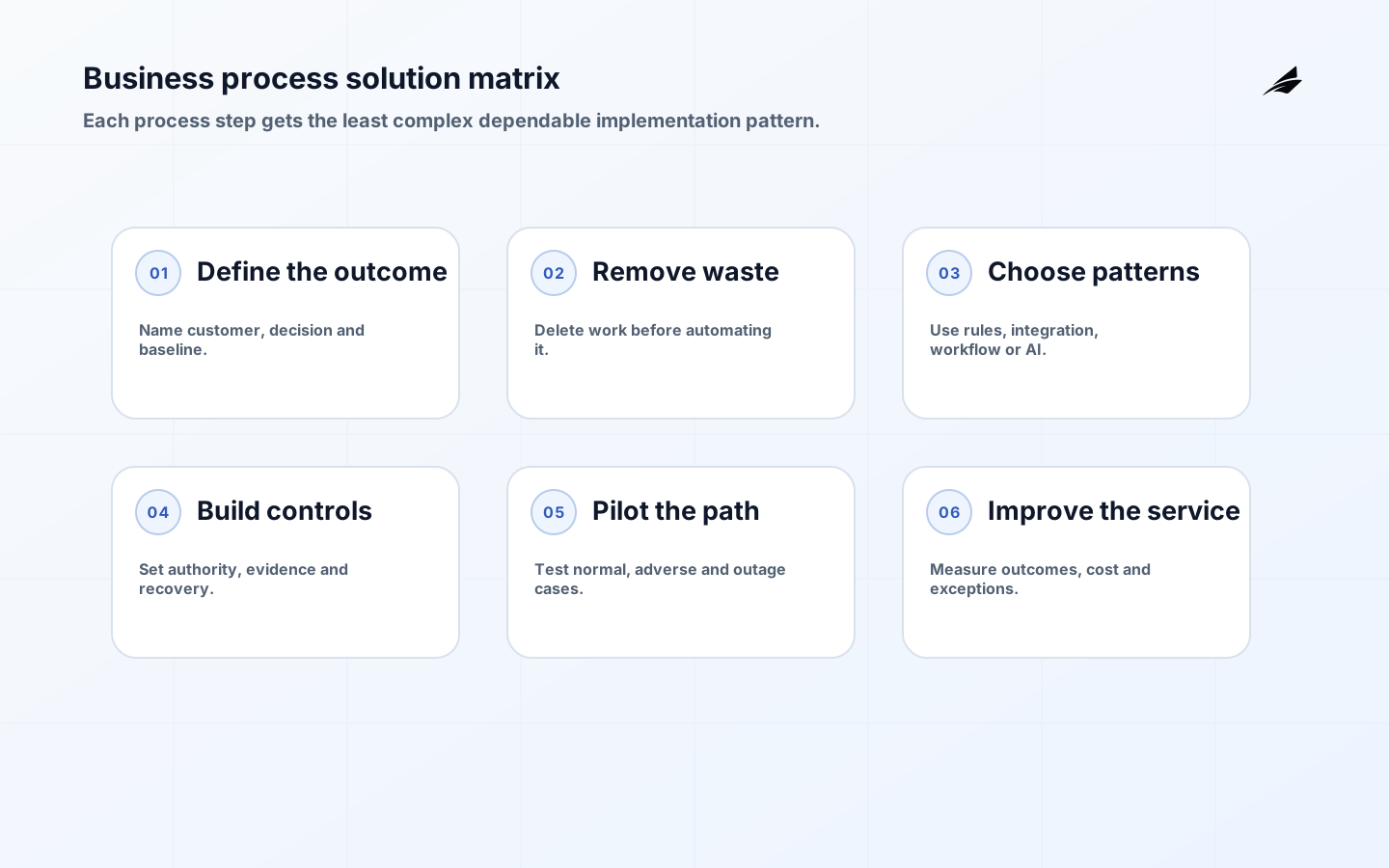
Business process solutions improve how work reaches an outcome across people, policy, data and systems. They may use redesign, forms, case management, integration, rules, robotic automation or AI. The delivery mistake is choosing the technology before understanding the decision and exceptions. A useful solution makes ordinary work simpler while preserving authority, evidence and recovery when conditions are not ordinary.
Connect this plan to Edilec's AI automation ROI framework, workflow escalation rules and human-in-the-loop automation mistakes. Together they cover value, exception authority and operating design.
Key takeaways
- Measure one customer or operational outcome before selecting technology.
- Remove unnecessary work and clarify policy before automating steps.
- Use deterministic rules for authority and AI where uncertainty has managed value.
- Design exceptions, evidence, security and recovery into the main workflow.
- Pilot end to end and scale only when local outcomes survive full cost and risk.
Baseline the process as it actually runs
Choose a process boundary from a recognizable trigger to an outcome: request received to access granted, invoice received to approved payment, or complaint opened to remedy accepted. Observe real cases. Record touch time, waiting, handoffs, rework, failure demand, queue age, outcome quality and customer effort. Separate the common path from variants instead of averaging them into one imaginary flow.
Map actors, decisions, records, systems, controls and evidence. Use a consistent notation only as far as it improves shared understanding. The OMG BPMN specification provides a formal standard for business process modeling, but a diagram still needs plain-language definitions and validation with people who perform the work. Record policy ambiguities exposed during mapping.
| Baseline element | Measure | Evidence | Design implication |
|---|---|---|---|
| Outcome | Correct completion and customer effort | Case sample and feedback | Protect what users value |
| Flow | Wait, touch and handoff time | Timestamped history | Target delays, not busy steps |
| Exceptions | Rate, cause and age | Queue and case review | Design explicit routes |
| Controls | Defect detected or prevented | Audit and incident history | Keep effective evidence |
| Cost | Labor, platform and failure demand | Volume-based model | Compare total service patterns |
Remove work before automating it
Challenge each step: is it legally or operationally required, does it prevent a known failure, and who uses its output? Remove duplicate entry, obsolete approvals and status reports that compensate for poor visibility. Simplify forms and policies. Combine checks when one trusted data source can support several decisions. Automation multiplies the effects of unnecessary and ambiguous steps.
Bound the first release by population, channel, transaction type and consequence. Define exclusions and manual fallback. Name the process owner and decision owners. Set target measures and balancing measures such as error, complaint, staff workload or access inequity. A narrow complete path yields better evidence than automating fragments across the enterprise.
Choose the least complex dependable pattern
Use direct integration when systems need reliable exchange, workflow or case management when people coordinate stateful work, rules when eligibility is explicit, and robotic automation when a stable interface lacks a suitable API. Use AI for classification, extraction, retrieval, drafting or prediction when uncertainty is acceptable and measurable. Often the best design combines several patterns with clear boundaries.

Keep authority deterministic. AI may propose a category or draft a response, while policy code checks eligibility and a named role approves an exception. The NIST AI RMF helps govern, map, measure and manage AI risk. Use it when AI is present, but do not label every workflow an AI system or impose model controls on ordinary deterministic steps.
| Pattern | Best fit | Main strength | Watch for |
|---|---|---|---|
| Process redesign | Unnecessary or unclear work | Removes cost and delay | Automating before simplification |
| Integration | Structured system exchange | Reliable data movement | Unowned semantics |
| Workflow or case | Human coordination and state | Visible ownership | Rigid treatment of exceptions |
| Rules | Explicit repeatable decisions | Testability | Policy sprawl |
| RPA | Stable legacy interface | Fast bridge | Fragile UI coupling |
| AI | Unstructured or uncertain tasks | Flexible assistance | Unsupported confidence and excess authority |
Design controls and evidence into the flow
Define identity, role, separation of duties, approval thresholds, value limits and audit events at each consequential step. Validate inputs and reference data. Preserve who or what made a decision, under which policy and version, using which evidence. A person clicking approve is not meaningful oversight if the interface hides uncertainty or makes rejection impractical.
Threat-model integrations, workflow administrators, bots, models and support tools. Apply least privilege and protect secrets. The NIST Cybersecurity Framework connects governance, protection, detection, response and recovery. CISA's Secure by Design program reinforces ownership of customer security outcomes; process platforms should not push unsafe defaults and excessive configuration burden onto operators.
Make exceptions a first-class product path
Classify exceptions by missing information, policy ambiguity, technical failure, suspected abuse and required discretion. Route each to a qualified owner with context, reason, priority and target. Give staff ways to request information, correct data, override within authority, escalate and return work to the automated path. Avoid generic exception queues that become hidden manual departments.
Measure exception rate, age, repeat cause, override and downstream outcome. High exception volume may signal poor scope, changing demand, weak source data or an overly rigid rule. Use exception evidence to improve policy and design. Do not merely train a model on historical overrides; those decisions may contain inconsistency or bias.
Build, test and release the complete service
Version process definitions, rules, forms, integrations, prompts and models. Use the NIST Secure Software Development Framework for software and automation components. Test normal paths, boundaries, duplicate submissions, concurrency, unauthorized actions, unavailable dependencies, delayed events, incorrect reference data, accessibility and recovery.
Pilot with a controlled population and compare to baseline. Observe users rather than relying only on dashboards. Check whether work shifted to another queue, whether customers can understand status and whether staff can recover without engineering. Release gradually with feature controls, queue limits, rollback and a manual continuity path for critical cases.
Price the full service and expected value
Estimate design, integration, migration, licenses, infrastructure, model use, security, testing, training, support, review, exception handling and retirement. Include parallel run and source-system remediation. Model cost per completed outcome at expected and stressed volumes. A low per-task model price can be irrelevant when human review or failed integrations dominate.
Quantify benefit through released capacity, shorter cycle time, fewer errors, reduced loss or better customer outcome. Discount theoretical hours that cannot be reassigned. Use ranges and show assumptions. Set stop or redesign thresholds before the pilot: for example, excessive exception cost, no sustained cycle-time improvement or a balancing measure that worsens beyond tolerance.
Operate and improve the process portfolio
Monitor outcome completion, cycle and wait time, failure demand, exception age, control failures, manual intervention, security events, accessibility issues and cost. Segment by customer group and path. Alert on conditions that require action. Keep runbooks for provider outage, queue backlog, bad release, data correction and suspected compromise.
Maintain an inventory with owner, purpose, dependencies, controls, versions and review dates. Review policy and automation together after incidents or demand changes. Retire duplicate bots, obsolete rules and shadow workflows. Scale reusable capabilities such as identity, approvals and audit evidence, while allowing domain owners to keep process-specific meaning.
Worked example: employee access requests
A company targets access requests that wait days for approval and often contain the wrong application role. Observation shows duplicated manager approval, unclear role descriptions and manual account creation. The redesign creates a role catalog with owners, removes one redundant approval for low-risk access and keeps security review for privileged roles. The first release covers employees and five applications.
Workflow manages request state and reminders; deterministic rules check employment status, manager relationship, role prerequisites and separation of duties; integrations provision supported applications; a bot remains temporarily for one stable legacy interface. AI suggests a role from the employee's description but cannot approve or provision. The requester sees the suggested role, evidence and owner before submitting.
The pilot tests duplicate requests, manager absence, job change, terminated employee, conflicting role and downstream outage. It measures time to usable access, inappropriate grants, requester effort, exception age and revocation. The program scales only after reconciliation proves provisioned permissions match approved requests and the operations team can pause integrations, process urgent cases manually and repair partial completion.
A release decision record captures roles in scope, policy and catalog versions, approval boundaries, integration permissions, bot dependencies, AI evaluation, reconciliation evidence and manual continuity. Security accepts the access controls; application owners accept role mappings; operations accepts queue and outage procedures. The product owner accepts the measured outcome and residual exclusions, creating one accountable basis for expansion.
Business process solution checklist
- Trigger, outcome, users, baseline and exclusions are agreed.
- Unnecessary steps and ambiguous policy are addressed before build.
- Each task uses a justified pattern with explicit authority boundaries.
- Exceptions, audit evidence, security and recovery are designed.
- Pilot tests end-to-end outcomes and balancing measures.
- Full cost, ownership, change control and retirement are funded.
Frequently asked questions
Do we need a BPM platform?
Not always. Choose tools after defining state, coordination, integration, audit and change needs. Existing platforms may be enough for a bounded process; complex casework may justify specialized capabilities.
When is RPA appropriate?
As a controlled bridge for stable, rules-based interaction where no suitable interface exists. Monitor UI changes, credentials and exceptions, and keep an exit plan.
When should a pilot scale?
After the complete path improves the target outcome, balancing measures remain acceptable, exceptions are operable, cost assumptions hold and owners can support change and incidents.
Conclusion
Business process solutions succeed through disciplined choices, not maximum automation. Measure the real workflow, remove waste, match patterns to tasks, preserve authority and learn from exceptions. Deliver one complete, controlled service and scale the evidence that it improves outcomes at a sustainable cost. Revisit the pattern when policy, volume, user needs or system capability changes; the best original design is not permanent permission to stop learning.