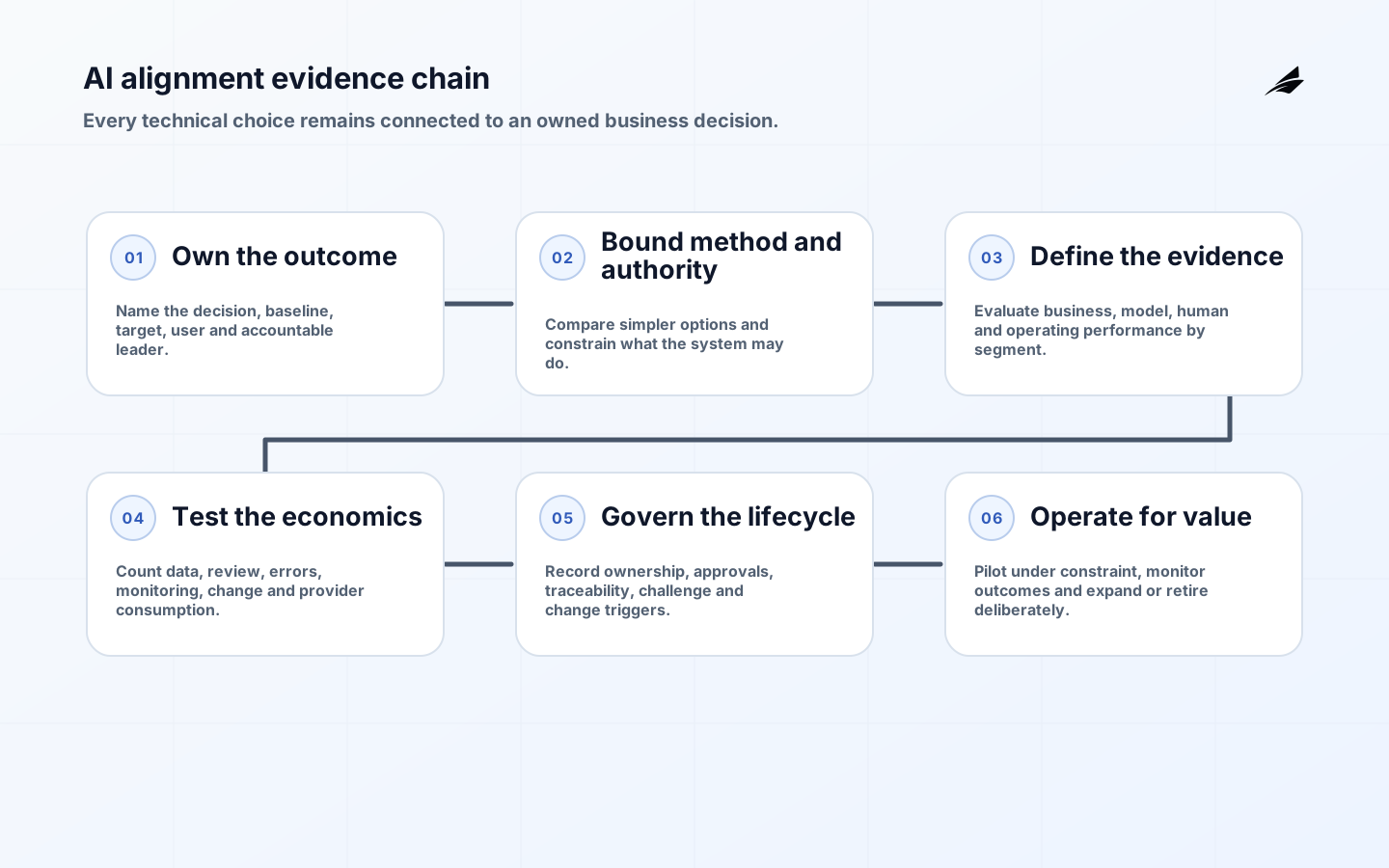
To align AI solutions with business goals, begin with the decision or workflow that must improve and work backward to data, method and controls. A model is not a business outcome. The organization needs evidence that users can act on its output, that errors remain within an acceptable boundary and that benefits exceed build, operation and change costs. Alignment is therefore a continuing management discipline, not a strategy workshop completed before development.
This plan complements Edilec's AI alignment implementation checklist, AI alignment FAQ and AI services delivery guide. Use it to define a bounded investment, compare non-AI alternatives and establish the evidence gates for production.
Translate strategy into an owned decision outcome
Write one outcome statement naming the user, current decision, proposed change, baseline, target and accountable owner. For example, improve the percentage of correctly routed service requests while keeping inappropriate priority changes below a defined threshold. Separate the model output from the business action. A classifier may propose a route; application policy determines whether it may update a queue automatically or needs human confirmation.
Map affected people and failure consequences before estimating value. Consider safety, privacy, employment, access to services, financial exposure, reputation and workload transferred to reviewers. The NIST AI Risk Management Framework organizes risk work around Govern, Map, Measure and Manage. Use that sequence to connect executive intent, deployment context, evaluation and continuing operation rather than treating governance as a final approval.
| Alignment test | Required evidence | Stop signal |
|---|---|---|
| Decision value | Baseline, target and named outcome owner | No workflow action changes |
| AI necessity | Comparison with rules, search or process redesign | Simpler option meets the target |
| Risk fit | Affected groups, error cost and authority limit | High-impact action lacks challenge or review |
| Operational fit | Data, integration, support and feedback path | Outcome cannot be observed after launch |
Scope data, method and authority together
Inventory data used for training, retrieval, evaluation and live inference. Record owner, rights, collection context, quality, population coverage, refresh, retention and sensitive attributes. Trace transformations and preserve versioned evaluation sets. Historical data may encode a prior policy rather than an objective truth. When labels are delayed or disputed, define how outcomes will be adjudicated and how uncertainty affects the pilot schedule.
Compare approaches from least to most complex: process change, deterministic rules, conventional analytics, predictive models and generative systems. Select according to the task and acceptable error, not market attention. Define authority separately: draft, recommend, prioritize, decide or execute. The same model can present very different risk when its output moves from an analyst's screen to an irreversible external action. Enforce authority in application controls, not prompt wording alone.
Define evidence before building the solution
Create an evaluation plan that spans business, model, human and operational performance. Choose metrics related to the decision: calibration, recall, review burden, cycle time, avoided loss, customer resolution and cost per completed case. Evaluate important segments and rare costly events. Report sample size and uncertainty. A single aggregate accuracy can conceal a system that performs poorly for a critical product, language, location or user group.
Generative systems require task-specific tests for groundedness, unsupported claims, harmful content, information leakage, prompt attacks, refusal and tool execution. The NIST Generative AI Profile identifies risks such as confabulation, information integrity, data privacy and cybersecurity. Build representative and adversarial cases from approved material, retain failed examples, and define human adjudication for outputs that cannot be scored reliably by automation.
Model total AI cost and value
Estimate discovery, data preparation, integration, model or API use, evaluation, security, change management, support, monitoring and periodic revalidation. Include human review, exception handling and correction of downstream errors. Consumption costs vary with input size, output length, retrieval, retries, traffic and provider pricing. Build low, expected and stress scenarios. A prototype unit price cannot support an investment decision if production needs audit retention, redundancy and twenty-four-hour support.
Value should reflect incremental improvement over the current process and the best simpler alternative. Separate capacity released from cash saved: reducing handling time creates financial benefit only if the organization can redeploy or avoid capacity. Include quality, risk and revenue effects without double counting. Define the observation window and attribution method. Require a minimum evidence threshold for expansion and a retirement threshold when ongoing cost or risk exceeds realized value.
| Value layer | Example measure | Guardrail |
|---|---|---|
| Efficiency | Minutes per resolved case | Rework and reviewer load |
| Quality | Correct routing or completion rate | Performance by important segment |
| Experience | Resolution time and complaint rate | Clear escalation to a person |
| Financial | Incremental margin or avoided cost | Full operating and error cost |
| Risk | Reduced exposure or control coverage | New AI-specific incidents |
Create governance that follows the lifecycle
Maintain an AI system record linking purpose, owner, affected users, data, model or vendor, evaluation, approvals, deployment, incidents and review date. ISO/IEC 42001 specifies a management system for establishing, maintaining and continually improving responsible AI use. Apply change review when models, prompts, retrieval sources, thresholds, populations or authorized actions change materially. Time-limit approvals so evidence is revisited instead of inherited indefinitely.
Separate development, validation and release authority according to impact. The OECD accountability principle emphasizes traceability and systematic risk management across the lifecycle. Make human review credible with context, time, competence and authority to disagree. Record overrides as learning signals. Provide notice and challenge routes where appropriate, and define who can suspend the system after harmful patterns, control bypass or uncertain data provenance.
Deliver through a bounded production pilot
A valid pilot uses production-like data, identities, integrations, latency, support and monitoring while limiting users, volume or authority. Shadow mode can compare outputs without influencing decisions; recommendation mode keeps action with a user; constrained automation can cap value or case type. Define entry, success, stop and rollback criteria before exposure. Train users on purpose, limitations and escalation, then observe over-reliance, under-use and workarounds.

Instrument the complete decision chain: source quality, model input, output, policy, user action and eventual outcome. Monitor latency, availability, consumption, safety events, complaints, overrides, segment performance and business value. NIST's AI Resource Center provides operational resources for testing, evaluation, verification and validation. Assign an action to every alert and schedule review according to impact and rate of change.
Example: align AI-assisted invoice review
A finance team may propose AI to extract invoice fields and flag possible mismatches. The outcome is not extraction accuracy alone; it is faster correct posting without increasing duplicate payment, tax or supplier risk. Scope the first release to approved invoice formats and recommendation-only authority. Compare it with improved templates and deterministic validation. Map the source document, purchase order, receipt and supplier master needed for a reviewer to decide.
Build an evaluation set spanning suppliers, languages, image quality, credits, taxes and known exceptions. Measure field correctness, mismatch recall, reviewer time, correction and eventual posting quality by segment. Red-team altered bank details and prompt-like text inside documents. The application should prevent a model from changing supplier payment data, require independent approval for material differences and preserve source, output, rule, reviewer and final action.
Pilot in shadow mode, then present recommendations to a trained group. Recalculate value using observed eligibility, review effort, provider consumption and exception cost. Expansion requires stable outcomes, acceptable segment performance and a supported queue for uncertain cases. If standardized supplier submission removes more effort at lower risk, adjust the roadmap. Alignment means funding the best way to improve the business decision, not defending AI after it was selected.
Align vendor procurement and internal ownership
Ask vendors for architecture, data-use terms, evaluation evidence, model and service change notices, security controls, incident duties, logs, retention, regional processing, pricing drivers and exit support. Contractual performance commitments should map to the business workflow, not only API availability. Preserve the ability to export prompts, evaluation cases, configuration, audit evidence and operational data. A provider change can alter quality without changing your application release.
Keep product, risk and operating accountability inside the organization. A supplier can operate components or provide assurance, but it should not make the client's risk-acceptance decision. Pair domain, data, engineering, security, legal and operations roles around one owner. Fund evaluation and monitoring as product work. When an AI initiative has no long-term operating budget or outcome owner, it is not aligned enough to enter production.
AI alignment takeaways
- Define the decision, baseline, target and owner before selecting a model.
- Compare AI with process, rule and analytics alternatives.
- Evaluate business, model, human and operating performance together.
- Count review, errors, monitoring and change in total cost.
- Constrain authority in application policy and maintain a challenge path.
- Expand only when production evidence supports value and risk claims.
Frequently asked questions
Why do AI proofs of concept fail to scale?
Many prove model capability without proving data rights, workflow integration, user behavior, support, controls or economics. A production-shaped pilot should test those conditions. If the outcome owner cannot observe value or the organization cannot respond to failures, improving the model alone will not close the gap.
How often should an AI solution be reviewed?
Set frequency by impact, change rate and feedback delay. Review after material model, data, prompt, policy, population or vendor changes and on a fixed schedule. High-impact uses need more frequent monitoring and stronger release evidence. Include a decision to continue, constrain, improve or retire.
Conclusion
Aligning AI solutions with business goals requires a traceable chain from an owned decision to production outcomes. Scope authority with the method, define evidence and total cost before build, govern change and keep monitoring tied to action. That approach lets teams invest in AI where it creates measurable advantage and stop where a simpler, safer option is better.