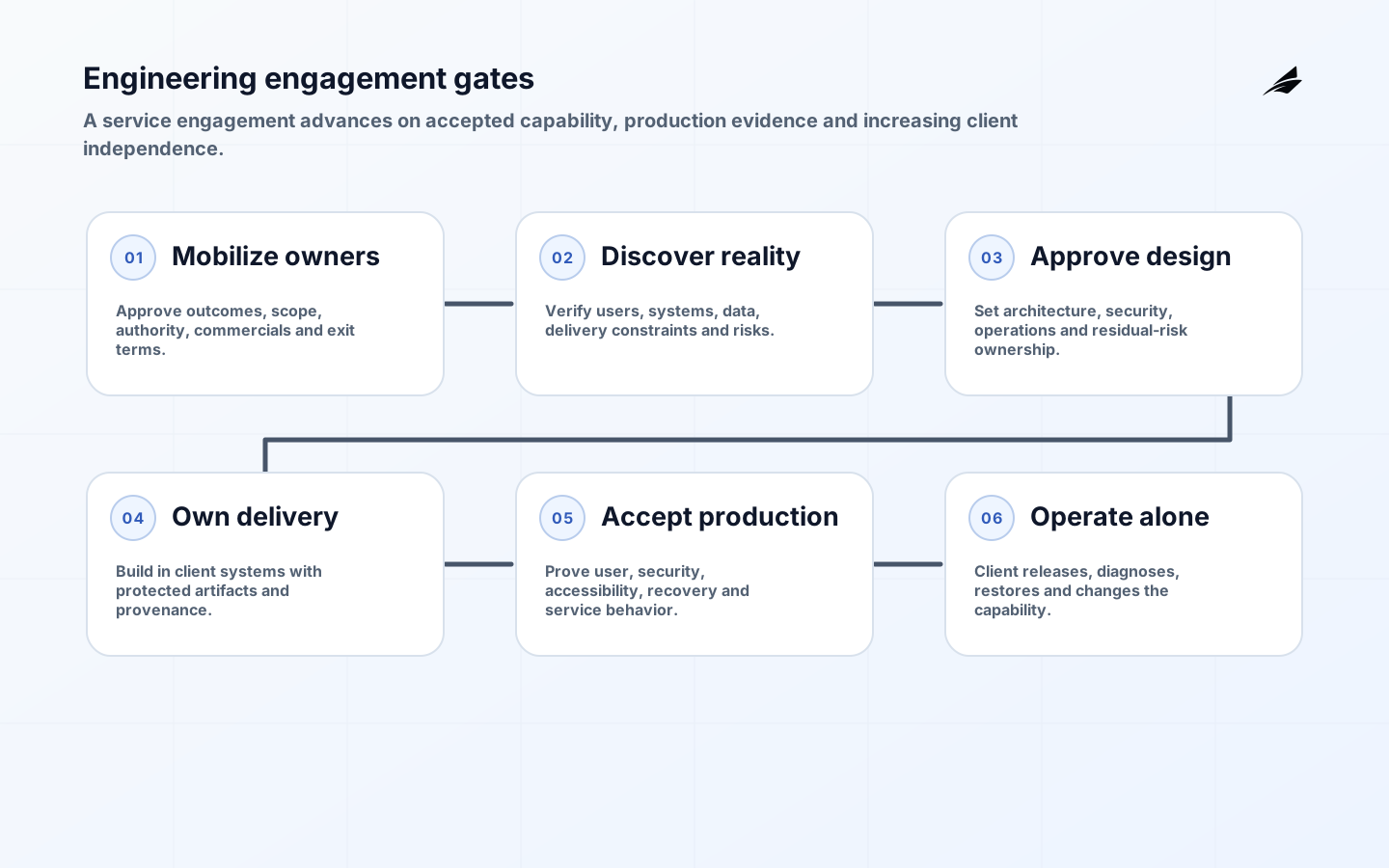
A software engineering services implementation checklist should make a client more capable of changing and operating its software, not only produce code. The engagement must connect an accountable business outcome to a production system, evidence, support and retained ownership. Before work begins, settle decision rights, access, delivery controls, intellectual property, security, service expectations and transition. Ambiguity in these areas becomes delay or dependency precisely when the first release is under pressure.
Use this checklist with the software engineering services scope guide, the services FAQ and the digital engineering checklist. Tailor depth to product risk, but require the same basic chain: outcome, authority, design, artifact, verification, release, operation and learning.
1. Mobilize around outcomes and decision rights
Write an engagement charter that names target users, baseline, desired behavior, quality guardrails, first production slice and accountable sponsor. Define what is excluded and which assumption could stop the work. Map client and provider roles for product priority, architecture, data, security risk, production access, release, spending and incident command. Set decision response times and an escalation route. A responsibility matrix is useful only when named people accept the authority assigned.
- Approve outcome measures, scope boundary, budget envelope and stop conditions.
- Name product, technical, security, data and operational owners on both sides.
- Confirm working hours, locations, subcontractors, communication and records of decision.
- Define deliverables as usable capabilities and evidence rather than document counts.
- Agree intellectual-property, open-source, confidentiality, retention and exit terms.
2. Establish access and evidence-led discovery
Provision named, least-privilege identities through the client's approved process. Separate development, test and production access; time-bound privileged work; and test revocation before onboarding scales. Inventory repositories, pipelines, environments, data, interfaces, dependencies, operational dashboards, support cases and known risks. Observe users and current operations. Profile representative data under approved privacy controls. Do not export production data to provider tools by convenience.
Produce a current-state map with confidence and evidence: journeys, system context, ownership, quality constraints, delivery path, incidents and cost. Validate it with client operators, not only program leadership. Turn findings into prioritized hypotheses and risks. Distinguish remediation required for the first slice from attractive modernization. Discovery is complete enough when the team can state an end-to-end change, its dependencies, evidence and rollback.
| Mobilization evidence | Owner | Acceptance test | Red flag |
|---|---|---|---|
| Outcome charter | Client product sponsor | Baseline and guardrails can be measured | Feature list without user result |
| Access matrix | Client system owners | Joiner, elevation and revocation exercised | Shared accounts or provider-controlled identity |
| System map | Joint technical lead | Critical dependencies and records of authority verified | Diagram copied from an old proposal |
| Initial backlog | Product owner | Items connect to outcome, evidence and risk | Large solution committed before discovery |
3. Approve architecture and security controls
Document significant decisions with context, options and consequences. Define component and data ownership, identity, authorization, tenancy, API and event contracts, failure behavior, retention, observability and recovery. Review technology choices for client skill, support horizon, licensing, portability and total operating cost. Require a thin end-to-end proof for uncertain integrations or performance. The client architecture owner should be able to explain and change the design without provider mediation.
Integrate NIST SSDF practices into the lifecycle: prepare people and toolchains, protect source and builds, produce well-secured software and respond to vulnerabilities. Threat-model sensitive journeys and map verification requirements, using OWASP ASVS where it fits web application risk. Establish dependency approval, secrets management, environment hardening, logging and vulnerability service levels. Record accepted risk with owner and expiry; do not let a ticket closure become risk acceptance.
4. Build a client-owned delivery path
Use client-controlled repositories, artifact registries, cloud accounts and operational telemetry wherever feasible. Protect branches and production workflows with reviewed permissions and independent recovery. Automate build, tests, security checks, provenance and promotion. SLSA provides guidance for artifact integrity and build provenance; select a level appropriate to threats and acquisition needs. Version infrastructure, database and configuration changes with application work.
- Create a change in a client repository and link it to an approved need.
- Run repeatable build, unit, dependency, secret and static checks.
- Generate an immutable artifact and associated provenance or bill of materials.
- Promote the same artifact through production-like verification.
- Approve release through named client authority and a tested recovery decision.
- Observe user and system outcomes, then capture follow-up work.
Keep local development documented and reproducible. Define code review expectations, test ownership and quality thresholds; exceptions need rationale and expiry. Protect test data and generate synthetic cases for sensitive or rare scenarios. Make accessibility part of design and verification, using WCAG 2.2 criteria for web experiences and representative assistive-technology testing. A passing pipeline is necessary evidence, not proof of product fitness.
5. Verify quality through risk-based acceptance
Create a test strategy from critical journeys and failure consequences. Place deterministic tests close to components, verify contracts at boundaries and retain a focused set of end-to-end scenarios. Include data migration, authorization, concurrency, performance, accessibility, dependency failure, restore and rollback. Use production-shaped environments and data distributions without copying unnecessary personal information. Track defects by severity, escape stage and recurrence rather than raw count.

| Acceptance domain | Provider supplies | Client proves | Blocking condition |
|---|---|---|---|
| Product | Implemented journey and analytics | Representative users complete the task | Material task or accessibility failure |
| Security | Threat model, test results and dependency evidence | Risk authority accepts residual exposure | Uncontrolled critical path or secret |
| Operations | Telemetry, runbook and recovery automation | Client responds and restores in an exercise | No owned alert or recovery proof |
| Ownership | Source, decisions, documentation and training | Client changes and releases independently | Provider-only access or knowledge |
6. Release, operate and measure the service
Plan cohort, feature-flag or canary release with explicit guardrails and rollback. Confirm support, incident, security and supplier contacts. Observe critical journeys, service objectives, data quality and cost. Provider engineers may support early life, but client operators should lead rehearsed procedures. Record production changes, decisions and customer communication. Remove temporary access and debug settings immediately after use.
Measure product outcomes and engineering system health together. DORA now describes five software delivery metrics: change lead time, deployment frequency, failed-deployment recovery time, change fail rate and deployment rework rate. Apply them to one service over time and investigate constraints; do not compare individuals or unrelated teams. Add reliability, security, accessibility, user outcome, support burden and unit cost. Review evidence jointly and fund the next highest constraint.
7. Govern commercials, evidence and change
Tie commercial milestones to accepted capabilities and evidence. Track forecast, actual cost, scope decisions, provider staffing, subcontractor use, cloud and license consumption, and retained client effort. Use change control for material outcome, risk, cost or schedule movement without requiring bureaucracy for normal backlog learning. Review invoices against delivered roles and approved expenses. Avoid incentives that reward ticket volume, code volume or extended dependency.
Maintain an evidence index linking decisions, code, tests, releases, controls, operations and training. Keep it in client systems under agreed retention. Review audit and regulatory needs before the first release. Define exit assistance, artifact export, credential revocation, data deletion, license transfer and unresolved work. Run a transition rehearsal before contract end or major renewal so commercial leverage does not determine operational continuity.
Final readiness checklist
- The client sponsor accepts measured user and business outcomes against guardrails.
- Client owners approve architecture, data boundaries, residual risk and operating cost.
- The production artifact is reproducible, traceable and promoted through controlled environments.
- Critical journeys, access, migration, load, failure, restore and rollback have passed.
- Alerts, incidents, vulnerability response, support and supplier escalation have named owners.
- Client staff have independently released, diagnosed, recovered and changed the capability.
- Temporary identities, data copies, exceptions and tools have been removed or time-bound.
- Transition, retention, intellectual-property and deletion evidence is complete.
Key takeaways
- Contract for an outcome, operating capability and evidence, not code volume.
- Keep client authority over identity, repositories, environments, releases and risk.
- Integrate secure development and supply-chain controls into the standard path.
- Accept releases against user, security, accessibility, operational and ownership evidence.
- Demonstrate transition continuously and rehearse exit before renewal pressure.
Frequently asked questions
Should software engineering services use fixed price?
Fixed price can fit a well-understood bounded outcome, while discovery-heavy products benefit from staged funding and explicit evidence gates. In either model, avoid incentives to hide learning. Define assumptions, quality, change and acceptance clearly.
Who should own source code and cloud accounts?
For a client-specific strategic product, the client usually needs ownership or durable rights and control of production accounts. Exact terms vary, but the client must be able to operate, secure, audit and change the system after provider exit.
What is a useful acceptance criterion?
It is observable and tied to behavior or evidence: a defined user completes a task, an unauthorized role is denied, a restore meets its objective, or a client engineer releases the artifact. Completion of provider activity alone is weak acceptance.
Run governance as a working review of decisions and evidence. A useful monthly session examines product outcomes, delivery constraints, architecture decisions, security and operational risk, forecast, team health and client ownership. Resolve or assign decisions in the meeting and record them in client systems. Status decks assembled by the provider should not become a parallel source of truth. Invite the people who can change priorities, accept risk or remove access barriers.
Protect continuity when named provider staff rotate. Require current role coverage, access recertification, documented handoff and paired client participation for critical components. Review concentration of knowledge as a delivery risk. A nominal team size does not help when only one person can diagnose the data migration, release pipeline or production integration.
Conclusion
A good engineering partner leaves a working product and a stronger owner. Clear authority, client-controlled delivery, risk-based evidence, production operation and rehearsed transition make the engagement valuable during delivery and resilient after it ends.