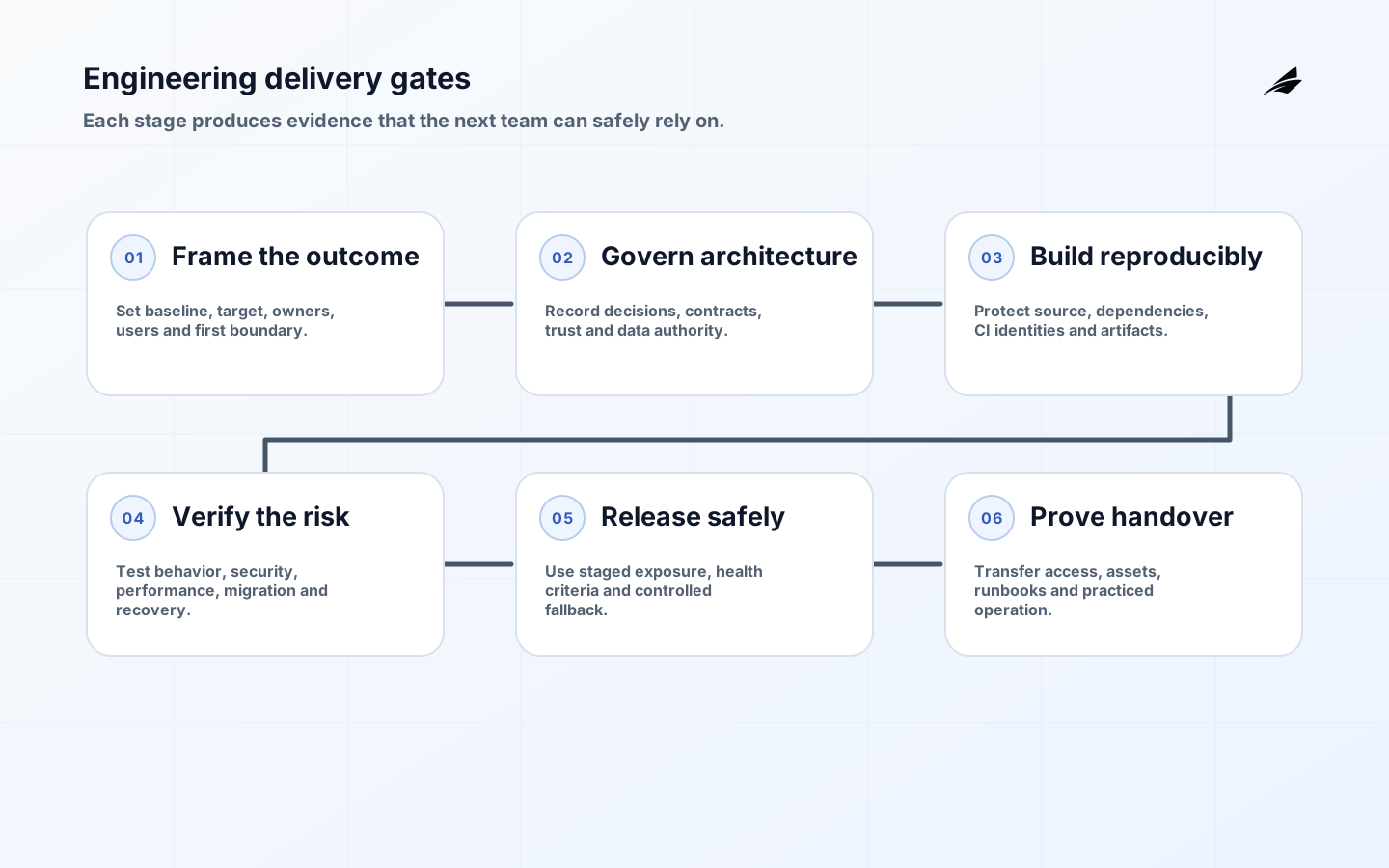
Engineering services and solutions turn a business need into an operable technical service. This implementation checklist is for customer and provider teams establishing that delivery system. It covers decisions and evidence from discovery through handover, with enough detail to expose unclear ownership, brittle architecture, unsafe releases and supplier dependence before they become production problems.
Pair it with the engineering services scope and delivery plan and engineering services FAQ. Enterprise teams can compare the digital engineering implementation checklist when coordinating multiple platforms and suppliers.
1. Mobilize around a measurable outcome
Name the sponsor, product owner, technical owner, service owner and risk approvers. Write one outcome with baseline, target, population and date. Document users, workflows, records, integrations, obligations and constraints. Collect real examples and recent failures. Define the first production boundary and explicit exclusions. A kickoff deck is not mobilization unless people can make decisions and access the systems needed for discovery.
- Approve the problem statement, business measure and decision authority.
- Inventory existing code, environments, vendors, data, licenses and documentation.
- Agree working hours, communication, repositories, issue tracking and escalation.
- Record assumptions that affect estimate, security, migration and acceptance.
- Create a decision log and risk register with owners and review dates.
| Gate | Required evidence | Approver | Stop condition |
|---|---|---|---|
| Discovery | Observed workflow, baseline, constraints and first-release boundary | Product sponsor | No accountable outcome owner |
| Architecture | Quality scenarios, decisions, contracts and threat model | Technical and risk owners | Critical trust or data boundary unresolved |
| Build | Working slice, automated evidence and dependency provenance | Engineering owner | Change cannot be reproduced |
| Release | Migration, security, recovery, support and rollback evidence | Service owner | Critical journey or recovery unproved |
| Handover | Access, source, runbooks, telemetry, training and backlog | Customer owner | Provider remains sole operator |
2. Establish architecture and contracts

Describe the system context, trust boundaries, record authority, deployment topology and external dependencies. Write measurable scenarios for availability, performance, security, accessibility, privacy and recovery. Record material architecture decisions with alternatives and consequences. Prefer simple boundaries and established platform patterns unless a different design solves a measured constraint.
Version APIs, events, files and schemas. Define authentication, authorization, timeouts, retry, idempotency, pagination, rate limits and error meaning. Assign each field and record an authoritative source and correction path. Create compatibility tests and provider sandbox fixtures. An interface is not complete until failure, replay and observability are designed.
3. Prepare a secure, reproducible delivery path
NIST's Secure Software Development Framework supplies a common vocabulary for preparing the organization, protecting software, producing well-secured software and responding to vulnerabilities. Map applicable tasks into repository, CI, dependency, review, test and incident controls. Document exceptions; do not represent tool installation as framework conformance.
- Use attributable identities, protected branches, least privilege and reviewed elevation.
- Keep secrets in approved stores and test rotation and revocation.
- Pin dependencies, scan provenance and define vulnerability response ownership.
- Build from versioned source and configuration in isolated, maintained runners.
- Generate tamper-evident build and test records tied to the released artifact.
- Back up repositories and critical configuration and test restoration.
For open-source dependencies, use inventory and risk context rather than a single score. OpenSSF Scorecard automates checks about project security practices, but maintainers, release provenance, vulnerability history, licensing and replaceability still require review. Keep a software bill of materials where policy or customer need requires it and link components to deployed versions.
4. Deliver thin end-to-end increments
Build the smallest slice that crosses user interface, business rule, data, integration, deployment and observation. This reveals architecture and environment problems earlier than completing layers in isolation. Keep work items small, acceptance examples concrete and feature exposure controllable. Demonstrate behavior in a deployed environment, not only on a developer machine.
Review code for intent, readability, failure behavior, authorization, data handling, concurrency and operations. Keep generated and AI-assisted changes under the same controls. DORA's 2025 AI-assisted development research describes AI as amplifying the surrounding system; increase fast feedback and review capacity when assisted tools increase change volume.
5. Verify risk at the appropriate layers
Use unit and component tests for deterministic logic, contract tests at interfaces, integration tests for real adapters, and a focused end-to-end suite for critical journeys. Add exploratory, security, accessibility, performance, migration and recovery work according to risk. Google SRE's testing for reliability frames tests as confidence about changes; maintain diagnostic speed and system-level evidence together.
| Area | Acceptance example | Artifact |
|---|---|---|
| Functional | Critical state transitions and exceptions produce correct records | Versioned tests and traceable results |
| Security | Cross-role and cross-tenant access is denied and logged | Threat model, tests and remediated findings |
| Performance | Priority journey meets percentile and error targets under workload | Model, script, result and capacity assumptions |
| Migration | Counts, relationships and control totals reconcile after trial | Mapping, exception report and approval |
| Recovery | Service restores and data reconciles within objectives | Exercise timeline and runbook changes |
| Accessibility | Priority tasks satisfy applicable criteria and manual checks | Audit evidence and user-impact fixes |
Manage flaky checks as defects. Isolate data, time and state; replace fixed waits with condition-based assertions; and make failures diagnostic. Report retries rather than hiding them. Set release gates by risk and define who can accept an exception, with compensating control and expiry.
6. Instrument the service before release
Instrument critical business transactions, not just hosts. OpenTelemetry concepts cover traces, metrics, logs, resources and semantic conventions. Choose bounded dimensions, preserve correlation and avoid sensitive identifiers in metrics. Dashboards should show completion, errors, latency, backlog, dependency health, saturation and release version.
Every alert needs a decision, threshold, owner, route and runbook. Test telemetry by causing known safe failures. Verify clock synchronization, retention and access. Record service-level indicators and review windows. During pilot, compare system signals with user reports so apparently healthy dashboards do not conceal incomplete work.
7. Control deployment, migration and rollback
CISA's multi-agency safe software deployment guidance recommends a deployment program supported by robust testing and measurement. Define deployment authority, staged exposure, health criteria, abort conditions and customer communication. Keep changes small enough to diagnose and recover.
- Rehearse deployment and rollback with the release artifact and production-like configuration.
- Run migration at representative scale, reconcile outputs and time every step.
- Protect backward compatibility during mixed-version operation.
- Confirm backups, keys, queues and third-party limits before cutover.
- Assign a cutover commander and decision checkpoints.
- Observe a defined stabilization window before removing the previous path.
8. Accept operations and handover
Handover is proven operation by the receiving team. Transfer source, history, architecture decisions, infrastructure definitions, environments, credentials process, dependency inventory, test assets, dashboards, alerts, runbooks, support contacts, licenses and known risks. Pair sessions with supervised exercises: deploy, restore, rotate a secret, triage an alert and resolve a failed integration.
Define incident, problem, vulnerability, change and service-review routines. Preserve a prioritized backlog with rationale. The customer should control repositories and production access or have a tested escrow and export arrangement. Remove provider access that is no longer required and verify revocation. Record exit assistance and data deletion evidence.
9. Measure outcomes and supplier performance
Review the business outcome, adoption, task completion, reliability, change lead time, change failures, recovery, security findings, support demand, cost and technical debt. Define measures before work begins and preserve baselines. Use trends to improve the system; do not rank engineers by commits, tickets or test counts.
Provider reviews should examine delivered outcomes, quality evidence, aging risks, staffing continuity, subcontractors, consumption and forecast. Pair service-level speed with quality and prevention. A provider that closes tickets quickly through repeated manual work may be meeting the metric while making the service worse.
Example: applying the checklist to a client portal
For a client portal, define the outcome as reducing status-request calls while preserving confidentiality and response quality. Observe how clients, service staff and administrators exchange files, messages and approvals. Identify the CRM as customer authority and the document platform as file authority. The first release may expose one case type, one upload flow and one notification provider, with other workflows explicitly out of scope.
Architecture evidence includes tenant isolation, role and delegation rules, file scanning, API contracts, retention, audit events and a recovery scenario. Build a thin slice that creates a case, authorizes a client, uploads a file, records its accepted state and notifies the service team. Verify cross-tenant denial, duplicate upload, provider timeout, inaccessible document state, large file behavior and revoked user access.
Before release, migrate a representative set of open cases and reconcile identifiers, files, owners and status. Rehearse rollback before clients create new portal-only records; after that point use a forward-fix or controlled disable path. Instrument case completion, failed uploads, notification delay, support demand and permission errors. During pilot, compare call volume and task completion with the baseline.
Handover requires the customer team to deploy a change, rotate a provider credential, investigate a failed upload and restore the service. Source, infrastructure, tests, decisions, dashboards and known risks remain in customer-controlled systems. The example turns each checklist item into a fact that can be accepted, rather than a document that says architecture, testing and training were completed.
Key takeaways
- Mobilize engineering services around a measurable outcome and named decisions.
- Make architecture, data authority and interface failure behavior explicit.
- Use reproducible secure delivery and layered, risk-based verification.
- Prove deployment, recovery, observability and receiving-team operation.
- Accept reusable assets and outcomes, not activity volume.
Frequently asked questions
When is implementation complete?
When the agreed outcome and acceptance evidence are met, the receiving team can operate the service, material risks are accepted, and remaining work has ownership. Code completion alone is not service completion.
Conclusion
This engineering services and solutions implementation checklist keeps delivery accountable from first decision to steady operation. Use each gate to produce evidence that the next stage can safely rely on. The strongest engagement leaves behind a service the customer understands, can change and can recover without depending on undocumented provider knowledge.