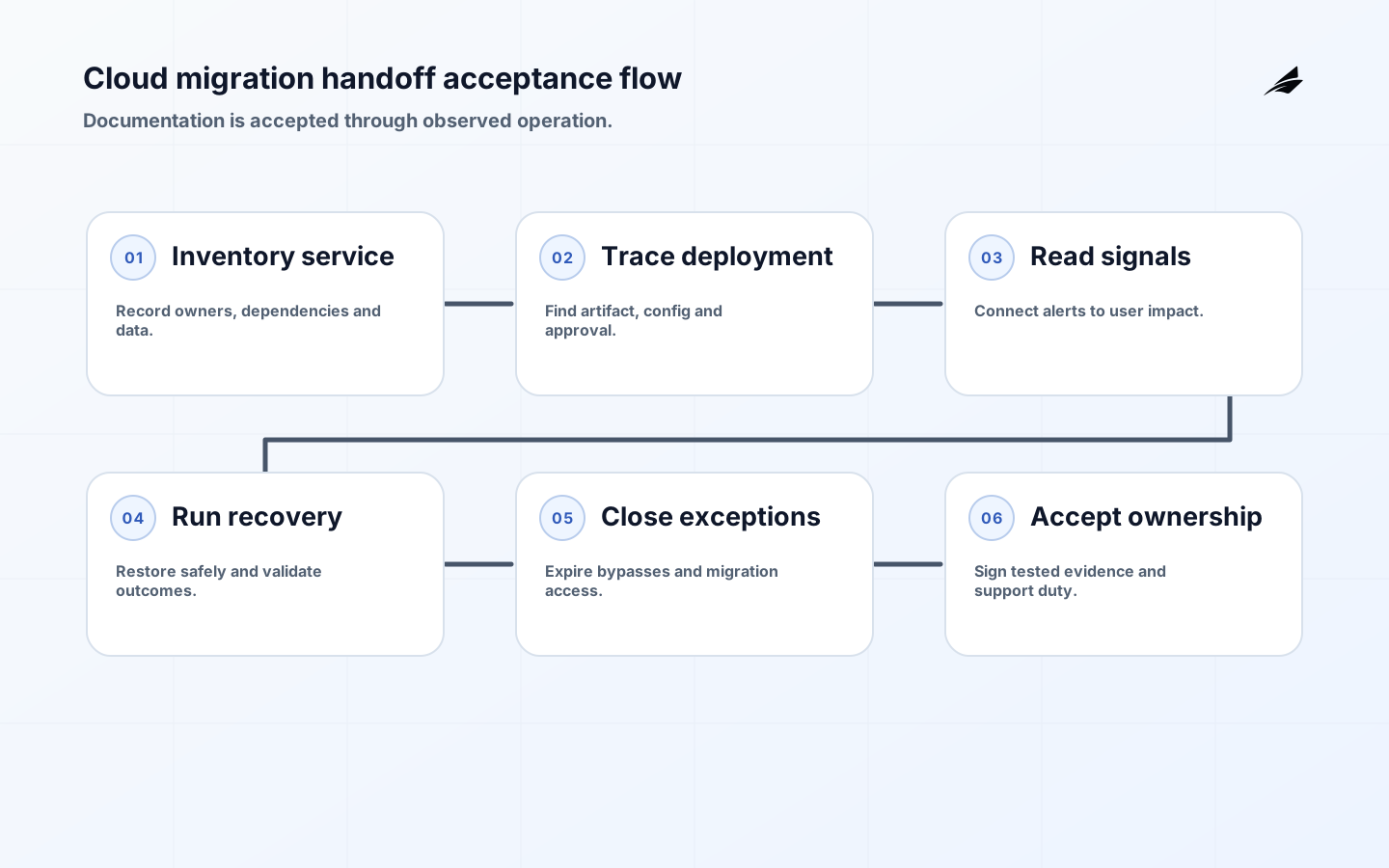
Developer handoff documentation for a cloud migration should help the next person make a safe decision at an awkward hour, not merely describe the project after it is complete. Migration work often changes hosting, identity, network paths, data stores, deployment automation, monitoring, and supplier boundaries at once. A handoff that says the service is in the cloud leaves operations with the most important questions unanswered: what customer outcome it serves, where authority lives, how to deploy or roll back it, and which signals show trouble. Build the document around those decisions and keep it close to the repository and running service.
Prove the handoff with a no-author drill
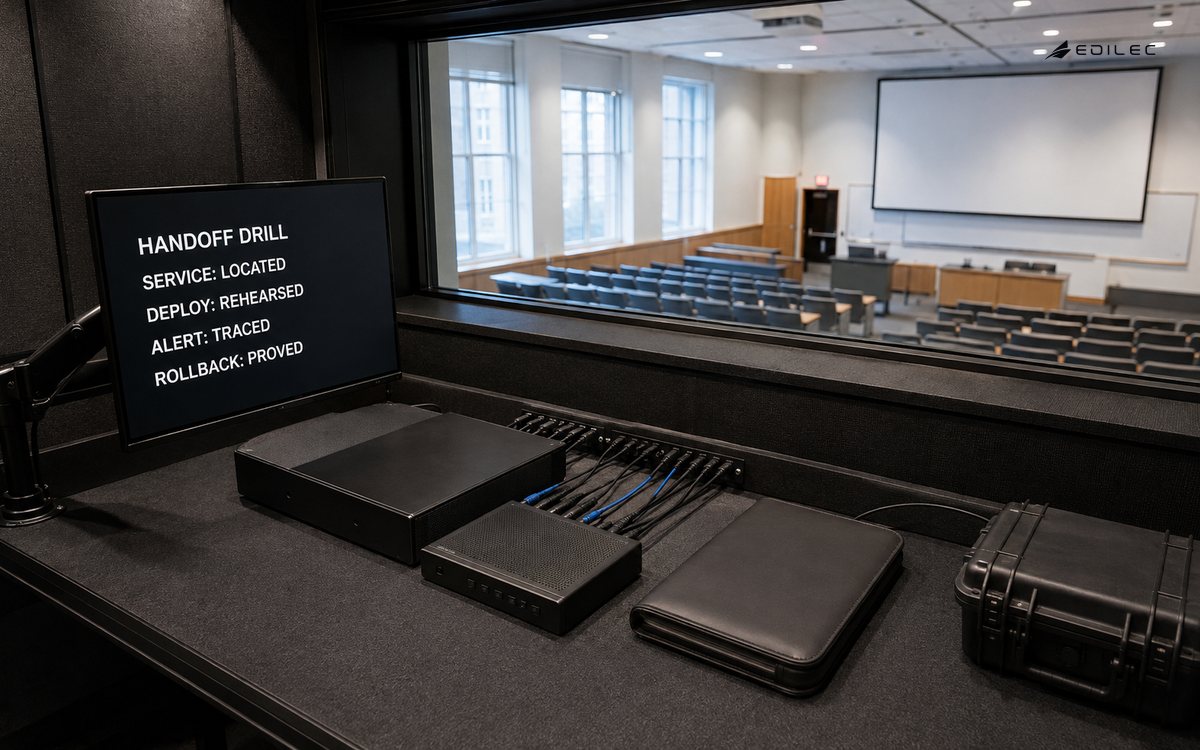
Documentation is not accepted because the migration team uploaded a folder. It is accepted when an on-call engineer who did not write it can diagnose and recover a representative failure. Schedule a no-author drill before the handoff date. Give the receiving team an alert, a recent deployment and a controlled dependency failure. The authors may observe but cannot supply missing commands or context. Record every place where the operator cannot identify impact, find the owning component, locate a dashboard, obtain safe access, select a rollback or verify recovery. Those gaps are defects in the operating system, not requests for nicer prose.
| Handoff artifact | Drill question | Acceptance signal |
|---|---|---|
| Service map | Which user journey and dependency are affected? | Operator traces impact from alert to owner without oral help |
| Deployment record | What changed and which artifact is running? | Version, configuration and approver are discoverable |
| Recovery runbook | How is service restored without corrupting data? | Step is rehearsed, bounded and includes validation |
| Access guide | How is emergency authority granted and removed? | Time-limited access and review evidence work |
| Observability contract | Which signals prove health after cutover? | Dashboards, alerts and traces match service objectives |
The drill should test both technical and organizational handoff. Confirm vendor contacts, escalation paths, data-retention duties, support hours and who can accept residual migration risk. The Google SRE book treats reliable operation as an engineering concern, and the OpenTelemetry specification provides a common basis for correlated traces, metrics and logs. Connect the handoff to Edilec’s guides for software support playbooks, developer documentation before development and workflow-first cloud migration. Close only after the receiving service owner signs the tested acceptance record and every temporary migration credential, bypass and monitoring exception has an owner and expiry.
Key takeaways
- Write for operating decisions rather than project history.
- Name service, data, configuration, and escalation owners.
- Document interfaces, failure behaviour, and transfer-of-traffic criteria.
- Keep sensitive material in controlled systems, not prose.
- Prove the handoff through deployment and recovery rehearsal.
Cloud migration handoff
Start with a concise service profile: purpose, customers or internal users, owner, critical dependencies, data classification, availability expectation, and support route. Follow with an architecture map that identifies trust boundaries, external integrations, queues, stores, scheduled jobs, and configuration ownership. Avoid an idealized diagram that omits managed services or manual steps. The handoff should state what the system does not do as well as what it does, because false assumptions during a migration cause accidental scope expansion. Link each major component to a responsible team and a source of current configuration.
| Planning element | Decision to make | Accountable role |
|---|---|---|
| Service profile | State purpose, owner, users, and criticality. | Service owner |
| Architecture | Map dependencies, trust boundaries, and configuration authority. | Technical lead |
| Operations | Document deploy, rollback, monitoring, and escalation. | On-call owner |
| Data | Record source of truth, movement, reconciliation, and retention. | Data owner |
Design the developer handoff documentation operating boundary
Document operational interfaces as contracts. For APIs and events, define authentication, payload ownership, idempotency, ordering assumptions, timeout behaviour, retry limits, and how a consumer detects an error. For data movement, identify the source of truth, mapping, validation, reconciliation, and rollback limits. Include deployment prerequisites, migration sequence, secrets-management mechanism, and the decision point for transferring traffic. A short, tested runbook is more valuable than a long narrative: it should let a qualified engineer perform a known operation while explaining which conditions require escalation.
Build controls and evidence
Handover material can itself create risk. Keep credentials, tokens, and private customer information out of general documentation, and link to controlled systems where access is governed. NIST SSDF supports the idea that secure practices and release evidence belong in normal development work. Record decisions that alter risk, such as an accepted network exception or a temporary compatibility mode, with owner and expiry. Use OpenTelemetry or an equivalent observability standard to specify what traces, metrics, logs, dashboards, and alerts are expected, including the correlation identifier used to follow a request across services.
| Condition | Control or test | Owner |
|---|---|---|
| Deployment fails | Use tested rollback steps and capture release context. | Release engineer |
| Dependency times out | Check trace, timeout policy, queue, and escalation. | Service owner |
| Configuration differs | Locate declared source and reconcile controlled change. | Platform owner |
| On-call cannot proceed | Escalate through named support route with evidence. | Duty manager |
Roll out with real work
Treat the handoff as an exercise, not a deliverable. Ask an engineer who did not build the migration to deploy to a nonproduction environment, diagnose a failed dependency, locate a changed configuration, and reverse a controlled release using only the documented routes. Run a cutover rehearsal with business and support owners as well: technical rollback is not enough if customer communications or manual reconciliation are unclear. Update the material immediately from failed exercises, then assign a recurring review date so diagrams and runbooks do not drift from the service.
Measure and improve
The quality of a handoff appears in operating outcomes. Track time for a new on-call engineer to find ownership, mean time to detect and restore after a migration incident, runbook success rate, documentation defects found in rehearsal, and unresolved configuration drift. Avoid measuring pages written or wiki views. A short current record that enables a safe response is better than a comprehensive but untrusted archive. Make documentation changes part of the definition of done when a service boundary, deploy route, or recovery procedure changes.
Record architecture decisions with their expiry
A migration produces choices that remain important after the cutover: why a database mode was selected, why traffic is routed through a particular service, or why a compatibility layer exists. Capture the context, decision, alternatives, consequence, owner, and review date in short decision records. This saves later operators from treating an intentional trade-off as an accidental defect. It also makes temporary arrangements visible. When a decision expires, the responsible team can remove or renew it deliberately rather than discovering it during an incident.
Document the observability contract
A dashboard link alone is not an observability handoff. Define the service-level indicators, alert thresholds, expected traffic patterns, trace entry points, log fields, and known blind spots. State how an operator distinguishes a customer-impacting issue from a noisy dependency or expected batch activity. Include links to runbooks for the alerts that require action, and test those links during rehearsal. Observability should reduce time to a safe hypothesis, not merely produce more telemetry. This contract is especially important when cloud-managed components move diagnostics into several consoles.
Make cutover communications operational
Technical cutover has customer and business dependencies. Document the communications owner, approved status language, support briefing, change freeze, decision authority, and customer recovery route for a delayed or reversed migration. Provide a timeline that links technical checkpoints to communication checkpoints so nobody announces completion before reconciliation proves it. After the event, preserve the decision log and actual timeline. It will make the next migration more predictable and helps explain any customer impact without relying on individual memory.
Set an operating cadence
Ownership during and after migration must be unambiguous. State which team approves infrastructure changes, who owns application behaviour, who responds to a supplier incident, and how shared incidents are coordinated. Include service hours and escalation methods, not only names that may become stale. For each critical dependency, record the evidence needed to determine whether the fault is local or external and the customer-safe workaround if available. This turns a handoff into a usable collaboration model. Without it, teams can possess accurate technical documents yet still lose time during incidents deciding who is expected to act.
Practical acceptance example
Practical example: during a migration rehearsal, a new operator receives an alert that order confirmations are delayed. The handoff directs them to the queue metric, trace search, deployment history, and escalation path. They determine that a downstream provider is timing out, enable the documented retry ceiling, and issue the approved customer status message while the provider owner investigates. Acceptance evidence is a timed rehearsal, a trace linked to the case identifier, a complete change record, and an updated runbook for the discovered alert ambiguity. The decision criterion is whether an engineer outside the project can restore or safely contain the service without undocumented knowledge.
Final acceptance check
Make acceptance conditional on a clean ownership test too: an on-call directory lookup, an expired credential check, and a change to an infrastructure setting should all lead to the correct controlled system and accountable responder. These small tests catch the operational drift that diagrams alone cannot reveal.
Treat a successful test as incomplete until its evidence and follow-up corrections are incorporated into the maintained handoff record.
Implementation checklist
- Write for operating decisions rather than project history.
- Name service, data, configuration, and escalation owners.
- Document interfaces, failure behaviour, and transfer-of-traffic criteria.
- Keep sensitive material in controlled systems, not prose.
- Prove the handoff through deployment and recovery rehearsal.
Frequently asked questions
What is the smallest useful migration handoff? It includes service purpose, ownership, architecture and dependencies, data authority, deploy and rollback procedure, observability links, known risks, and escalation route. Add detailed procedures where a mistake has high consequence. The test is whether a qualified engineer can safely operate the service without relying on the original builders.
Should handoff documents live in the repository or a knowledge base? Keep versioned technical procedures and architecture decisions near the code when they change together; use an accessible knowledge base for service ownership, cross-team context, and business process material. Link the two. Location matters less than review discipline and access control.
Conclusion
A migration handoff is operational infrastructure. Write it for real decisions, prove it in rehearsal, and keep it synchronized with the service so ownership survives the project team.