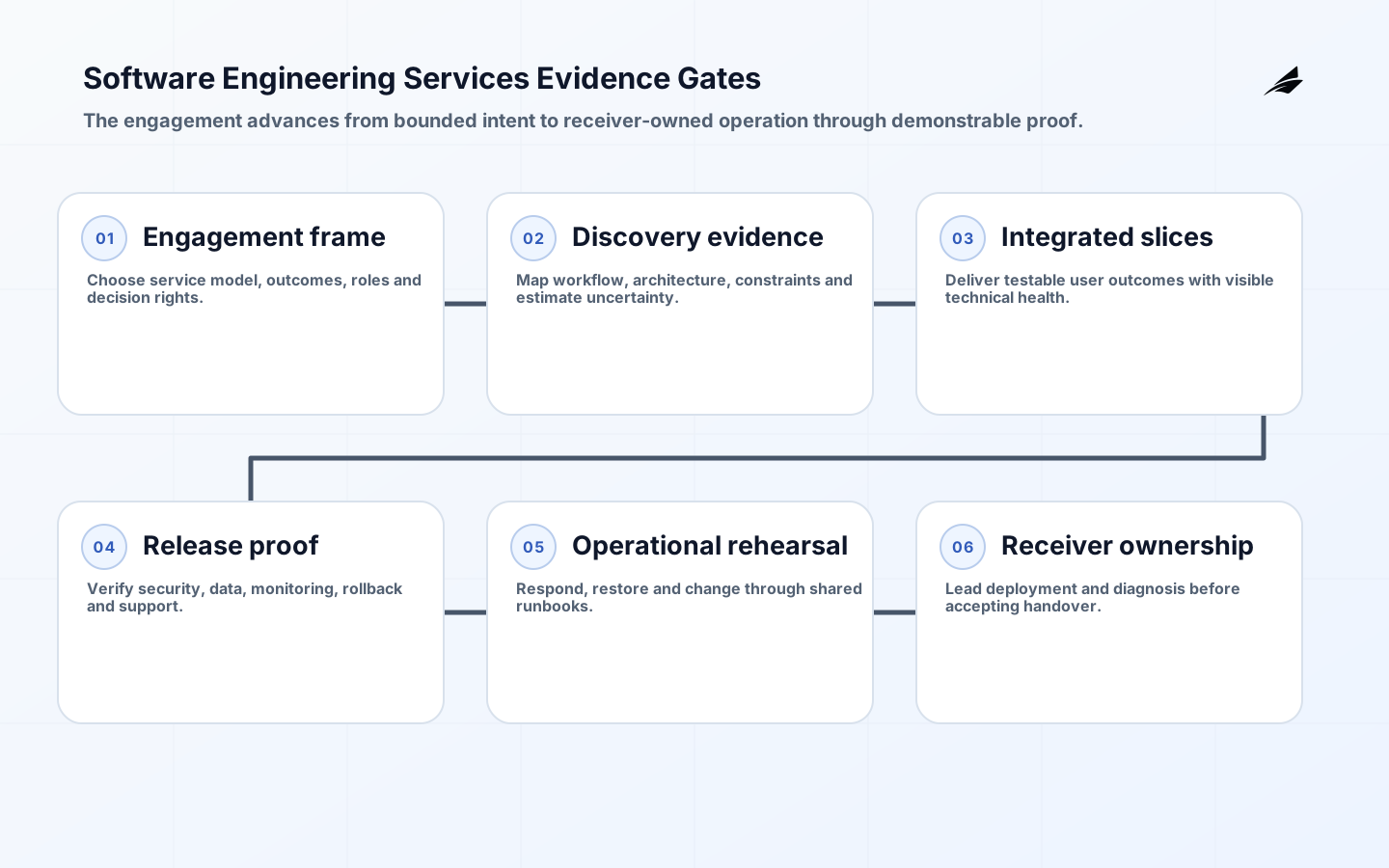
Software engineering services can provide a delivery team, specialist capability, modernization support or continuing product ownership. The label says little about the engagement. Buyers need to define the outcome, decision rights, technical estate, security obligations, acceptance evidence and handover before comparing rates or résumés. A well-governed service makes progress and risk visible while leaving the client able to understand, operate and change what is delivered.
This guide treats software engineering services: scope, cost, risks and a delivery plan buyers can govern as a set of decisions that can be reviewed and tested. The aim is not to prescribe one vendor or promise a universal result. It is to help business and technical owners define boundaries, preserve evidence, expose failure behavior and decide when the work is ready to expand.
Choose the engagement model that matches the problem
A fixed outcome suits bounded, understood work; a dedicated team suits an evolving product backlog; specialist advisory work resolves a defined uncertainty; managed support owns a service level. Mixing models without clear accountability creates conflict.
Name product, architecture, security, data, release and budget decision rights. Clarify what the client supplies, what the provider owns, and which decisions require joint approval.
| Service model | Good fit | Governance focus |
|---|---|---|
| Fixed outcome | Bounded requirements and acceptance | Change control and integrated evidence |
| Dedicated team | Evolving product and stable ownership | Prioritization, throughput and technical health |
| Specialist advisory | Narrow high-risk uncertainty | Decision record and capability transfer |
| Modernization program | Incremental change across legacy boundaries | Migration, parity and decommissioning |
| Managed support | Continuing service ownership | Service objectives, incidents and improvement |
Test the model against scope change, staff absence, production incident and dependency delay. The contract and working rhythm should produce a clear response in each case.
Turn "Choose the engagement model that matches the problem" into a working control by naming one accountable owner, one maintained artifact and one review forum. The exit standard for this part of software engineering services: scope, cost, risks and a delivery plan buyers can govern is concrete: Test the model against scope change, staff absence, production incident and dependency delay. The contract and working rhythm should produce a clear response in each case. For this part of the system, name the accountable owner, supporting evidence, exception route, and next measurable check.
Write scope as outcomes, boundaries and evidence
Describe users, workflows, records, systems, environments, migration, nonfunctional needs and explicit exclusions. Replace broad feature labels with acceptance scenarios and measurable operating conditions.
Maintain assumptions and dependencies beside estimates. Define how discovery can change scope and who chooses between budget, schedule and capability when new evidence appears.
Use a traceable backlog connected to outcome and risk. Completed tickets are not acceptance if the integrated workflow, security or operational readiness remains unproven.
Turn "Write scope as outcomes, boundaries and evidence" into a working control by naming one accountable owner, one maintained artifact and one review forum. The exit standard for this part of software engineering services: scope, cost, risks and a delivery plan buyers can govern is concrete: Use a traceable backlog connected to outcome and risk. Completed tickets are not acceptance if the integrated workflow, security or operational readiness remains unproven. Within this evaluation, name the accountable owner, supporting evidence, exception route, and next measurable check.
Evaluate team capability and continuity
Review the actual proposed roles, availability, technical judgment and communication, not only the supplier portfolio. Ensure product, design, quality, platform and security responsibilities are covered in proportion to risk.
Define onboarding, replacement, leave coverage and knowledge transfer. Shared repositories, environments and decision records should prevent one person or supplier account from becoming an operational gate.
Turn "Evaluate team capability and continuity" into a working control by naming one accountable owner, one maintained artifact and one review forum. The exit standard for this part of software engineering services: scope, cost, risks and a delivery plan buyers can govern is concrete: Ask the receiving team to build, test, deploy and diagnose a representative change before major handover. Demonstrated access is stronger than a document inventory. When implementing this part of the system, name the accountable owner, supporting evidence, exception route, and next measurable check.
Understand the real cost model
Price reflects team composition, uncertainty, integration, migration, quality requirements, compliance, availability and support. A low development rate can be outweighed by coordination, rework or missing operational scope.
Compare estimates on the same responsibility boundary. Include discovery, design, testing, environments, third-party services, security review, launch, warranty, support and transition.
Review forecast versus actual by capability and risk, not by pressuring every variance into overtime. Update the range as uncertainty is resolved and make tradeoffs explicit.
Turn "Understand the real cost model" into a working control by naming one accountable owner, one maintained artifact and one review forum. The exit standard for this part of software engineering services: scope, cost, risks and a delivery plan buyers can govern is concrete: Review forecast versus actual by capability and risk, not by pressuring every variance into overtime. Update the range as uncertainty is resolved and make tradeoffs explicit. Before releasing this cost decision, name the accountable owner, supporting evidence, exception route, and next measurable check.
Govern delivery through evidence gates
Use discovery to establish workflow and architecture, incremental build to prove vertical slices, controlled release to observe production behavior, and transfer to establish durable ownership.

Hold concise reviews of outcomes, risks, decisions, quality and forecast. Keep architecture decisions, security findings and operational readiness visible beside feature progress.
Gate release on tested acceptance scenarios, authorization, accessibility, data reconciliation, monitoring, rollback and staffed support. A demonstration environment cannot prove production readiness alone.
Turn "Govern delivery through evidence gates" into a working control by naming one accountable owner, one maintained artifact and one review forum. The exit standard for this part of software engineering services: scope, cost, risks and a delivery plan buyers can govern is concrete: Gate release on tested acceptance scenarios, authorization, accessibility, data reconciliation, monitoring, rollback and staffed support. A demonstration environment cannot prove production readiness alone. While operating this evaluation, name the accountable owner, supporting evidence, exception route, and next measurable check.
| Evidence gate | Required proof | Client decision |
|---|---|---|
| Discovery | Workflow, constraints, architecture and estimate range | Fund bounded delivery |
| Slice complete | Integrated user outcome and automated evidence | Continue or revise approach |
| Release ready | Security, data, rollback, monitoring and support | Approve controlled production |
| Operate ready | Runbooks, access, incident rehearsal and ownership | Expand usage |
| Transition ready | Receiver-led deploy and diagnosis | Accept handover or extend support |
Protect software, data and business continuity
Specify data access, development environment, secrets, dependency controls, vulnerability handling, incident notification and personnel access changes. Align requirements to the software’s actual risk.
Clarify intellectual property, open-source obligations, reusable supplier components, source and artifact custody, cloud accounts and data return or deletion. Obtain legal advice for contract interpretation.
Audit access and artifacts during delivery, not only at exit. Require a tested incident and transition path, including account revocation and credential rotation.
Turn "Protect software, data and business continuity" into a working control by naming one accountable owner, one maintained artifact and one review forum. The exit standard for this part of software engineering services: scope, cost, risks and a delivery plan buyers can govern is concrete: Audit access and artifacts during delivery, not only at exit. Require a tested incident and transition path, including account revocation and credential rotation. When changing this data handoff, name the accountable owner, supporting evidence, exception route, and next measurable check.
Make operation and handover continuous
Handover should accumulate through shared work: runbooks, dashboards, architecture notes, deployment automation, known issues, dependency inventory and support shadowing. A final document dump is not knowledge transfer.
Define service objectives, incident roles, escalation, maintenance, release ownership and improvement backlog. The receiving team should lead rehearsals while the provider observes and corrects gaps.
Measure deployment health, change lead time, escaped defects, incidents, support queue age, documentation use and receiver independence. End the engagement only when required operational outcomes are demonstrated.
Turn "Make operation and handover continuous" into a working control by naming one accountable owner, one maintained artifact and one review forum. The exit standard for this part of software engineering services: scope, cost, risks and a delivery plan buyers can govern is concrete: Measure deployment health, change lead time, escaped defects, incidents, support queue age, documentation use and receiver independence. End the engagement only when required operational outcomes are demonstrated. During support for this part of the system, name the accountable owner, supporting evidence, exception route, and next measurable check.
Key takeaways
- Match the service model to uncertainty, product ownership and operating needs.
- Define scope through outcomes, boundaries, assumptions and acceptance evidence.
- Evaluate the actual team and ensure repositories and accounts remain accessible.
- Compare full responsibility and lifecycle cost, not hourly rates alone.
- Treat security, operational readiness and receiver-led handover as delivery work.
Frequently asked questions
Fixed price or time and materials?
Fixed price can suit bounded work with stable acceptance; time and materials suits evolving discovery. Both need transparency, assumptions and decision rights. The wrong scope model cannot be repaired by contract terminology.
How should proposals be compared?
Normalize outcome, roles, exclusions, quality, environments, security, support, transition and third-party costs. Ask how uncertainty changes the estimate and what evidence is produced at each stage.
What protects against vendor lock-in?
Use shared accounts and repositories, documented contracts, portable data, standard build and deployment paths, decision records, regular receiver participation and tested transition. Legal rights matter, but practical operability matters too.
When is handover complete?
When the receiving team can independently build, deploy, monitor, restore, diagnose and safely change the service within the agreed responsibility boundary. A checklist without demonstration leaves material risk.
Conclusion
Software engineering services are easiest to govern when the engagement exposes decisions and produces durable evidence, not just activity. Clear outcomes, shared technical custody, risk-based quality and continuous handover let a buyer benefit from external capability without surrendering understanding. Select the model deliberately, review integrated behavior, and make receiver independence an acceptance condition from the beginning.