Device platform software connects physical products, embedded code, gateways, networks, cloud services, applications and support operations. Its hardest failures cross those boundaries: a valid cloud command reaches the wrong actuator, an interrupted update leaves a site offline, or telemetry appears healthy while the physical process is not. Good architecture starts with the device’s real environment and safety impact, then builds identity, control, observability and lifecycle management around it.
This FAQ supports product managers, embedded engineers, platform teams and operational owners planning a connected-device product or fleet. Use it with the device platform business guide, the device platform implementation checklist and the application management transition checklist. Safety, radio, sector and market-access obligations vary by product and jurisdiction and require specialist review.
What belongs in device platform software?
The platform typically includes device firmware or an agent, secure boot and identity material, provisioning, a local protocol or gateway, message ingestion, a device registry, command routing, update orchestration, digital-state representation, telemetry storage, user and fleet applications, audit evidence and support tools. Draw trust boundaries between physical device, local network, gateway, public network, cloud control plane, tenant, operator and vendor support. State which component is authoritative for each state and command.
NIST’s IoT cybersecurity program series separates manufacturer activities, device capabilities and non-technical support. That distinction is useful beyond cybersecurity: a product is not operable merely because firmware supports an update protocol. The organization also needs vulnerability intake, customer communication, update publication, support periods and end-of-life behavior.
How should hardware and software boundaries be drawn?
Start with physical functions, timing, power, memory, connectivity, service life, environmental conditions and consequences of failure. Keep safety-critical control local when network delay or loss cannot be tolerated. Use the cloud for fleet coordination, analysis and policy when a local fallback remains safe. Define an edge contract with commands, telemetry, version, units, allowed ranges, timing, acknowledgment and idempotency. Never infer successful physical action from message acceptance alone.
Build a hardware and software compatibility matrix covering board revision, secure element, bootloader, firmware, gateway, protocol, cloud API and mobile application. Version every interface and support an intentional overlap during rollout. Test brownouts, clock drift, flash wear, corrupt storage, full queues and weak radio, not only a lab connection. The most reliable cloud service cannot repair an update that exceeds a device’s available partition.
| Boundary | Contract to define | Failure to simulate | Required evidence |
|---|---|---|---|
| Sensor to firmware | Units, range, calibration and freshness | Stuck or implausible reading | Validity flag and diagnostic |
| Device to gateway | Identity, protocol, ordering and retry | Duplicate and delayed message | Idempotent processing |
| Gateway to cloud | Authentication, queue and backpressure | Long network outage | Buffered recovery without overload |
| Cloud to device | Authorization, expiry and acknowledgment | Replayed or stale command | Rejected command audit |
| Platform to operator | Tenant, role, status and action semantics | Wrong-site selection | Confirmation and attributable event |
How are devices identified and authorized?
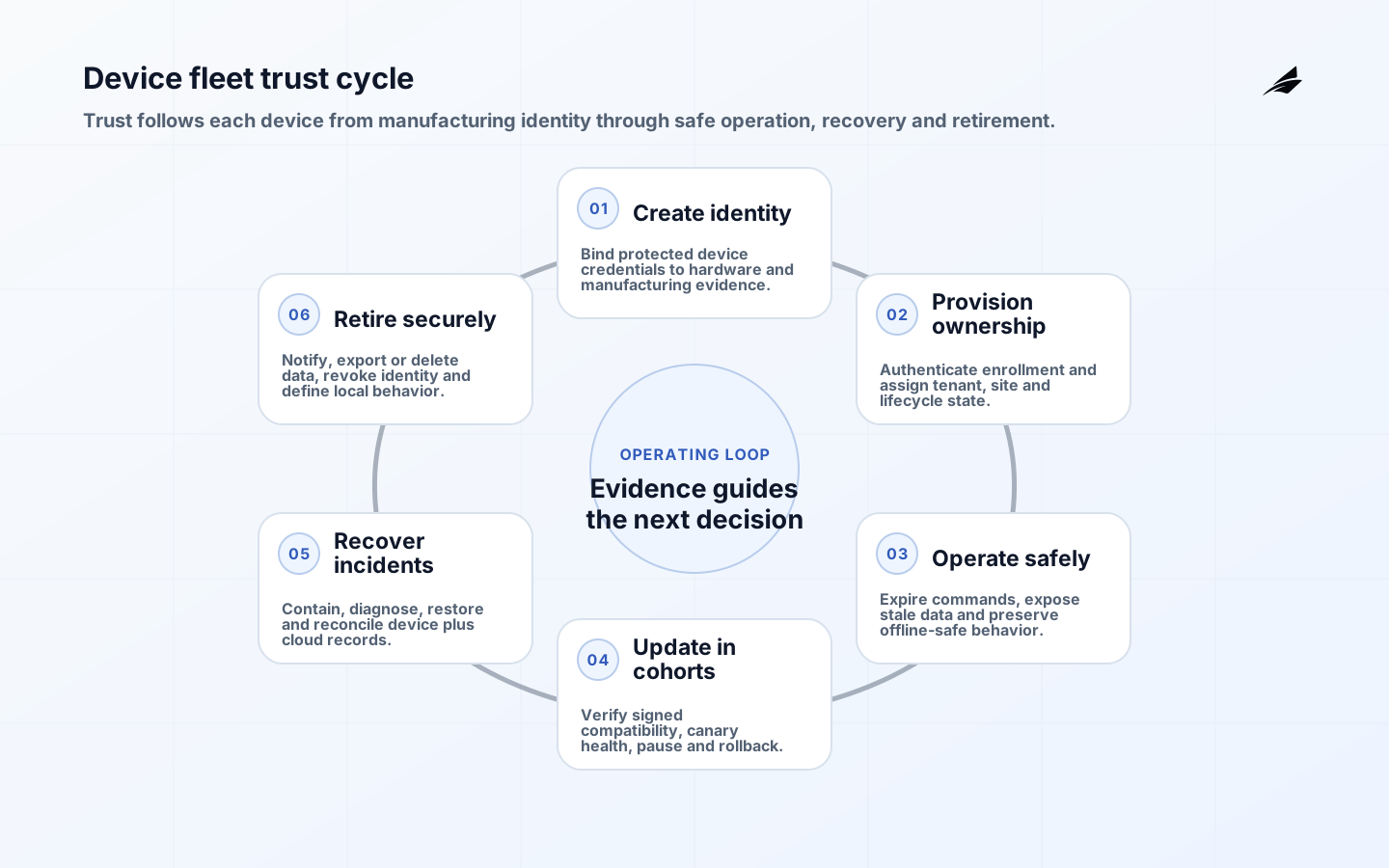
Give every manufactured device a unique identity rooted in protected material appropriate to the hardware and threat model. Provision through an authenticated process that binds manufacturing record, device identity, ownership or tenant and current lifecycle state. Use mutually authenticated channels where feasible, rotate credentials, revoke compromised units and prevent a reset from silently transferring ownership. Factory, development and production identities must be visibly distinct.
Identity is not authorization. A genuine device may still be decommissioned, assigned to another customer or forbidden from a command. Evaluate device, tenant, site, role, firmware posture and requested action at the command boundary. NIST IR 8259A’s core baseline includes device identification, configuration, data protection, interface access, software update, cybersecurity-state awareness and device security. Tailor capabilities to product risk rather than treating the baseline as a one-size certification.
What should happen when connectivity disappears?
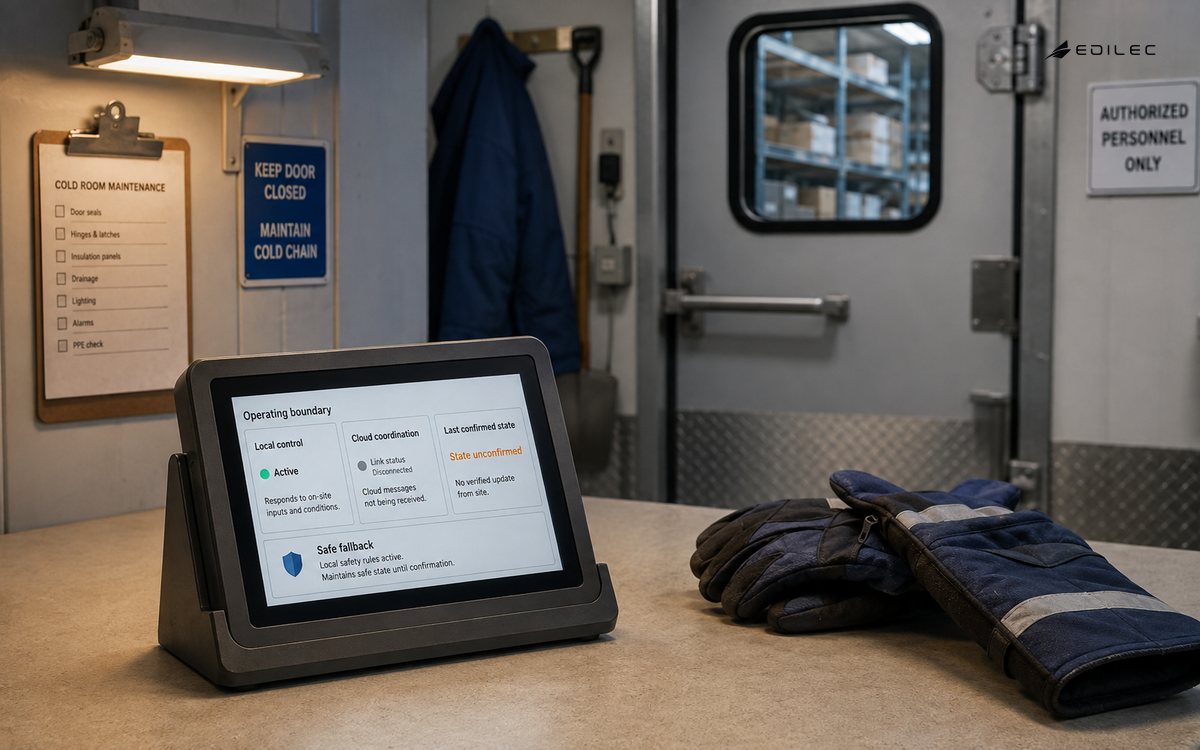
Define an offline mode for every critical function: continue locally, degrade safely, stop, or require manual operation. State how long data can queue, what happens when storage fills, which commands expire and how clocks are reconciled. Use message identifiers and monotonic sequence where appropriate so reconnect does not duplicate physical actions. Apply jittered backoff to avoid an entire fleet reconnecting simultaneously after a regional outage.
Digital twins or desired-state records need explicit conflict rules. If an operator changes a set point while the device is offline and a local technician makes a different change, decide which source wins and whether human review is required. Expose last-observed time and confidence in user interfaces; stale telemetry must not look live. Reconciliation should be an auditable state transition, not a background overwrite.
How should secure updates work?
Sign firmware and manifests, verify authenticity and integrity before installation, enforce product and hardware compatibility, prevent unauthorized rollback, and preserve a known-good recovery path. Use phased cohorts: internal devices, canaries across hardware and network conditions, a small customer cohort, then wider rollout. Pause automatically on boot failure, health regression, support spikes or telemetry loss. Do not update every unit merely because package delivery succeeded.
Define update support and vulnerability response through end of service life. NIST IR 8259 Revision 1 describes foundational manufacturer activities, while 8259B addresses documentation, information and query reception, information dissemination, and education and awareness. Publish supported versions, security contact, update mechanism, support period and end-of-life plan in language customers can act on.
| Update stage | Gate | Abort trigger | Recovery |
|---|---|---|---|
| Build | Reproducible artifact, SBOM and signature | Unexpected component or failed verification | Reject artifact |
| Eligibility | Hardware, bootloader, power and storage check | Incompatible or insufficient device | Keep current version |
| Canary | Representative fleet health baseline | Boot, battery or function regression | Pause and roll back |
| Rollout | Cohort limits and network capacity | Error threshold or support surge | Freeze cohort expansion |
| Completion | Reported running version and functional check | Missing or inconsistent confirmation | Retry safely or service device |
Which security and regulatory issues matter?
Threat-model manufacturing, debug interfaces, supply chain, local wireless, credentials, cloud APIs, tenant separation, operator consoles, mobile apps and update infrastructure. Remove or protect unused interfaces; keep secrets out of firmware images and logs; rate-limit commands; and record administrative actions. CISA’s Secure by Design guidance encourages producers to make secure defaults and vulnerability handling part of the product rather than a customer add-on.
For federal US acquisition, NIST SP 800-213 helps organizations establish IoT device cybersecurity requirements. Products placed on the EU market may fall within the Cyber Resilience Act, with phased obligations and product-specific applicability. Also assess radio, electrical, machinery, medical, automotive, privacy and accessibility rules as relevant. Maintain a requirements matrix tied to markets, versions and evidence.
How should telemetry and privacy be managed?
Collect telemetry for a named operational or product purpose. Classify raw readings, location, identifiers, user actions and derived inferences; a device serial can become personal data when linked to a household or worker. Minimize frequency and precision where they are unnecessary, encrypt transport and storage, separate tenants, restrict support access and set retention by data class. Keep security logs distinct from product analytics when access and retention differ.
Create a schema registry with units, provenance, device and firmware version, event time, observed time and quality flags. Reject or quarantine malformed events instead of silently coercing them. Plan for late and out-of-order data. A fleet dashboard should distinguish “healthy,” “last seen two hours ago,” “reporting invalid data” and “unknown.” That precision prevents an analytics convenience from becoming an operational safety claim.
How is a device fleet operated?
Maintain inventory across manufactured, provisioned, active, quarantined, returned and retired states. Track hardware and firmware, owner, site, credential age, configuration, last contact, security posture, warranty and support eligibility. Establish service objectives for command acknowledgment, telemetry freshness, update success and recovery. Support needs safe remote diagnostics, redacted logs, consent-aware access and escalation to field service. Avoid a universal administrator account.
- Observe device health and data quality by hardware, firmware, region and network.
- Triage whether the fault is physical, embedded, connectivity, cloud, configuration or user workflow.
- Contain risk by expiring commands, revoking identity, quarantining units or pausing a cohort.
- Recover through retry, rollback, reset, replacement or field procedure with safety approval.
- Reconcile device, cloud, customer and inventory records after service is restored.
- Feed findings into hardware tests, update policy, support content and the next design revision.
Key takeaways
- Architect from physical behavior, offline safety and hardware constraints outward.
- Separate device identity from current ownership and command authorization.
- Make updates signed, compatible, phased, observable and recoverable.
- Treat customer support, vulnerability response and end-of-life as platform capabilities.
- Operate from attributable fleet state and test failures across device, network, cloud and human boundaries.
Frequently asked questions
Should we build or buy an IoT platform?
Buy commodity device registry, messaging or update capabilities when they fit requirements, but retain ownership of the device contract, safety behavior, data policy and operations. Evaluate protocol, scale, isolation, regions, offline support, export, pricing and exit. A provider service does not remove product lifecycle responsibility.
Which device protocol should we use?
Choose from power, bandwidth, topology, reliability, latency, security, tooling and interoperability constraints. MQTT, HTTP, Bluetooth, cellular and industrial protocols solve different problems. Prototype under representative interference and outage, and define application semantics above transport.
Does every device need a digital twin?
No. A twin is useful when applications need a durable desired and reported state, but it adds synchronization and conflict semantics. For append-only telemetry or simple request-response control, a registry plus event history may be enough. Use the smallest state model that operators can explain.
Conclusion
Reliable device platform software makes physical truth, cloud state and human action coherent through imperfect networks and long product lives. Define boundaries, protect identity, expire commands, update in recoverable cohorts and operate every lifecycle state. The result is not merely connected hardware; it is a supportable product whose behavior remains trustworthy after shipment.