Firmware Update Operations for Connected Systems: A Field Guide
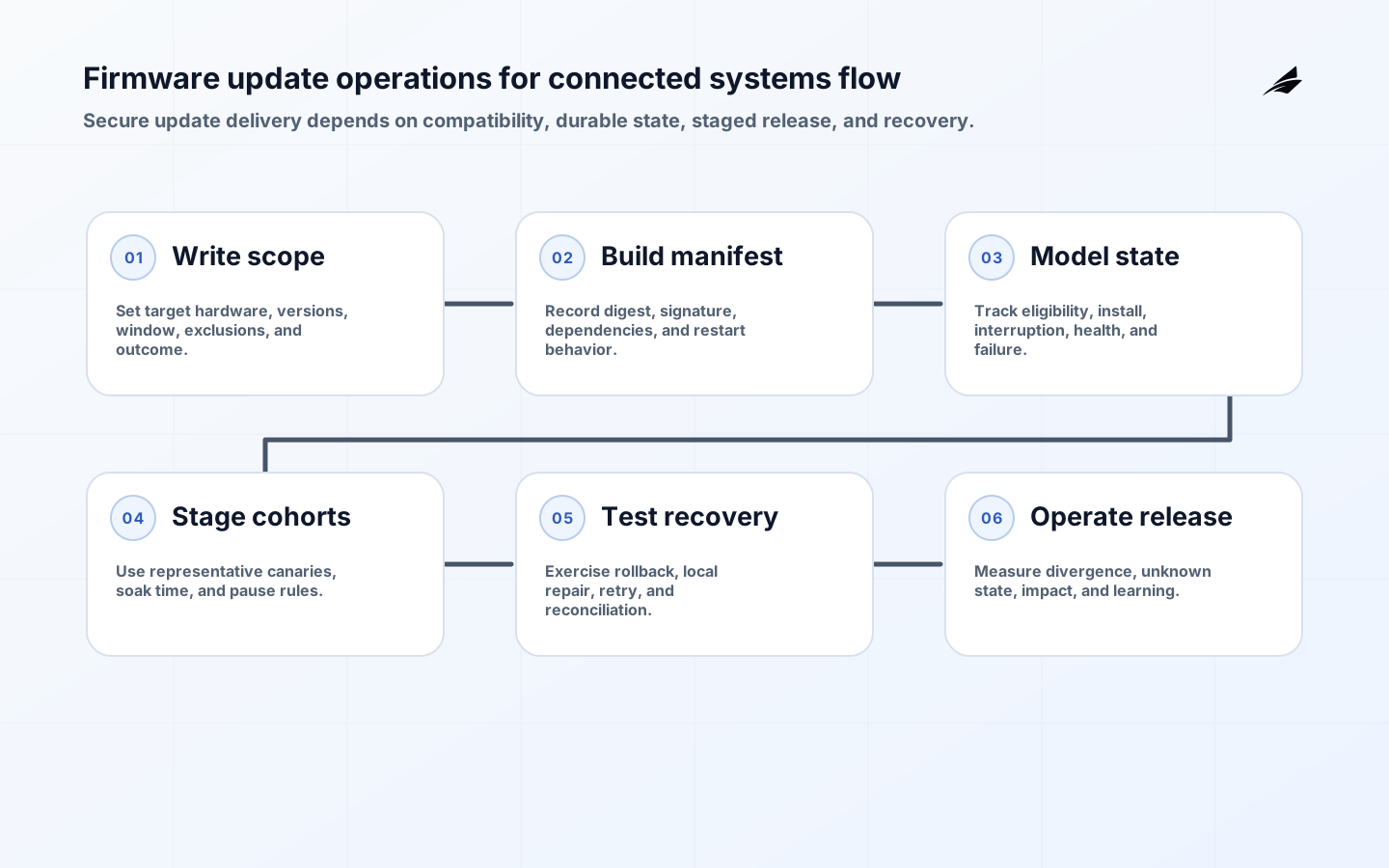
Firmware update operations for connected systems combine software release engineering with field operations. A package may be technically correct and still be unsafe to deploy if the target inventory is wrong, the device is in a sensitive operating mode, the network cannot sustain the transfer, or no one can recover a device that fails after reboot. This guide focuses on the decisions that turn an update into a controlled change: package identity, device eligibility, staging, health evidence, and recovery. The aim is not a universal tool choice. It is a repeatable path that makes uncertainty visible before it becomes fleet-wide work.
Set eligibility and completion rules
Record the reason for the release, the affected hardware and software versions, the supported configuration range, and the consequence of a failed installation. Include devices that are intentionally excluded and why. A practical scope statement might say: update gateway model G2 with hardware revision B or later, at sites with local support, during the approved maintenance window, excluding units with unknown battery state. This level of detail makes the rollout auditable and prevents a broad tag such as production devices from becoming an uncontrolled selector.
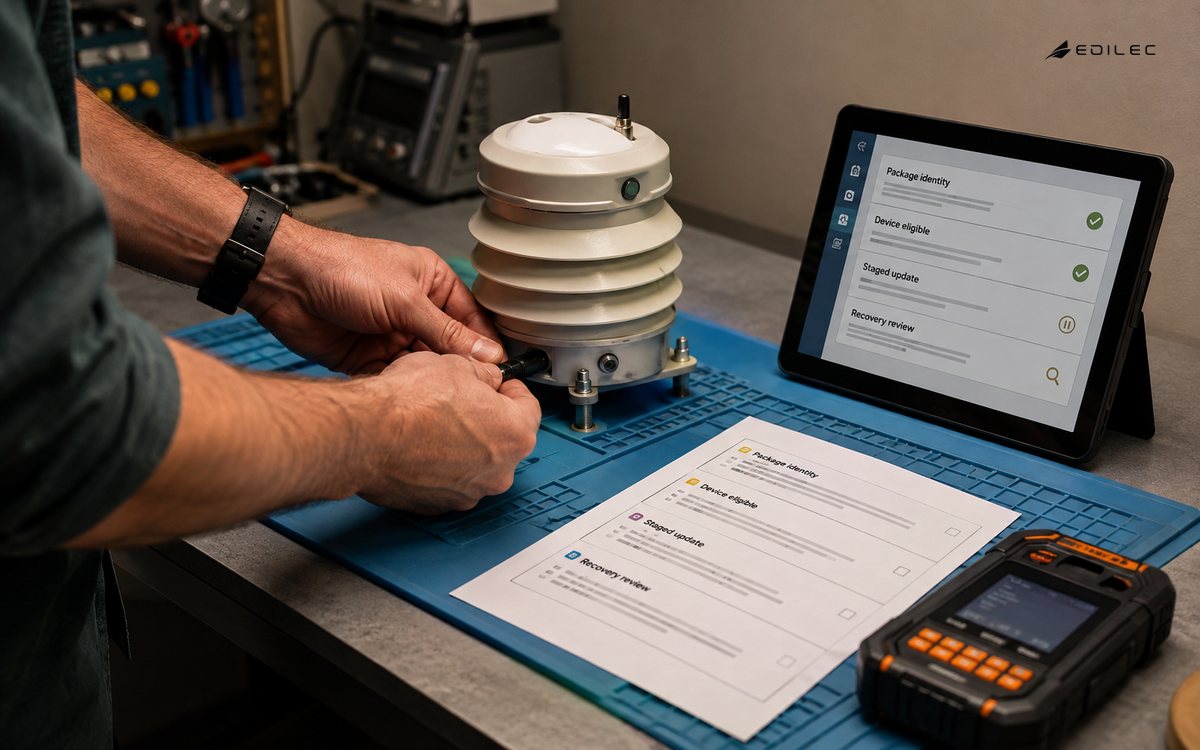
The NIST IoT software-update profile separates device capabilities from the supporting work around them. The device may need secure installation and state awareness; the organization also needs ownership, communication, support, and a process for exceptions. Put both in the release plan. A device that can verify a signature but cannot tell the operator its current version is still difficult to operate safely.
| Scope item | Decision | Release artifact |
|---|---|---|
| Target identity | How is the exact device and hardware revision resolved? | Inventory query and eligibility snapshot |
| Compatibility | Which versions, configurations, and dependencies are supported? | Compatibility matrix and lab result |
| Operating window | What local work must stop or continue during restart? | Window approval and site checklist |
| Completion | Which technical and business signals prove success? | Health query, process check, and evidence link |
Bind the artifact to hardware and intent
A good manifest binds the package to its purpose and target. Include a unique release identifier, digest, signature metadata, build provenance, target hardware, minimum version, dependency constraints, configuration migration, expected restart behavior, and an expiration or supersession rule. Store the manifest with the approval record. Do not rely on a filename or a human-entered version string as proof of identity. If a package is copied between repositories or gateways, the verification result should remain the same.
NIST's software update catalog calls for authorized entities, restricted installation, and an effective way to verify a valid source, such as signatures, checksums, or certificate validation. Put that requirement into tests. Try an altered package, an expired certificate, an unauthorized installer, a mismatched hardware revision, and a downgrade. Record denial as a successful safety outcome when the attempted action was outside policy.
Represent interruption as a first-class state
Represent the update as a state machine rather than one status flag. Useful states include eligible, approved, staged, downloading, verified, installing, rebooting, healthy, failed, deferred, and recovered. Each transition needs an actor or service identity, timestamp, package digest, attempt number, and reason. Model what happens when power is removed between verification and installation, when a device reconnects with an old version, and when a retry arrives after the platform has already accepted the job.
Keep the device's last known good state separate from the last command sent. This distinction matters during outages. A queued update is not an installed update; a reported version is not application health; and a gateway connection is not proof that downstream devices are reachable. The state model should tell the operator which facts are current, which are inferred, and which require a local check.
Use hardware-aware cohorts and soak time
Start with lab verification, then a representative canary, then controlled cohorts. Choose canaries for variation and consequence: include a common configuration, a less common configuration, a constrained network, and a site with a responsive owner. Observe the full operating cycle that matters. A device that restarts successfully may still report bad data after a shift change, a temperature cycle, or a reconnection to a downstream service. Define a minimum soak period before expanding.
Every gate should have a stop rule and a named decision maker. Examples include boot failure above baseline, missing health data, increased command latency, unexpected configuration change, or a business process that cannot complete. Pause the next cohort automatically when a stop condition is reached, but keep humans responsible for deciding whether to resume, repair, or roll back. An automatic pause protects time; it does not supply judgment.
| Risk | Control | Signal to review |
|---|---|---|
| Wrong population | Re-resolve identity and eligibility at execution time. | Denied and changed-target count |
| Unsafe restart | Use maintenance windows and local readiness checks. | Interrupted work and operator confirmations |
| Package compromise | Verify signature and digest at every install boundary. | Verification failures by source |
| Unknown outcome | Keep durable state and reconciliation jobs. | Devices with stale or conflicting status |
| Retry side effect | Use idempotent jobs and an attempt key. | Duplicate install requests and outcomes |
Choose recovery actions before deployment
Recovery depends on device capability. A dual-bank image can make rollback fast, while a single-image device may need a local console, a replacement unit, or a service visit. Document the exact sequence and test it on each supported hardware family. Include how to preserve configuration, how to prove the previous image is trusted, and how to prevent an automatic retry from reapplying a bad package. If rollback is not possible, the release must use a smaller cohort and stronger preflight evidence.
The ITU secure update recommendation is a useful external check on secure update design, but recovery also needs local operating detail. Identify who can reach the device, what process may continue, what data must be reconciled, and when a customer must be informed. A technical recovery that leaves business state inconsistent is only a partial recovery.
Expose divergence, health, and unknown state
Measure eligible-to-healthy completion, not just bytes transferred. Track time in each state, retry and deferral reasons, version divergence, stale inventory, gateway capacity, failure concentration, recovery time, and manual effort. Correlate the update with an operational outcome such as data continuity, machine availability, or completed work. Keep the package digest and policy version in telemetry so a later investigation can distinguish a bad artifact from an incorrect target or a network problem.
Use dashboards that show unknown state prominently. If a device has not checked in for a week, the safest label is not current; it is unknown since a timestamp. Sample healthy devices for application-level checks, because a version report can be accurate while a sensor pipeline or local configuration is broken. This evidence is what lets an operations leader decide whether to expand or hold the rollout.
Give operators a release-day sequence
The runbook should include preflight queries, approval roles, package verification, cohort selection, maintenance communication, live monitoring, pause commands, recovery actions, and post-rollout reconciliation. Keep the instructions short enough for an incident and detailed enough for a new operator. Attach examples of normal, deferred, failed, and recovered cases. Review the runbook after each release; recurring confusion is evidence that the product or platform needs a clearer state model.
Use Edilec's firmware update operations for connected systems playbook for fleet routines, the device provisioning security review for identity prerequisites, and the operations leaders firmware guide for decision ownership. These links are useful together because a rollout cannot be safer than the identity, inventory, and recovery practices around it.
Compatibility is a field property, not only a build property. Test configuration files, device clocks, network proxies, certificates, local storage limits, and downstream services that may differ from the laboratory. Include an old but supported device and a device with an interrupted prior update. A package can pass unit and integration tests while failing because a real fleet contains state that the test fixture never represented.
Make release communication part of the technical design. Site teams need the affected devices, expected interruption, local readiness checks, support contact, and stop rule. Customers may need notice when a device can be unavailable or when data continuity could change. Communication also improves evidence: a local owner can confirm whether the process behaved as expected rather than merely reporting that a device reconnected.
Keep a package retirement policy. Old vulnerable or incompatible packages should not remain selectable forever, but removing them without considering rollback can make recovery harder. Mark packages as current, supported for rollback, restricted, or retired. The fleet service should enforce the policy and record when an exception is approved. This keeps a recovery image trusted without allowing uncontrolled downgrades.
Compare update results with the original reason for change. A security fix should be reviewed for exposure reduction and failed installations; a reliability update should be reviewed for the relevant error or continuity measure; a capability update should be reviewed for actual adoption. If the intended outcome did not improve, do not declare success from technical completion alone. Feed the result into the next release decision.
Do not let the fleet service become the only source of truth. Reconcile its job state with device-reported version, application health, gateway observation, and the business process that the device supports. When those sources disagree, keep the conflict visible and assign it to an owner. Reconciliation is especially important after a provider outage, a certificate rotation, or a partial cohort failure.
Treat an update as a customer and site communication event when it can interrupt work. Explain the purpose, expected impact, support route, and evidence that will show completion. This makes local teams part of the control rather than an unplanned dependency. It also creates a useful feedback loop for compatibility cases that no lab environment can fully represent.
Key takeaways
- Define target, compatibility, operating window, and completion evidence before packaging.
- Verify a package and its target at the point of installation, not only in a build pipeline.
- Model state transitions, interruptions, retries, and unknown outcomes explicitly.
- Use representative canaries, minimum soak periods, and named stop authorities.
- Test recovery by hardware family and reconcile business state after technical recovery.
- Treat version divergence and unknown state as operational work, not dashboard noise.
Frequently asked questions
Is rollback required for every connected device?
A device may not support rollback, but every release needs a recovery decision. If rollback is unavailable, use stronger compatibility tests, smaller cohorts, explicit local recovery, and a longer observation period. Document the limitation rather than allowing operators to assume that a version can always be reversed.
How large should a firmware canary be?
Large enough to exercise the important hardware, configuration, network, and operating variations; small enough that a failure is containable. The consequence of failure should determine the size and soak time. A single representative device is not sufficient when the fleet has several materially different revisions.
When is an update complete?
When the intended device is running the intended package, passes its relevant health check, remains stable through the operating cycle, and has a reconciled record. A download, reboot, or reconnect alone is not completion.
Conclusion
Secure firmware updates for connected systems are a coordinated operating process. Make the package verifiable, the target unambiguous, the rollout staged, the outcome observable, and the recovery path real. That discipline lets teams address vulnerabilities and improve devices without turning every update into a fleet-wide act of faith.