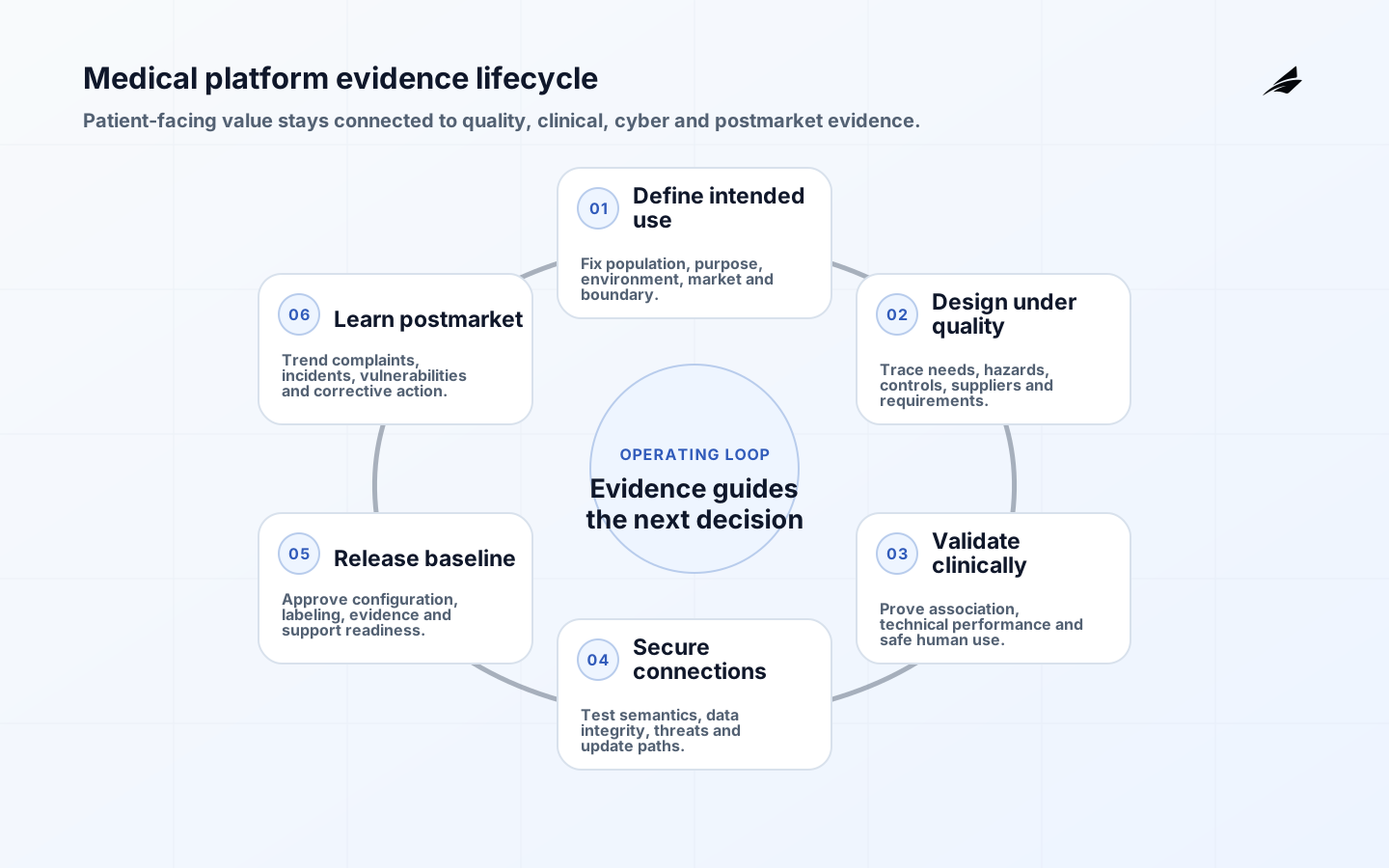
Medical device platforms connect device software, cloud services, clinician applications, patient interfaces, data pipelines, support tools and cybersecurity operations. The product challenge is not merely building a secure SaaS backend. Intended use and patient impact determine whether functions are regulated and what evidence is needed. Teams must identify each jurisdiction and obtain qualified regulatory, clinical, quality and security advice. This guide explains an engineering operating model; it is not a classification decision or legal advice.
Use it with the medical device platform implementation checklist, the medical device platform FAQ and the products and platforms guide. For the United States, FDA's QMSR became effective February 2, 2026 and incorporates ISO 13485:2016 by reference. Other markets have different classification, evidence, privacy and vigilance requirements.
Define intended use and regulatory boundary
Write the intended user, patient population, use environment, input, output and clinical purpose of every function. Separate device functions from wellness, administrative and infrastructure capabilities without assuming a label removes oversight. FDA's software policy focuses regulatory attention on device software functions whose failure could create patient risk. Record jurisdiction, classification hypothesis, submission path and competent reviewer. Marketing claims, interface text and analytics must remain consistent with the authorized intended use.
Draw the system boundary across device, mobile app, cloud, integration, support portal and third parties. Identify which organization is the legal manufacturer, specification developer, supplier, operator and health-care delivery organization. Allocate quality and cybersecurity duties contractually. A cloud provider's certification does not validate the medical function, and a hospital operating procedure does not replace manufacturer design controls. Maintain one traceable product configuration for each marketed version.
| Decision | Question | Evidence owner |
|---|---|---|
| Intended use | What medical purpose and population? | Product, clinical and regulatory |
| Function boundary | Which components affect safety or effectiveness? | Systems engineering |
| Risk class | What harm can failure cause? | Regulatory and risk management |
| Market | Which authority and submission apply? | Regulatory affairs |
| Change | Could the modification affect cleared claims or risk? | Change review board |
Build the platform inside the quality system
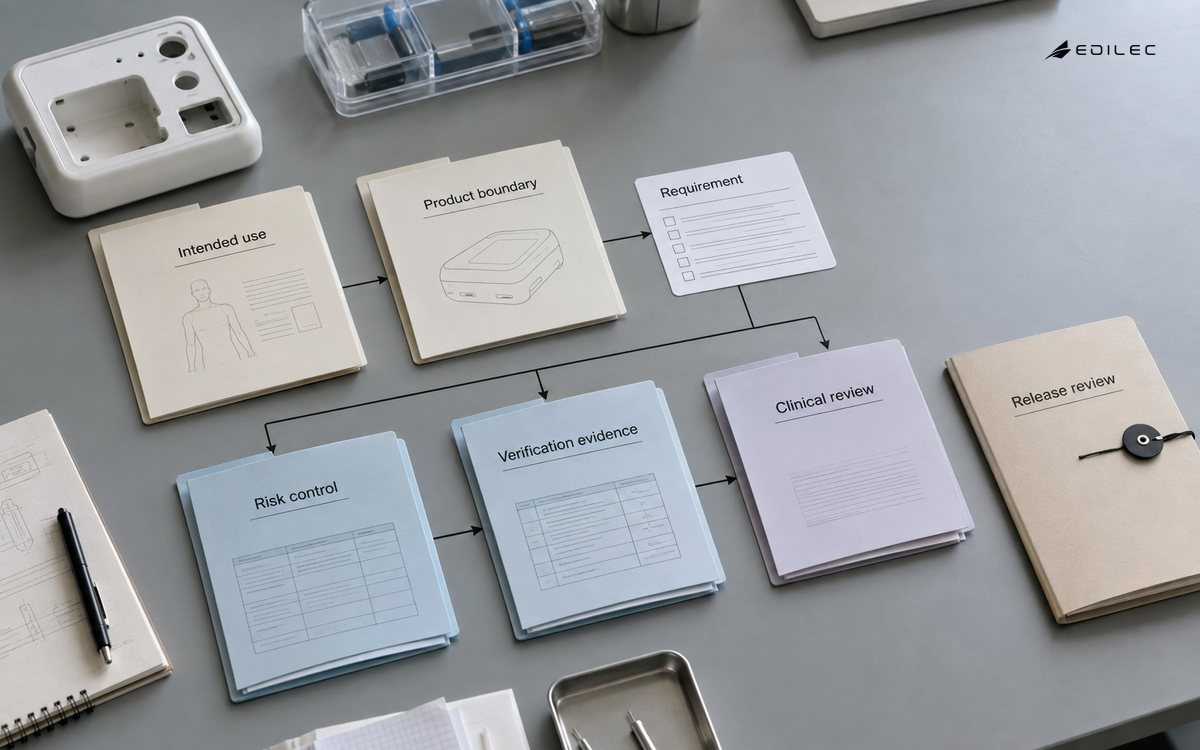
Connect user needs, system requirements, architecture, risk controls, implementation, verification, validation and release through traceability. Control documents, records, suppliers, nonconformities, complaints and corrective action under the applicable quality system. The QMSR aligns U.S. device CGMP requirements more closely with ISO 13485, but teams must read the incorporated and supplemental requirements rather than treating certification as automatic compliance. Validate software tools whose failure could compromise product quality according to intended use and risk.
Run risk management continuously. Identify hazards from incorrect output, delay, unavailable service, confusing presentation, interoperability, cybersecurity, use error and maintenance. Estimate risk using the organization's approved method, choose controls in an appropriate hierarchy, and verify implementation and effectiveness. Review residual risk and benefit with accountable clinical and regulatory input. Production incidents and complaints must feed the risk file; a static premarket worksheet does not manage an evolving platform.
Plan clinical evaluation and human factors
IMDRF describes SaMD clinical evaluation through valid clinical association, analytical or technical validation and clinical validation. Translate that framework to the function and risk. Define the question, reference standard, representative population, endpoints, sample justification, protocol, analysis and limitations before collecting convenient data. Separate algorithm performance from workflow outcome. Monitor subgroup behavior and data drift where relevant, and prevent retrospective metric selection from overstating performance.
Validate the whole user interaction in realistic environments, including alarms, connectivity loss, interruptions, accessibility, language and training. Observe representative clinicians, patients and support staff completing critical tasks. Treat use-related hazards as design issues, not user failures. Make uncertainty and required confirmation visible. A platform that produces accurate output but encourages a predictable unsafe action has not demonstrated safe use.
Engineer safe interoperability and data integrity
FDA defines interoperability as safely, securely and effectively exchanging and using information. Specify data semantics, units, ranges, timing, identity matching, provenance, versioning, error behavior and the permitted effect on another system. Validate normal, malformed, stale, duplicated, missing and out-of-order data. Label interface capabilities and limitations. An accepted message does not prove the receiving workflow interpreted it safely.
Protect data integrity from acquisition through clinical display and audit. Record transformations and model or rule versions, synchronize time, detect incomplete transfers and reconcile critical totals. Minimize personal data and apply applicable consent, access, retention and deletion rules. Separate production from research uses and govern secondary datasets. De-identification must be assessed against context and re-identification risk, not assumed from removing names.
Operate cybersecurity across the device lifecycle
FDA's February 2026 guidance recommends cybersecurity design and premarket documentation for devices with cybersecurity risk and addresses statutory requirements for cyber devices. Maintain threat models, security architecture, software bill of materials, vulnerability assessment, secure update, coordinated disclosure and incident communication. Use least privilege, authenticated updates, cryptographic key management, logging and resilience. Protect patient safety during cyber degradation, not only confidentiality.
Monitor dependencies and fielded versions, assess new vulnerabilities in device context, test patches and communicate mitigations. Define support periods and end-of-support transitions before launch. Rehearse a cloud outage, credential compromise, vulnerable component and failed update with manufacturer, provider and care organization roles. Security work belongs in design history, change control and postmarket processes; a penetration test immediately before submission is too late.
| Release evidence | What it proves | Failure that blocks release |
|---|---|---|
| Trace matrix | Needs, risks and tests are connected | Unverified critical control |
| Clinical report | Performance supports intended use | Unresolved population limitation |
| Interoperability results | Interfaces fail safely and preserve meaning | Silent unit or identity error |
| Cybersecurity file | Threats, components and updates are managed | No viable patch or vulnerability process |
| Operational readiness | Support, complaints and vigilance work | No accountable escalation route |
Release through controlled evidence and postmarket learning
Establish a release baseline containing code, infrastructure, configuration, device identifiers, labeling, training, risk file, test evidence, SBOM and approved suppliers. Use independent review proportionate to risk. Validate deployment, rollback or safe forward correction, data migration, backup and support. Confirm the marketed configuration matches the reviewed product. Feature flags need quality-system control because enabling a dormant function can be a product change.
After launch, trend complaints, adverse events, service reliability, cybersecurity, false results, subgroup performance and use problems. Define reportability and escalation with qualified personnel. Investigate root causes across the platform and supplier chain, implement corrective action and verify effectiveness. Assess each change for regulatory impact before release. Postmarket monitoring is part of the product evidence lifecycle, not a customer-support dashboard.
A ten-step platform delivery procedure
Create a cross-functional product plan controlled under the quality system. Regulatory, clinical, quality, security, engineering, human factors and postmarket owners should review the same product boundary and configuration. The sequence below is deliberately evidence-led; a gate may send the team back when intended use or risk changes.
- Approve intended use, users, population, environment, clinical purpose, claims, jurisdictions and initial classification with qualified reviewers.
- Map device and non-device functions across hardware, apps, cloud, interfaces, support tools, suppliers and legal-manufacturer responsibilities.
- Establish design, document, supplier, software-tool, nonconformity, complaint and corrective-action controls inside the applicable quality system.
- Translate patient and user needs into requirements, quality attributes, hazards, risk controls and traceable acceptance evidence.
- Plan clinical evaluation and human-factors studies with representative populations, predefined endpoints, reference standards and known limitations.
- Specify interoperability semantics, identity, units, timing, provenance, errors, version compatibility and safe behavior for malformed or stale data.
- Threat-model the fielded system, maintain the SBOM, design secure updates, define vulnerability response and rehearse cyber degradation.
- Verify implementation, validate intended use, reconcile data and independently review unresolved safety, quality and cybersecurity findings.
- Approve one release baseline containing software, infrastructure, configuration, labeling, training, evidence, suppliers and support readiness.
- Monitor complaints, adverse events, reliability, subgroup behavior and vulnerabilities; assess every change and verify corrective-action effectiveness.
Key takeaways
- Anchor every platform function to intended use, jurisdiction and patient risk.
- Build traceability, supplier control and change evidence inside the quality system.
- Evaluate clinical validity and realistic human use, not algorithm metrics alone.
- Specify interoperability semantics and failure behavior end to end.
- Operate cybersecurity, complaints and corrective action across fielded versions.
Frequently asked questions
Can a medical device platform use public cloud?
Potentially, when the architecture, provider controls, shared responsibilities, jurisdiction, validation and continuity meet product requirements. Cloud certification alone does not establish device safety or regulatory compliance.
Is every health application SaMD?
No. Classification depends on intended use, function and jurisdiction. Obtain a documented determination from qualified regulatory professionals before relying on wellness or administrative labels.
Can an AI model update continuously after release?
Only within an applicable authorized and controlled change approach. Every market has requirements. Maintain version traceability, validation, risk review and regulatory assessment rather than allowing uncontrolled learning in production.
Control environments and test artifacts with the same configuration discipline as code. Record device and operating-system versions, browsers, network conditions, datasets, simulators, instruments, calibration, model version and infrastructure configuration that produced a result. Investigate deviations rather than rerunning until a test passes. When production includes multiple supported combinations, use a risk-based compatibility matrix and field telemetry to keep validation representative.
Prepare communication before a safety or cybersecurity event. Define contacts for regulators, health-care organizations, patients, researchers, suppliers and media; identify who approves risk language and recommended action. Communications should distinguish known fact, uncertainty, affected configurations and immediate mitigation. Coordinate vulnerability disclosure without delaying necessary patient-safety information. After action, reconcile which fielded versions received, installed and successfully completed the correction.
Set reliability objectives around clinical use, not generic uptime. Measure whether required information is correct, timely and available at the point of care, including degraded and recovery states. Define maintenance windows and notification with care organizations. Where temporary unavailability can affect treatment, provide safe operating instructions and verify that users can recognize the state instead of trusting stale output.
Conclusion
A medical device platform is a regulated product system, not a generic app with added documents. Intended use, quality management, clinical evidence, human factors, interoperability, cybersecurity and postmarket learning must form one traceable lifecycle. That structure lets teams innovate while keeping patient safety and accountable evidence ahead of release pressure.