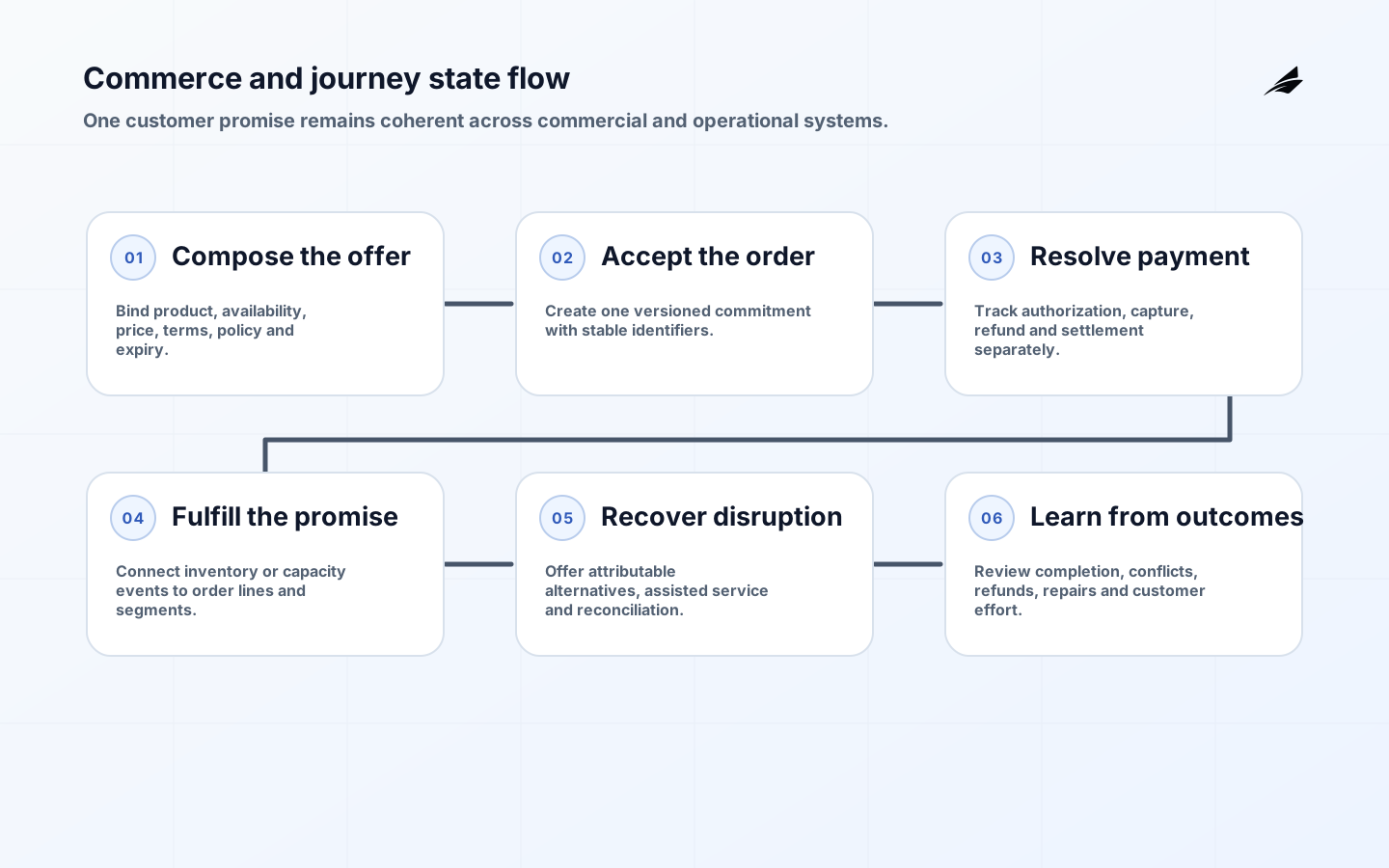
Retail, travel and transportation systems promise a customer something that operations must fulfill through changing inventory, capacity, price, location and disruption. The platform has to preserve one coherent commitment across digital channels, stores, stations, vehicles, partners, payments and service desks. This retail, travel and transportation systems implementation checklist focuses on state, ownership and reconciliation from offer through fulfillment and after-sales service.
Use the retail, travel and transportation business guide to frame the operating model and the sector systems FAQ for architecture questions. The retail, travel and transportation FAQ covers post-launch concerns. Start with one end-to-end journey and its exception paths, not a channel-by-channel replacement plan.
Define the customer promise and operating boundary
Map the journey from discovery and offer to order, payment, allocation, delivery or travel, change, refund and support. Name the customer, agent, merchant, carrier, supplier and operator roles. Define which legal entity makes the offer, collects funds, supplies the service and handles claims. Include assisted and offline channels. A smooth web checkout is not success if a station or store cannot see, change or honor the resulting order.
Write measurable promises: price validity, availability hold, delivery or departure window, accessibility service, refund timing and disruption communication. Separate an offer from a confirmed order and a reservation from fulfilled service. Record terms, currency, taxes, fees, products or segments and policy version at commitment time so later rule changes do not silently alter the contract.
| State | Required authority | Key invariant |
|---|---|---|
| Offer | Pricing and availability services | Terms, scope and expiry are explicit |
| Order | Order management system | One identifier represents the accepted commitment |
| Payment | Payment provider and financial ledger | Authorization, capture, refund and liability reconcile |
| Fulfillment | Inventory, carrier or field operation | Delivered quantity or service maps to the order |
| After-sales | Order and policy services | Changes preserve history and financial effect |
| Disruption | Operational control | Alternatives and communication remain attributable |
Design an authoritative order and event model

Define stable identifiers for customer or traveler, offer, order, line or segment, product, location, asset, payment and fulfillment event. Specify state transitions and who may perform each one. Use idempotency keys and event versions so retries do not create duplicate charges or shipments. Preserve the sequence and source of changes; do not overwrite a canceled or rebooked state without retaining the prior commitment and financial consequence.
Airline retailing is moving toward offers and orders. IATA's airline retailing program describes modern retailing supported by NDC, ONE Order and related standards. ONE Order aims to create a single integrated customer order record for fulfillment, delivery and accounting while phasing out separate legacy booking and ticketing artifacts. Implement standards against official schemas and agreed business semantics, not only successful message transport.
Control inventory, capacity and traceability
Determine the unit of availability: item, location, room, seat, vehicle capacity, time slot or service segment. Define hold, allocation, release, substitution and oversell rules and how quickly channels receive updates. Distinguish physical stock, sellable stock, safety stock and promised stock. In travel, distinguish schedule, availability, confirmed service and operational status. Expose staleness and do not present cached availability as a guaranteed commitment.
For supply-chain events, the GS1 EPCIS 2.0 standard provides a common language for visibility and supports JSON/JSON-LD, REST capture and query, sensor data and certification details. Use event standards where partners need interoperable traceability. Record what happened, when, where, why and to which objects. Validate identifiers, time zones, aggregation and correction events, and protect commercially sensitive or personal data in shared event networks.
- Reconcile item, service, location and partner master data before transaction migration.
- Define availability authority, cache limits and channel behavior when it is unreachable.
- Use idempotent reservation, payment and fulfillment commands.
- Preserve event time, processing time, source and correction history.
- Test split, partial, substituted, canceled, delayed and returned fulfillment.
- Provide operations with a queue for state conflicts and a controlled repair action.
Separate order and payment state
An order can exist before payment succeeds, and payment can settle after an order changes. Model authorization, authentication, capture, void, refund, chargeback and settlement as related but distinct states. Tokenize payment credentials and minimize the cardholder data environment. The PCI Data Security Standard provides baseline technical and operational requirements for entities that store, process or transmit account data or can affect its security. Confirm scope with qualified expertise.
Reconcile the order subledger, payment provider, bank or acquirer and general ledger. Test currency conversion, rounding, tax, fees, split tender, partial capture, partial refund, expired authorization and partner settlement. Every manual adjustment should require a reason, authority and audit record. Customer support should see enough payment state to explain the next action without exposing full payment data.
| Scenario | Test | Expected operational evidence |
|---|---|---|
| Duplicate request | Repeat checkout or booking command | One order and one intended financial effect |
| Partial fulfillment | Deliver one of several lines or segments | Remaining commitment and refund eligibility are clear |
| Disruption | Cancel or delay a service after payment | Affected orders, alternatives and notices are traceable |
| Offline operation | Lose network during scan or service | Queued events reconcile without silent duplication |
| Partner failure | Timeout after uncertain response | Inquiry or retry resolves state safely |
| Privacy request | Access, correction or deletion workflow | Applicable records and retention exceptions are handled |
Build accessible and assisted journeys
Accessibility is an end-to-end service property. Apply WCAG 2.2 to web and mobile interfaces, test keyboard and assistive technology use, and include accessible authentication, errors, timeouts and payment. Preserve assistance needs and communication preferences with appropriate consent and privacy. Do not force customers to disclose sensitive details repeatedly when a verified service request can travel with the order.
Design an assisted path for customers and frontline staff when self-service fails. Agents need a unified view of order history, eligibility, payment consequence, operational status and permitted actions. High-risk overrides should require reason and approval without making routine recovery impossible. Test call center, store, airport, station and field workflows under peak load and disruption, because these channels absorb failures from the digital path.
Govern customer and journey data
Map personal data across identity, loyalty, payment, location, travel documents, preferences, support and partner exchanges. Define purpose, retention, residency, access and deletion or correction behavior for each class. The NIST Privacy Framework helps organizations manage privacy risk through enterprise risk management. Evaluate adverse consequences of combining purchase, location and behavior data even when every source was collected legitimately.
Keep analytics and personalization separate from operational necessity. A customer may need an order fulfilled without consenting to unrelated profiling. Enforce partner data minimization and deletion commitments and audit exports. Use pseudonymous identifiers where possible and restrict sensitive data in support screenshots, logs and non-production environments. Incident procedures should identify affected journeys and partners quickly.
Migrate and cut over by journey
Choose a bounded market, product, route, location or channel that exercises the core state model. Reconcile open orders, inventory, payments, entitlements and customer communications before cutover. Decide whether legacy orders remain in the old system, are migrated or are represented through a service layer. Test mixed journeys in which booking or purchase occurs before cutover and fulfillment or refund occurs afterward.
Run operational simulations for peak demand, inventory conflict, payment degradation, carrier or partner failure, mass disruption and rollback. Define command ownership and customer communication. Monitor completion, state conflicts, oversell, duplicate financial effects, refund age, assistance failures and manual repair. Expand only after frontline teams can resolve exceptions and financial reconciliation closes.
Implementation example: disrupted multi-segment journey
A customer buys two travel segments and an ancillary service through a partner. Payment is authorized once, while each segment has independent fulfillment state. When the first segment is canceled, the operational event identifies affected orders and eligible alternatives. The order service preserves the original offer and creates a versioned change proposal with price and refund effect. The customer can accept digitally or use an assisted channel that sees the same options and accessibility request.
Tests cover duplicate cancellation events, partner timeout after rebooking, partial ancillary refund, expired payment authorization and offline station scanning. Reconciliation proves the final order, delivered services, provider captures, refund and settlement. Communications record channel, template version and delivery result. Accessibility testing verifies that the changed journey and assisted route expose equivalent information and actions. Operations monitor customers without a viable alternative and exceptions older than the service objective. This scenario exercises the platform's real value: maintaining a coherent commitment and financial record when the happy path breaks.
Measure journeys and operational recovery
Measure completed journeys rather than isolated channel clicks. Track offer-to-order conversion with availability accuracy, fulfillment attainment, state conflicts, duplicate financial effects, refund age, assisted-service completion, disruption recovery and reconciliation exceptions. Segment results by product, route or location, partner, channel and accessibility need where lawful and useful. Pair averages with tail performance because a small group can experience severe delay. Review manual repairs to identify broken contracts or missing platform actions, then verify that fixes reduce both customer effort and operator workload.
Key takeaways
- Model the customer promise and its exceptions across every channel and operator.
- Use authoritative order state, stable identifiers and idempotent transitions.
- Separate inventory, payment and fulfillment while reconciling their effects.
- Apply industry standards with agreed semantics and conformance testing.
- Make accessibility, assisted service and privacy part of the core journey.
- Cut over by bounded journeys and prove disruption, repair and financial close.
Should retail, travel and transportation share one platform?
They can share capabilities such as identity, offer composition, order state, payments, communication and observability, but domain rules and operational authorities differ. Build shared contracts and platform services around stable common needs. Keep airline, hotel, retail inventory or transport-control logic in owned domains. One database is not required for one coherent journey.
Conclusion
Dependable retail, travel and transportation systems preserve a promise through volatile operations. Clear state, authority, standards, reconciliation and assisted recovery matter more than a seamless happy path. Implement one bounded journey, prove its exceptions and expand with evidence from customers, frontline teams and financial close.