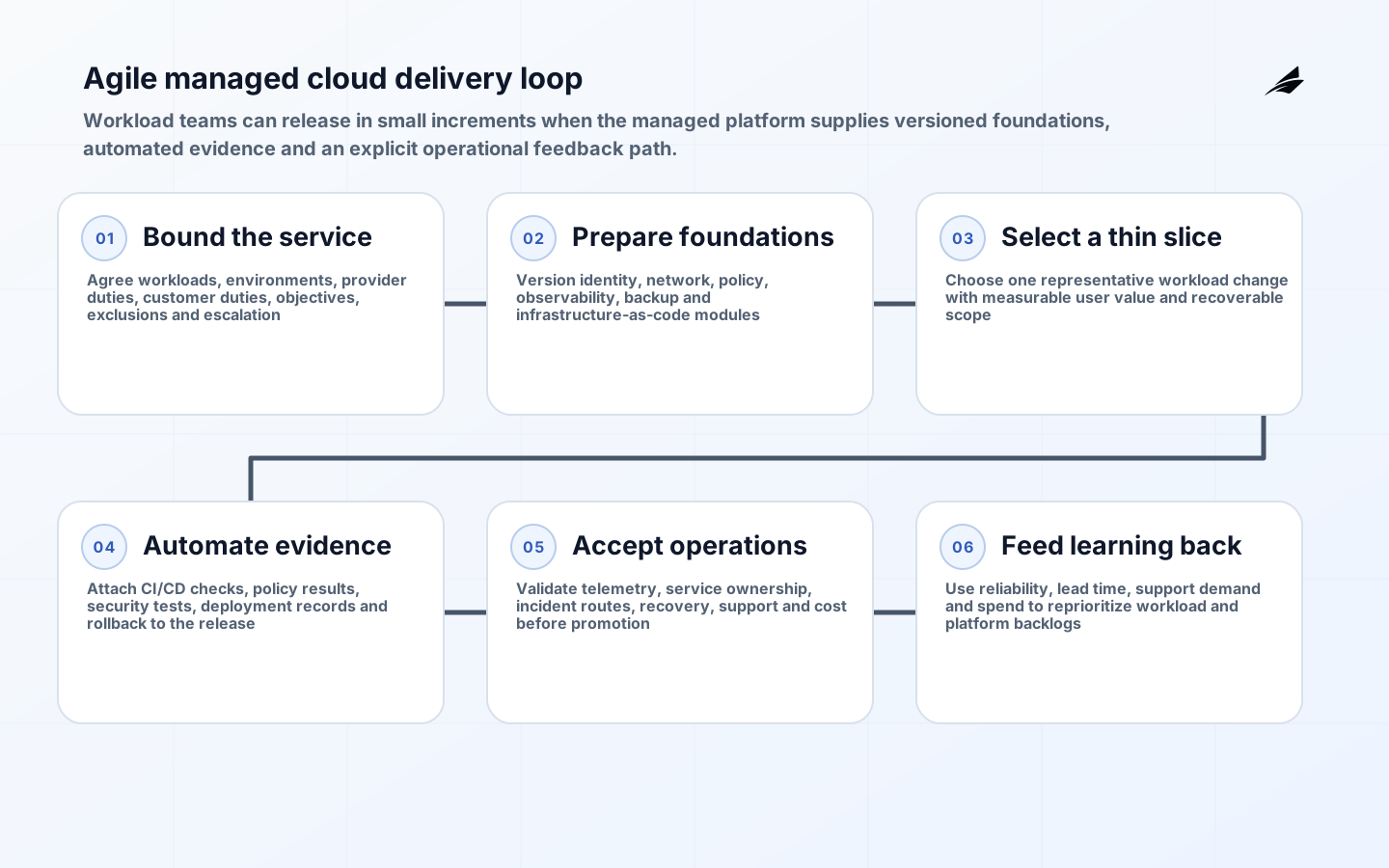
An agile managed cloud services implementation checklist should connect rapid learning with disciplined operations. Agile does not mean accepting unplanned change without evidence, and managed service does not mean transferring all accountability to a supplier. The customer remains accountable for business priorities, risk tolerance and data obligations; the provider owns the operational activities explicitly assigned in the contract. A successful implementation makes that boundary observable through a shared backlog, service objectives, change records, incident evidence and cost decisions. It also gives both parties a repeatable way to improve automation, reliability and user outcomes after transition.
Use this checklist with the managed cloud scope and delivery plan and managed cloud FAQ. The implementation should begin with a baseline of workloads, dependencies, incidents, costs and team responsibilities. Without that baseline, a provider may report activity while neither party can prove improvement. The goal is a service that can release routine changes safely, respond to failure, explain spending and adapt priorities without bypassing security or exhausting operations staff.
Define service outcomes and the management boundary
Inventory each workload by business owner, users, critical transactions, data classification, deployment path, dependencies, recovery objectives and existing support commitments. Then state which activities the managed service will perform: monitoring, incident response, backup, patching, vulnerability remediation, deployment, platform engineering, cost management or advisory work. Avoid phrases such as end-to-end management unless the endpoints are named. A responsibility matrix should identify who decides, who executes, who approves risk and who communicates during normal work and incidents. Shared responsibility must become task-level responsibility before transition.
Define exclusions and assumptions as carefully as included work. A service cannot guarantee recovery if application owners have not supplied restore tests, and it cannot optimize cost if teams can create untagged resources outside guardrails. Record customer dependencies, third-party contracts, maintenance windows, regulatory constraints and required access. The general managed cloud implementation checklist can help identify baseline operational controls; this article adds the agile decision cadence needed to evolve them without confusing backlog movement with service value.
| Service area | Customer accountability | Provider accountability | Acceptance evidence |
|---|---|---|---|
| Reliability | Set business criticality and approve SLO trade-offs. | Operate telemetry, response and tested recovery procedures. | SLIs, error budgets, drills and incident records reconcile. |
| Security | Set risk tolerance, data rules and exception authority. | Apply assigned controls, monitor and report control health. | Access, vulnerability and incident evidence is reviewable. |
| Change | Prioritize outcomes and accept material business risk. | Automate, test, release and recover within the agreed path. | Lead time, failure rate and rollback evidence are visible. |
| Cost | Own budgets, product value and consumption decisions. | Allocate spend, surface anomalies and propose optimization. | Invoices reconcile to tagged usage and named owners. |
| Suppliers | Approve critical dependencies and exit tolerance. | Manage assigned subcontractors and disclose material change. | Dependency register, assurance and exit artifacts stay current. |
Baseline the estate before service transition
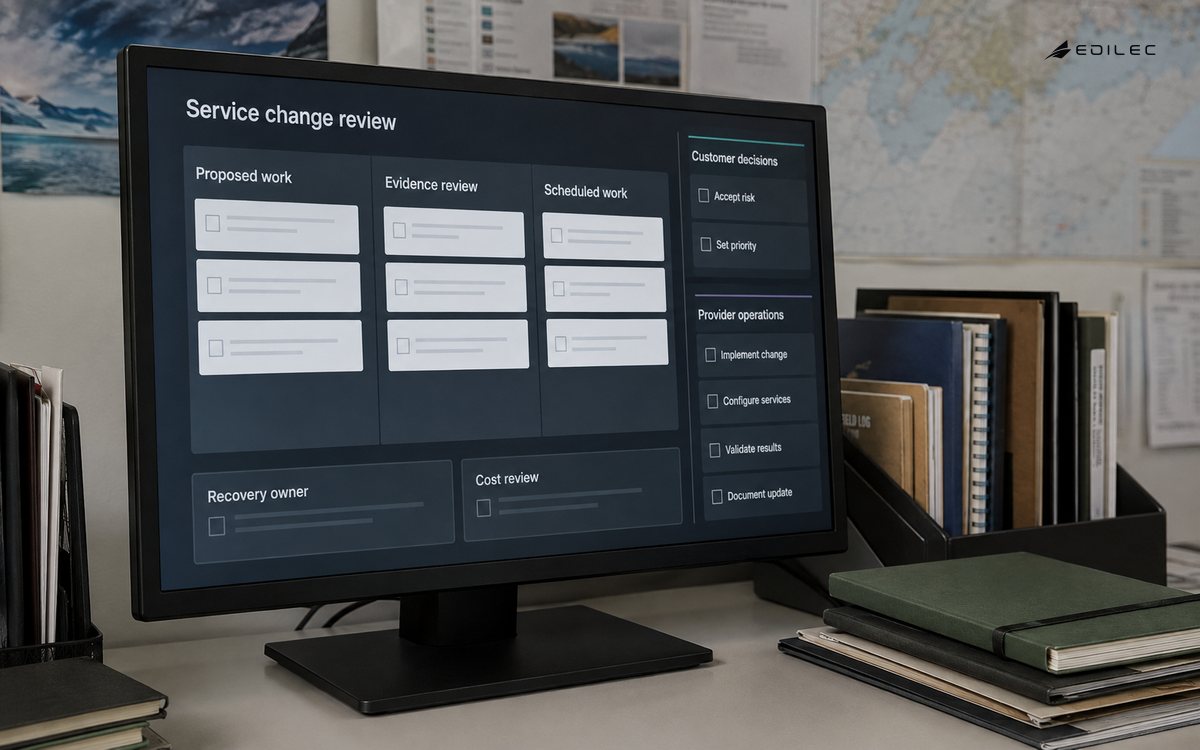
Discovery must use technical evidence as well as interviews. Export cloud inventory, identity assignments, network routes, image and package versions, backup status, vulnerability findings, monitoring coverage, incident history and billing data. Map application dependencies and scheduled jobs because a quiet component may still be critical at month end. Classify unknowns instead of converting them into optimistic assumptions. The transition register should track each workload from discovered through documented, observed, shadow-supported, accepted and fully operated, with objective entry and exit criteria for every state.
Run knowledge transfer as paired operation. The incoming team should observe current staff, execute procedures under supervision and then lead while incumbents observe. Validate credentials, escalation contacts, vendor access, certificates, deployment keys, backup restoration and out-of-hours communication. Do not close transition because documents were delivered; close it when the new team can detect, diagnose, communicate and recover representative failures. Carry unresolved risks into a dated remediation backlog with accountable owners rather than hiding them in transition minutes.
Set SLOs, incident paths and recovery evidence
Define service level indicators around user-visible behavior: successful transactions, valid responses, latency, freshness or durable processing. The Google SRE guidance on SLOs starts from what users care about and works backward to measurable indicators. Set an objective and measurement window, then identify what action follows budget consumption. Infrastructure availability alone is insufficient when an application returns errors or stale data. SLAs can govern commercial remedies, but SLOs should guide engineering decisions before contractual failure occurs.
Create severity definitions from business impact, not the seniority of the person reporting. For each severity, name command authority, technical response, communications, evidence preservation and update cadence. Incident tooling should provide one timeline across alerts, actions, decisions and customer messages. After restoration, conduct a learning review that separates contributing conditions from individual blame and converts findings into prioritized work. Test backup restoration, regional failover, credential recovery and supplier escalation; a backup job marked successful is not proof that the service can recover within its objectives.
Implement security and supplier controls
Use named, least-privileged identities for operators and automation. Require strong authentication, time-bound elevation, session or command evidence where proportionate, and alerts for privilege changes or unusual access. Separate customer tenants and production from non-production. Define patch and vulnerability clocks by exploitability, exposure and asset importance rather than one undifferentiated score. The NIST Cybersecurity Framework 2.0 helps connect governance, protection, detection, response and recovery outcomes to responsible roles and evidence.
A managed provider can become a high-impact route into many customer systems. CISA and international partners emphasize transparent discussion and baseline protections in their guidance for managed service providers and customers. Contracts should address subcontractors, identity separation, logging access, vulnerability disclosure, incident notification, forensic cooperation, data location, service termination and secure return or deletion. Exercise the exit process before it is urgent, including export formats and removal of provider identities.
| Control signal | Healthy condition | Trigger for action | Required response |
|---|---|---|---|
| Error budget | User-facing reliability remains within the agreed objective. | Budget burns faster than the review threshold. | Pause risky change and prioritize reliability work. |
| Change failure | Routine releases use one repeatable low-risk path. | Rollback, hotfix or customer impact rises. | Review batch size, tests, approvals and architecture. |
| Privileged access | Elevation is attributable, bounded and reviewed. | Standing privilege or unexplained access appears. | Revoke, investigate and correct the access design. |
| Vulnerability exposure | Findings meet risk-based remediation clocks. | Known exploitation or overdue critical exposure occurs. | Contain, patch, validate and communicate residual risk. |
| Cloud spend | Usage is allocated and tied to service value. | Anomaly, idle capacity or ownerless spend persists. | Stop waste safely and assign an economic decision owner. |
Build a safe automation and change path
Store infrastructure, policy and deployment definitions in version control. Require peer review, automated validation, environment promotion and an attributable release record. Protect state files and secrets, pin or verify dependencies and prevent direct production drift except through a declared emergency path. Small changes are useful only when they move through a reliable system. DORA's continuous delivery research links low-risk releases with short lead times, low change failure and rapid restoration, while warning that deployment frequency without process and architecture improvement can increase failure and burnout.
Treat operational toil as backlog evidence. Repeated manual restarts, alert triage, access grants and report assembly should be measured by frequency, effort and risk. Automate work when the process is understood, testable and recoverable; do not automate ambiguity into a faster failure. Every automated action needs an owner, telemetry, bounded retries, safe handling of partial success and a route for human intervention. Review emergency changes for patterns, but retain a fast path that uses the same core controls wherever possible rather than creating an invisible parallel release system.
Govern cloud cost and capacity continuously
Create allocation standards for account or project hierarchy, labels, environments and shared services before optimizing. Reconcile provider invoices with usage exports and business ownership. Budgets and anomaly alerts need named responders and decision thresholds; an alert with no action model is noise. Evaluate reservations, savings commitments and architectural changes against credible demand and exit plans. Cost per transaction, customer or environment is more useful than a total bill when it can be measured consistently. Include support, data transfer, observability, licensing and staff effort in total service economics.
Capacity planning should combine demand forecasts, load tests, quotas, scaling ceilings and dependency limits. Autoscaling does not remove the need to understand database connections, third-party rate limits or regional resource availability. Set maximums to contain cost but test whether they fail predictably under demand. Review idle resources only after confirming recovery and retention requirements. Optimization proposals should state expected saving, reliability impact, implementation effort, reversibility and owner, allowing product teams to make economic decisions instead of receiving an unexplained list of underutilized resources.
Run an agile service cadence around evidence
Use one visible backlog for reliability, security, cost, automation, technical debt and requested change. Prioritize by business impact, risk reduction, effort and time sensitivity. Daily coordination should unblock active operations; weekly service review should examine SLOs, incidents, changes, vulnerabilities and spend; monthly or quarterly governance should decide material investment, risk acceptance and supplier performance. Keep incident command separate from backlog ceremonies during an active disruption. Agile cadence helps decisions arrive at the right frequency, but it cannot replace accountable authority.
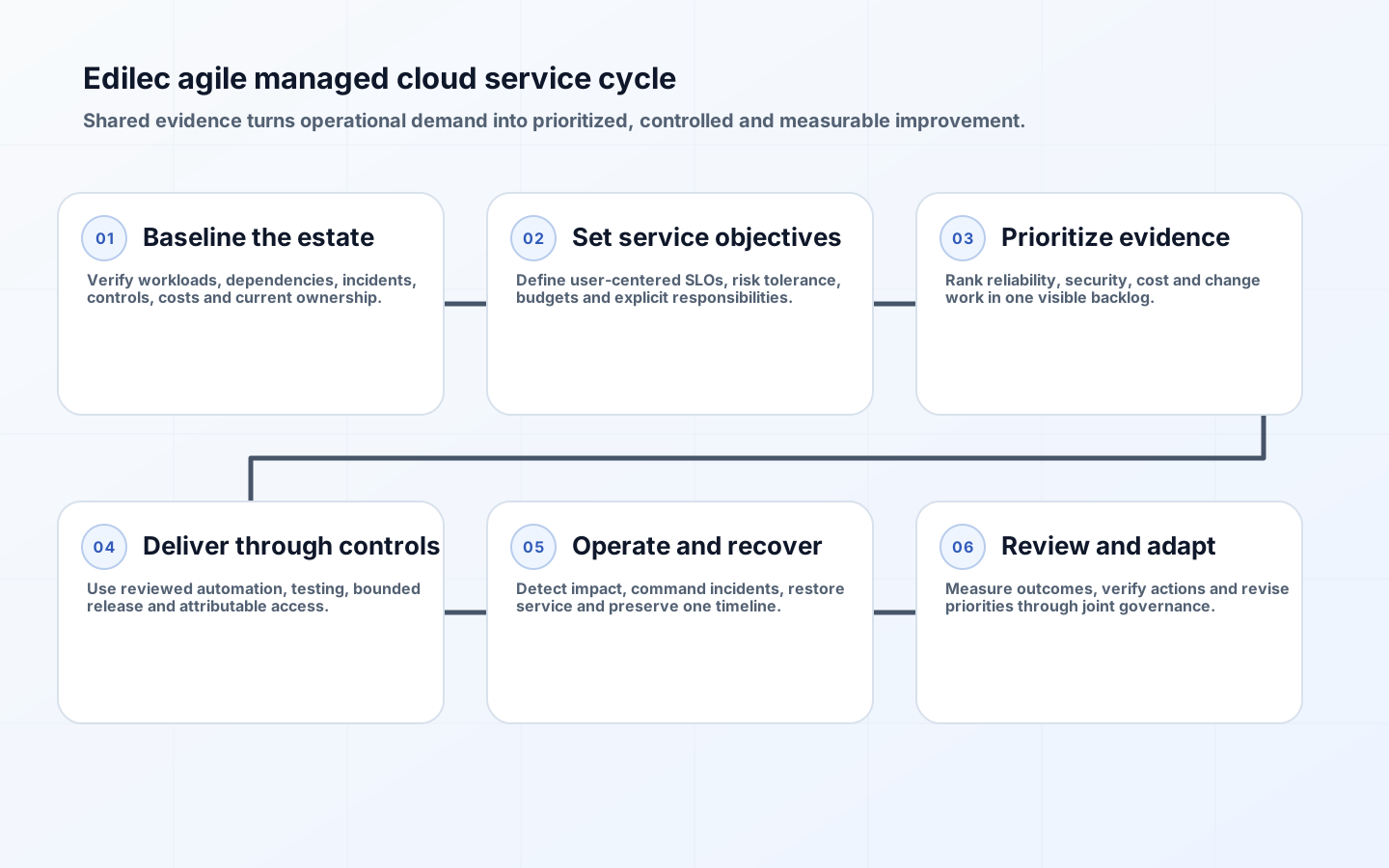
Define completion with evidence: code and policy reviewed, tests passed, telemetry active, runbook updated, security impact assessed, cost considered and rollback or forward recovery understood. Demonstrate outcomes in service language, such as reduced failed checkouts or faster restoration, rather than reporting story points as value. Track aging and blocked work because an apparently busy team can leave important risks untouched. Retrospectives should select a small number of owned improvements and verify whether previous actions changed the measured system.
Agile managed cloud takeaways
- Translate shared responsibility into task-level ownership, evidence and escalation.
- Accept transition only after the incoming team can operate and recover representative workloads.
- Use user-centered SLOs and error budgets to balance reliability with change.
- Protect managed-service access and include suppliers in incident, recovery and exit planning.
- Automate through versioned, testable paths with bounded failure and human intervention.
- Run one evidence-led backlog across reliability, security, cost and improvement work.
Frequently asked questions
Does agile managed service mean there is no fixed scope? No. The service boundary, accountability, control requirements and commercial model should be explicit. Agile methods govern how prioritized improvements and changes are selected and delivered within that boundary; material scope changes still require informed agreement.
Which metrics should appear in a managed cloud review? Include user-facing SLOs, incidents and recovery, change lead time and failure, vulnerability exposure, privileged access, backup restoration, cloud allocation and unit cost, backlog aging and unresolved risk. A compact set tied to decisions is better than a large dashboard nobody acts on.
Can the provider own all cloud risk? No. A provider can perform assigned controls and accept contractual liabilities, but the customer retains responsibility for business use, risk tolerance, data obligations and supplier oversight. Contracts and operating evidence should make the division clear.
Conclusion
Agile managed cloud services work when operational accountability and learning reinforce each other. A precise boundary, verified transition, user-centered SLOs, secure access, safe delivery, explainable cost and evidence-led cadence let the service improve without losing control. Completing this checklist produces more than a supplier handoff: it creates a joint operating system for making reliable decisions as workloads and priorities change.