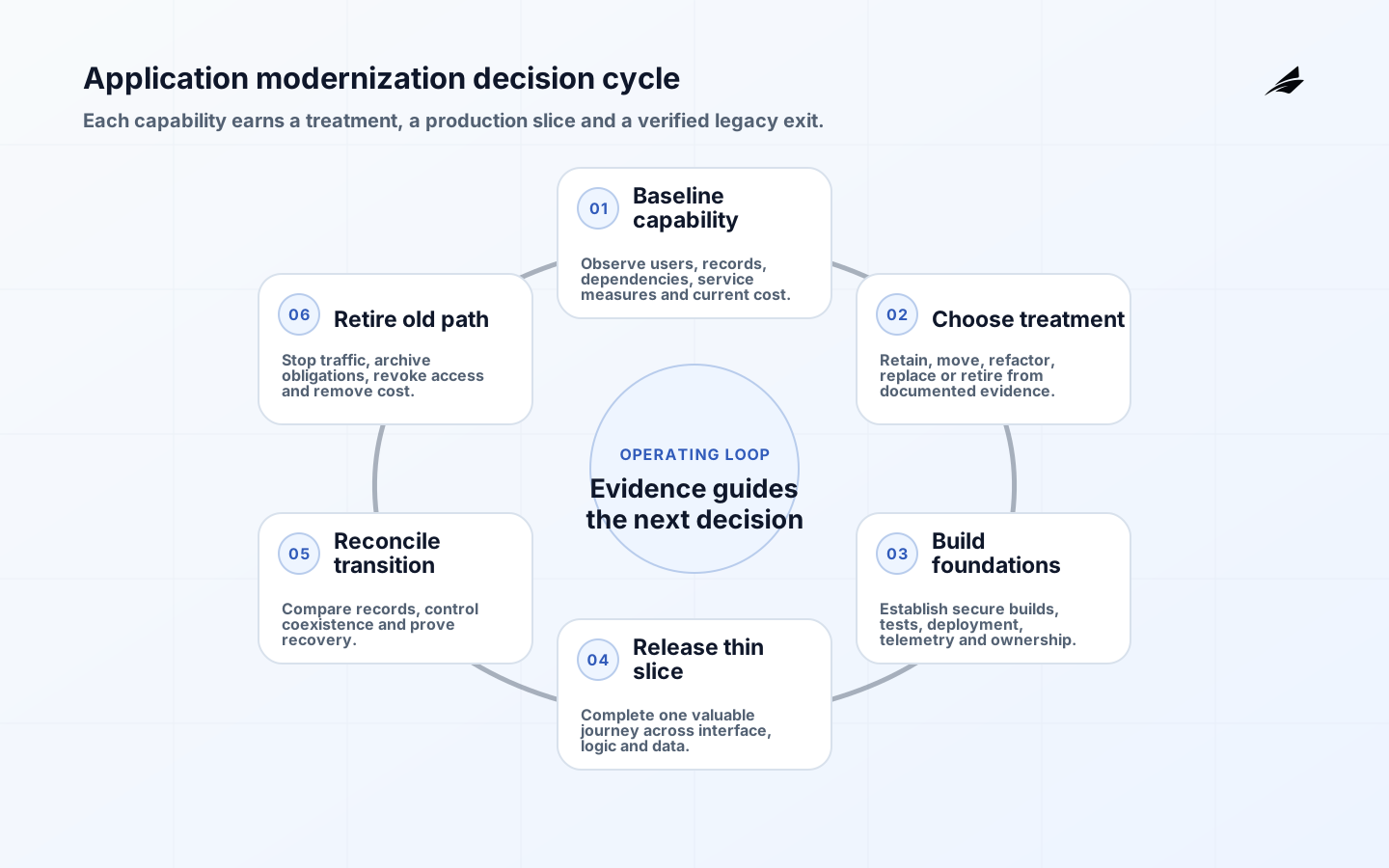
Application development and modernization is the coordinated work of improving how a business capability is delivered, not simply moving old code to newer infrastructure. It may involve building a new workflow, changing an existing application, replacing a package, exposing stable APIs, improving data quality, or retiring technology that no longer earns its operating cost. The strongest programs connect every technical change to a user outcome, an accountable service owner and an explicit plan for removing the old path.
This FAQ helps product, operations and technology leaders make the early decisions that determine modernization risk and value. For a staged execution view, use the development and modernization implementation checklist. Teams still comparing scope and commercial options can read the modernization delivery plan and the related software product engineering checklist.
What application modernization should change
A modernization initiative should change a measurable capability: how quickly a customer receives a decision, how reliably an order moves between systems, how safely a team releases software, or how much effort is spent reconciling records. Infrastructure age matters, but age alone is not a business case. A stable older system with clear ownership, supportable technology and acceptable performance may deserve retention. A newer service with weak controls, duplicated data and no recovery plan may need urgent redesign.
Define the capability boundary before selecting technology. Name the users, critical journeys, records, integrations, volume, regulatory obligations, availability needs and peak events. Record current cycle time, failure demand, support effort, release frequency and cost. These baselines turn broad language such as faster, scalable or cloud-ready into decisions that can be tested. They also prevent a platform migration from being declared successful while customers experience the same delays and manual exceptions.
How do you choose the right treatment?
| Treatment | Use it when | Evidence required |
|---|---|---|
| Retain and improve | The application remains fit, but operations, testing or observability are weak | Support horizon, service measures and a funded improvement backlog |
| Rehost or replatform | Infrastructure is the main constraint and behavior can remain stable | Compatibility test, cost model, recovery rehearsal and exit plan |
| Refactor by capability | Business change is blocked by tightly coupled code or data | Bounded domain, dependency map and incremental release path |
| Replace with a product | The capability is standard and configuration covers real needs | Fit-gap evidence, integration design, data migration and contract terms |
| Retire | Use is negligible, duplicated or no longer justified | Owner approval, retention obligations, archive and access revocation |
Treatment is best decided per capability rather than per application portfolio label. One large system can contain a commodity reporting function worth replacing, a differentiating pricing function worth refactoring and a dormant module worth retiring. Score options against user value, change frequency, security exposure, data sensitivity, vendor support, dependency complexity and transition cost. Keep the decision reversible until discovery has tested the assumptions most likely to change it.
What does a practical modernization roadmap look like?
- Discover one business capability through user observation, production evidence, dependency mapping and data profiling.
- Choose a treatment and document why the alternatives were rejected, including the assumptions that could reopen the decision.
- Establish delivery foundations: versioned source, reproducible builds, automated tests, secure environments, deployment controls, telemetry and named service ownership.
- Release a thin vertical slice that completes a real user outcome across interface, logic, data and integration boundaries.
- Run old and new paths together only where reconciliation rules, ownership, duration and exit criteria are explicit.
- Cut traffic over progressively, verify business records and recovery, then retire software, credentials, infrastructure and supplier cost.

The sequence should be expressed as outcomes, not a multiyear inventory of components. A useful quarterly milestone might be that service agents can correct one class of customer error in the new workflow and that the equivalent legacy screen is disabled. That milestone delivers user value and reduces the old estate. By contrast, finishing a generic service layer without a production user can create another platform that must be maintained before its value is known.
How should architecture and data coexistence be handled?
Architecture work should clarify ownership. For each important record, decide which system may create it, which system is authoritative, how changes are identified and how discrepancies are resolved. Prefer explicit, versioned contracts over direct access to another application's database. During coexistence, design idempotent processing, correlation identifiers, retries with limits, dead-letter handling and reconciliation reports. A message being delivered does not prove that its business effect happened once or that both systems interpret the record the same way.
Nonfunctional requirements belong in the first slice. Identity boundaries, least privilege, encryption, accessibility, response time, audit evidence, backup, restore and support diagnostics should be exercised on representative production-like data. NIST's SSDF organizes secure development around preparing the organization, protecting software, producing well-secured software and responding to vulnerabilities. Those practices are useful acceptance criteria for new foundations, not a security phase added after migration.
What drives modernization cost and duration?
| Cost driver | Questions to answer | Control |
|---|---|---|
| Discovery | Are rules documented, and can users explain exceptions? | Time-box research and produce testable capability maps |
| Data | How much history, duplication and semantic drift exists? | Profile early, define reconciliation and rehearse at scale |
| Integrations | Which consumers depend on undocumented behavior? | Observe traffic, version contracts and test failure modes |
| Coexistence | How long will two paths operate and who supports both? | Set an expiry date and fund retirement work |
| Assurance | Which security, accessibility and recovery evidence is mandatory? | Automate checks and schedule independent review |
| Change adoption | Which roles, policies and support processes must change? | Pilot with real users and measure completed work |
Estimate a bounded capability slice before estimating the whole estate. Include product discovery, engineering, testing, cloud or platform use, data remediation, vendor licenses, dual running, training, support and retirement. Present ranges tied to assumptions rather than a false single number. Duration often depends more on access to subject-matter experts, data quality and third-party release windows than on coding capacity. A commercial proposal should therefore price discovery and delivery gates separately and identify what evidence permits the next commitment.
Which risks deserve executive attention?
The largest risks are usually organizational and transitional: no owner for end-to-end outcomes, modernization funding that excludes retirement, business rules hidden in manual work, data copied without authority, and a cutover plan that has never been rehearsed. Security debt can also move unchanged into a new environment. CISA's secure-by-design guidance reinforces that customer security should be a core product responsibility. Require safe defaults, supported authentication, vulnerability response and useful evidence from suppliers and internal teams.
How is modernization success measured?
Use a balanced scorecard covering customer outcome, service reliability, delivery flow, security and total cost. A claims workflow might measure median time to decision, percentage completed without manual repair, successful requests, restoration time, lead time for an approved change, unresolved high-risk vulnerabilities and cost per completed claim. Define each measure, data source, owner and review cadence. Google SRE's SLO guidance is especially useful: measure behavior users care about, set an objective and agree what action follows when the error budget is consumed.
Compare modernized and legacy paths during rollout, but account for different case mixes. Segment by journey, user group and complexity so the new path is not credited merely because it receives easier work. Track retirement as a first-class result: disabled interfaces, revoked credentials, archived records, canceled licenses and removed infrastructure. Modernization is incomplete when the new application is live but the organization still pays and carries risk for every old component.
How should modernization be procured and owned?
Procure a bounded discovery and first capability slice with named team roles, customer-controlled repositories, evidence milestones and clear intellectual-property terms. Require suppliers to identify subcontractors, platform dependencies, data handling and handover obligations. Keep product priority, architecture acceptance, risk decisions and service ownership with named client leaders. The delivery partner can supply expertise and capacity, but accountability cannot be transferred through a statement of work. Pair internal staff from the beginning so knowledge grows while the product changes.
Key takeaways
- Start with a business capability and baseline, not a preferred platform.
- Choose retain, move, refactor, replace or retire per capability using explicit evidence.
- Deliver complete vertical slices so user value and legacy removal advance together.
- Treat data authority, coexistence and reconciliation as design decisions.
- Include security, accessibility, reliability and recovery in the first production slice.
- Measure outcomes and retirement, not only migrated components or engineering activity.
Frequently asked questions
Does modernization always mean moving to cloud?
No. Cloud services can improve provisioning, elasticity and access to managed capabilities, but they do not repair unclear ownership, poor data or brittle design automatically. Choose placement from latency, resilience, regulation, skills, cost and exit needs. A rehost can be a sensible infrastructure step, but it should not be presented as application transformation unless capability outcomes improve.
Is a full rewrite ever justified?
Sometimes, particularly when the existing model cannot represent the required capability or the technology cannot be supported safely. Even then, replace by bounded journey where possible. Full rewrites delay production evidence and invite teams to rediscover years of edge cases at once. Define parity selectively: preserve required outcomes and obligations, not every historical screen or accidental behavior.
What should happen in the first 30 days?
Select one valuable capability, name its owner, observe users, map data and dependencies, establish baseline measures and test the riskiest treatment assumption. End the month with a decision record, a thin-slice backlog, initial architecture boundaries and clear evidence needed for funding. Avoid promising an estate-wide completion date before data and dependency discovery.
Conclusion
Application development and modernization succeeds when each release improves a real capability and removes a verified portion of old risk. The disciplined path is to discover how work happens, select treatment from evidence, build secure delivery foundations, release narrow end-to-end slices, reconcile data and retire what the new path replaces. That approach gives leaders frequent investment decisions and gives users useful change long before a portfolio program reaches its final milestone.