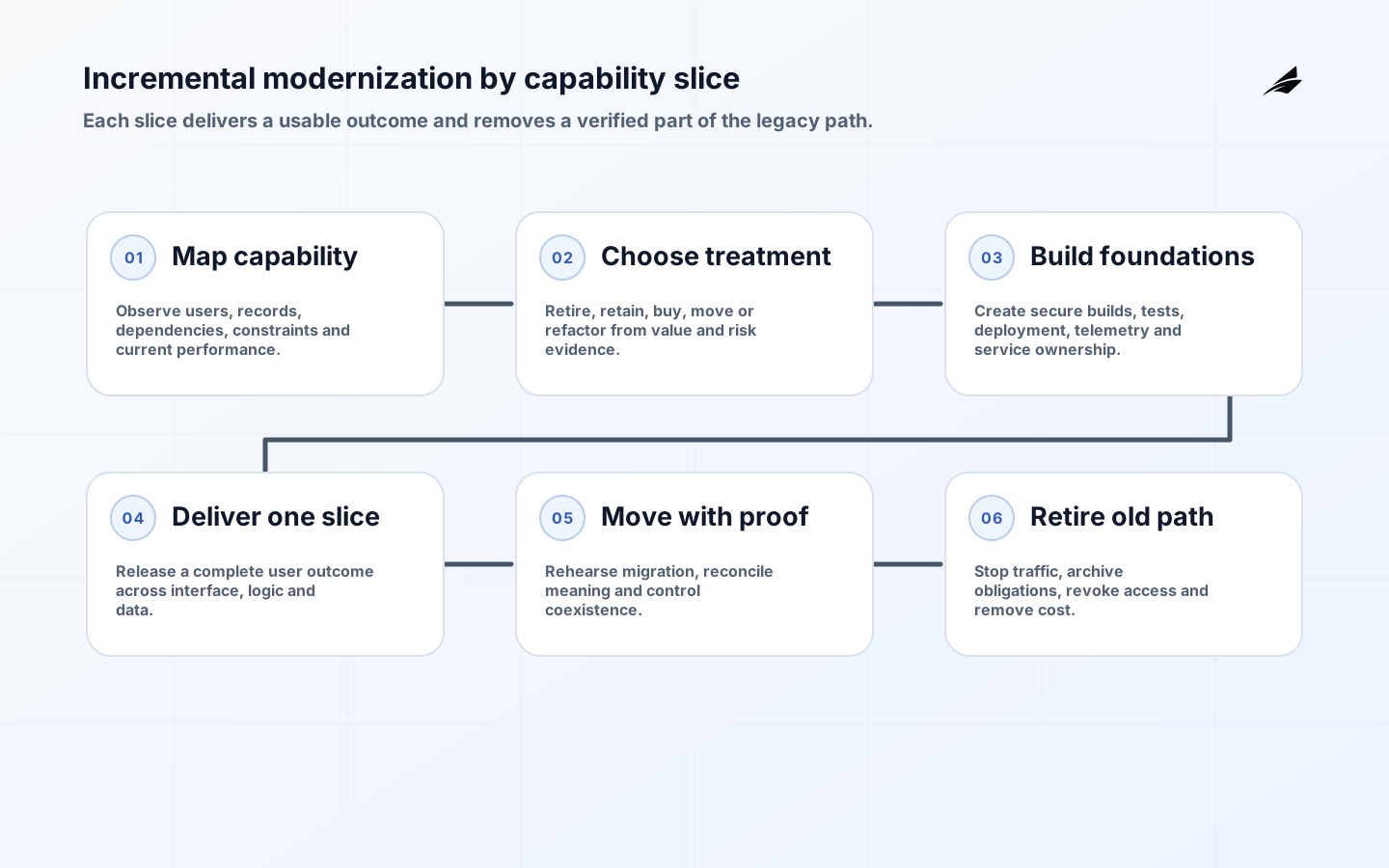
Application development and modernization is successful when a business capability becomes easier and safer to change, not when old code merely runs on newer infrastructure. A migration can reduce hardware risk while preserving slow releases, opaque dependencies and manual reconciliation. A rewrite can reproduce obsolete behavior at great cost. The implementation checklist therefore connects product outcomes, portfolio treatment, engineering foundations, data transition and actual retirement.
Use the development and modernization FAQ to align stakeholders on options, then apply the SaaS growth modernization roadmap checklist when subscription scale is the driver. The guide to common modernization roadmap mistakes helps challenge an existing program before more budget is committed.
1. Define the capability outcome
Name the users, business capability and constraint that justify change. Establish a baseline for cycle time, error, outage, cost, security exposure, release effort and customer impact. Replace vague goals such as cloud-ready with testable outcomes: release a pricing rule within one day; recover the order service within one hour; remove unsupported runtime exposure; or let customers complete an address change without staff re-entry. Assign a business owner who can decide which legacy behaviors should not survive.
- Document the present workflow, including unofficial spreadsheets, batch jobs, manual corrections and exception queues.
- Identify policy, regulatory, contractual and retention constraints separately from implementation habits.
- Agree outcome and guardrail measures before selecting a target architecture.
- Set a decision horizon and funding increment tied to usable capability, not percentage of code converted.
- Record which users and partners must be included in discovery and acceptance.
2. Build an evidence-based estate map
Combine configuration inventory with runtime evidence. Repositories and diagrams miss file transfers, direct database reads, scheduled tasks and support scripts; network observations and job histories miss dormant regulatory processes. For each application, capture owner, users, data, dependencies, technology, support status, deployment path, recovery, spend and change demand. Mark confidence in every fact so discovery gaps are visible rather than converted into false precision.
| Evidence | What it reveals | Validation method |
|---|---|---|
| Business interviews | Purpose, exceptions and critical periods | Observe real work and compare roles |
| Runtime traffic | Active integrations and call direction | Sample peak, month-end and failure windows |
| Data profiling | Volume, quality, keys and sensitive fields | Reconcile with system owners and reports |
| Change history | Hotspots, lead time and recurrent defects | Connect commits, tickets and incidents |
| Cost and license data | Run cost and contractual constraints | Reconcile invoices, assets and actual use |
Map business capabilities to applications rather than treating every application as an indivisible unit. One system may contain a valuable pricing engine, a replaceable reporting module and a dormant workflow. Capability mapping creates smaller treatment choices and exposes duplicate functions. It also prevents a technically easy application from being prioritized while a high-friction customer journey crosses several systems.
3. Choose a treatment for each capability
AWS documents seven migration strategies: retire, retain, rehost, relocate, repurchase, replatform and refactor or re-architect. Use them as a decision vocabulary, not a mandate to move everything. Add process change where software should disappear. Score each capability against differentiation, urgency, risk, dependency, data gravity, vendor fit, skill and total cost. A low-value custom workflow may be repurchased; a stable mainframe function may be retained behind an API; a high-change differentiator may justify refactoring.
| Treatment | Good fit | Evidence before approval |
|---|---|---|
| Retire | No current value or duplicate capability | Usage check, retention and dependency sign-off |
| Retain | Stable value with no justified change | Support, security and integration plan |
| Rehost or relocate | Infrastructure constraint is the immediate risk | Performance, license, recovery and cost test |
| Repurchase | Market product fits a non-differentiating process | Workflow fit, data exit and configuration proof |
| Replatform | Managed runtime removes material operations | Compatibility and operating model pilot |
| Refactor or replace | Changeability or product experience is strategic | Vertical-slice proof and incremental roadmap |
Challenge big-bang replacement by default. Martin Fowler's updated Strangler Fig description presents gradual displacement: build new behavior around the old system and move pieces over time. The approach lowers cutover concentration and can release value earlier, but it requires routing, data ownership and retirement discipline. Without deletion, the organization funds both worlds indefinitely.
4. Establish delivery and security foundations
Modern architecture without modern delivery still produces slow change. Put code, configuration, infrastructure and database migration artifacts under version control. Create repeatable environments, automated tests, artifact provenance, deployment, rollback and observability. NIST's Secure Software Development Framework groups practices around preparing the organization, protecting software, producing well-secured software and responding to vulnerabilities. Integrate those controls into the delivery path rather than adding a security phase before release.
- Name product and service owners with authority over scope, risk and operating priorities.
- Create a fast build with unit, contract, security and migration checks appropriate to the system.
- Separate deploy from release with safe feature controls where the product permits it.
- Use workload identity, secrets management and least privilege in every new component.
- Define logs, metrics, traces, service objectives, alerts and runbooks before production traffic.
- Maintain a vulnerability intake and remediation path for first- and third-party components.
CISA's secure-by-design guidance asks manufacturers to take ownership of customer security outcomes and favor secure defaults. Apply that principle during modernization: do not reproduce default passwords, optional audit logs or customer-funded basic protections because the old system had them. Modernization is a rare opportunity to move burden out of operations and into the product design.
5. Deliver vertical capability slices
Choose a slice that crosses interface, business rule, data, security, deployment and support, while remaining bounded. A read-only customer history can prove access and observability but may not prove transaction integrity. A better early slice might let one customer segment submit and track a low-risk change from interface through system of record. Define routing between old and new paths and how support knows which path handled a case.
| Slice gate | Question | Required evidence |
|---|---|---|
| Behavior | Does the new path meet the business outcome? | User acceptance and outcome comparison |
| Data | Are records complete, correct and reconcilable? | Counts, totals, exceptions and lineage |
| Operations | Can the team detect and recover failure? | Incident and restore exercise |
| Security | Are threats and access controls addressed? | Threat review, tests and closed findings |
| Retirement | Which old behavior can now stop? | Usage evidence and approved shutdown plan |
Use contract tests and change-data techniques carefully when old and new systems coexist. Pick one authoritative writer for each record and state transition. Dual writing from application code creates partial-success ambiguity; if temporary duplication is unavoidable, use durable events, idempotency and reconciliation. Make every compatibility bridge owned, monitored and dated for removal.
6. Rehearse data migration and cutover
Profile source data before designing transforms. Define canonical keys, cleansing ownership, retention, legal hold and acceptance tolerances. Migration code should be versioned, restartable and observable. Rehearse with representative scale and production-like constraints, measure duration, and reconcile business totals rather than only row counts. Preserve a mapping from source to target so defects can be investigated.
- Freeze or explicitly version source schema and reference data for the migration window.
- Run extraction, transformation, load and reconciliation repeatedly in a safe environment.
- Classify exceptions into correct before cutover, migrate with approved treatment or retain for case handling.
- Define the point of no return and rollback limits for code, data and external messages.
- Practice business validation, communications, support routing and supplier escalation.
- Protect migrated copies with production-equivalent privacy and access controls.
7. Retire the legacy path and measure change
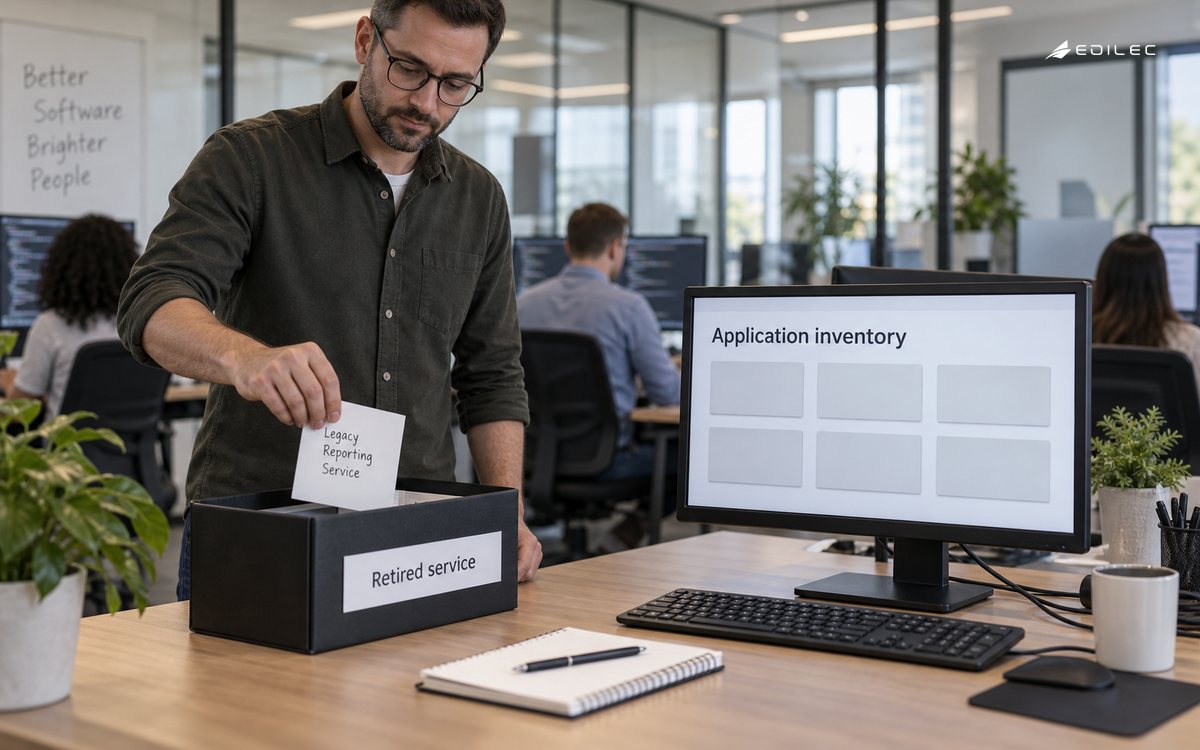
Retirement requires proof that users, integrations, reports, audit, retention and recovery no longer depend on the old path. Disable traffic, monitor for attempted use, archive required records, revoke identities, end licenses, remove infrastructure and update support material. A powered-off server with live credentials, unresolved data obligations or an expensive contract is not retired.
DORA's delivery measures include change lead time, deployment frequency, failed deployment recovery time, change fail rate and deployment rework rate. Track them for the modernized service alongside business outcome, reliability, security exposure and unit cost. Compare trends within one service rather than using universal targets. The modernization has worked when the organization can deliver valuable change more safely and sustainably after the project team leaves.
Schedule a benefits and architecture review after the first normal operating cycle. Confirm that promised legacy costs disappeared, users adopted the new path, support demand is understood and ownership is durable. Feed any gap into product planning rather than reopening an indefinite transformation project.
Key takeaways
- Anchor modernization to a business capability and measurable constraint.
- Use runtime, data, cost and change evidence to map the real estate.
- Choose retire, retain, buy, move or refactor at capability level.
- Deliver complete slices with one authoritative data path and dated coexistence bridges.
- Count retirement and improved change performance as required outcomes.
Frequently asked questions
Does modernization require cloud migration?
No. Cloud services may improve provisioning or operations, but modernization can also improve architecture, delivery and user workflow on existing infrastructure. Choose placement from outcome, constraints and responsibility.
When is a full rewrite justified?
When the capability is strategic, existing boundaries prevent incremental change, target behavior is understood and the organization can manage cutover risk. Even then, seek staged user and data transition instead of waiting for one final reveal.
What if the legacy system has few tests?
Add characterization tests around behavior being changed, contract tests at boundaries and production observations with privacy controls. Do not attempt to cover every old line before learning; protect the slice and highest-consequence behavior.
How should modernization be funded?
Fund capability increments that deliver user value, reduce quantified risk or retire cost. Maintain product funding for the modernized service. A one-time project budget that ends at technical cutover leaves reliability and improvement work unfunded.
Conclusion
Modernization is a sequence of evidence-backed capability decisions. Understand the real workflow and estate, choose treatment honestly, create a secure delivery path, replace in vertical slices, reconcile data and finish retirement. That discipline turns a risky technology program into steady improvement in how the business changes.