Application development and modernization is the disciplined improvement of software that already carries business responsibility. It may include replacing an unsupported runtime, moving a workload to managed infrastructure, improving a difficult codebase, separating a constrained component, rebuilding a user journey or retiring an application entirely. The goal is not to make every system look new. It is to improve a defined outcome, such as release safety, resilience, security, operating cost or the speed of changing a critical workflow, while preserving the data and behavior the business still needs.
Modernization is a portfolio decision before it is a coding project
A credible plan begins with the application portfolio. Identify each system's owner, users, critical business processes, data classifications, technology support status, interfaces, operating cost, incident history and planned business change. AWS's portfolio assessment guidance treats discovery and continuous refinement as core work because incomplete dependency information weakens wave plans and business cases. The inventory should include scheduled jobs, file transfers, identity providers, reporting extracts and manual reconciliation, not only documented APIs.
Rank applications by business value and change pressure, then by technical and operational risk. A stable system with low change demand may need containment and support rather than reconstruction. An application on an unsupported platform, with repeated outages and blocked product changes, may justify deeper intervention. Retirement and replacement must remain real options. Modernization becomes expensive when a preferred technology is selected first and every workload is forced toward it.
| Disposition | Use when | Main caution |
|---|---|---|
| Retain | The application is supportable, low risk and not blocking material outcomes | Do not confuse low change demand with permission to ignore security and recovery |
| Retire or consolidate | Usage is negligible or another system can own the capability | Archive, retention and downstream dependencies may outlive the interface |
| Replace | A supported product meets the differentiated and regulatory needs | Process fit, migration and exit terms can outweigh license price |
| Rehost or replatform | The code works but infrastructure or runtime operations create risk | Technical debt remains and platform assumptions still need testing |
| Refactor | Code structure, testing or dependencies prevent safe change | Broad cleanup without measurable boundaries can consume the roadmap |
| Rearchitect | Current boundaries cannot meet required scale, resilience or change patterns | Distributed designs add operational and consistency complexity |
Scope the outcome, behavior and operating model
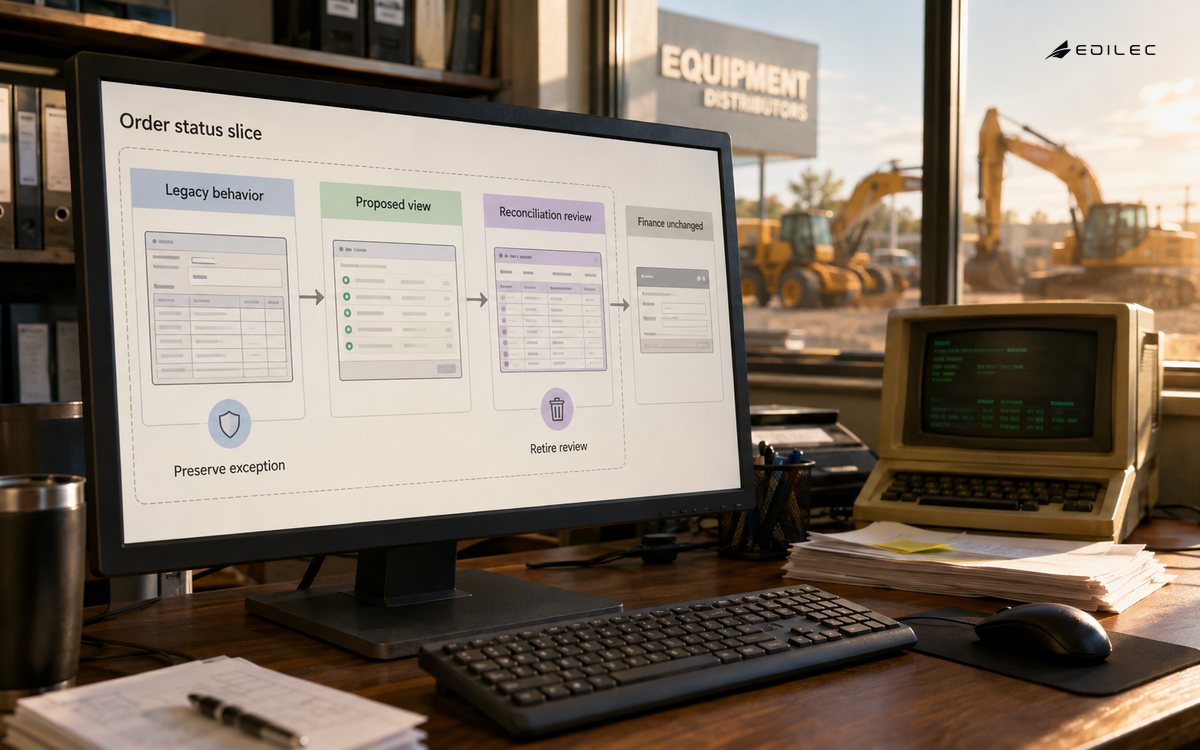
Define a modernization slice in business terms. Instead of 'move the order system to the cloud,' specify the affected journeys, records and service targets: for example, modernize order status and fulfillment integration while preserving price calculation and finance posting. Document current behavior with production telemetry, user observation, contract tests and representative data. Legacy behavior often includes undocumented exceptions that users depend on, even when nobody would design them today. Each exception needs an explicit decision: preserve, correct, migrate or retire.
- Name the business owner, technical owner, risk owner and decision forum.
- Set measurable baselines for reliability, response time, release performance, defects, support effort and infrastructure consumption.
- Map synchronous calls, events, files, batches, reports, identity flows and operational handoffs.
- Classify data and define retention, residency, deletion, encryption and access requirements.
- Write target service objectives and recovery expectations around user journeys, not server availability alone.
- Define what is outside the first slice and how old and new paths will coexist.
Design the target architecture and controls together
Use architecture principles as constraints, not decoration. Clear ownership boundaries, versioned contracts, least privilege, observable state changes and automated recovery reduce change risk. A modular monolith can be a sound target when one team owns a cohesive domain and independent scaling is unnecessary. Microservices are justified when domain boundaries, deployment independence or scaling patterns are strong enough to pay for network failure, distributed data and additional operations. The modernization decision should follow workload needs rather than fashion.
Security must travel through the delivery process. NIST's SSDF organizes practices around preparing the organization, protecting software, producing well-secured releases and responding to vulnerabilities. Translate that into owned requirements: threat modeling for changed trust boundaries, reviewed dependencies, protected build credentials, reproducible artifacts, security testing proportionate to risk, vulnerability response and provenance for deployed versions. A platform move without identity, logging and recovery design can merely relocate the existing risk.
Build a cost model that includes transition and operation
Modernization cost cannot be estimated responsibly from application size alone. Discovery quality, testability, data complexity, integrations, availability requirements and the duration of parallel operation are major drivers. Separate one-time delivery cost from recurring run cost and from retained cost in the legacy estate. Cloud unit prices are only one input; support coverage, observability, security tooling, data transfer, backup, vendor commitments and engineering ownership determine the operating model.
| Cost area | Questions to estimate | Evidence |
|---|---|---|
| Discovery and design | How many workflows, dependencies, exceptions and controls are unknown? | Inventory, dependency map, decision records and representative traces |
| Application change | Which code, runtime, interfaces and user experiences change? | Backlog by vertical slice with acceptance tests |
| Data migration | What volume, quality, downtime and reconciliation are required? | Profiling results, mapping rules and rehearsal timings |
| Platform and security | Which environments, controls, pipelines and recovery capabilities are missing? | Target architecture and control mapping |
| Transition | How long must dual systems, support teams and licenses coexist? | Wave plan, cutover runbook and decommission criteria |
| Ongoing operation | What capacity, support, observability and supplier costs remain? | Demand model, service objectives and ownership schedule |
Example: modernizing a fulfillment application
Consider a fulfillment application that accepts orders, allocates stock, creates warehouse work and posts shipment status. The unsupported user interface is painful, but the highest risk lies in tightly coupled allocation rules and nightly inventory files. A sensible first slice establishes observability and contract tests around allocation, replaces the status interface and publishes shipment events through a versioned integration boundary. The old allocation component remains authoritative while its rules are characterized. A later slice can replatform the database or extract allocation only if measurements show that the boundary improves delivery or resilience.
During cutover, a small user cohort receives the new status experience while every state transition is reconciled against the existing fulfillment record. Release gates cover error rate, latency, missing events and support contacts. Rollback routes users to the old interface without reversing valid business transactions. Only after retained records, reports, recovery tests and downstream consumers are verified can the old interface and its infrastructure be decommissioned.
Manage modernization risks explicitly
| Risk | Control | Early signal |
|---|---|---|
| Hidden dependencies | Combine interviews, code analysis, logs, network observation and batch inventory | Unexpected consumers or reconciliation differences |
| Behavioral regression | Characterization, contract and journey tests using representative cases | Correction volume and business exceptions |
| Data loss or divergence | Repeatable migration, control totals, immutable source and signed reconciliation | Count, balance or checksum mismatch |
| Operational complexity | Production readiness review, runbooks, alerts, ownership and recovery exercises | Alerts without owners or manual deployment steps |
| Cost transfer rather than reduction | Track unit cost, utilization, licenses and legacy retirement together | New spend rises while retained spend does not fall |
| Permanent dual running | Fund decommissioning and set evidence-based exit criteria | Cutover milestones pass without retirement decisions |
A phased modernization delivery plan
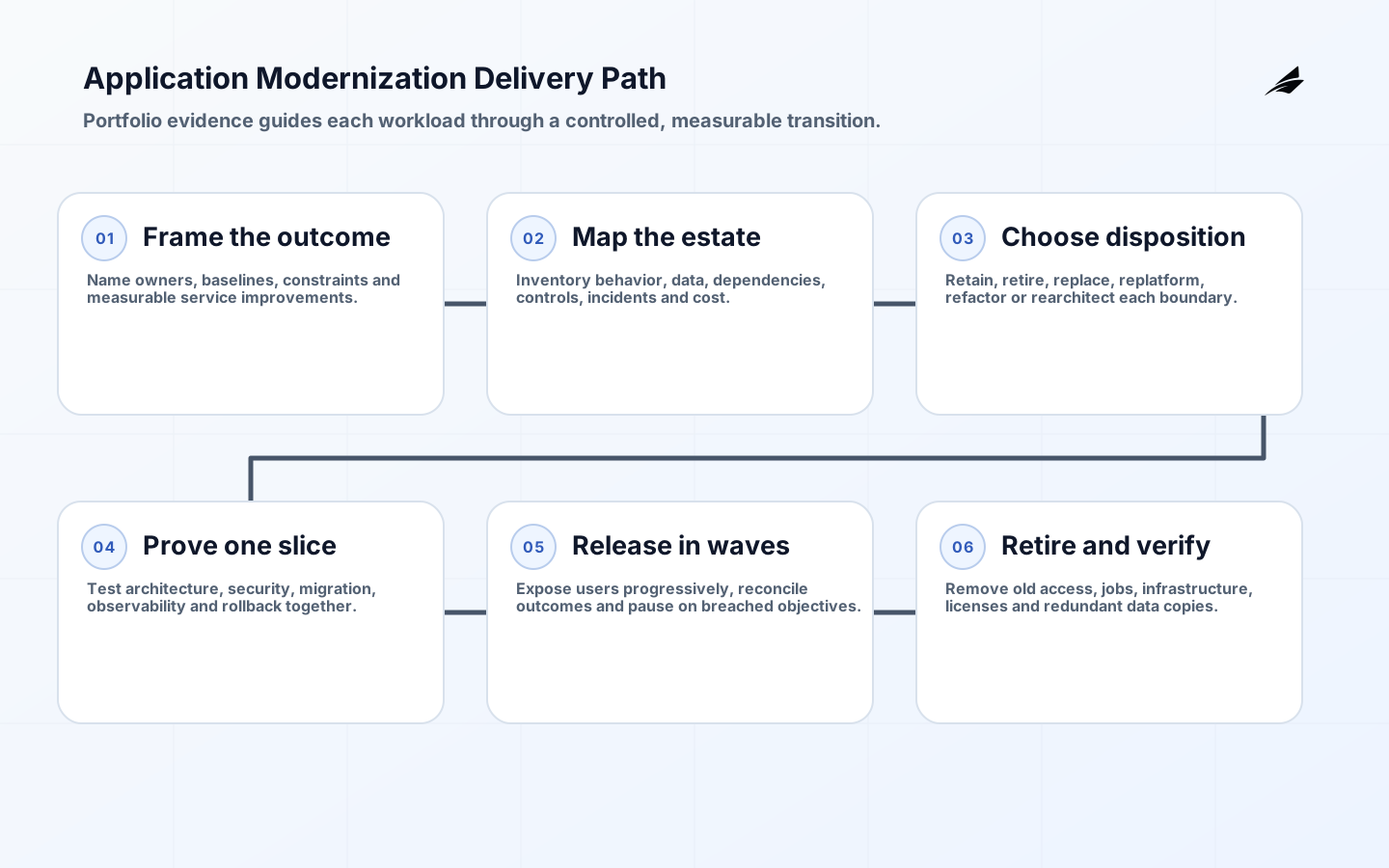
- Frame: agree the outcome, owners, constraints, baseline and investment guardrails.
- Discover: inventory behavior, data, dependencies, controls, incidents and cost; record uncertainty rather than filling gaps with assumptions.
- Decide: choose a disposition per application or component and document alternatives, consequences and exit conditions.
- Prove: deliver one representative vertical slice, including pipeline, observability, security, migration and rollback.
- Expand: release in controlled waves, progressively expose traffic or users, reconcile outcomes and pause when service objectives are threatened.
- Retire and optimize: remove old access, jobs, infrastructure, licenses and data copies; verify recovery and compare outcomes with the baseline.
Measure the application or service over time, not individual productivity. DORA's current delivery measures cover change lead time, deployment frequency, failed deployment recovery time, change fail rate and deployment rework rate. Pair them with user-centered service indicators, security findings, support effort, cost per business transaction and retirement progress. Google SRE guidance recommends choosing indicators from what users care about and making objectives explicit about measurement and validity. Those disciplines make a modernization claim testable.
Application modernization takeaways
- Choose a disposition for each application or component from portfolio evidence.
- Scope modernization around measurable user, operational and risk outcomes.
- Preserve valid behavior and reconcile data through every transition.
- Release in small, observable waves with tested rollback and recovery.
- Fund decommissioning so obsolete cost and risk actually leave the estate.
Frequently asked questions
Should we rewrite or refactor a legacy application?
Prefer incremental refactoring when behavior is valuable, boundaries can be introduced and the system can be tested. Consider replacement or a bounded rewrite when the platform is unsupportable, the required model is fundamentally different or incremental change cannot reach the target safely. Validate the choice with a representative slice before committing the portfolio.
How much does application modernization cost?
There is no defensible universal rate. Estimate discovery, application work, data, integrations, platform controls, testing, transition and ongoing operation separately. Use ranges tied to assumptions, then narrow them after dependency mapping and a production-like slice.
Does modernization require moving to the cloud?
No. Modernization can improve code, security, interfaces, data and operations on any supported platform. Cloud services may reduce undifferentiated infrastructure work, but workload requirements, regulation, latency, skills, economics and exit needs should determine placement.
How do we know modernization succeeded?
Compare agreed outcomes with the baseline: user journey reliability, delivery throughput and instability, security posture, support burden, unit cost and the amount of legacy estate actually retired. A successful deployment that leaves old cost and risk untouched is incomplete.
Conclusion
Strong application modernization is selective, measurable and reversible. It starts with portfolio evidence, chooses a proportionate disposition, secures the delivery path, and releases in slices that preserve business continuity. The final test is not whether the architecture looks contemporary. It is whether users receive a better service, teams can change it more safely, risks are controlled and the obsolete estate is genuinely removed.