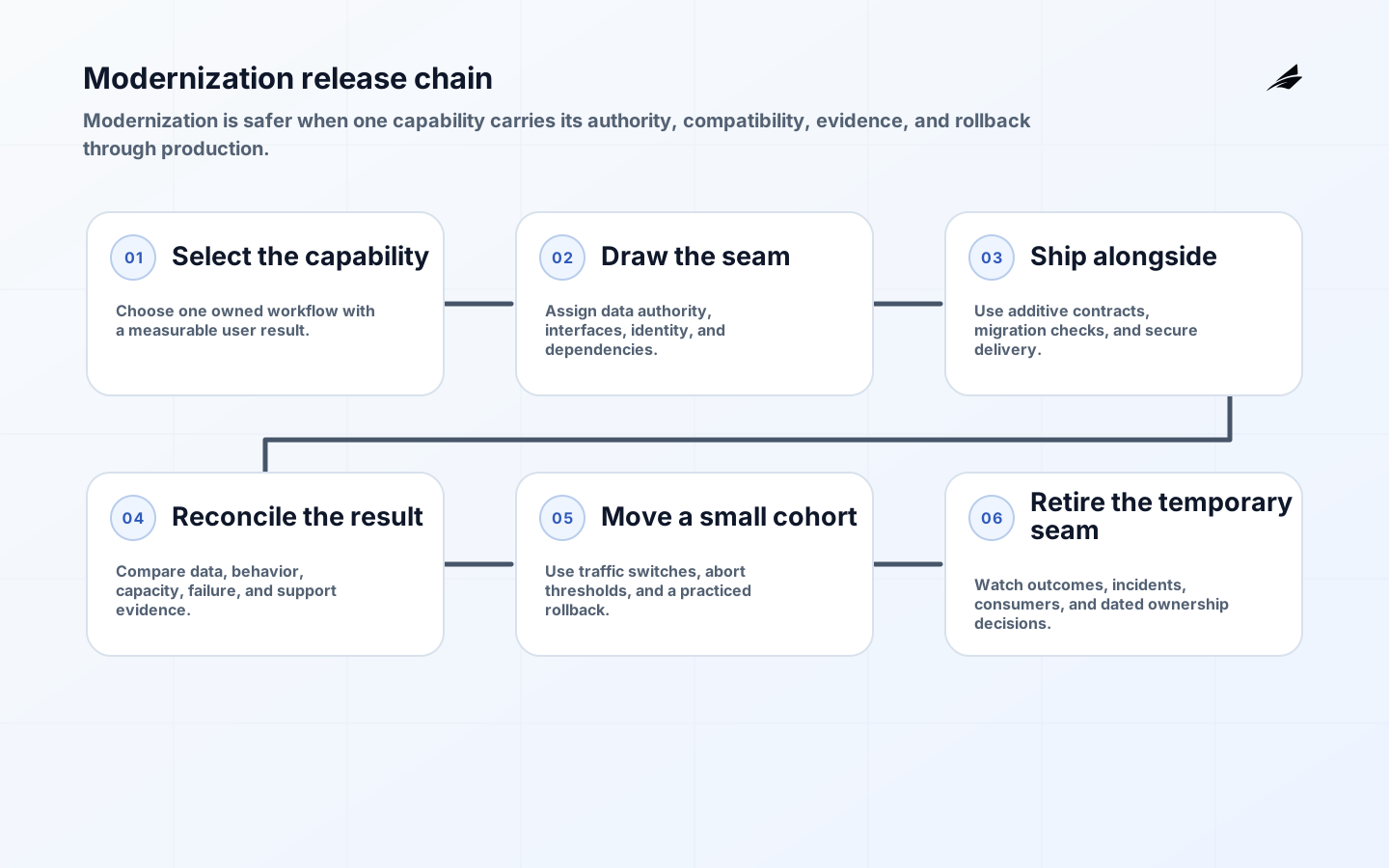
Software modernization changes meaning when it reaches production. A new framework or service may look successful in a test environment while real users, data, integrations, support habits, and recovery responsibilities expose a different system. Choose a business capability and a measurable outcome before choosing a replacement platform. Martin Fowler’s strangler application pattern is useful because it emphasizes a controlled boundary and incremental replacement rather than a single irreversible cutover. Google’s canary release guidance adds operational guidance, while NIST SSDF anchors secure delivery practices.
Choose a capability before a platform
Select a bounded workflow with a clear owner, manageable dependencies, and a result that can be compared with the existing path. Record users, data authority, latency, compliance, failure consequence, and rollback. Avoid starting with the easiest code if it has no meaningful production signal. Avoid starting with the most critical path if the team cannot observe or reverse it. PostgreSQL’s ALTER TABLE guidance illustrates why compatibility and lock behavior belong in a modernization plan. A good first slice teaches the organization how boundaries, contracts, migration, support, and operational acceptance will work.
| Question | Evidence | Decision |
|---|---|---|
| Can the capability be isolated? | Calls, data writers, owners | Proceed, narrow, or map a seam |
| Can outcomes be compared? | Baseline time, errors, business result | Define acceptance |
| Can it be reversed? | Routing and data rollback plan | Add a control before build |
| Can it be operated? | Alerts, runbook, on-call owner | Delay release until named |
Design a boundary that survives change
A production boundary needs an explicit contract for identity, data, errors, retries, timeouts, versioning, and ownership. Decide whether the old or new path is authoritative during coexistence. Reconcile writes rather than assuming that two databases will converge. Preserve correlation identifiers so support can trace a request across both paths. Treat undocumented consumers and batch jobs as dependencies until evidence proves otherwise. The boundary is successful when the team can explain a normal request, a duplicate request, a partial failure, and a rollback without consulting the source code line by line.
Release the modernization slice safely
Use additive changes, compatible versions, dual reads or writes only when reconciliation is visible, and progressive routing. Test realistic data volume, delayed messages, permission changes, schema drift, and a dependency outage. NIST’s SSDF provides a useful lifecycle frame for secure development; Google’s SRE workbook adds practical thinking about service objectives, error budgets, and operational learning. Include migration duration, locks, capacity, rollback, and customer communication in the release record.
| Area | Evidence | Owner |
|---|---|---|
| Behavior | Representative scenarios and comparison | Product owner |
| Data | Counts, checksums, reconciliation queue | Data owner |
| Security | Access, secrets, dependency review | Security owner |
| Reliability | Load, degradation, recovery exercise | Operations owner |
Operate from modernization evidence
Monitor business completion, latency, errors, queue age, reconciliation, support contacts, resource use, and rollback triggers. Segment by cohort and route so a healthy average does not hide a failing customer group. Give the on-call team a bypass or traffic switch and a runbook that explains which data is authoritative. Review incidents for missing controls and unclear ownership. Modernization is not complete when the new code deploys; it is complete when the service can be supported, recovered, and improved with evidence.
Record the boundary decision
Keep the why, scope, alternatives, assumptions, risks, interfaces, data plan, security controls, acceptance measures, rollout stages, rollback, and owners in one accessible record. Revisit it after the pilot and after the first incident. This prevents the project from becoming a permanent exception that nobody can explain. It also helps future teams distinguish a deliberate compatibility layer from accidental architecture that should eventually be removed.
- Select a measurable capability, not a fashionable technology target.
- Name authority, coexistence, reconciliation, and rollback before cutover.
- Preserve observability across old and new paths.
- Treat security, migration, and support evidence as release work.
- Roll out progressively and keep a tested bypass.
- Retire temporary seams only after dependency evidence is clear.
Key takeaways
Production modernization is a change in operating responsibility, not just a code replacement. Choose a bounded outcome, create a compatible boundary, prove data and recovery, release in slices, and keep evidence visible to the people who operate the result.
A modernization wave example
For legacy order search, baseline result accuracy, latency, corrections, data freshness, and dependency calls. Keep the existing route while the new path compares results on internal traffic. Exercise deleted orders, delayed updates, permissions, partner failure, and rollback. Route a small cohort only after mismatches have an owner and support can identify the path from a correlation id. Retire the old route after consumers are inventoried, data reconciles, recovery is rehearsed, and the business owner accepts the outcome. List the components that remain on the old path so modernization does not expand by implication. The exit gate is operational confidence, not a cleaner codebase alone.
Modernization gate signals
Treat a modernization wave as controlled comparison. Baseline accuracy, latency, corrections, freshness, dependency calls, and support contacts before changing route ownership. Let the new path read from an agreed authority, translate identifiers, and emit comparison evidence while the existing path remains available. Exercise normal, deleted, delayed, permission-changing, partner-failure, and rollback cases. Route an internal cohort only after mismatches have an owner. During expansion, show route, errors, latency, reconciliation, and customer outcome by cohort. At exit, inventory consumers, reconcile data, rehearse recovery, update runbooks, and decide whether the old path is retired or kept as a dated exception.
What the first wave must prove
The first wave should show that the chosen capability has a clear owner, the boundary protects data and identity, old and new paths can coexist, mismatches are visible, and rollback is practical. Baseline customer result, latency, corrections, support demand, and operating cost. Use representative traffic and difficult cases, not only the common path. Keep a dated decision record that explains what remains old and why. Expand only after the business owner accepts measured outcomes and operations can support the route without the project team.
A modernization wave with explicit gates
For a legacy order-search capability, begin with a baseline of result accuracy, p95 latency, correction rate, data freshness, dependency calls, support contacts, and operating cost. Let the new path read from an agreed authority, translate identifiers, and emit a comparison record while the existing path remains available. Exercise normal orders, deleted orders, delayed updates, permission changes, partner failure, duplicate requests, and rollback. Route an internal cohort only after mismatches have a named owner and a support operator can trace a request across old and new paths. During progressive release, show route, errors, latency, reconciliation, and customer outcomes by cohort. At the exit gate, inventory consumers, reconcile data, rehearse recovery, update runbooks, and decide whether the old path is retired or kept as a dated exception. Do not remove a compatibility seam because the new implementation looks cleaner; remove it when evidence shows no unknown consumer depends on it and the business owner accepts the result. Keep intentionally old components listed with an owner and review date so modernization does not expand by implication.
| Decision | Evidence to collect | Stop or change when |
|---|---|---|
| Scope | Representative workflow, owner, and measurable baseline | The boundary or outcome remains ambiguous |
| Safety | Negative, failure, recovery, and permission scenarios | A critical state has no tested response |
| Operations | Telemetry, runbook, capacity, and escalation | No named owner can respond |
| Release | Cohort, rollback, comparison, and acceptance record | The result cannot be compared with baseline |
A modernization decision should include entry and exit gates. Entry requires a measurable capability, clear owner, data authority, security controls, rollback route, and representative test cases. The build gate requires compatible interfaces, migration evidence, telemetry, and support documentation. The traffic gate requires a small cohort and an abort switch. The retirement gate requires reconciliation, recovery exercise, consumer inventory, and a dated decision. This sequence costs coordination, but it prevents a technically successful replacement from becoming an unowned production change. Revisit assumptions after the first incident and after traffic, regulation, dependencies, or product policy changes.
Which modernization gate comes next?
Ask the capability owner, data steward, and incident lead to review the modernization evidence together. The next boundary decision should follow observed production behavior, not a tally of delivered features.
Software modernization FAQ
What is the best first modernization slice?
Choose a capability with a clear owner, measurable baseline, manageable dependencies, and a reversible route. It should teach the team about production boundaries without putting the most consequential path at immediate risk.
How do we avoid data divergence?
Assign authority, define dual-write or migration behavior, reconcile with counts and checksums, monitor mismatches, and keep the transition window explicit. Never assume that eventual consistency means eventual correctness.
When is modernization finished?
When the new path meets the acceptance outcome, support and recovery are owned, old dependencies are removed or deliberate, and production evidence supports continued operation.
Conclusion
Modernization becomes trustworthy when it is bounded, observable, reversible, and accountable. Let production evidence decide when to expand, when to pause, and when a temporary compatibility layer can safely disappear.
The first modernization wave should have entry, traffic, and retirement gates. Entry requires a bounded capability, data authority, owner, baseline, and rollback. Traffic requires comparison evidence, a small cohort, telemetry, and an abort switch. Retirement requires consumer inventory, reconciliation, recovery rehearsal, updated support material, and an accountable acceptance decision. Keep temporary seams dated and visible.
Keep the old route until data, support, recovery, and consumer evidence show that retirement is safe. A dated compatibility seam is preferable to an undocumented dependency.
The release record should also explain how customer support identifies the active route, how operators pause traffic, how data is corrected, and when the next review occurs. This keeps modernization connected to the service after the project milestone.
Keep a dated decision record, publish the active route to support, and review the next migration gate with the accountable owner before expanding traffic.