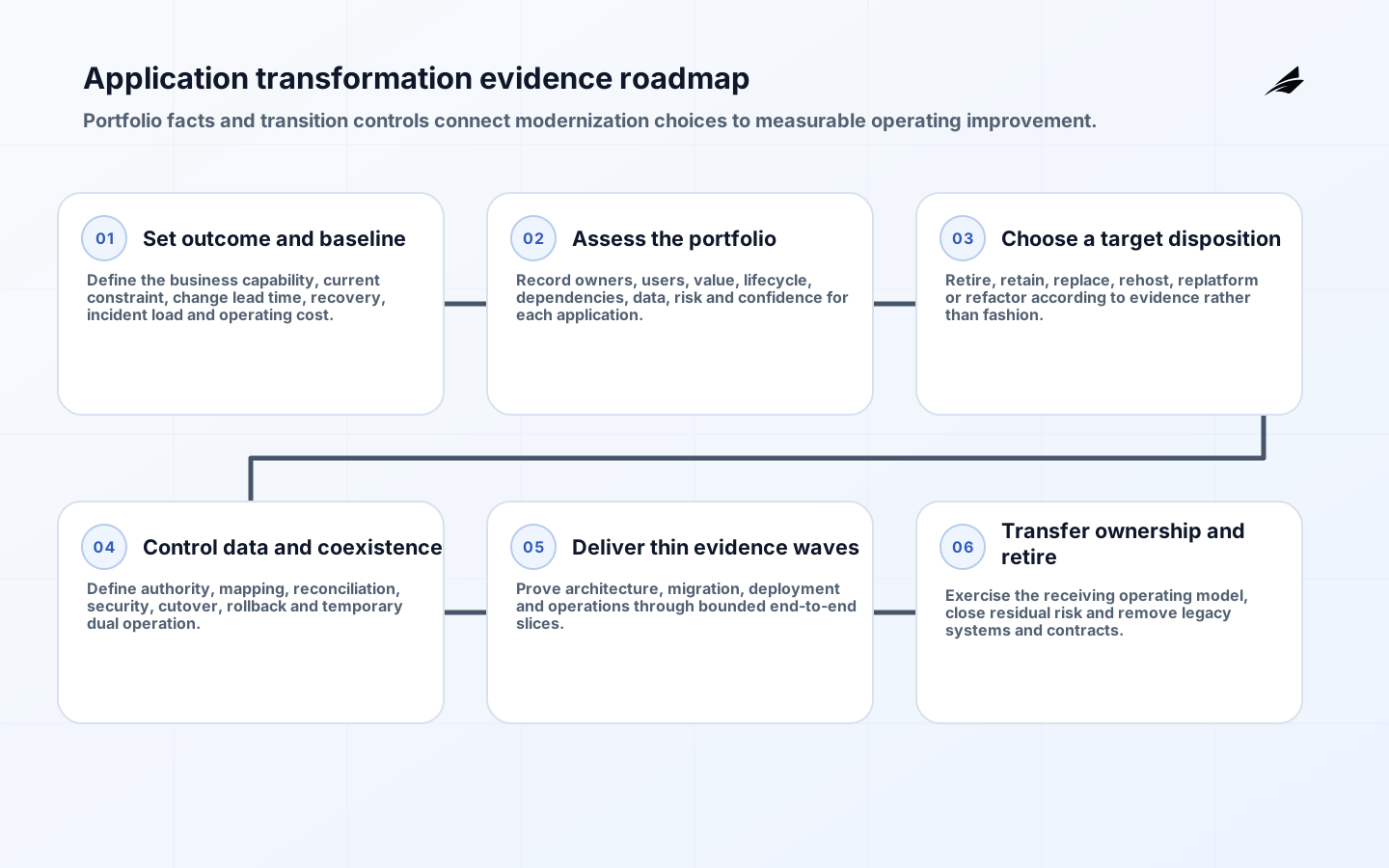
Application transformation services change how an organization delivers and operates business capability; they are broader than a code rewrite or infrastructure move. A transformation may retire redundant software, simplify a process, expose stable APIs, improve deployment, change data ownership or move a suitable workload to managed cloud services. The right combination depends on evidence from the portfolio and the outcomes the organization needs.
This FAQ addresses the decisions sponsors, application owners and engineering leaders face before and during modernization. The companion application transformation implementation checklist provides delivery gates, while the application management FAQ covers steady-state ownership after change.
1. What do application transformation services include?
Services normally combine portfolio discovery, business-process analysis, architecture, data planning, security, delivery and operating-model change. Possible outcomes include retirement, retention, rehosting, platform change, refactoring, replacement or rebuilding. These are not maturity levels. Retiring a low-value application can be more transformative than rebuilding it, and retaining a stable system may be responsible when change would not repay its risk.
Define transformation in business terms: faster product change, lower incident exposure, improved resilience, removal of unsupported technology, consolidated data or simpler customer journeys. Then establish measurable baselines. Cloud adoption or microservices are means, not outcomes. A decision record should explain why the selected path beats feasible alternatives over the planning horizon.
| Disposition | Best fit | Evidence needed |
|---|---|---|
| Retire | Capability is unused, duplicated or no longer required | Usage, dependency and retention analysis |
| Rehost | Time-bound exit with limited application change | Compatibility, cost and operational plan |
| Replatform | Managed capability removes operational burden | Behavior, portability and performance test |
| Refactor or rebuild | Architecture blocks strategic change | Value, decomposition and migration evidence |
2. How should an organization assess its portfolio?
Create an evidence-backed inventory of owner, users, business criticality, lifecycle, cost, incidents, dependencies, data, change demand and regulatory constraints. Do not wait for perfect data. Mark confidence, close gaps around priority candidates and keep the register alive. AWS’s portfolio assessment guide treats assessment as continuous across discovery, prioritized analysis, planning and migration.
Score applications only to support discussion; avoid letting a composite score conceal a severe dependency or immovable deadline. Map upstream and downstream systems, identity, network, batch schedules, reporting and manual work. Group candidates into coherent waves based on dependencies and organizational capacity. Include business calendar and data-retention events, not only technology relationships.
3. How is the target architecture chosen?
Start from quality attributes and change patterns: availability, recovery, throughput, latency, isolation, audit, data consistency and deployment frequency. Select the simplest architecture that meets them. Modular boundaries can improve ownership without requiring distributed services. Managed platforms can remove maintenance but introduce quotas, service dependencies and exit considerations. Record trade-offs and test risky assumptions with representative workloads.
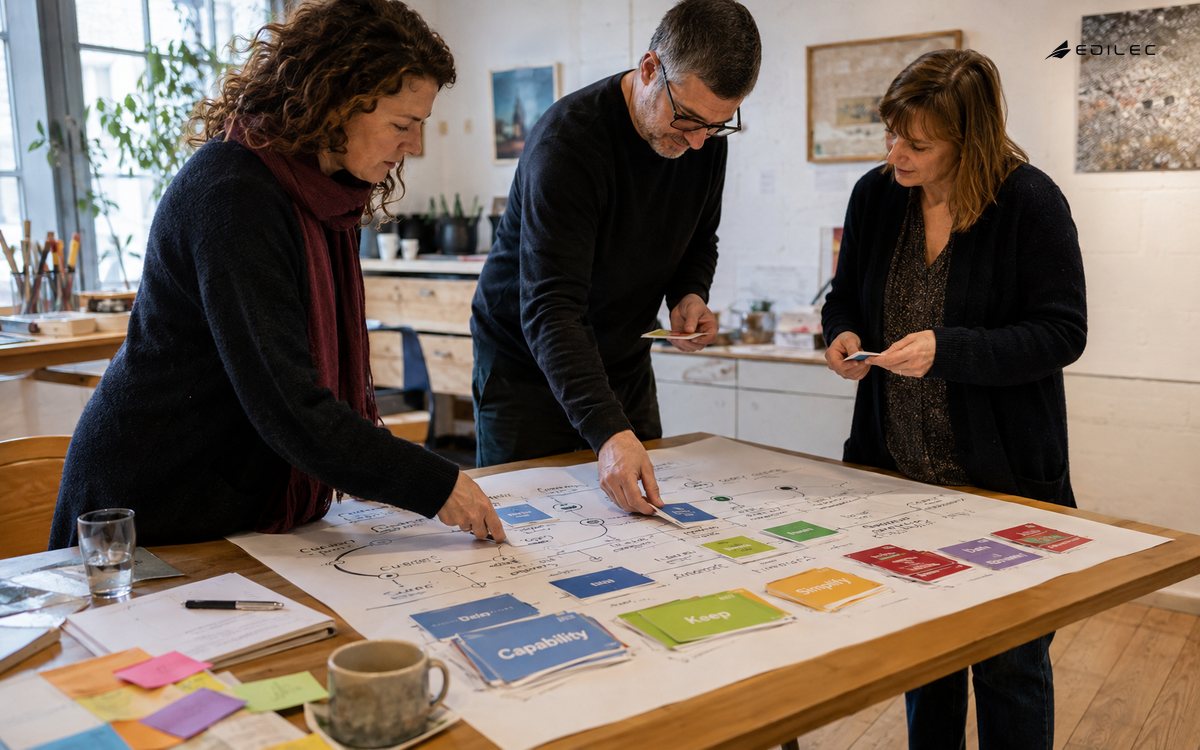
AWS’s guidance on modern application development connects modernization with organizational practices, architecture, delivery and operations rather than a single hosting change. Organizational readiness is part of architecture: the Google Cloud Adoption Framework highlights leadership, learning, scale and security. A target state that the operating team cannot support is incomplete.
| Decision area | Question | Proof before scale |
|---|---|---|
| Service boundary | Can teams change it independently without unsafe coupling? | Dependency and release exercise |
| Data ownership | Which system is authoritative during transition? | Reconciliation and conflict test |
| Reliability | How does the service fail and recover? | Load, fault and restore evidence |
| Operability | Can the assigned team diagnose and deploy it? | Runbook rehearsal and observed pilot |
4. How are data and security handled during transformation?
Profile data quality, ownership, volume, sensitivity and retention before moving it. Define schema mapping, cleansing, migration sequence, reconciliation and rollback. During coexistence, state which system may write each record and how conflicts resolve. Dual writes create complex failure modes; use them only with explicit monitoring and repair. Preserve legal holds and provenance, and delete temporary migration copies when their approved purpose ends.
Security requirements travel with the business capability. NIST’s SSDF supports integrating secure practices into any lifecycle, while OWASP ASVS offers testable application controls. Threat-model both target and transition: old endpoints, broad migration credentials, replicated secrets, inconsistent authorization and forgotten rollback environments frequently enlarge exposure.
5. How should transformation be sequenced?
Deliver a thin end-to-end slice that proves architecture, data, deployment and operations. Establish enabling work such as identity, network, observability and automated environments before many teams depend on it, but keep foundations tied to real workload needs. Use strangler-style replacement when boundaries allow traffic or capability to move incrementally. A big-bang cutover may still be necessary for tightly coupled state, but requires stronger rehearsal.
Set entry and exit evidence for each wave: dependency confirmation, data quality, performance, security, support readiness, reconciliation and rollback. Track decisions and unresolved risks. Limit parallel work to the organization’s review and operational capacity. Transformation slows when every team waits on the same architects, environments or approvers; expose those constraints and change the system of delivery rather than adding status meetings.
6. How are value and completion measured?
Measure outcomes against the original baseline: lead time for a representative change, recovery performance, availability, incident load, operating cost, user completion and retirement of legacy obligations. Separate one-time migration spend from recurring run cost. Include vendor commitments, data transfer, platform staffing and coexistence. A lower infrastructure bill does not prove value if delivery and support become harder.
Completion means the new capability operates under named ownership and the old obligations are closed. Decommission servers, credentials, integrations, licenses, monitoring, support queues and obsolete data according to policy. Transfer knowledge and budgets. Review target assumptions after real usage, then optimize. Declaring victory at cutover leaves the most expensive part—parallel estates and ambiguous accountability—untouched.
7. Align teams, suppliers and change adoption
Map future ownership before selecting technology. Product teams need authority over priorities and service health; platform and security teams need clear interfaces; operations and business users need time to test changed work. Identify skill gaps and address them through paired delivery, practice environments and recruitment. Training after architecture is fixed cannot compensate for an operating model that assigns work to teams without capacity or decision rights.
Structure supplier contracts around interoperable outputs and transition. Require source, infrastructure definitions, data mappings, test assets, documentation, vulnerability handling and termination support in usable formats. Clarify intellectual property and licenses. Avoid acceptance tied only to component completion; use end-to-end service evidence. Keep strategic decisions and production accounts under enterprise control even when a supplier operates them temporarily.
Plan adoption by user journey and business event. Communicate what changes, when, why and where help is available. Observe real work during pilots and adjust process, policy and software together. Track parallel manual tasks and shut them down deliberately after confidence is established. If users maintain shadow spreadsheets or old screens, investigate the missing need rather than labeling it resistance.
Create a capacity plan for subject-matter review, architecture, environments, data migration, testing and operational acceptance. These shared specialties often determine throughput more than developer count. Limit concurrent modernization waves to the capacity of the whole delivery system. Measure waiting and rework at handoffs, then improve standards, automation or decision rights where congestion repeats. A credible roadmap shows these constraints rather than assuming every application progresses independently.
Manage coexistence as a temporary product with users and risks. Publish which capabilities remain in each system, how staff navigate them and who owns cross-estate incidents. Instrument traffic and reconciliation so leaders see whether the old path is shrinking. Give every temporary adapter exit criteria and a review date; without those controls, transition architecture quietly becomes permanent architecture.
Retain financial traceability from business case to wave outcome. Update forecasts as discovery closes uncertainty, but preserve original assumptions and explain variance. Track internal labor, supplier spend, licenses, coexistence and decommission cost by capability. Do not count benefits twice across platform and application programs. Finance and service owners should jointly approve realized savings before budgets or contracts are removed.
Apply architecture fitness checks to the qualities modernization is meant to improve. Tests can enforce dependency direction, supported runtimes, deployment independence, recovery configuration or observability fields. Choose a small set tied to known risks and run them continuously. Fitness checks turn architectural intent into timely feedback, but they need owners and review; obsolete checks can freeze yesterday’s design just as surely as an inflexible approval board.
Review the roadmap quarterly against application lifecycle, vendor notices and business priorities. Re-sequence when evidence changes instead of protecting an obsolete plan. Publish the reason so dependent teams can adjust funding, staffing and transition dates coherently.
Key takeaways
- Choose dispositions from portfolio evidence and business outcomes.
- Design transition architecture and data authority as carefully as target state.
- Match technical ambition to team skills and operational ownership.
- Prove one end-to-end slice before scaling modernization waves.
- Finish by retiring legacy obligations and measuring the intended result.
Frequently asked questions
Does transformation require moving to cloud?
No. Cloud can enable managed services and elastic capacity, but process, architecture, data and delivery improvements can occur elsewhere. Choose deployment from quality attributes, economics, constraints and operating capability rather than treating location as the goal.
Must a monolith become microservices?
No. A modular monolith may provide clearer boundaries and safer change with less distributed complexity. Extract a service when independent scaling, deployment, ownership or isolation produces evidence-backed value and the team can operate the additional failure modes.
Which application should go first?
Select a meaningful but manageable candidate with committed ownership, visible value and limited dependency uncertainty. Avoid both the trivial demonstration that proves little and the most critical tangled system before foundations and delivery practices have been tested.
Conclusion
Application transformation is a portfolio and operating-model discipline expressed through technology change. Strong programs connect every modernization choice to an outcome, validate transition risks early and close the legacy estate behind them. That is how transformation produces lasting capability rather than a new layer of platforms.