Software modernization services should improve a business capability and the organization’s ability to change it safely. Replacing a framework, moving servers or splitting a monolith can be useful means, but none is the outcome by itself. A modernization program needs evidence about the current system, explicit reasons to change, a proportionate target, protected continuity and a funded route to retire old technology and duplicated operations.
AWS modernization guidance recommends assessing business, functional, technical and financial significance and producing a roadmap, target blueprint and action plan for capability gaps. That portfolio discipline prevents every old application from becoming a rewrite. Use the software modernization scope and delivery guide to frame the engagement and the modernization implementation checklist to verify execution.
When is modernization justified?
Modernize when current constraints materially block an outcome: changes take too long or fail frequently, security updates are unavailable, recovery cannot meet need, capacity is exhausted, essential skills are disappearing, vendor terms are untenable or users cannot complete important work. Quantify the baseline and consequence. An unsupported component may require urgent containment even if revenue is stable; a fashionable architecture does not justify disruption when the system is reliable and change demand is low.
Include the option to retain, retire, replace or renegotiate. Some applications should move to a supported packaged service; some can be isolated and maintained; duplicated functions can be removed. Create a portfolio view of business value, risk, cost, dependencies, data and change demand. Sequence shared identity, network, integration and data foundations before teams need them, without turning the foundation into an endless program detached from a released service.
| Disposition | Good fit | Primary caution |
|---|---|---|
| Retain and remediate | Stable value with bounded, fixable risk | Do not defer an explicit end-of-support trigger |
| Rehost | Urgent infrastructure exit with compatible workload | Location change may preserve application constraints |
| Replatform | Managed runtime or database removes real toil | Service semantics and cost can change |
| Refactor incrementally | High change demand around separable capabilities | Distributed complexity can outrun benefit |
| Replace or retire | Commodity capability or low-value duplication | Data, records and user transition still need ownership |
What must discovery establish?
Map users, journeys, business rules, interfaces, batch schedules, data stores, reports, identities, certificates, infrastructure, support routines, incidents, recovery, licenses and change history. Mine code and runtime evidence but validate it with operators and users. Hidden dependencies often live in file drops, spreadsheets, scheduled jobs and manual reconciliations. Identify periods when change is constrained, such as financial close or enrollment.
Baseline outcomes and delivery performance. DORA’s current measures separate throughput from instability: change lead time, deployment frequency, failed deployment recovery time, change fail rate and deployment rework rate. Add service-level indicators, security exposure, support effort, unit cost and user completion. A baseline allows the team to prove whether modernization improved change and operation rather than merely producing a new codebase.
How should the target architecture be chosen?
Design around change boundaries, data consistency, scale and team ownership. CNCF’s cloud-native definition emphasizes loosely coupled systems, resilience, manageability and observability, but not every application needs containers or microservices. A modular monolith may give one team better deployability and simpler transactions. Managed services can remove undifferentiated operation when their limits, data model and exit path fit. Record each major decision and the evidence expected to validate it.
Create transition architecture, not just a future-state picture. Show how identity, traffic, events, data, reports and support work while old and new coexist. Define compatibility adapters and their retirement dates. Keep observability across the boundary with common correlation IDs and business events. Avoid unbounded dual writes; use an owned synchronization or migration pattern with reconciliation and a clear source of truth.
| Risk | Control | Proof at an increment boundary |
|---|---|---|
| Undocumented behavior lost | Characterization tests and user scenario capture | Old and new produce agreed outcomes for sampled cases |
| Data divergence | Source-of-truth rule, reconciliation and exception queue | Counts, totals and sampled records match within approved tolerance |
| Security regression | Threat model and SSDF-aligned delivery controls | Access, dependency and abuse-case tests pass |
| Operational overload | Runbook, service ownership and telemetry before traffic | On-call resolves a rehearsed fault from available signals |
| Permanent duplicate estate | Exit criteria, budget and removal owner | Old route, access, license and infrastructure are retired |
How should modernization be divided into increments?
Select a thin capability with meaningful value and manageable dependencies, then deliver it through the production path. A strangler approach can route a bounded function to the new implementation while the legacy system handles the rest. Begin at a stable interface or business capability, not an arbitrary code layer. Each increment needs working software, migrated or synchronized data, controls, support readiness, measured behavior and a retirement step.
Use feature flags or controlled routing when they provide safe exposure, and maintain rollback or roll-forward procedures. Small releases reduce change risk only when testing and observability expose errors. NIST’s Secure Software Development Framework should be integrated into the chosen lifecycle: prepare the organization, protect software, produce well-secured releases and respond to vulnerabilities. Modernization is an opportunity to improve provenance and dependency management, not postpone them.
How should data migration be controlled?
Profile schema, volume, quality, ownership, retention, residency, encryption, referential integrity and downstream use. Define field-level mappings and transformations with business owners. Decide how late changes are captured, when writes freeze, how errors queue and who approves reconciliation. Preserve audit history and records obligations. A successful row count can hide altered totals, missing relationships or changed business meaning.
Rehearse migration with production-like scale and safe data handling. Time extraction, transformation, load, validation and rollback. Compare counts, hashes, control totals and sampled business records. Test restart after partial failure and ensure idempotency. At cutover, name one decision authority and communicate user impact. After observation, archive or delete source data according to policy and revoke old pathways to prevent accidental reactivation.
How are cost and commercial models evaluated?
Estimate discovery, target foundations, product increments, migration, testing, security, licenses, cloud consumption, training, parallel operation, retirement and contingency. Fixed price can work for a bounded assessment or well-defined migration unit; uncertain legacy behavior favors staged discovery and transparent capacity-based delivery. Tie payment and acceptance to usable evidence and outcomes rather than document volume or code lines.
Model the steady state as well as project spend. A decomposed system can increase network, observability, platform and on-call cost. Managed services change staffing and risk but may add consumption or exit fees. Track forecast against realized unit cost, delivery improvement and retired spend. Benefits claimed from a legacy shutdown should not be counted while licenses, support and infrastructure remain active.
How are acceptance and capability transfer proven?
Define acceptance per increment across functional behavior, data integrity, performance, security, accessibility, reliability, cost and operability. Evidence should identify the environment, version, test data, tolerance, owner and result. Business acceptance confirms that users can complete the changed journey; technical acceptance confirms the service can be deployed, observed and recovered. Record known gaps with owners and dates rather than allowing a broad sign-off to hide them.
Transfer capability throughout delivery. Pair internal staff with supplier engineers, rotate operational roles and require teams to explain and modify the new system. Run game days and have the receiving team deploy, diagnose and restore from the delivered repositories and runbooks. Documentation is necessary but insufficient when no one has practiced the work. Update role and training plans as legacy specialists move into product, platform or data ownership.
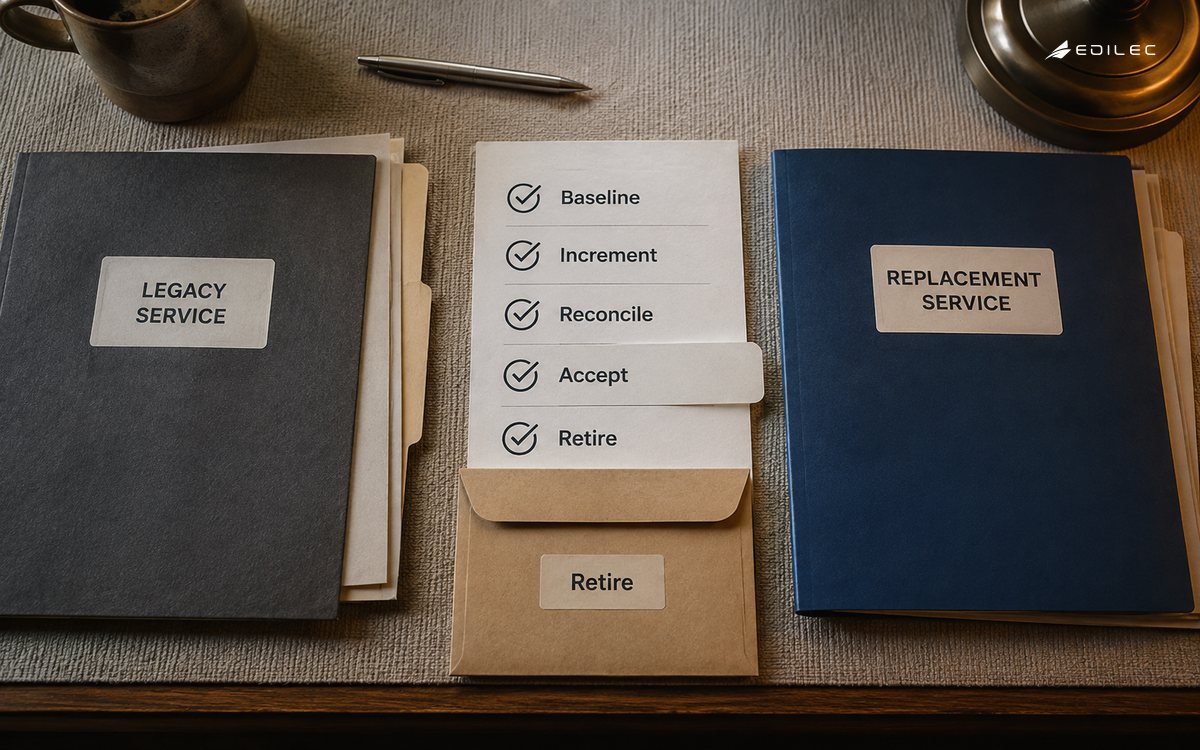
Close each wave with a retirement review. Confirm traffic, jobs, identities, data, integrations, contracts, monitoring and support no longer depend on the old component. Remove access and infrastructure through controlled change, retain records as required and verify invoices stop. A modernization program that leaves every legacy route available creates a more complex estate than the one it was funded to simplify.
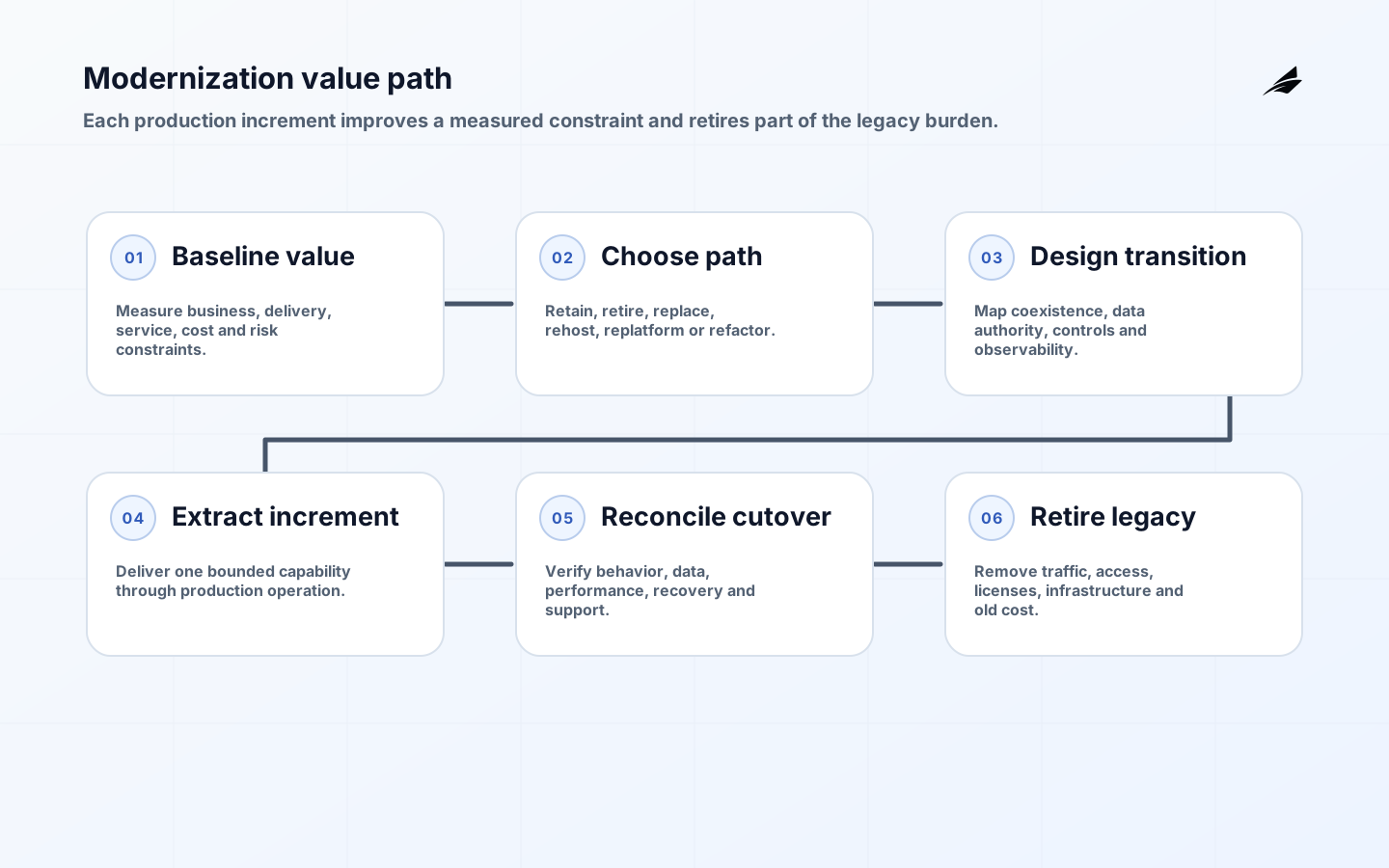
What six-stage delivery plan works?
- Baseline business outcomes, software delivery, service behavior, cost, risk and user pain across the portfolio.
- Choose retain, retire, replace, rehost, replatform or refactor per application using explicit evidence.
- Design a proportionate target and transition architecture with security, observability, data and ownership built in.
- Deliver one thin production increment, reconcile behavior and data, and rehearse failure and recovery.
- Expand by bounded capability while removing adapters, duplicated paths and legacy components at each stage.
- Verify outcomes and total cost, transfer operations, retire the remaining estate and maintain a new improvement backlog.
Key takeaways
- Modernize a measured business or operating constraint, not age or fashion alone.
- Choose a disposition per application and include retention, replacement and retirement.
- Design the coexistence period, data authority and observability as carefully as the target state.
- Make each increment production-ready and remove a piece of legacy burden.
- Count value only when outcomes improve and old cost or risk is actually retired.
Frequently asked questions
Is a full rewrite ever appropriate?
Yes, when the system is small enough, behavior is understood, the old platform cannot support incremental change and continuity can be protected. Full rewrites remain high risk because hidden behavior and long periods without user feedback accumulate. Use explicit parity, migration, cutover and rollback evidence.
Does moving to cloud count as modernization?
It can remove infrastructure constraints or enable managed services, but a rehost alone may preserve code, data and delivery limitations. Describe the specific capability gained and measure it. Migration and modernization can be separate stages when that reduces risk.
Are microservices the default target?
No. They are useful when independent change, scale and team ownership justify distributed-system cost. A modular monolith or managed platform is often simpler. Choose boundaries from business change and data needs, then verify that teams can operate the resulting architecture.
Conclusion
Good software modernization services replace constraints with demonstrably safer change, reliable operation and maintainable ownership. Evidence-led disposition, thin production increments, reconciled data and disciplined retirement keep the program connected to value. Teams focused on the delivery system itself can use the CI/CD modernization checklist and CI/CD modernization FAQ alongside this plan.