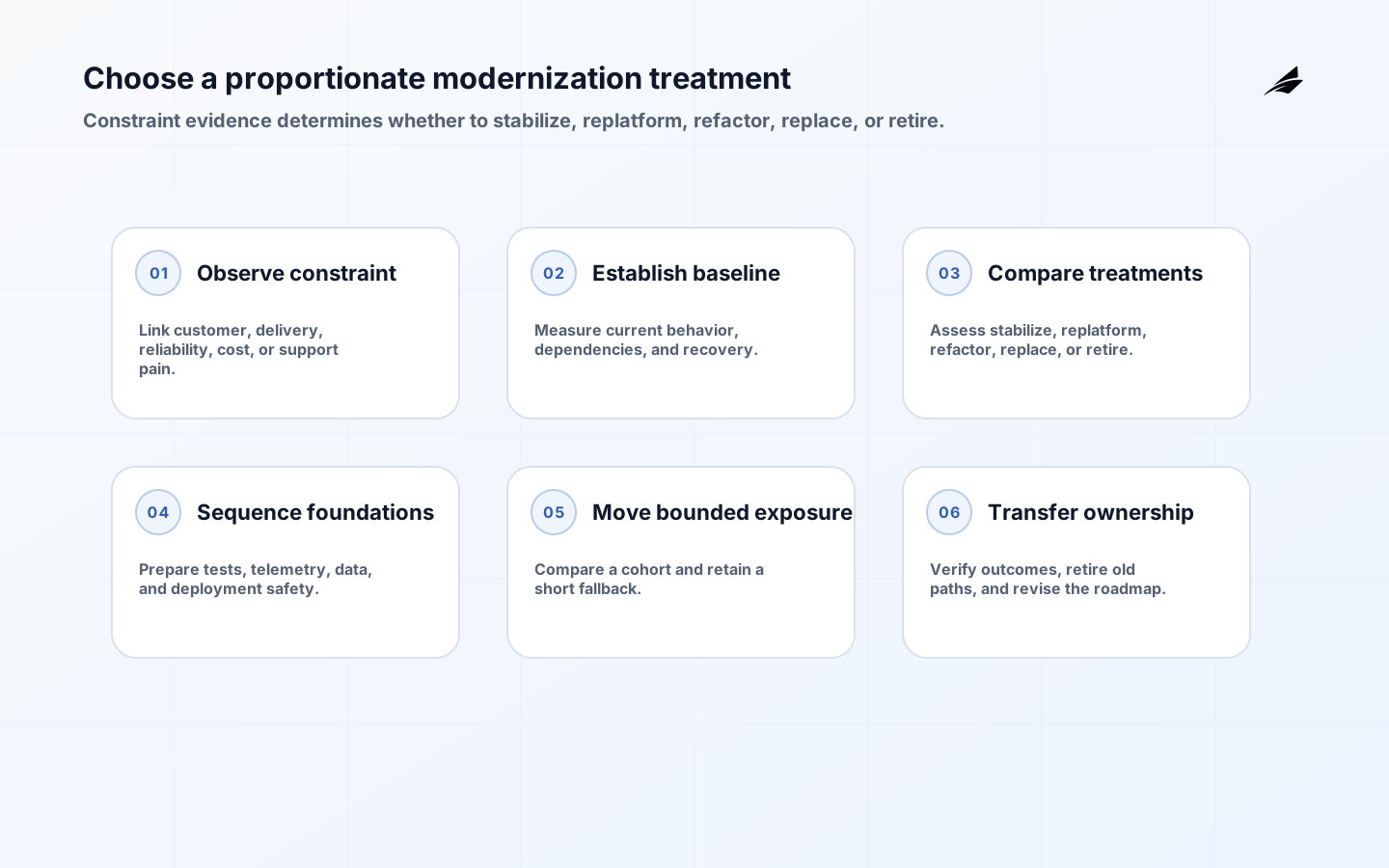
A software modernization roadmap is an ordered set of investments that improves a product’s ability to serve customers and operate reliably without betting the business on a full rewrite. It connects observable constraints—slow releases, unsupported components, fragile data changes, rising incident load, or expensive onboarding—to outcomes and evidence. Each roadmap item should state the affected capability, the proposed treatment, dependencies, customer risk, recovery plan, and measure of success. Technology replacement is a means, not the roadmap’s organizing principle.
Choose the lightest treatment that removes the constraint
Consider a SaaS billing module that blocks weekly releases because every change requires a long regression window. Rehosting it may change infrastructure cost but leave the release constraint intact. Replatforming the database could reduce operational burden; refactoring calculation boundaries could improve testability; rearchitecting may be justified only if the current design prevents essential pricing or scale. Microsoft’s cloud modernization planning guidance distinguishes replatform, refactor, and rearchitect strategies and explicitly warns against over-modernization. AWS modernization readiness guidance recommends assessing business, functional, technical, and financial significance before choosing the target.

Sequence work around dependencies and reversible slices. First establish observability, characterization tests, backups, and a trusted deployment path. Then isolate one capability, migrate representative traffic or data, compare outcomes, and retain a fallback until reconciliation is complete. Track delivery and reliability rather than counting migrated services. The DORA metrics guidance provides useful system-level measures, but combine them with customer and cost results. Edilec’s modernization operations playbook, growing-company roadmap, and modernization mistakes guide help turn the sequence into accountable delivery.
| Observed constraint | Candidate treatment | Evidence before commitment | Completion measure |
|---|---|---|---|
| Unsupported runtime creates security and hiring risk | Upgrade or replatform the runtime | Dependency inventory, compatibility test, support dates | Supported version with equal behavior and lower patch effort |
| Changes require touching unrelated modules | Refactor boundaries around one business capability | Change coupling and regression history | Smaller change set and shorter verified lead time |
| Data model prevents required product behavior | Migrate schema behind compatibility layer | Data quality profile and reconciliation design | New capability works with reconciled records and tested rollback |
| Single component limits reliability or scale | Rearchitect only the limiting path | Load profile, failure modes, target service level | Constraint removed without higher incident or operating burden |
| Manual releases cause inconsistent environments | Standardize build and deployment | Baseline failure rate and environment drift | Reproducible artifact, staged release, faster recovery |
| Low-value subsystem consumes specialist time | Retire or replace | Usage, contractual need, export and retention plan | Traffic removed, records retained, cost and support load reduced |
Key takeaways
- Rank work by customer consequence, recoverability, and strategic change demand.
- Name an owner and exit evidence for every modernization initiative.
- Protect data authority before moving reads or writes.
- Instrument old and new routes with shared transaction context.
- Review incidents and operating cost as roadmap inputs.
Software modernization roadmap decision
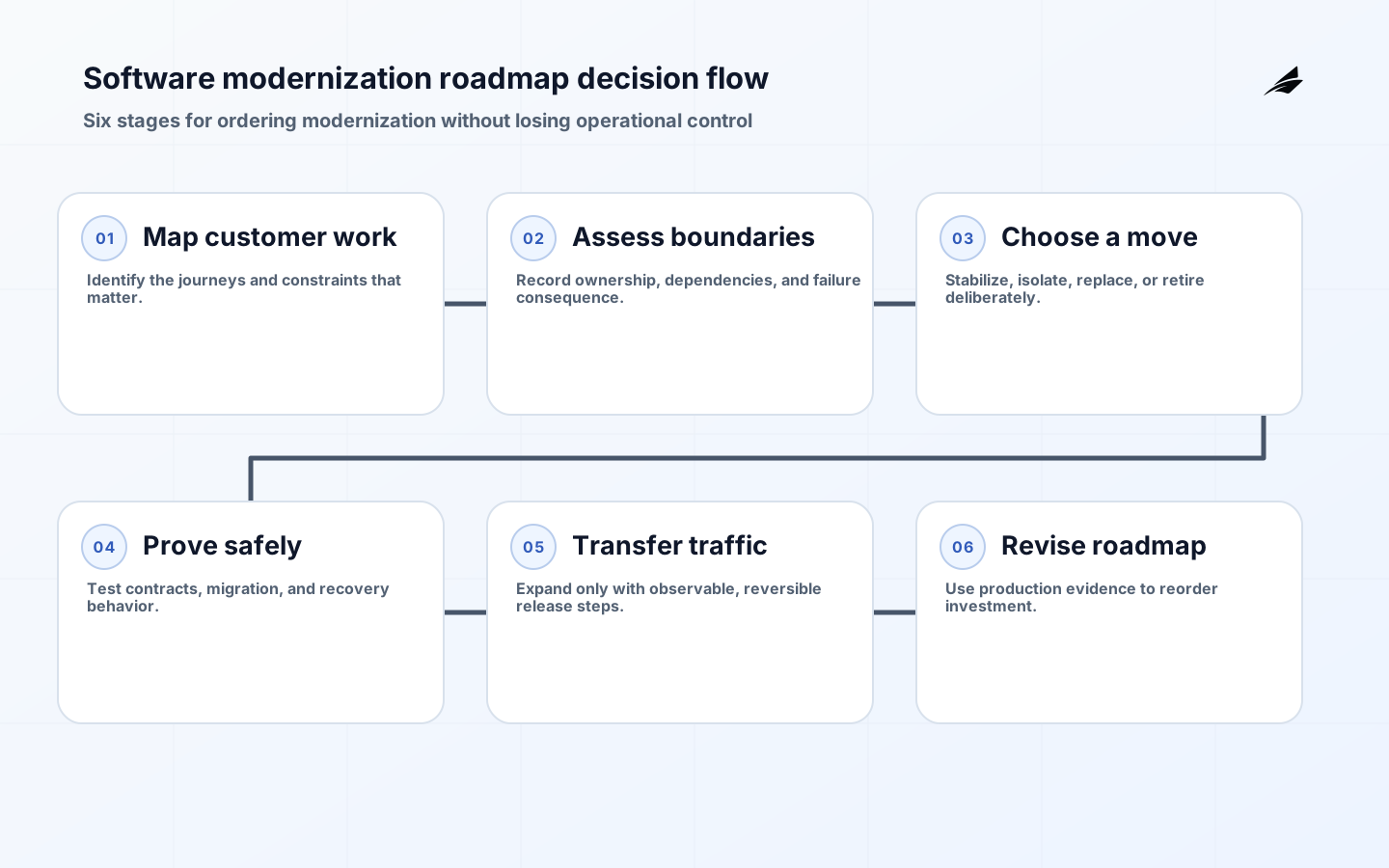
Create an inventory that is decision-ready rather than exhaustive. For each service, record the business capability it enables, the accountable owner, change frequency, operational symptoms, data sensitivity, integration dependencies, and a plausible failure consequence. Distinguish a component that is old but stable from one that constrains recovery or blocks a strategic product change. Interview support and finance as well as engineering: recurring refunds, reconciliation work, and delayed account changes often reveal priority better than source-code age. The first roadmap horizon should cover a small number of valuable journeys and explicitly state which risks are accepted for now.
| Planning element | Decision to make | Accountable role |
|---|---|---|
| Business capability | Name the customer or internal outcome it enables. | Product owner and service owner |
| Risk signal | Record failure history, recovery difficulty, and dependency concentration. | Engineering lead |
| Modernization move | Select stabilize, isolate, replace, or retire. | Architecture owner |
| Exit evidence | Define the proof needed before the next stage. | Release owner |
Design the software modernization roadmaps operating boundary
Choose a modernization path per boundary, not one grand approach for the whole product. A stable module may need characterization tests and a supported runtime before any functional change. A high-change capability can be separated behind a versioned interface, then evolved using a strangler route while the existing path continues to serve customers. Data deserves its own plan: name the source of truth, define compatible reads and writes, and rehearse reconciliation before moving authority. Each initiative needs a measurable exit condition, such as a tested restore, a reduced deployment lead time, or an eliminated manual correction queue.
Build controls and evidence
Before changing a legacy boundary, capture the behavior that customers and integrations depend on. Add characterization tests around billing, entitlement, identity, and data exports; inventory dependencies and unsupported components; and record the current recovery time. A modernization release should promote one identifiable artifact through repeatable environments, preserve software provenance, and protect deployment credentials. For data or interface changes, run compatibility and reconciliation checks rather than relying on a green unit-test suite. The release owner should know which signals pause migration, whether rollback is technically possible after a write, and when a forward repair is safer.
| Condition | Control or test | Owner |
|---|---|---|
| New route is slower | Compare representative transactions and inspect traces. | Keep cohort small; tune or revert before expansion. |
| Data differs after migration | Reconcile identifiers, counts, and material values. | Pause authority transfer and repair with an audit trail. |
| Dependency fails during cutover | Exercise timeout, queue, and manual handling paths. | Route to an owned exception queue. |
| Parallel path persists | Set a dated ownership-transfer decision. | Retire it after evidence and sign-off. |
Roll out with real work
A modernization wave should expose uncertainty gradually. Start with non-mutating reads, shadow comparison, or an internal cohort before transferring write authority. Route a small customer segment through the new boundary while the old path remains available for a deliberately short fallback period. Support teams need the version, known differences, and escalation route before traffic moves. Compare outputs at the transaction level and classify differences instead of averaging them away. Expand only when error, latency, reconciliation, and customer-outcome thresholds hold; otherwise stop, repair the cause, and repeat the same evidence set.
Measure and improve
Judge the roadmap by constraints removed. Useful measures include verified lead time for the affected capability, change failure rate, restore time, escaped defects, manual reconciliation hours, support contacts, infrastructure cost per transaction, and the age of unsupported dependencies. Establish the baseline before the first migration wave and annotate major product or traffic changes so comparisons remain honest. A faster release process that increases billing corrections is not progress. After each wave, decide whether to continue the chosen treatment, change sequence, stabilize the remaining system, or retire an item whose expected value no longer justifies transition risk.
Make the investment case from operating evidence
Build the investment case as a comparison among options: keep and stabilize, replatform, refactor a boundary, replace a product, rearchitect a capability, or retire it. For each option, estimate delivery effort, transition capacity, temporary duplicate running cost, data work, training, supplier commitments, and expected reduction in incidents or delay. State uncertainty ranges rather than a single confident total. Tie the recommended option to a named business constraint, such as an onboarding bottleneck or inability to meet recovery objectives. This makes the decision reviewable if growth, vendor pricing, or customer commitments change.
Treat data as a migration program
Treat data migration as its own controlled workstream. Profile keys, nulls, duplicates, historical exceptions, retention obligations, and relationships before designing the target schema. Define which store is authoritative during every phase, how writes are paused or synchronized, and how late events are handled. Reconcile counts and business invariants—such as balances, entitlements, and lifecycle state—not only row totals. Sample high-risk records with domain owners, preserve source-to-target lineage, and rehearse restart after a partial failure. Do not decommission the old store until restore tests, retention, exports, and downstream consumers have been verified.
Govern the roadmap without creating theatre
Run a roadmap review that can change the order of work. Examine newly observed incidents, dependency changes, realized benefits, migration defects, team capacity, vendor dates, and upcoming customer commitments. Every active item should retain a business sponsor, service owner, next evidence threshold, accepted risk, and stop condition. Record why work was accelerated, deferred, or cancelled so a later team does not repeat the same investigation. The review should remove obsolete initiatives as readily as it adds new ones; a shorter roadmap tied to current constraints is more credible than a permanent transformation inventory.
Set an operating cadence
During an active wave, use a short weekly decision review involving the product owner, service owner, migration lead, data owner, security representative, and support lead. Review exceptions and evidence rather than status narration: unresolved record differences, rollback readiness, customer impact, and the next exposure step. Keep technical work in ordinary delivery systems, but maintain a compact decision log for risk acceptance and authority transfer. After the boundary stabilizes, move to a monthly service review and keep modernization measures beside product and reliability measures so gains do not disappear into a project closeout.
Implementation checklist
- Rank work by customer consequence, recoverability, and strategic change demand.
- Name an owner and exit evidence for every modernization initiative.
- Protect data authority before moving reads or writes.
- Instrument old and new routes with shared transaction context.
- Review incidents and operating cost as roadmap inputs.
Frequently asked questions
How much of a legacy system should be replaced at once? Replace the smallest independently testable boundary that removes a material constraint. A full replacement is justified only when data, security, architecture, and operating dependencies cannot be isolated at acceptable cost. Even then, divide acceptance by business capability and rehearse migration and recovery before the final cutover. The goal is not to preserve old code indefinitely; it is to make each irreversible decision after the team has learned enough to own the consequence.
Should modernization wait until growth slows down? Usually not. Growth raises the cost of fragile releases, manual reconciliation, and concentrated knowledge. Reserve explicit capacity for the constraints that threaten customer commitments, security, or recovery, and sequence that work beside product delivery. A bounded modernization slice can support growth immediately; an open-ended rewrite that consumes every team is far harder to justify.
Conclusion
A useful software modernization roadmap does not celebrate how much technology was replaced. It shows which customer or operating constraint is being removed, why the selected treatment is proportionate, what evidence permits the next exposure step, and how the team will recover. Modernize one accountable boundary at a time, protect data authority, compare real outcomes, and revise the sequence whenever production evidence changes the decision.