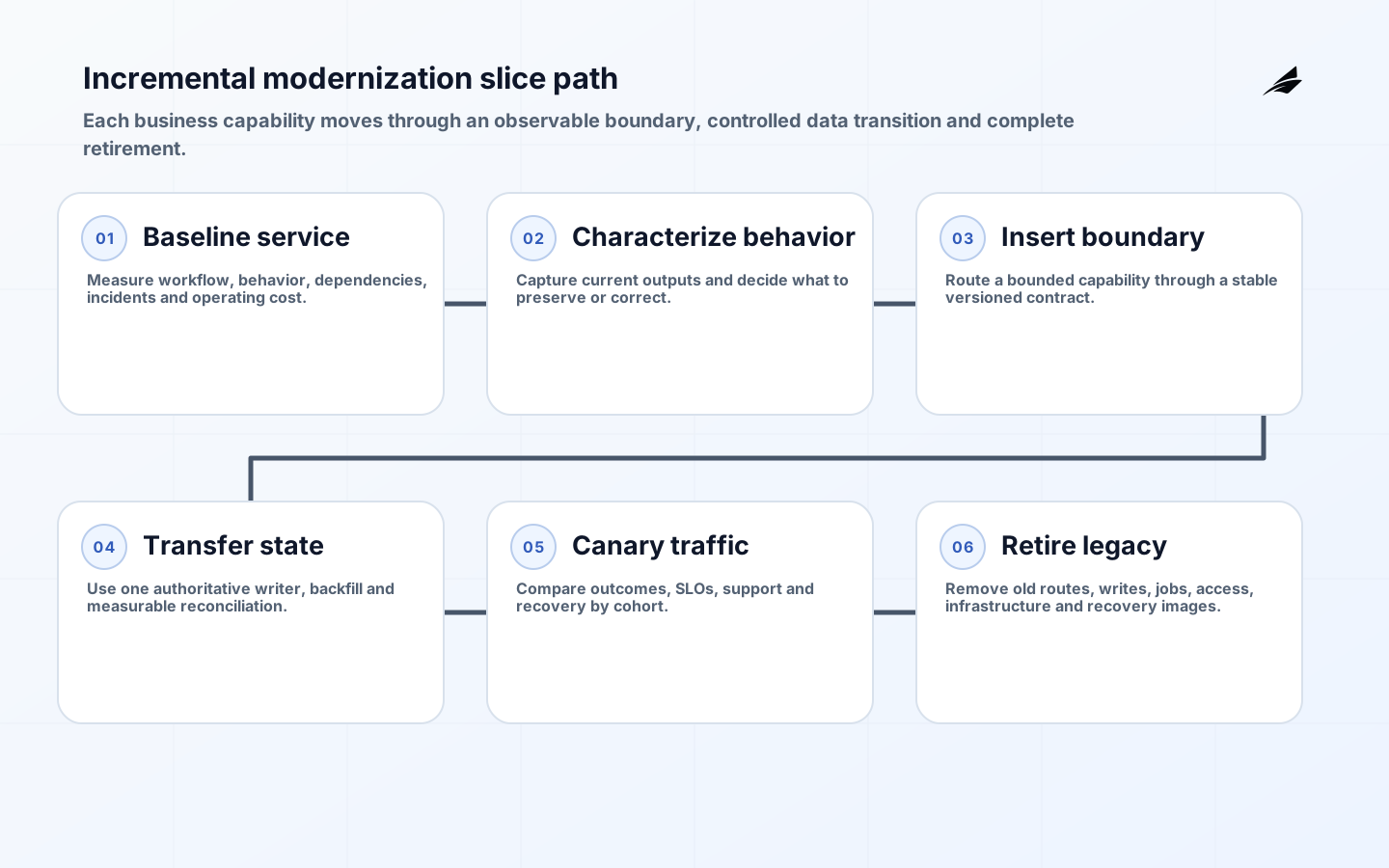
Software modernization without a rewrite replaces risk and friction one controlled boundary at a time while the existing system continues to serve the business. A full rewrite often underestimates undocumented rules, data history, reports, integrations and operational habits. Incremental modernization makes those dependencies observable and lets teams deliver value before the entire estate is understood. It can still involve substantial new software, but each slice has a migration, acceptance and retirement path.
AWS describes the strangler fig pattern as placing a boundary in front of legacy services and progressively routing behavior to replacements. The pattern is useful, but the proxy is not the strategy. Teams must choose slices around business capability, preserve or deliberately change behavior, control data ownership and operate old and new paths together. OpenTelemetry and SRE practices help compare outcomes and diagnose the hybrid period. This guide focuses on the decisions that make gradual modernization safer than an indefinite dual system.
Baseline the business service and current risk
Map users, workflows, decisions, records, integrations, reports, batch jobs, support procedures and failure history. Identify which behaviors are contractual, regulated or merely accidental. Measure lead time, change failure, incidents, recovery, user effort and operating cost before choosing technology. A slow-looking module may be stable and low value, while a small integration can create most incidents. Prioritize a business outcome with a bounded dependency surface and a reason to change.
Create an evidence backlog for unknown behavior. Interview operators and inspect real examples, logs, database constraints, exports and scheduled jobs. Characterization tests capture current outputs without claiming they are correct; product owners then decide which behavior to preserve or improve. Document nonfunctional requirements and peak periods. Modernization should not discard a hidden reconciliation or end-of-day control because it was not visible in the user interface.
| Candidate slice | Useful signal | Caution |
|---|---|---|
| High-change capability | Frequent releases and business demand | May have broad undocumented dependencies |
| Failure hotspot | Incidents, manual recovery and customer impact | Stabilize before adding migration complexity |
| Scaling bottleneck | Measured saturation and growth constraint | Do not split without data and load evidence |
| External boundary | Clear API or partner contract | Partner timing can control migration |
| Read-only journey | Lower write and rollback risk | May not prove data ownership transition |
| End-of-life component | Known supplier deadline | Replacement window may limit discovery |
Create a stable interception boundary
Choose an API gateway, reverse proxy, event interface, adapter or user-flow boundary that can direct selected work without leaking replacement details to every caller. Define identity, authorization, idempotency, errors, timeouts and versioning. Keep the boundary thin; moving all legacy logic into an orchestration layer creates a new monolith. Use an anti-corruption layer where the old data or vocabulary should not shape the new domain model.
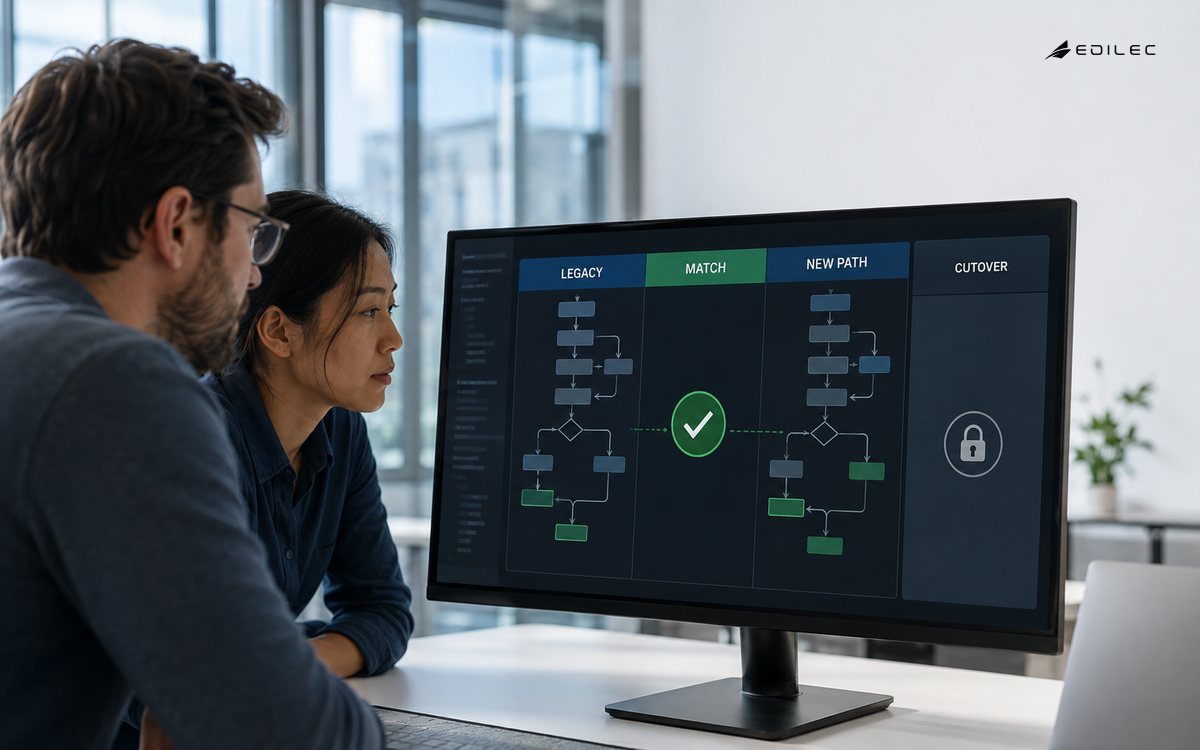
Route by capability, cohort or operation, not by random code path. Begin with pass-through behavior and telemetry, then shadow or compare the replacement where privacy and side effects permit. Feature flags need owners, expiry and tested emergency behavior. Do not duplicate write effects merely to compare systems. For writes, use a controlled system of record, event outbox or migration workflow that can prove exactly which side owns each state.
Move data ownership deliberately
Data is usually the hardest boundary. Identify the authoritative source for every field during each phase. Avoid uncontrolled dual writes; partial failure makes two systems disagree. Prefer one writer with change capture, an outbox, replication or an explicit migration service. Reconcile counts, identifiers, sums, state transitions and sampled records. Record lineage and timestamps so operators can explain differences. Plan retention, legal hold, export and deletion across both stores.
Backfill in restartable batches with checkpoints and integrity checks. Measure replication lag and define what users see while data is incomplete. Rehearse cutover and rollback using production-scale data. A rollback that sends traffic back to legacy must account for changes made in the new system. When the replacement becomes authoritative, prevent old code and jobs from writing, update reporting and recovery, and remove access after a monitored period.
Prove behavior, security and operability
Use characterization, contract, integration and end-to-end tests around the slice. Compare business outcomes, not just response shapes. Add authorization and misuse tests to the new boundary using an application security standard such as OWASP ASVS as a verification input. Instrument old and new paths with correlated traces, metrics and logs. Track workflow completion, error, latency, manual correction and support contacts by route and cohort.
Production readiness includes deployment, configuration, secrets, backup, restore, monitoring, capacity, on-call and incident procedures. A containerized legacy component is not modernized if releases and recovery remain fragile. Automate repeatable builds and environments, but preserve a clear operating owner. Exercise dependency failure and rollback before moving critical traffic. Use SLOs to decide whether the slice can expand rather than relying on a successful demonstration.
Shift traffic in observable increments
Start with internal users, a low-risk region or a tenant cohort. Define entry, expansion and stop criteria. Observe complete business cycles, including scheduled work and reconciliation, before increasing exposure. Keep support informed about which path serves a user and how to capture evidence. Rollback should be quick but not casual; record why it happened and what state must be reconciled. Avoid keeping every old path indefinitely “just in case.”
Retirement is part of each slice. Remove routes, jobs, tables, credentials, dashboards, infrastructure and documentation that no longer serve. Archive required records in a verifiable form. Update disaster-recovery images and exercises so a restore cannot resurrect the old writer. Confirm cost reduction and reduced operational burden. A modernization program that only adds new services while retaining every legacy component increases complexity and attack surface.
| Gate | Required evidence | Decision |
|---|---|---|
| Baseline | Workflow, behavior, risk and operating measures | Slice has a justified outcome |
| Boundary | Versioned contract, identity and routing | Callers can move without broad coupling |
| Data | Ownership, backfill, reconciliation and rollback | State remains explainable |
| Readiness | Security, capacity, recovery and support tests | Replacement can carry production work |
| Canary | Outcome and SLO comparison by cohort | Traffic can expand or return safely |
| Retirement | Old writes, access, jobs and assets removed | Complexity and risk actually decline |
Run modernization as a product program
Maintain a capability map, dependency record, slice backlog and retirement ledger. Fund platform improvements that make later slices cheaper: identity, deployment, telemetry, data movement and test environments. Keep product and operational owners involved because modernization choices change workflows, not only code. Report customer outcome, reliability, change speed, operating effort and retired risk. Lines of code or microservice count do not prove value.
- Baseline one business capability, its hidden rules, dependencies and service measures.
- Capture current behavior and decide what must be preserved or corrected.
- Introduce a thin versioned boundary with trusted identity and observability.
- Move data through one authoritative writer and measurable reconciliation.
- Canary the replacement with explicit readiness, expansion and rollback gates.
- Retire legacy routes, data access, jobs, infrastructure and recovery artifacts.
Set program guardrails for the hybrid estate
The coexistence period needs explicit limits. Define how many versions, data paths and temporary adapters the organization will support, who owns each and when it expires. Add temporary components to security scanning, monitoring, capacity and recovery rather than treating them as migration scaffolding outside production standards. Review the modernization backlog against operational load so teams do not open more slices than they can safely carry and retire.
Create an architecture fitness review for each completed slice. Confirm deployment independence, contract stability, tenant and user authorization, telemetry, support, cost and reduced legacy dependency. Ask operators whether diagnosis and recovery are easier. Compare business measures with the baseline and inspect whether users created new manual workarounds. If the slice adds complexity without retiring old behavior or improving an outcome, stop expansion and correct the boundary.
Communicate the sequence in business language. Stakeholders need to know which capability changes, which records remain authoritative, what downtime or training is expected and when old behavior disappears. Publish cutover and rollback contacts. This prevents parallel business projects from binding themselves to a component scheduled for retirement and gives affected teams time to update reports, integrations and procedures.
Key takeaways
- Modernize by business capability with a measurable outcome and bounded dependency surface.
- Characterization tests reveal behavior; owners decide which behavior remains correct.
- One authoritative writer and explicit reconciliation are safer than uncontrolled dual writes.
- The hybrid system needs complete security, observability, support and recovery.
- Every slice should retire legacy assets or the estate becomes more complex.
Frequently asked questions
Is the strangler fig pattern only for monoliths?
No. It can incrementally replace services, integrations, user flows or data boundaries. It works when a stable interception point can route a bounded capability and the team controls state transition.
How do we avoid running two systems forever?
Give every slice retirement criteria, owner and date. Remove old writes and routes after monitored acceptance, update reporting and recovery, revoke access and track remaining legacy dependencies in a retirement ledger.
When is a full rewrite justified?
A rewrite may be justified for a small, well-understood product or when no safe boundary exists and the platform is unsupportable. It still needs behavior discovery, data migration, parallel validation and cutover evidence.
Conclusion
Incremental modernization works when each slice improves a real service, keeps state trustworthy and ends by removing old risk. Stable boundaries, explicit data ownership, correlated evidence and controlled traffic shifts let the organization learn while delivering. The goal is not a fashionable architecture; it is software that becomes easier to change, operate and explain with every completed slice.