Software modernization roadmaps are worth building when they make a real operating decision safer, faster, or easier to explain. A growing company can have a stable but expensive legacy component beside a newer service that fails often. Age alone is not a useful priority. The roadmap must connect technical constraints to a customer journey, recovery difficulty, cost of change, and the next business move. Growing companies should begin with a system boundary and the customer or operational capability it enables, because that exposes the people, systems, policy constraints, and evidence a useful product must connect. The objective is not a prettier version of a spreadsheet. It is a dependable path for work that leaves enough context for the next person, survives an integration failure, and can be measured after release.
Key takeaways
- Start with a system boundary and the customer or operational capability it enables, not a collection of screens.
- Make explicit whether to stabilize, isolate, replace, retire, or leave a component unchanged for now.
- Keep a named source of truth for important facts and record consequential changes.
- Enforce permissions on the server and test denied paths as carefully as allowed paths.
- Use release evidence and production signals to improve software modernization roadmaps after launch.
Map the software modernization roadmaps decision
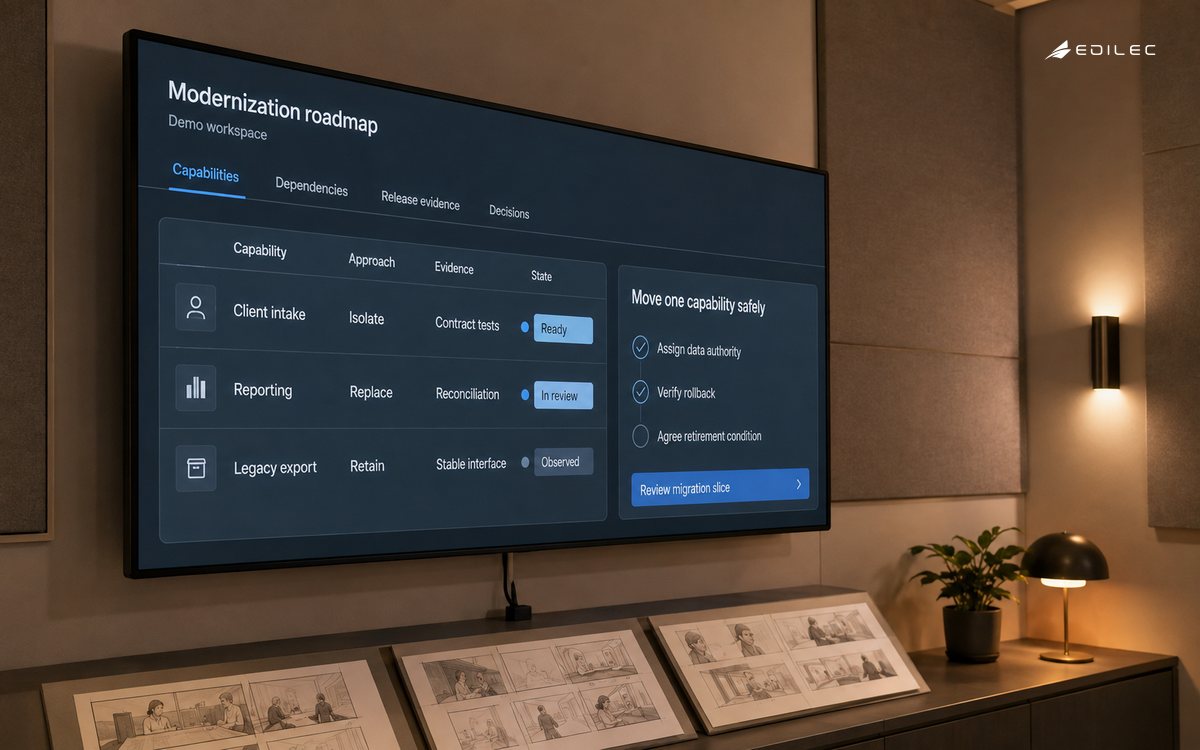
The first workshop should follow a concrete example from beginning to end. Ask who initiates it, what information is needed, what rule determines the next step, who owns a delay, and what a satisfactory outcome looks like. Capture the ordinary path and the exceptions that staff already solve by email or chat. This creates a shared operating model and avoids a common delivery error: building a surface that looks complete while leaving the most consequential handoff outside the system. The resulting map should name whether to stabilize, isolate, replace, retire, or leave a component unchanged for now.
| Planning element | Question to answer | Useful evidence |
|---|---|---|
| Outcome | What business result should this journey produce? | A completed example with a clear owner. |
| State | What changes and who may make that change? | A transition rule and audit entry. |
| Data | Which system owns the fact? | Field lineage and refresh expectation. |
| Exception | What happens when the ordinary path fails? | A queue, timer, and recovery owner. |
Set a deliberate software modernization roadmaps boundary
Build a decision-ready inventory rather than a catalogue of technologies. Capture capability, accountable owner, change frequency, dependencies, data sensitivity, failure consequence, and recovery evidence. Rank work by customer consequence and strategic demand; a quiet component with no planned change may deserve less attention than a small integration blocking a new market.
Make data and access explicit
Give data its own modernization plan. State the source of truth, compatible read and write paths, migration identifiers, reconciliation checks, retention requirements, and the condition for transferring authority. A replicated read model can be introduced safely before moving writes, but only when lag and repair responsibilities are understood.
| Condition | Control | Release check |
|---|---|---|
| User requests a protected action | Evaluate role, record scope, and action on the server. | Attempt the action with an unentitled account. |
| An integration is retried | Use a durable identifier and record the prior outcome. | Send the same command twice. |
| A record changes concurrently | Detect a stale version or reconcile deliberately. | Submit an edit after another change. |
| A support issue is investigated | Link logs, events, and audit history by correlation ID. | Trace a test item across the workflow. |
Build security and usability in
Use secure delivery controls throughout the roadmap. NIST SSDF describes practices for preparing an organization, protecting software, producing well-secured releases, and responding to vulnerabilities. Characterization tests, dependency updates, contract checks, backup restoration, and rollback limits make an incremental change credible rather than merely reversible in theory. The NIST Secure Software Development Framework is a practical reference for making secure design, verification, release integrity, and vulnerability response part of normal delivery. For browser-facing work, WCAG 2.2 gives testable accessibility guidance that also improves day-to-day task completion.
Assign ownership and change control
Growing companies need a lightweight but explicit ownership model for software modernization roadmaps. Name the business owner who decides what good looks like, the service owner who is accountable for availability and recovery, the data owner who approves material changes, and the person who may accept residual risk. Keep a dated decision log for policy changes, interface changes, and temporary exceptions. When a rule changes, identify records already in flight and decide whether they remain under the old rule, are recalculated, or need a human review. That discipline prevents a routine release from silently changing the meaning of work already promised to a customer or colleague.
Verify before expanding access
Before widening software modernization roadmaps to another team, tenant, or workflow, rehearse the conditions that usually create expensive support work. Use representative data, deliberately incomplete inputs, slow or unavailable dependencies, duplicate requests, and a user whose permission should be denied. Confirm that the team can find the event, explain the state, correct it without hidden database edits, and communicate the next step. A release gate should include functional acceptance, accessibility checks where relevant, authorization tests, integration contract evidence, and a documented limit on what can be rolled back. Passing a demonstration is useful; passing these operating checks is stronger evidence.
Prepare support and recovery
Write a short support playbook before the pilot. It should state the service objective, ownership hours, dashboards or searches to use, expected state transitions, escalation contact, and safe repair actions for software modernization roadmaps. Include a communication template for a client-facing delay and a reconciliation step for any action that may have completed in one system but not another. Runbooks should be tested with a realistic case, not left as an aspirational document. This is particularly important when an application coordinates several teams: a fast technical restart does not resolve an item whose business owner, evidence, or downstream status remains unclear.
Release with operating evidence
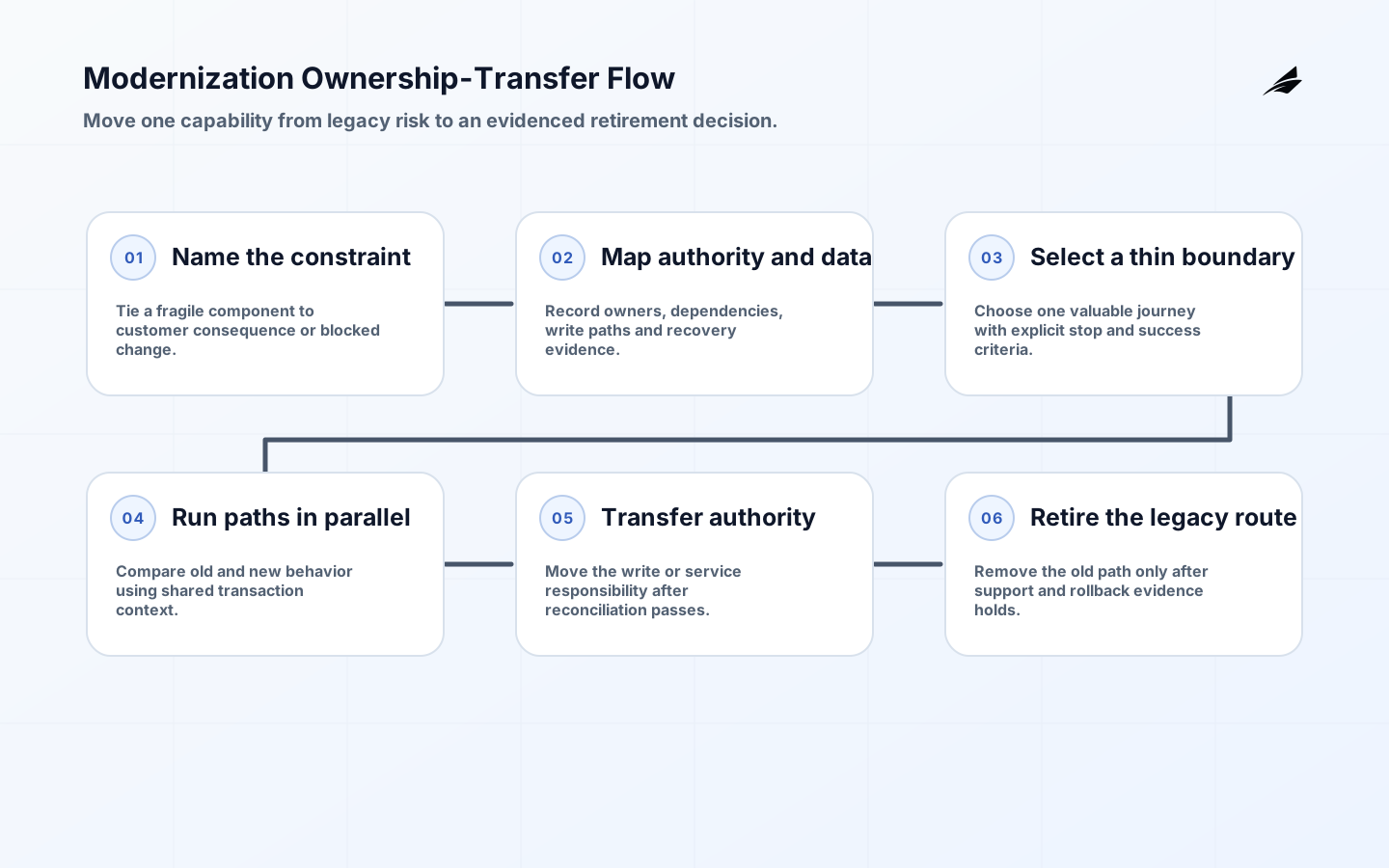
Move one boundary at a time and compare old and new behavior with shared transaction context. A gradual traffic shift needs stop criteria, a clear owner, and a reconciliation plan for work completed during a partial failure. Review incident trends, support burden, lead time, and operating cost after each stage so the next roadmap decision uses evidence. Use OpenTelemetry documentation as a reference when agreeing how services emit traces, metrics, and logs. Monitoring should answer an operational question: which step is delayed, for whom, and why? It should not be a collection of technical charts disconnected from the work the application is meant to improve. Related delivery practices are also covered in this developer handoff documentation.
Avoid common software modernization roadmaps failures
A rewrite programme stalls when it asks a team to replace everything before customers benefit. Equally risky is a series of isolated upgrades with no ownership-transfer decision. Keep the existing route stable, retire it deliberately after evidence is met, and protect the data contract throughout the transition.
Measure and improve
Choose measures that connect software behavior to the operating problem. For this work, inspect change lead time, restore-test success, production incidents by boundary, manual reconciliation workload, and the percentage of legacy routes retired with documented ownership transfer. Establish a baseline before the pilot, segment results by workflow type or role where that changes the meaning, and pair numbers with sampled cases. A lower average time can conceal more work being pushed into an unowned exception queue. Review the evidence with the people responsible for the outcome, then change the policy, interface, integration, or training that the cases actually support.
Keep decisions explainable
As software modernization roadmaps mature, the difficult question is rarely whether the application can execute a rule. It is whether a supervisor, auditor, support colleague, or affected user can understand the decision later. Preserve the facts used at the time, the rule or policy version, the actor or automated service that acted, and the reason an exception was accepted. Explainability does not require exposing private implementation details; it means the accountable team can distinguish a valid decision, an incomplete request, a stale input, and a system failure. Review a small sample of completed and exceptional cases every release. Those reviews reveal ambiguous policy, misleading interface language, and integration assumptions long before aggregate metrics make the problem obvious. For growing companies, this review is also the clearest way to decide whether the next investment belongs in policy, process, data quality, or software.
Frequently asked questions
Should the first release include every role and exception? No. For software modernization roadmaps, support one complete, valuable journey and the controls needed to operate it responsibly. Defer a role only when there is a safe, owned way to handle its work outside the new application; do not defer the authorization or audit rule that protects the released path.
How should the team handle errors from connected systems? In software modernization roadmaps, decide whether a request is rejected, accepted for later processing, or completed with a warning. Give callers a stable, useful response. RFC 9457 standardizes problem details for HTTP APIs, but error messages should help a user correct an issue without exposing internal implementation or sensitive information.
Conclusion
Software modernization roadmaps become durable when the team can explain the work, data authority, permission boundary, exception route, and evidence of benefit. Begin with the smallest accountable journey, release it with observability and recovery in place, and let measured operating experience determine the next investment. That approach protects both users and delivery capacity while producing software that can grow with the business.