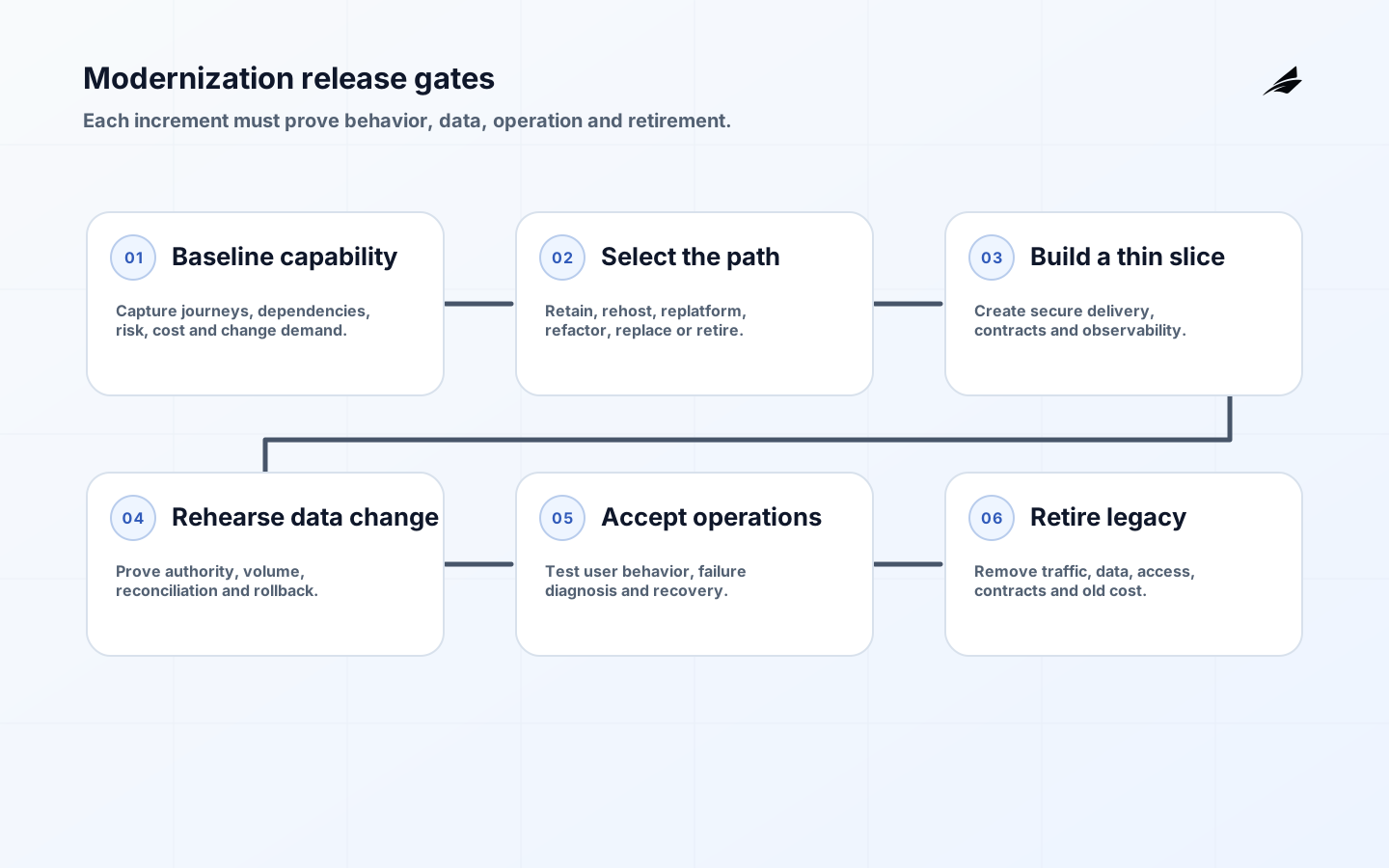
This software modernization services implementation checklist is not a product purchase with a predictable outcome. It is an operating change spanning applications, data, interfaces, delivery systems, operating teams and business workflows. The useful question is whether the proposed service improves a named workflow while preserving security, recoverability and accountable ownership. This guide turns that question into a sequence of decisions, evidence and release gates that buyers, architects and delivery leaders can use together.
Begin with the companion Edilec resources on software modernization scope and cost, the software modernization FAQ, modernization without a full rewrite. They provide neighboring architecture and implementation detail. This article concentrates on the exact boundaries, delivery evidence and recurring management decisions that determine whether modernization program remains useful after the first release.
Start with outcomes, portfolio evidence and constraints
The checklist begins with a portfolio baseline: business capabilities, users, transaction volumes, release pain, incidents, data stores, interfaces, unsupported components, recovery objectives and operating cost. Rank problems by business consequence and change demand. “Move to cloud” or “use microservices” is not an outcome. Good objectives are measurable: reduce pricing change lead time, remove an unsupported runtime, recover within four hours, make audit evidence available or let a product team deploy independently.
Establish decision authority and non-negotiable constraints. Name product, architecture, security, data, operations and finance owners. Record regulatory retention, availability windows, vendor dependencies, seasonal freezes, skills and exit dates. Define what remains, what is retired and who owns the transition. Modernization services should transfer decisions and operating knowledge to the accountable team; a supplier-delivered target that only the supplier can change is a new legacy system.
| Decision | What must be explicit | Acceptance evidence |
|---|---|---|
| Capability | Business behavior, users, pain and change demand | Baseline journey and measurable target |
| Path | Retain, rehost, replatform, refactor, replace or retire | Architecture record with evidence and constraints |
| Data | Authority, migration, reconciliation, retention and rollback | Dry run with signed reconciliation |
| Release | Increment, compatibility, observability and recovery | Production-like deployment and rollback |
| Retirement | Traffic, data, access, contract and archive closure | Decommission record and cost removal |
Choose a modernization path per capability
Choose at capability level. Stable low-change modules may remain or be rehosted; unsupported platforms may need replatforming; capabilities constrained by coupling may be extracted behind explicit contracts; commodity functions may be replaced. Avoid decomposition by technical layer alone. Map transaction boundaries, consistency needs, latency, batch dependencies and failure behavior. Introduce APIs or events only with ownership, versioning, idempotency and support expectations. The target architecture should reduce a known constraint rather than maximize novelty.
Treat data migration as product work. Profile source quality, ownership, keys, duplicates, history, retention and downstream consumers. Define source-to-target mappings, transformation rules, reconciliation totals and rejected-record handling. Rehearse representative volumes and restart behavior. During coexistence, name the system of record and control writes; unrestricted dual write creates ambiguous truth. A rollback must state what happens to data created after cutover, not merely how application binaries return.
Build security, observability and recovery into the target
Modernization changes trust boundaries and delivery mechanisms, so threat modeling and secure development belong in each increment. Establish protected repositories, reproducible builds, dependency policy, artifact provenance, secret management and vulnerability response. Instrument service-level indicators, business transactions, logs and traces before traffic moves. Recovery needs controlled configuration, dependency order and restored-data verification. Accessibility and performance baselines should travel with functional behavior rather than becoming final-stage audits.
NIST’s Secure Software Development Framework supplies lifecycle security practices. CISA’s Secure by Design guidance reinforces manufacturer ownership and safe defaults. DORA’s current software delivery metrics help measure throughput and instability. The OpenTelemetry documentation provides an open observability model, and the W3C Web Content Accessibility Guidelines 2.2 give testable accessibility criteria for web interfaces.
| Control area | Implementation detail | Proof before scale |
|---|---|---|
| Supply chain | Protected source, reviewed change, provenance and dependency policy | Trace a release from commit to deployed artifact |
| Interfaces | Versioned contracts, authentication, quotas and compatibility tests | Old and new consumer conformance |
| Data | Mappings, validation, reconciliation and controlled authority | Volume rehearsal and signed totals |
| Operations | Service indicators, traces, alerts, runbooks and on-call ownership | Fault diagnosis and recovery exercise |
| User quality | Journey, accessibility and performance regression suites | Representative user acceptance |
Implement in thin, reversible increments
Create a walking skeleton through build, test, deployment, telemetry and recovery, then modernize one thin business slice. Use strangler routing, adapters or feature controls to move bounded traffic while legacy behavior remains available. Compare outputs where safe, capture discrepancies and define stop conditions. Each wave should retire something: an interface, runtime, manual release or support dependency. If transition complexity only grows, pause and redesign the sequence before adding another coexistence layer.
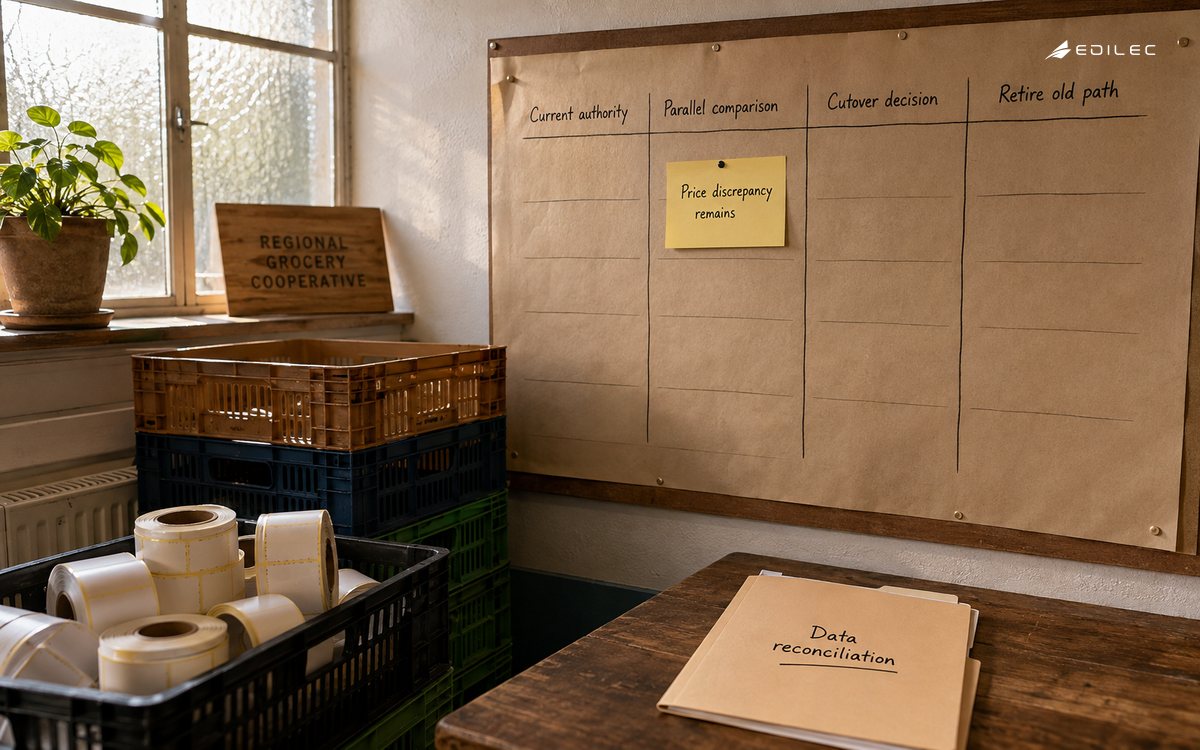
Treat every stage as a gate, not a calendar milestone. The owner records the decision, evidence, unresolved exceptions and rollback trigger. A stage closes only when representative users complete the workflow, telemetry explains failure, support can diagnose it, and recovery has been exercised. This keeps modernization program from expanding on enthusiasm while operational debt remains invisible.
Fund the transition state, not only the target
Modernization cost includes discovery, target engineering, legacy stabilization, duplicate environments, adapters, data migration, testing, security, observability, training, support, vendor termination and decommissioning. Coexistence can dominate the budget, so fund a retirement backlog and assign dates. Estimate by capability and risk, not lines of code. Use ranges for unknown data quality and interface ownership, then reduce uncertainty with short technical spikes and migration rehearsals before making a full-program commitment.
For software modernization, estimate lifecycle cost by workload and by responsibility. Include discovery, integration, migration, verification, security review, environments, observability, support, change management, vendor management, data movement, incident response and exit work. Keep contingency attached to known uncertainty rather than hiding it in a blended rate. Reforecast after the pilot with observed effort and consumption; that is more defensible than extrapolating a demonstration.
Common failure modes and practical responses
Frequent failures are portfolio-wide rewrites, cloud relocation presented as modernization, microservices without team ownership, test automation deferred until after migration, data reconciliation defined too late, and old systems retained indefinitely as fallback. Teams also copy legacy defects because no product owner decides intended behavior. Preserve necessary business rules, not accidental implementation. A failed first release often reflects an oversized batch or weak observability rather than proof that incremental modernization cannot work.
For software modernization, the practical response is a small control loop: detect the condition, identify the accountable owner, limit exposure, preserve evidence, recover the workflow, and decide whether the underlying design must change. Record exceptions with an expiry date and compensating control. Repeated exceptions are architecture evidence, not administrative noise, and should change the roadmap or narrow the service boundary.
Example: extracting order pricing from a legacy application
A retailer’s pricing rules sit inside an order application that requires coordinated quarterly releases. The team first captures pricing journeys, rule precedence, volumes, latency, audit needs and failure behavior. It introduces a versioned pricing contract and a new service behind an adapter. For selected product groups, the legacy application calls both implementations, uses the legacy result and records a privacy-safe comparison for analysis.
After discrepancy classes are resolved, a feature control makes the new service authoritative for a small cohort. Alerts cover decision errors, latency, dependency failures and fallback use. A rollback returns authority without losing newly created pricing records because rules are versioned in a controlled store. Once full traffic and two seasonal events succeed, the embedded pricing module, its release job and obsolete infrastructure are retired and costs are verified as removed.
For software modernization, the team releases only the proven slice, monitors user and system outcomes through a full operating cycle, and keeps the previous route available until reconciliation closes. At the review, leaders compare baseline and observed results, examine near misses and support effort, and either expand, redesign or stop. That decision discipline matters more than completing every item in an original feature list.
How to measure value and operating health
Track objective-specific outcomes plus delivery health: change lead time, deployment frequency, failed deployment recovery time, change fail rate and rework; unsupported component count; incident rate; recovery attainment; transaction correctness; escaped defects; user-task success; cloud and support cost; and legacy components retired. Measure by service over time. Do not compare unlike teams or turn one metric into a target that encourages smaller reporting boundaries rather than better delivery.
| Measure type | Example measure | Decision it informs |
|---|---|---|
| Business | Time and error rate for the modernized workflow | Whether the capability improves |
| Delivery | Lead time, frequency, failure and rework | Whether teams can change it safely |
| Risk | Unsupported exposure and recovery attainment | Whether modernization removes material risk |
| Retirement | Legacy cost and components actually removed | Whether transition debt is closing |
Key takeaways
- Baseline business behavior, risk and change demand before selecting technology.
- Choose retain, rehost, replatform, refactor, replace or retire per capability.
- Rehearse data authority, reconciliation and rollback at realistic volume.
- Move thin slices with telemetry and explicit stop conditions.
- Close every wave by retiring legacy access, infrastructure or process.
Frequently asked questions
Must modernization move an application to cloud?
No. Modernization should remove a business, delivery, security or operating constraint. Cloud services may help, but an on-premises refactor, interface stabilization, data cleanup or delivery-system improvement can be the right path.
How much automated testing is enough before migration?
Cover critical journeys, business invariants, contracts, data reconciliation, security boundaries, performance and recovery according to risk. A smaller reliable suite tied to release decisions is more useful than broad fragile UI automation.
When can the legacy system be switched off?
After traffic has moved, data and downstream consumers reconcile, rollback and retention periods are settled, support accepts the target, access is removed, contracts are closed and finance verifies that legacy cost is actually gone.
Conclusion
A modernization services implementation checklist is effective when it turns a broad transformation into evidence-backed capability decisions and reversible releases. Protect business behavior, make data authority explicit, build secure delivery and observability early, and fund retirement. The program is complete only when teams can operate the target and the old risk and cost have genuinely left.