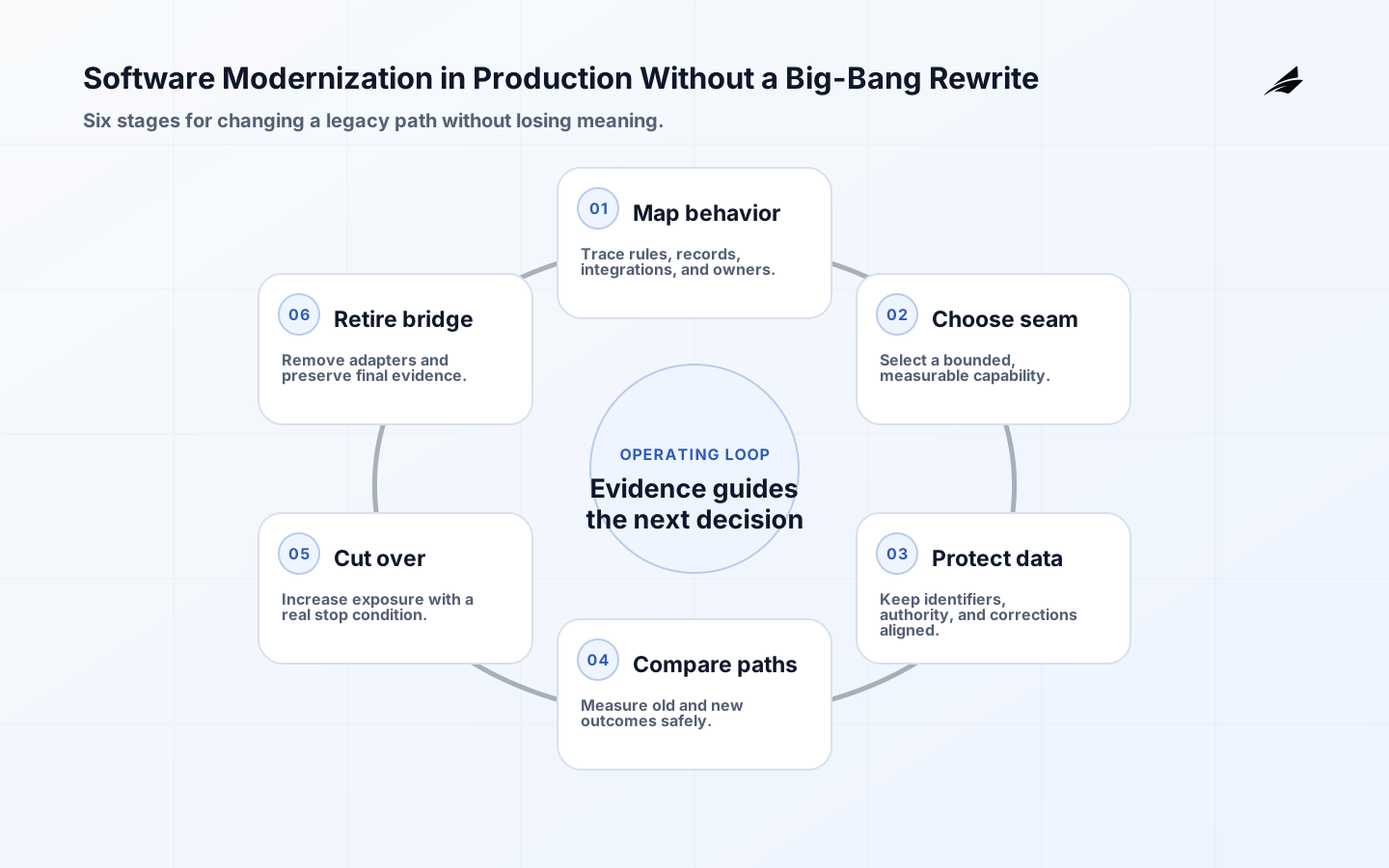
Software modernization becomes real when a live organization changes a system without losing customer service, business meaning, security, or the ability to recover. The hard part is rarely moving code to a newer runtime. It is discovering which rules live in old screens, batch jobs, exports, database triggers, manual work, and partner assumptions, then moving them without making two systems disagree. A safer modernization roadmap treats each production slice as a decision: what outcome is moving, which system is authoritative, how the old and new paths coexist, what proves equivalence, and what correction remains possible if reality differs.
Start with an outcome the legacy system can prove
Name the business result before choosing a target architecture. It might be faster account onboarding, a reliable order-status view, safer document approvals, or the ability to change one pricing rule without a weekend release. Define the current baseline, the user or operator affected, the authoritative records, and the evidence that would show improvement. A modernization program with only a technology target can declare victory after a migration while customers still wait, staff still reconcile spreadsheets, and the old system remains the real owner of every important decision.
Map behavior before choosing a target stack
Trace one journey from trigger to outcome. Identify callers, screens, batch jobs, APIs, data stores, integrations, manual approvals, failure behavior, service expectations, and owners. Distinguish an accidental behavior from a business rule, but do not discard an old behavior until its consumers are known. A nightly export may be the contract for a partner; a database trigger may enforce a rule that nobody wrote down; a manual correction may be the only recovery path. The Google Cloud application-modernization guidance is a useful reminder to assess and measure capability, not merely replace components.
| Observed fact | Question to ask | Artifact to keep |
|---|---|---|
| A nightly job changes records | Is it authoritative or derived? | Data-owner and timing note |
| A partner reads an export | What fields and timing are contractual? | Versioned sample and consumer |
| Staff fixes a status manually | Which rule or exception is missing? | Repair path and permission |
| Two services write the same object | Which writer wins during overlap? | Ownership and conflict rule |
| A screen hides a slow step | What does the user believe completed? | State map and timing baseline |
Choose a seam that can be reversed
Choose a bounded capability with a clear caller, authority, and measurable result. A read path, notification decision, attachment workflow, or one asset class is often easier to compare than an entire domain. Martin Fowler's Strangler Fig pattern captures the value of placing new behavior beside the existing path and moving incrementally. The seam must include routing, data ownership, observability, and a correction plan. A feature flag that only changes the screen is not reversible if the new path has already written incompatible state.
Protect data meaning during the handoff
Stable identifiers, effective dates, source versions, and explicit ownership are more important than a one-time copy. If old and new components both write, define the conflict rule before the overlap begins. If the new component derives a decision, compare it with a known sample and preserve the input and rule version that produced the result. Reconcile late corrections, deleted records, partial migration, and restore. A migration is complete only when normal changes and exceptional changes remain explainable, not when a data-transfer job reaches 100 percent.
| Data risk | Control before cutover | Proof after cutover |
|---|---|---|
| Different identifiers | Define a stable cross-system key | Sampled join and unmatched report |
| Different rule version | Record effective date and rule owner | Result comparison by version |
| Dual writers | Choose an authority and conflict path | No unexplained divergence |
| Late or corrected input | Replay or reconciliation procedure | Correction reaches both paths |
| Restore from old media | Document migration on restore | Restored records retain correct ownership |
Run old and new paths with a measured cutover
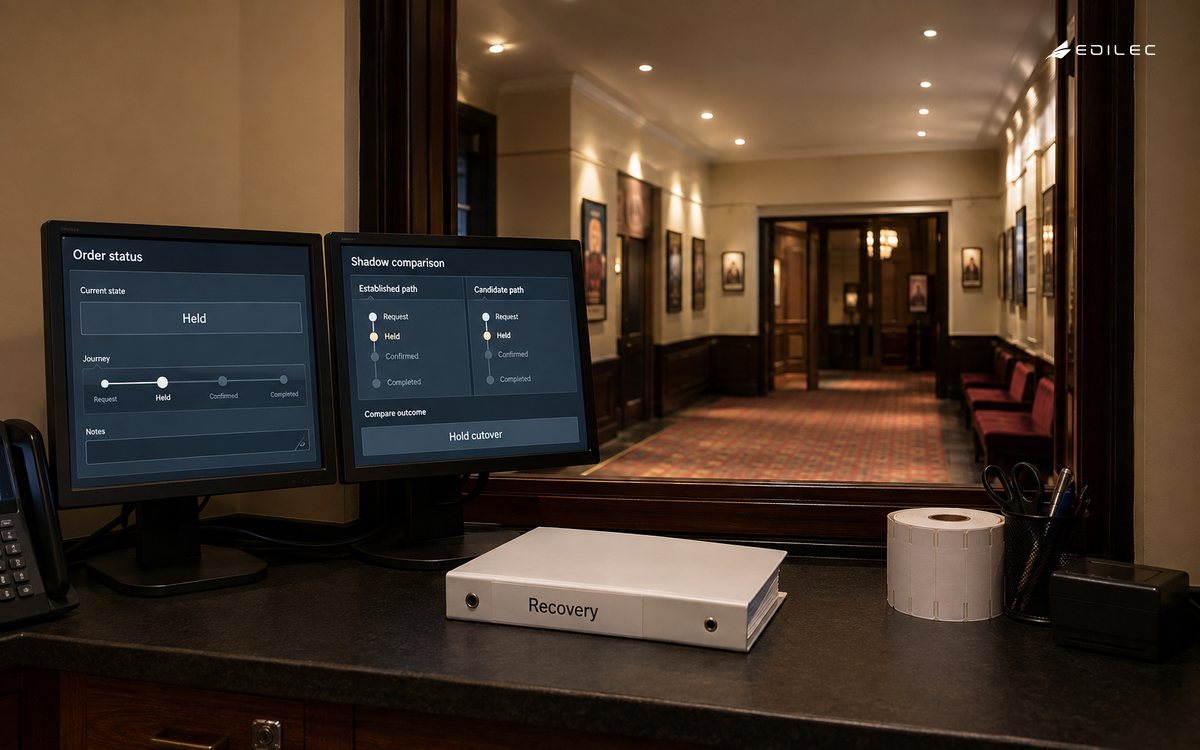
Use a canary cohort, shadow comparison, or asset-based routing when the outcome can be compared safely. Define the sample, the difference that matters, the stop condition, and the person who can pause exposure. AWS's phased modernization process emphasizes evaluation, starting small, and a roadmap that grows from evidence. Microsoft's planning guidance similarly separates replatform, refactor, and rearchitect choices and recommends phases that are small enough to execute and test. Keep rollback honest: a stateful write may require a compensating repair or forward migration rather than a switch back.
Carry security and operations across the boundary
A newer runtime does not automatically preserve access policy, audit requirements, backup, privacy, vulnerability handling, or incident ownership. Treat the bridge between old and new as a temporary attack surface: constrain credentials, validate messages, protect copied data, and monitor unusual traffic. NIST's Secure Software Development Framework is a useful anchor for integrating requirements, protected development, review, testing, dependency management, and vulnerability response into the delivery lifecycle. Create the production runbook before the first customer cohort moves, and include the steps for support, restore, pause, repair, and retiring the legacy route.
Turn each slice into a better next decision
Maintain a roadmap of outcomes, dependencies, evidence, owners, and stop conditions rather than a list of technologies. After each slice, review customer result, operational load, data differences, security findings, support burden, and cost. Decide whether to expand, repair, hold, or retire the approach. The software modernization operations playbook and custom software modernization guide are useful adjacent reads when the operating model needs more detail. Keep the roadmap honest about work that exists only to remove a bridge or dual-run path; temporary architecture has a cost and an owner.
| Review result | Interpretation | Next move |
|---|---|---|
| Equivalent result, lower support effort | The seam is carrying value | Expand the cohort or asset set |
| Better latency, different business result | Technical change altered meaning | Pause and repair the rule or data |
| No visible value, high bridge cost | Slice or outcome is weak | Retire or select a better boundary |
| Security or audit gap | Modernization moved faster than controls | Fix before exposure grows |
| Old path still owns every exception | New path is presentation only | Move authority or redefine the scope |
Retire the bridge deliberately
A dual-run path has its own cost and risk. Track the adapter, duplicated data, credentials, alerts, support instructions, and people who still understand the old behavior. Give the bridge a removal condition, not only a hope that the new service will eventually replace it. Before retirement, replay a representative history, verify partner contracts, close old write paths, and keep a short-lived archive of the decision and migration evidence. If an exception still requires the legacy application, either move that capability or record why the boundary remains.
Review the new operating model with the teams who inherit it. They should know where to look for a record, who owns an authorization decision, how to pause exposure, and how to restore or correct a result. The TypeScript architecture guide is a useful adjacent comparison when a language or module boundary is part of the modernization. Treat bridge removal as a production release with the same tests, communication, and rollback honesty as the first cutover.
Before deleting an adapter, rehearse a late correction, a failed restore, a partner replay, and a customer asking for historical state. Confirm that the new path can locate the same identifiers and that support no longer depends on the legacy screen for an essential decision. Keep the bridge's final removal evidence with the roadmap. If the old component must remain for a narrow exception, isolate that exception and give it a date and owner rather than allowing a permanent shadow architecture.
Budget the organizational transition as well as the technical one. The team operating the new path may need training, new dashboards, a different on-call rotation, or a supplier relationship that the legacy application previously hid. Measure the time spent reconciling and supporting the slice during its first releases. If that cost rises while the promised outcome does not improve, pause expansion and change the seam. A modernization roadmap is credible when it includes people, process, and retirement work alongside code.
Software modernization choices worth carrying forward
- Start from a customer or operating outcome and a baseline the legacy system can prove.
- Map hidden rules, exports, manual repair, integrations, and data authority before selecting a target stack.
- Choose a bounded seam with stable identifiers, observable routing, and an honest correction path.
- Run old and new paths with a comparison, stop condition, and named cutover authority.
- Treat security, support, recovery, and bridge retirement as part of the modernization work.
Questions teams ask about software modernization in production
Is a full rewrite ever the right choice?
Yes, when the current boundary cannot support a safe incremental move, the data and behavior can be specified and reconciled, and the organization can fund a controlled transition. A rewrite is still a production change that needs staged validation, compatibility, support, and recovery.
How do we know modernization is working?
Compare the selected business outcome and operating baseline before and after each slice. Include customer completion, data correctness, latency, support effort, security control coverage, cost, and the amount of legacy behavior still required. A newer stack alone is not evidence of value.
What should a team call rollback when state has changed?
Call it a data-aware recovery plan. It may combine traffic reduction, compensating updates, reconciliation, and a forward repair rather than simply routing requests to the old application. Naming the real action prevents a false sense of reversibility.
Conclusion: modernize through evidence-bearing seams
Software modernization is safer when every slice protects meaning and produces evidence for the next decision. Map the real behavior, choose a boundary that can be observed, move authority deliberately, and keep security and recovery beside the new code. Each incremental step is valuable when the organization can explain what changed, who owns it, and how to correct it.