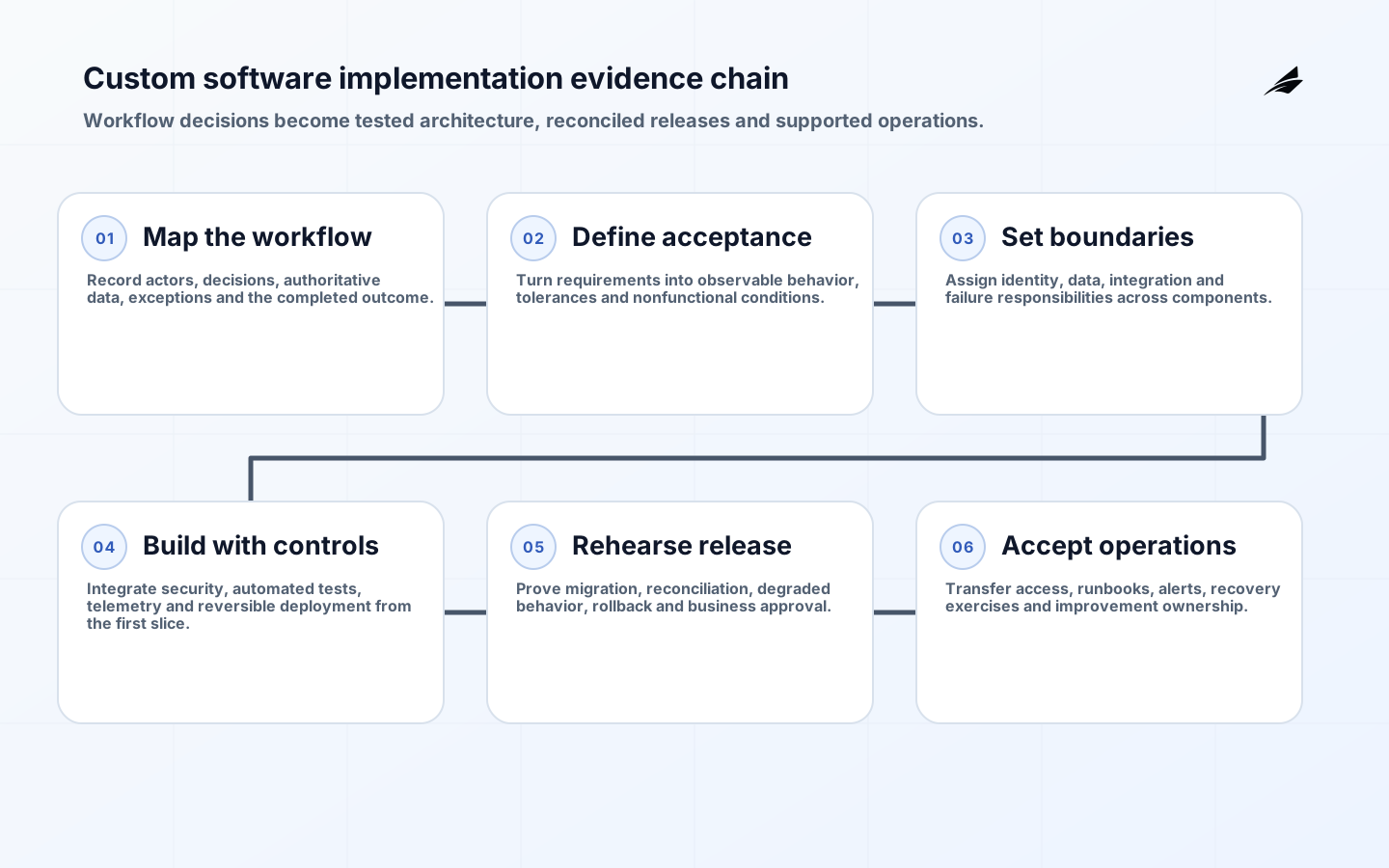
Custom software development implementation turns an observed business workflow into a maintained production service. The work includes more than programming: outcome definition, requirements, architecture, data and identity boundaries, secure delivery, migration, release, support and eventual retirement. Most implementation failures begin when teams treat uncertain policy as a feature list or postpone operational ownership until handover. This FAQ explains the decisions and evidence that keep custom software useful after the initial launch.
The scope, cost and risk plan helps establish commercial boundaries, while the readiness checklist supports approval. Teams building operational tools can also review the internal-tools launch checklist. The answers below assume accountable business, technical, security and service owners participate throughout delivery.
What belongs in implementation scope?
Scope the completed workflow, not isolated screens. Define trigger, roles, authoritative records, decisions, normal completion, exceptions and downstream effects. Include nonfunctional requirements such as availability, response time, capacity, privacy, security, accessibility, audit, retention, backup and recovery. State integrations, data migration, environments, documentation, training and support transition. Explicit exclusions prevent implied commitments and help prioritize a thin end-to-end release.
Separate known delivery from discovery questions. If users, policy or source data are uncertain, fund observation, prototypes or technical spikes before estimating the whole system. Link each uncertainty to a decision date. Scope should remain adaptable, but every change needs a visible effect on acceptance, cost, schedule and risk. An unbounded backlog is not an implementation plan.
| Scope area | Decision required | Evidence |
|---|---|---|
| Workflow | Who acts, on which record, toward what completed state? | Observed scenarios and exception map |
| Data | Which source is authoritative and who owns quality? | Data contract, classification and retention rule |
| Integration | What happens on timeout, duplicate or incompatible change? | Interface contract and failure tests |
| Service | Who supports availability, recovery and incidents? | SLO, runbook and escalation path |
| Acceptance | How will the owner know the outcome works? | Executable cases and measurable baseline |
How should requirements become acceptance?
Write examples that combine business and technical behavior. A requirement to approve an order should state eligible roles, amount limits, separation of duties, current record state, duplicate handling, notification and audit evidence. Add accessibility and failure conditions. Prioritize by consequence and learning value. Review examples with the people who do the work and those accountable for exceptions.
Automate stable acceptance at the appropriate layer: business rules in unit tests, interfaces in contract tests, data in reconciliation, and critical journeys in a small set of end-to-end tests. Keep exploratory review for new and ambiguous behavior. Acceptance is not a late demonstration; it is the evidence accumulated with each increment. The product owner approves business behavior, while technical and risk owners approve their respective controls.
Which architecture decisions matter most?
Start with identity, authorization, data ownership, integration, tenancy, deployment and recovery boundaries. Choose technology after these constraints are visible. Keep business policy separate from presentation, and isolate external systems behind versioned adapters. Use stable identifiers and explicit state transitions. Design idempotency for writes and durable state for long-running work. Record decisions, alternatives and consequences so future maintainers understand why the system looks as it does.

Prefer the simplest architecture that meets the required scale and reliability. A modular monolith can be easier to test and operate than premature distributed services. Introduce queues, caches or microservices only for a named need and assign their failure behavior. Model threats around real data and actions. Architecture is successful when it supports safe change, not when it maximizes the number of technologies.
How are security and quality built into delivery?
Apply NIST SSDF practices inside the chosen lifecycle: prepare the organization, protect software, produce well-secured releases and respond to vulnerabilities. Control repositories and build systems, review changes, pin and monitor dependencies, retain artifact provenance and protect secrets. Use OWASP ASVS requirements relevant to the application as testable controls. Security acceptance should trace to threat and consequence rather than a generic scanner score.
Quality includes accessibility, performance, reliability and operability. Test keyboard and assistive use, responsive layouts, load and dependency failure. Instrument critical journeys with logs, metrics and traces that avoid unnecessary sensitive content. Keep test data controlled. Define defect severity by user and business impact. A release can pass functional tests and still be unready because operators cannot detect or recover its failures.
| Release evidence | Purpose | Failure if absent |
|---|---|---|
| Reviewed source and immutable artifact | Connect approval to deployed code | Unknown or changed software reaches production |
| Automated and exploratory results | Demonstrate expected and edge behavior | Regression or ambiguous workflow escapes |
| Migration reconciliation | Prove records moved completely and correctly | Silent loss, duplication or wrong ownership |
| Security and accessibility review | Protect users and critical actions | Preventable exposure or exclusion |
| Telemetry, rollback and restore drill | Support detection and recovery | Incident becomes prolonged guesswork |
How should migration and cutover work?
Profile source data and define mapping, cleansing, rejection and reconciliation before migration code is complete. Preserve identifiers and lineage. Rehearse with production-like volume. Decide how writes are handled during cutover and whether parallel operation is necessary. Obtain owner approval for totals and sampled records. Encrypt transfer and restrict access. Keep a recoverable copy according to policy, not indefinitely by habit.
Release progressively where possible and monitor the actual workflow. Define rollback for application, configuration, schema and data. A database migration may be backward-compatible, forward-only or compensating; make that clear. Communicate user actions and support routes. Confirm that downstream integrations, reports and scheduled work operate correctly. Cutover is finished when the new service and records are reconciled and the old path is safely retired or bounded.
How are cost and schedule governed?
Estimate by thin slices, team roles, dependencies and risk, not a raw screen count. Include discovery, design, engineering, testing, security, infrastructure, migration, accessibility, documentation and support. Use a range with assumptions and contingency for unresolved questions. Review forecast against observed delivery and update it transparently. A fixed deadline may require reducing scope, not compressing verification.
Govern decisions at a practical cadence. Track accepted outcomes, work in progress, blocked decisions, defects, risks and budget. Keep architecture and product reviews focused on material choices. Avoid status based on percentage complete because unfinished integration and migration risk can hide behind it. A useful steering decision changes priority, scope, resources or risk acceptance.
What makes handover and operations credible?
Name the service owner before production. Define support hours, severity, response, dependencies, backup, recovery, vulnerability handling and change process. Runbooks need symptoms, diagnosis, safe actions, escalation and verification. Internal staff should participate in releases and recovery exercises. Store documentation with versioned work and keep access under least privilege.
Measure service objectives, workflow completion, incidents, correction effort, customer outcomes and operating cost. Review whether original value is being delivered. Feed incidents and support cases into tests and design. Plan upgrades and retirement; unsupported dependencies and abandoned workflows accumulate risk. Handover is complete when the receiving team can change, release, diagnose and recover the system with available evidence.
Integration ownership should remain explicit after launch. For each external system, record authentication, rate and size limits, supported versions, retry and duplicate semantics, maintenance windows, data owner and escalation contact. Monitor contract drift and test adapters against provider sandboxes or recorded fixtures. When a vendor deprecates an endpoint, the service owner should know which workflows, reports and customers are affected before production failures begin.
Privacy engineering requires more than a security control list. Map purpose, data categories, access, retention, correction, export and deletion across primary stores, logs, analytics, backups and third parties. Minimize data in development and support environments. Test subject or customer requests through every copy the product promises to govern. Record residual limitations honestly so contracts and user notices match actual system behavior.
Configuration needs the same review discipline as code. Feature flags, workflow thresholds, templates, role mappings and environment variables can change behavior immediately. Keep them versioned, validate types and ranges, restrict production modification and record who changed what and why. Define safe defaults and expiration for temporary flags. During an incident, operators should be able to compare current configuration with the last known good release and restore it without guessing.
Finally, establish an evidence package for each major release: approved requirements, architecture decisions, source and artifact identifiers, test and security results, migration reconciliation, configuration, known limitations, rollback and service-owner acceptance. Keep it concise enough to maintain. This package accelerates audits and incidents because teams can answer what changed, what was proven and which residual risks were consciously accepted.
Key takeaways
- Scope an end-to-end workflow and its operating requirements.
- Turn business rules and exceptions into reviewable acceptance evidence.
- Choose architecture from identity, data, integration and recovery boundaries.
- Secure source, builds, dependencies and releases throughout delivery.
- Rehearse migration, rollback, restore and support before declaring implementation complete.
Frequently asked questions
| Question | Answer |
|---|---|
| How long does implementation take? | Duration depends on workflow, uncertainty, integration, migration and assurance; estimate ranges after a bounded discovery rather than using a universal number. |
| Should requirements be complete before coding? | Critical outcomes and constraints must be clear, but thin slices should refine uncertain details through evidence. |
| Are microservices required for scale? | No. Use them only when independent scale, ownership or reliability needs outweigh distributed-system cost. |
| Who approves production? | Business, technical, security and service owners approve the evidence within their authority, with one named release decision. |
| What is the strongest completion test? | The receiving team can operate a real journey, diagnose failure, restore service and explain the residual risk. |
Conclusion
Custom software development implementation is complete when useful behavior, controlled change and operational ownership meet. Observe the workflow, make acceptance executable, protect the software supply chain, reconcile migration and prove recovery. The result should be a system the organization can understand and evolve—not a code delivery that becomes fragile the moment the project ends.