Custom software development services for enterprise teams are worth considering when a material business capability cannot be delivered safely through configuration, integration, or a supported product. The buying decision is therefore not simply vendor versus internal team. It is a decision about the workflow, ownership, evidence, and long-term service the organization is prepared to operate. This guide complements Edilec’s custom software discovery method, risk-based quality assurance guide, and developer handoff documentation guide.
A credible engagement starts with an outcome and ends with an operable service. The supplier should be able to show how requirements become acceptance evidence, how security and accessibility are designed into delivery, and how the buyer can recover, change suppliers, or bring the system in-house. Treat the proposal as an operating-model offer rather than a feature quotation.
Key takeaways
- Prove that a custom build is preferable to configuration, integration, process change, or purchase before seeking estimates.
- Scope one operational outcome with users, business rules, integrations, quality attributes, migration, controls, and support boundaries.
- Compare proposals on assumptions and total lifecycle cost, not day rates or a single fixed-price number.
- Use working software, automated checks, decision records, and operational rehearsals as delivery evidence.
- Make source code, environments, documentation, data export, and transition rights explicit contractual deliverables.
Make the build decision before buying services
Write a one-page problem brief before issuing a request. Name the affected users, current work, failure cost, required outcome, constraints, baseline measures, and executive owner. Then compare four options: improve the process, configure an existing platform, integrate systems, or build. A custom build is strongest when the workflow differentiates the organization, packaged products impose damaging compromises, and the organization can fund product ownership after launch.
Run a short discovery using real cases rather than interviews alone. Observe work, sample exceptions, map authoritative records, identify approvals, and quantify waiting, re-entry, error correction, and support. The discovery output should contain testable hypotheses and unresolved decisions. It should not be a large specification that creates the appearance of certainty. Buying discovery separately can reduce pressure to accept a build proposal before the difficult questions are answered.
| Option | Best fit | Evidence to request | Common trap |
|---|---|---|---|
| Process change | The problem is policy, ownership, or unnecessary work | Trial showing lower delay or error | Automating waste |
| Configure | A supported product matches most critical rules | Fit-gap demonstration with real cases | Excessive customization |
| Integrate | Capabilities exist but information is fragmented | Interface, identity, failure, and reconciliation design | Hidden source-system weakness |
| Custom build | The capability is distinctive and supportable | Thin production slice and lifecycle plan | Treating launch as completion |
Scope a service, not a feature inventory
A useful scope describes an end-to-end outcome. Include user groups, entry conditions, normal and exceptional paths, records changed, external systems, decisions, notifications, retention, and evidence. Add quality attributes such as response time, availability window, recovery objectives, data residency, accessibility, auditability, and expected volume. A feature list without these conditions cannot support a dependable estimate or acceptance decision.
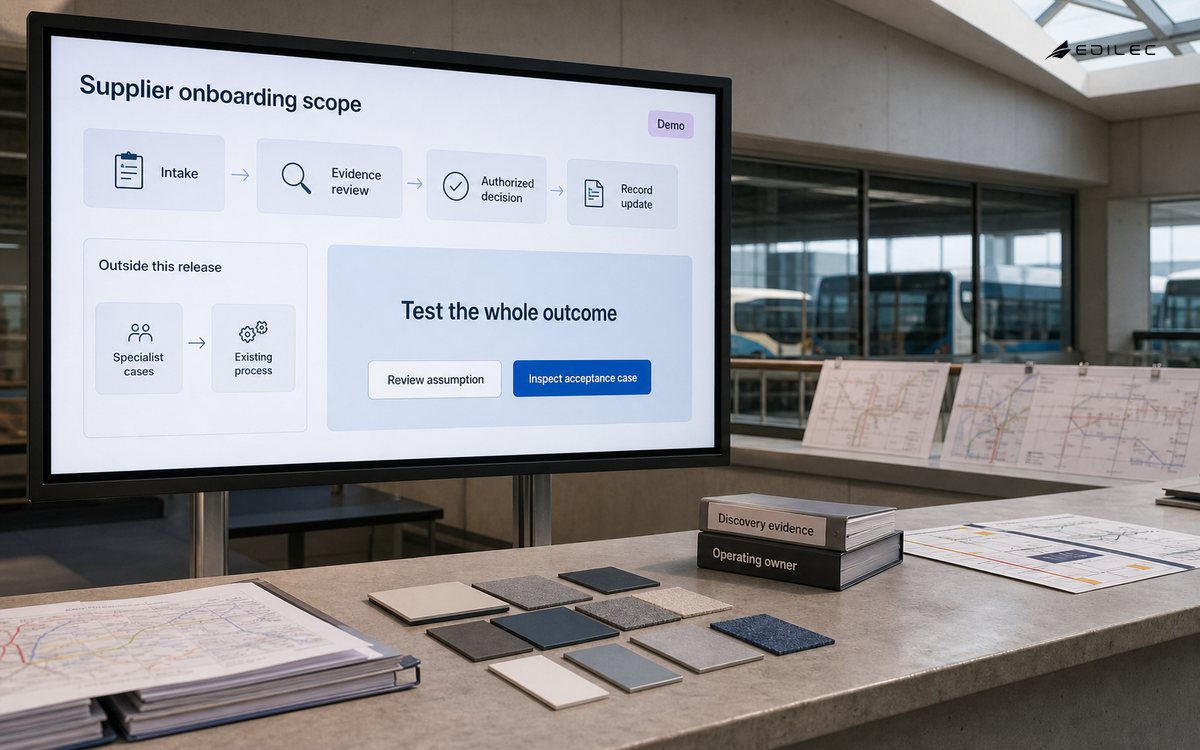
Define what is explicitly outside the first release and how excluded work will be handled. For example, a supplier-onboarding release might support domestic vendors, standard tax treatment, two approval levels, and one ERP connection while routing overseas or high-risk cases to the existing process. That boundary gives the team a usable slice while preserving a safe fallback. Attach each assumption to an owner and a decision date.
Evaluate the delivery partner and ownership model
Ask the proposed delivery lead and engineers to walk through a comparable system: a difficult requirement, a defect that escaped, an operational incident, and what changed afterward. Evaluate whether they expose uncertainty, involve users, write maintainable tests, and reason about production. References are most useful when they cover the transition from project delivery to support, not only the enthusiasm of the first release.
Clarify decision rights. The buyer should own product priorities, business rules, risk acceptance, data obligations, and release approval. The supplier may own technical design and delivery methods inside agreed constraints. Require access to repositories, backlogs, pipelines, environments, test results, architecture decisions, dependency inventories, and runbooks from the beginning. Avoid a final handover event that reveals the system only after leverage has disappeared.
| Evaluation area | Strong evidence | Contract signal | Warning sign |
|---|---|---|---|
| Delivery | Small releases tied to user outcomes | Demonstration and acceptance cadence | Progress reported as percent complete |
| Engineering | Automated tests, reviews, and reproducible builds | Quality gates and repository access | Testing deferred to the end |
| Security | Threat-led controls and traceable verification | Named security requirements | Generic compliance promise |
| Operations | Monitoring, recovery, support, and capacity evidence | Service acceptance criteria | Production excluded from scope |
| Exit | Portable code, data, knowledge, and credentials | Transition assistance and usable artifacts | Supplier-only tooling or accounts |
Estimate total custom software development cost
Separate the cost model into discovery, build, adoption, transition, and recurring operation. Build cost includes product management, design, engineering, environments, integration, migration, security, accessibility, testing, and release. Recurring cost includes hosting, licenses, observability, support, incident response, vulnerability remediation, dependency upgrades, data operations, and continuous improvement. Include buyer staff time; a low supplier quote can merely transfer analysis and assurance work back to the enterprise.
Estimate with ranges and drivers. Show how cost changes with integration count, data quality, permission complexity, migration volume, availability, peak load, and regulatory evidence. Fixed price can work for bounded discovery or a proven release slice, but it does not remove uncertainty. It often prices uncertainty through contingency or change control. Fund a decision horizon, review evidence at each stage, and maintain a reserve for discovered complexity.
Build security, accessibility, and reliability into acceptance
Use NIST’s Secure Software Development Framework to define practices across preparation, protection, production, and vulnerability response. Select relevant OWASP ASVS requirements as verifiable application controls rather than requesting a vague claim of security. Record threat scenarios, sensitive data, trust boundaries, privileged actions, dependency policy, secret handling, logging, and remediation ownership.
Acceptance must also cover the complete user journey. WCAG 2.2 provides testable accessibility criteria, while Google SRE’s service-level objective guidance helps translate reliability expectations into measurable service behavior. Test representative devices, assistive technologies, failure paths, load, backup restoration, monitoring, and operator response. A successful demonstration in a controlled environment is not production readiness.
Use a phased delivery and acceptance plan
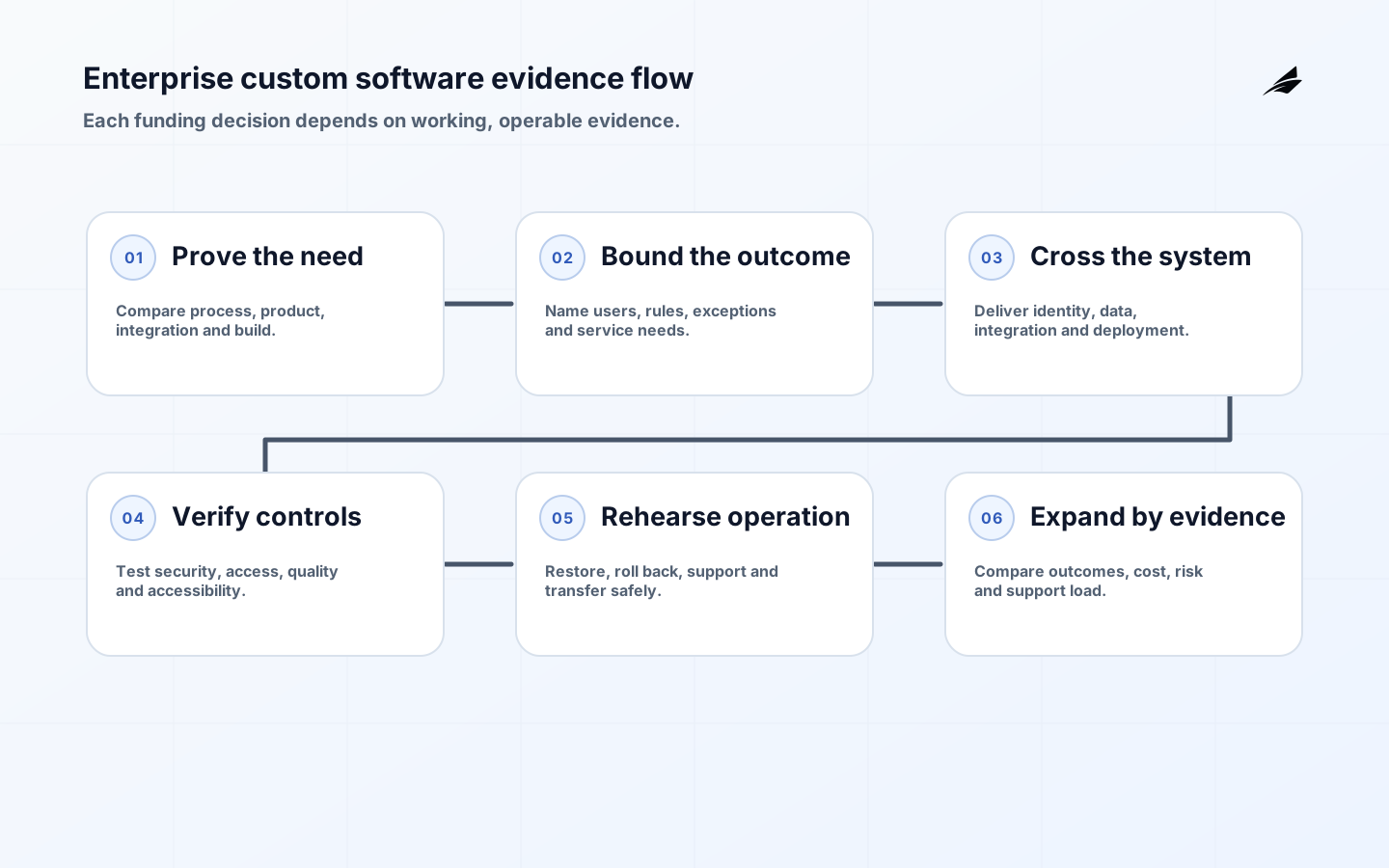
A practical plan moves through evidence gates: problem validation, architecture and risk framing, thin end-to-end slice, limited production pilot, service acceptance, and measured expansion. Each gate should state the decision, evidence, accountable approver, and stop condition. The thin slice must cross identity, data, integration, control, deployment, and support boundaries; a polished front end connected to test data hides the riskiest work.
During the pilot, compare real outcomes with the baseline and watch balancing measures such as error, manual review, abandonment, incidents, and support demand. Use DORA’s software delivery guidance to examine delivery flow and stability without turning metrics into individual targets. Expand only when users can complete the workflow, operators can diagnose and recover it, and the economics still hold under observed demand.
Put commercial controls around evidence and change
Tie payment and continuation decisions to observable deliverables: an accepted discovery brief, a working end-to-end slice, reconciled migration results, security verification, a recovery exercise, and service acceptance. Define what makes a deliverable reviewable, how quickly the buyer responds, and how disagreements are resolved. Time-and-materials work still needs a budget ceiling, forecast cadence, and clear authority to change priorities. Fixed-price work still needs assumptions, buyer dependencies, acceptance rules, and treatment of discoveries. Neither commercial form substitutes for active product ownership.
Maintain one decision and change log covering the request, reason, options, effect on outcome, cost, schedule, risk, and approving owner. Separate scope changes from corrections to work that never met acceptance. Review cumulative change, because a series of small additions can alter architecture, control needs, or support load more than any single request suggests. At each funding gate, compare remaining value with remaining cost and risk. Stopping a weak proposition after useful discovery is a successful governance decision, not a delivery failure.
For multi-supplier delivery, assign responsibility at the boundaries. Name who owns integration contracts, shared environments, test data, identity, release coordination, incident command, and end-to-end performance. A responsibility matrix should identify one accountable party for each outcome, but it must be exercised through joint rehearsals. Contractual responsibility that cannot be demonstrated in a failed dependency, rollback, or support scenario will not protect the service when pressure is highest.
Frequently asked questions
How long should enterprise custom software take?
There is no responsible duration without a bounded outcome. A team should usually produce meaningful risk evidence and a thin end-to-end slice within weeks, not spend months before integration begins. The full timeline depends on data, controls, migration, organizational decisions, and adoption as much as coding. Ask for a forecast range with assumptions and recurring re-estimation.
Should we demand a fixed price?
Use fixed price where output and uncertainty are genuinely bounded, such as discovery or a well-understood migration tool. For novel workflows, combine a capped stage budget with transparent capacity, evidence gates, and explicit options to stop or redirect. This preserves commercial control without rewarding hidden contingency or adversarial change requests.
What prevents supplier lock-in?
Practical portability prevents lock-in: buyer-controlled accounts, continuous repository access, reproducible builds, documented architecture, standard interfaces, exportable data, dependency rights, paired operations, and rehearsed transition. Contract language matters, but an exit plan that has never been exercised is only an intention.
Conclusion
The best custom software development services for enterprise teams make uncertainty and ownership visible. Buy a bounded outcome, insist on lifecycle economics and verifiable controls, and accept the system only when real users and operators can run it safely. That discipline turns a software project into a durable enterprise capability.