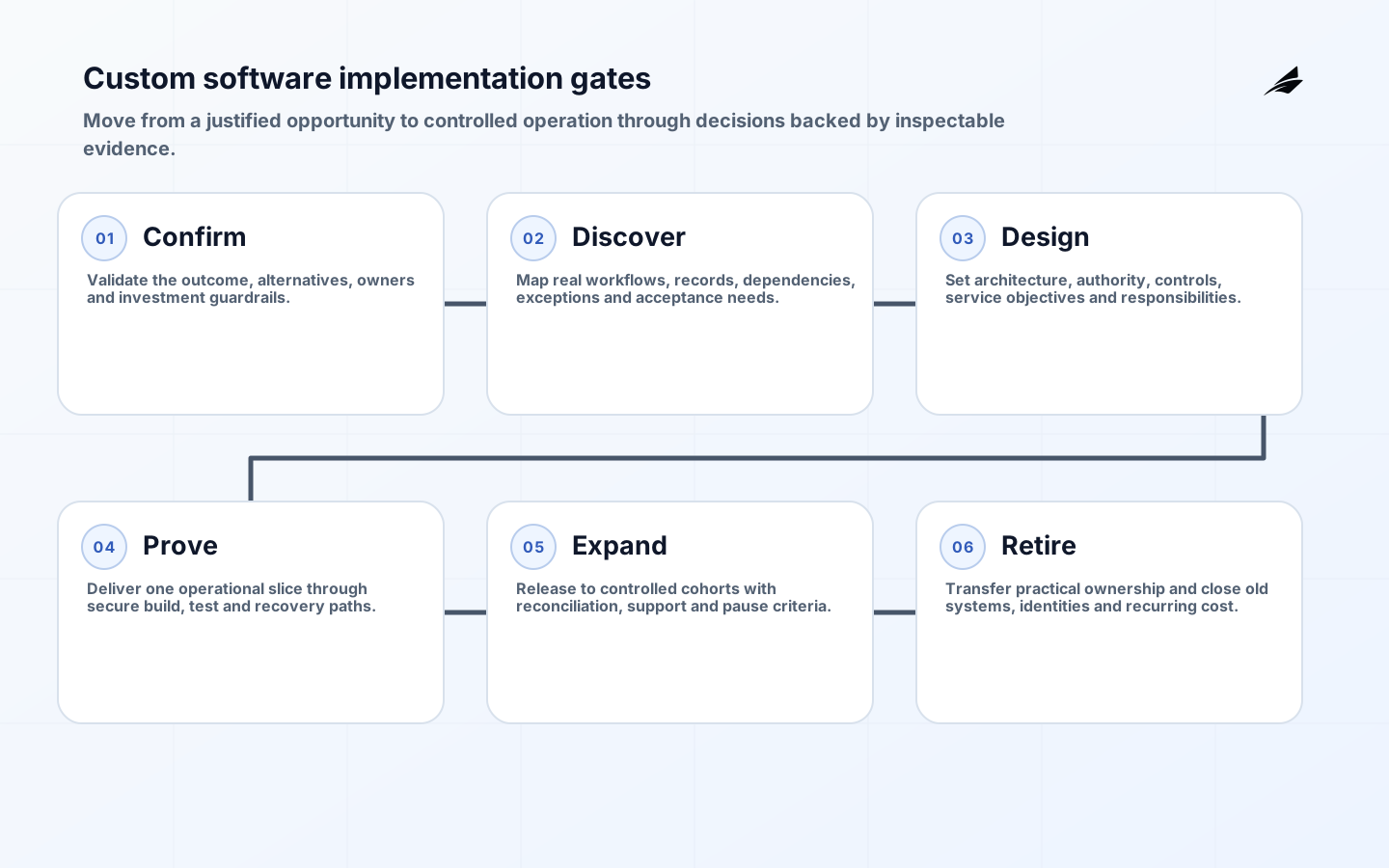
An implementation checklist is useful only when each check produces evidence and has an owner. Marking architecture, security or testing complete without an inspectable result turns governance into ceremony. Use this checklist to shape a custom enterprise application, prepare one operational vertical slice and decide whether it is ready to expand. Tailor the depth to data sensitivity, business consequence, regulation and service criticality.
Implementation gates at a glance
| Gate | Decision | Minimum evidence |
|---|---|---|
| Opportunity | Is custom development justified? | Outcome baseline, alternatives and accountable sponsor |
| Scope | Is the first slice coherent and bounded? | Journey, roles, records, exceptions and acceptance criteria |
| Architecture | Can the slice be secured, operated and changed? | Decisions, contracts, threat model and service design |
| Delivery | Can the team produce traceable releases repeatedly? | Protected pipeline, tests, artifacts and environment controls |
| Readiness | Can real users enter safely? | Migration rehearsal, recovery exercise, runbooks and sign-offs |
| Expansion | Should rollout continue? | Pilot outcome, reconciliation, support and risk evidence |
| Retirement | Can the old path be removed? | Consumers migrated, records retained and access closed |
1. Confirm the outcome and build case
- Name the business sponsor, product owner, technical owner, risk owner and operations owner.
- Describe the user and business outcome, current baseline and decision deadline.
- Compare simplify, retain, configure, integrate, buy, hybrid and build options.
- Document why custom ownership is proportionate to the value or constraint.
- Set investment guardrails, assumptions and conditions that would stop or reshape the work.
- Identify applicable legal, regulatory, contractual, accessibility and records obligations.
Exit this gate only when the sponsor understands that software needs ongoing product and operational ownership. A prototype or funding approval is not evidence that building is the right option. If available products were rejected, preserve the fit analysis so later teams know which constraints were decisive and when the decision should be revisited.
2. Discover the workflow and scope the first slice
- Observe representative users and trace actual cases, including workarounds and exceptions.
- Define actors, organizations, roles, triggers, states, decisions and prohibited transitions.
- Inventory authoritative records, classifications, retention, correction, export and deletion paths.
- Map APIs, files, events, scheduled jobs, manual handoffs and downstream reporting.
- Capture dependency owners, service expectations, test access and failure behavior.
- Choose one end-to-end slice and list explicit exclusions and deferred risks.
- Write acceptance examples for success, denial, invalid data, timeout, duplicate and recovery paths.
Use production evidence where authorized: logs, records, support cases and process observation often reveal behavior that interviews miss. Do not copy sensitive production data casually into development. Create representative, governed test data and preserve traceability from each material requirement to an acceptance method.
3. Establish architecture, data and controls
- Record system context, trust boundaries, data flows and material architecture decisions.
- Assign authority for every core record and define replication, conflict and reconciliation.
- Model authentication, resource-level authorization, privileged support and break-glass access.
- Define encryption, key and secret ownership, certificate rotation and audit requirements.
- Specify interface versioning, idempotency, timeout, retry, ordering and deprecation behavior.
- Set service indicators, objectives, capacity assumptions, backup scope and recovery objectives.
- Review accessibility architecture and component responsibilities against the applicable target.
Threat modeling should examine how the workflow can be abused, not only how infrastructure can be attacked. NIST's SSDF supplies lifecycle practices, while OWASP ASVS can help express verifiable application controls. Tailor requirements to risk and record accepted exceptions with compensating controls, an owner and expiry. Design data minimization and deletion before copies proliferate.
| Architecture question | Required answer | Proof technique |
|---|---|---|
| Who may perform this action? | Role, resource and context rule | Allowed and denied authorization tests |
| Which record wins? | Named authority and conflict behavior | Reconciliation scenario |
| What if a dependency times out? | Durable status, retry or operator path | Fault injection or controlled simulation |
| How is a release identified? | Traceable source, build and deployed artifact | Artifact provenance review |
| Can service be restored? | Backup boundary and recovery sequence | Timed restore exercise |
4. Mobilize the team and commercial model
- Define enterprise and provider responsibilities for decisions, delivery, risk, release and support.
- Confirm skills for product, domain, design, engineering, data, security, testing, platform and operations.
- Give authorized enterprise owners access to repositories, plans, artifacts, environments and evidence.
- Set decision and review cadence, escalation, change control and risk acceptance authority.
- Review intellectual property, open-source, data-processing, subcontractor and incident terms.
- Specify vulnerability handling, transition assistance and return or deletion of enterprise data.
Use NIST SSDF practices and OWASP verification requirements to make supplier security responsibilities concrete. A contract should reflect the delivery design, but the working controls must be visible in tools and practice. Pair provider and enterprise staff on code review, deployment and incident exercises from the beginning so transition readiness grows continuously.
5. Build a secure and repeatable delivery path
- Protect source control, build identities, secrets, branches and approval paths with least privilege.
- Pin and review dependencies; record licenses, vulnerabilities and update ownership.
- Automate repeatable builds, tests, security checks and environment promotion.
- Keep production changes attributable and prevent unreviewed artifact substitution.
- Test domain rules, contracts, permissions, accessibility and critical journeys at suitable layers.
- Instrument user-visible behavior with logs, metrics and traces that avoid unnecessary sensitive data.
- Exercise rollback or forward recovery without corrupting valid business state.
The first vertical slice should traverse the real path from user action to authoritative record and operational signal. Review it in a production-like environment with the people who will support it. Track known gaps explicitly. A demonstration is not acceptance when permissions, failure behavior, migration or observability remain mocked.
6. Prepare data, users and operations
- Profile source data and approve mapping, cleansing, ownership and rejection rules.
- Create repeatable migration steps with counts, checksums or business control totals as appropriate.
- Rehearse timing, cutover, reconciliation and rollback using representative volume.
- Prepare role provisioning, user communication, accessible training and support routes.
- Write and exercise incident, dependency failure, recovery and manual-continuity runbooks.
- Confirm dashboards, alerts, on-call coverage, escalation and external supplier contacts.
- Complete privacy, security, accessibility and operational reviews with residual risks recorded.
| Readiness area | Release gate | Pause trigger |
|---|---|---|
| Data | Migration reconciles within approved rules | Unexplained count, balance or relationship difference |
| Access | Roles provisioned and denial paths verified | Cross-role access or orphaned privilege |
| Service | Objectives, alerts and owners active | Critical signal is missing or unactionable |
| Recovery | Restore and workflow recovery demonstrated | Recovery exceeds agreed boundary or loses state |
| Support | Staff can diagnose and communicate | Unowned issue or unavailable escalation |
| User | Representative users complete critical tasks | Material accessibility or comprehension barrier |
7. Pilot and expand through controlled waves
- Choose a cohort that is representative enough to teach but limits consequence.
- Record entry criteria, exposure mechanism, observation window and decision owner.
- Monitor workflow correctness, user outcome, accessibility, reliability, security and support.
- Reconcile new records with authoritative systems and investigate every unexplained difference.
- Use predefined pause and fallback criteria; preserve valid completed transactions.
- Review evidence after each wave and update training, controls, capacity and forecast.
- Track deferred cases and exceptions to closure rather than normalizing permanent dual operation.
A hypothetical claims-review application illustrates the method. One claim category and one trained review group enter first. New decisions receive durable identifiers and are reconciled with the existing record. If an external document check is unavailable, work enters a visible pending state rather than being approved or silently lost. Expansion waits until permission tests, decision consistency, support demand and recovery evidence meet the agreed gate.
8. Operate, improve and retire the old path
- Review user and business outcomes against the original baseline.
- Use service-level DORA measures alongside correctness, security, support and reliability.
- Prioritize defects, vulnerabilities, dependency updates and operational toil in the product backlog.
- Revalidate service objectives and controls as users, data and integrations change.
- Demonstrate enterprise-led deployment, diagnosis, recovery and roadmap decisions.
- Archive or migrate records according to policy; remove old jobs, integrations, identities and secrets.
- Close obsolete licenses and infrastructure only after consumers and recovery obligations are verified.
Google SRE guidance recommends indicators based on user concerns and explicit measurement validity. Apply that discipline to the new service. DORA measures reveal delivery flow and instability, but they do not replace outcome or risk evidence. The checklist closes when ownership is routine and superseded cost and exposure have actually left the estate.
Risks the checklist should keep visible
| Risk | Checklist response | Owner question |
|---|---|---|
| Unvalidated value | Baseline and pilot outcome gate | Who can stop expansion? |
| Hidden dependency | Evidence-based discovery and failure tests | Who owns the dependency relationship? |
| Security shortcut | Threat model, requirements and residual-risk record | Who may accept the exception? |
| Migration divergence | Repeatable run and signed reconciliation | Who approves each difference? |
| Provider dependency | Shared access and demonstrated enterprise operation | Can another team take over now? |
| Legacy persistence | Funded retirement evidence | Who closes the final cost and access? |
Key takeaways
- Attach an owner, reviewer and evidence artifact to every implementation check.
- Treat controls, migration and operations as part of the first vertical slice.
- Use representative proof to refine architecture, cost and rollout decisions.
- Pause expansion when reconciliation, access, recovery or user gates fail.
- Finish by transferring practical ownership and removing superseded systems and access.
Frequently asked questions
Who should own this checklist?
The product owner should coordinate it, but evidence belongs to named specialists and accountable business, technology, security and operations owners. No single project manager can accept every domain risk.
Must every project complete every item?
Tailor depth to consequence and context, but record why an item is not applicable. Core ownership, authorization, data, delivery, recovery and rollout questions remain relevant even for a small first slice.
What is the strongest launch-readiness signal?
No single signal is enough. Look for converging evidence: representative users succeed, records reconcile, controls work, alerts have owners, recovery is demonstrated and residual risk is explicitly accepted.
When should checklist evidence be archived?
Keep decisions and evidence in governed repositories throughout delivery, then retain them according to the enterprise's audit, security and records needs. They should remain discoverable for incidents, changes and future transition.
Conclusion
A serious implementation checklist makes readiness observable. It connects business value to architecture, secure delivery, migration, operations and retirement, then gives decision-makers a reason to proceed, pause or change course. Used this way, the checklist helps an enterprise launch less by hope and more by evidence.