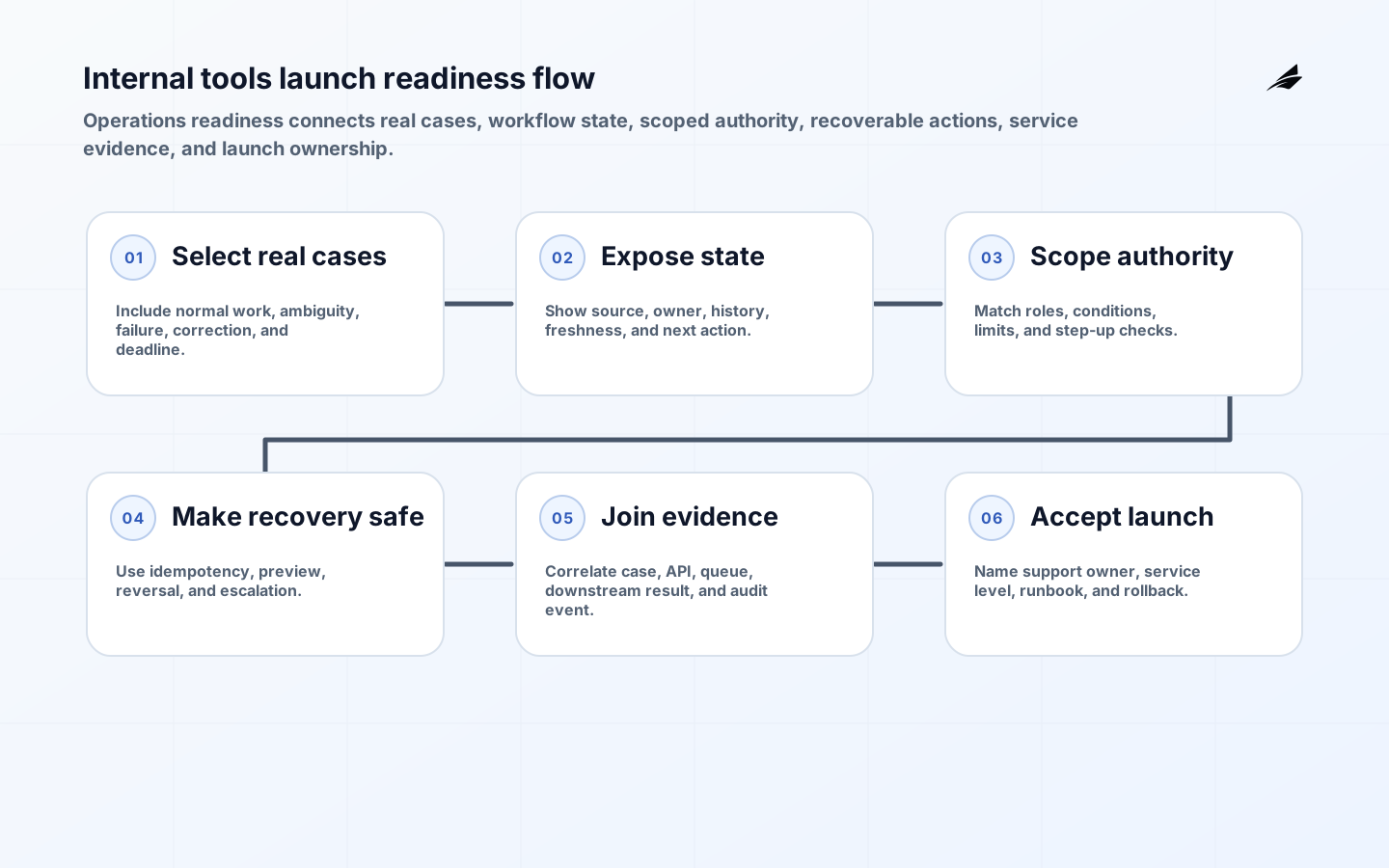
Internal tools for operations teams often determine whether a new product can actually be sold, supported, corrected, and trusted. A polished customer interface is not launch-ready if staff cannot verify an account, resolve a failed payment, replay an integration, correct an address, honour a deletion request, or explain a disputed change. The internal tool should model those jobs as controlled workflows rather than exposing raw database fields. Each action needs a clear state transition, appropriate authority, validation, evidence, and recovery path. This checklist helps product and operations leaders define the minimum launch surface, test it with representative cases, and avoid turning a temporary admin screen into an ungoverned production dependency.
Launch controls can be checked against the NIST Secure Software Development Framework, OWASP ASVS, WCAG 2.2, and the OpenTelemetry specifications. Each reference covers a different part of readiness: development integrity, application controls, accessible operation, and traceable runtime evidence. Related Edilec guides address admin dashboard architecture, approval workflow software, and client portal planning.
Run a launch-day operations simulation
A useful simulation follows a small set of cases from intake to closure while product, support, finance, engineering, and security observe the handoffs. Include a new customer that completes normally, a duplicate account, a payment that succeeds after the browser times out, an integration delivery that must be replayed, a user whose access should be suspended, and a privacy request with a deadline. Operators should be able to find the case, understand current state and source, see permitted actions, record a reason, and confirm the resulting customer outcome. Engineering should not need to edit production data for an ordinary exception, yet the tool should make it clear when specialist intervention is genuinely required.
Use the exercise to test access and usability as well as functionality. The OWASP Application Security Verification Standard provides a useful control catalogue for authentication, session handling, access control, validation, logging, and data protection. WCAG 2.2 applies to internal software too: keyboard operation, visible focus, clear errors, and sufficient target size materially affect people handling urgent cases. Instrument the workflow with OpenTelemetry-compatible context so a case can be correlated across the interface, API, queue, and downstream service. The release decision should consider completion and recovery, not just whether the page renders. If the team cannot identify who owns a stuck state or reverse a mistaken action, the operation is not ready for launch volume.
| Simulation case | Operator capability | Release evidence |
|---|---|---|
| Duplicate customer | Compare records, merge or reject under policy | No orphaned subscriptions or hidden identity conflict |
| Ambiguous payment | Inspect provider result and reconcile idempotently | One authoritative financial outcome |
| Failed integration | See attempts, payload reference, error and safe replay | Retry does not duplicate downstream work |
| Access incident | Suspend session or account within delegated authority | Action is immediate, reviewable and reversible |
| Customer correction | Edit allowed fields with validation and reason | History preserves the material before-and-after state |
| Privacy request | Route deadline, scope data and record completion | Request is owned and evidence survives handoffs |
Key takeaways
- Frame internal tools for operations teams around a measurable outcome and one bounded end-to-end journey.
- Name the order or product system of record, with visible freshness and a person accountable for correction before designing copied data, automation, or interface polish.
- Model explicit states: new, waiting for information, assigned, approved, actioned, completed, and cancelled.
- Enforce protected actions at the service boundary and preserve a recovery path.
- Release with representative founders and improve using observed exceptions, not opinions alone.
Define the internal tools for operations teams boundary
Write the outcome in plain language and make its boundary testable. For this work, that means let an operations team handle new-product exceptions, customer changes, and fulfillment decisions from one accountable work surface. Treat each launch exception as a working unit with a trigger, stable identifier, accountable owner, completion condition, and an understood error consequence. A boundary also names what is outside the first release. That protects the team when adjacent requests arrive from other parts of the organization. Review the boundary with operations coordinators, finance approvers, fulfillment staff, and support leads. Ask what evidence they need, which action they may take, and what happens when information is incomplete. The answer should be specific enough that a release reviewer can identify valid completion without interpreting a broad business aspiration.
| Question | Decision to document | Evidence to collect |
|---|---|---|
| Outcome | let an operations team handle new-product exceptions, customer changes, and fulfillment decisions from one accountable work surface | Baseline timing, rework, and named business owner |
| Working unit | A launch exception with stable identity and lifecycle | Recent normal and difficult cases |
| Authority | the order or product system of record, with visible freshness and a person accountable for correction | System owner, permitted editors, and policy reference |
| Completion | Durable result, visible confirmation, and recovery condition | Result record, receipt, and reconciliation rule |
| First release | One complete decision loop and its exceptions | Deferred work with owner and review date |
Model state, data, and authority
A state model prevents internal tools for operations teams from degrading into a collection of disconnected pages. Use states that explain what happened, what may occur next, who can act, and what is blocking progress: new, waiting for information, assigned, approved, actioned, completed, and cancelled. Avoid a generic pending status that hides whether the launch exception awaits data, a decision, a dependency, or manual repair. For material fields, record the authoritative source, effective time, update expectation, and permitted editors. A display copy can be useful, but it is not automatically allowed to correct the source. Retain the identifier that connects the initiating request, action, downstream call, and recovery activity. This gives operations and engineering a shared route to investigate disagreements without relying on inbox archaeology.
Design controls and recovery
Control design should fit the consequence of the action. In this case, make high-impact controls visible, scoped, and auditable rather than relying on bulk updates or shared access. Apply permission at the command or API boundary using the current actor, object, relationship, and requested action. Hiding a menu can improve clarity, but it cannot secure a direct request. The OWASP Application Security Verification Standard gives practical checks for authorization, validation, logging, and session handling. Plan a legible response when an action is denied, a dependency times out, or records disagree. A visible exception owned by a real person is safer than a silent retry or undocumented workaround. Significant changes should retain prior state, actor, time, reason, and correlation identifier while avoiding unnecessary personal data in diagnostic records.
| Condition | Expected behavior | Operational evidence |
|---|---|---|
| Information missing | Hold work in a recoverable state and state what is needed. | Validation result and next owner |
| Unauthorized request | Deny at the service boundary without exposing unrelated records. | Actor, action, object scope, review event |
| Dependency failure | Use bounded retry or compensation and expose recovery. | Correlation identifier, attempt history, exception owner |
| Replay or duplicate | Prevent repeated effect and return known outcome. | Request identity, prior result, idempotency decision |
| Manual override | Require authority, reason, and follow-up where appropriate. | Before-and-after state and policy basis |
Build a thin operational slice
Prove the full path before broadening the surface. Ship a queue, item detail, one controlled action, and audit receipt before broad reporting or low-volume tools. Include identity, retrieval of trusted context, allowed transition, usable outcome message, audit event, observable failure, and supportable recovery. Make integration behavior explicit: contract, expected time, duplicate behavior, and the owner who investigates a rejection or delay. The Secure Software Development Framework connects these requirements to secure design, implementation, verification, and release evidence. A thin slice is not a mock-up; it is a production-shaped capability whose behavior remains understandable when conditions are ordinary and when they are inconvenient.

Verify quality with real conditions
Test ten-times-normal queues, cross-team restrictions, duplicate action, and fulfillment or billing failure. Include keyboard users, assistive technology users, unreliable networks, and non-default data conditions in the review. WCAG 2.2 is useful for focus visibility, error identification, status messages, target size, and accessible authentication. Define acceptance evidence before implementation: expected outcome, protected boundary, error condition, data condition, and named observer. Pair workflow checks with contract and integration checks, then explore places where a person may misread status or take an irreversible action. Quality is not a release-day ceremony; it is credible assurance for the risks that would make this work unsafe or untrustworthy.
Operate and improve after release
Start with the launch cohort and review queue aging, rework, and confusing permissions daily. Instrument intent and outcome, not merely page loads. A correlation identifier across browser, service, and dependency activity connects a reported issue to its actual path; the OpenTelemetry Specification provides common concepts for traces, metrics, and logs. Review cycle time, failed transitions, queue age, corrections, and recovery time alongside user observation. DORA research also encourages teams to look at delivery performance with organizational outcomes rather than treating deployment frequency as success by itself. Retire old reports, credentials, and manual steps only after the replacement has earned trust in real work.
Define release evidence
For internal tools for operations teams, define the evidence an operator needs before a launch-critical action. A queue should reveal why an item is present, its age, current owner, client or order impact, and the source freshness that affects the decision. A detail view should lead with the facts needed for the next action and place less-used history behind deliberate disclosure. Before enabling a bulk operation, require a scoped selection, a preview of the intended effect, and a result receipt that lets the operator reconcile exceptions. Treat launch-day feedback as operational evidence: repeated filter changes can mean queue ordering is wrong, frequent reversals can mean context is missing, and shared credentials can mean the permission model does not match the actual work. These are design signals. Respond by adjusting the workflow and policy, not merely by adding another dashboard tab. Make a launch owner accountable for reviewing unresolved exceptions at a fixed cadence, including items that were handled outside the tool and must be reconciled.
Frequently asked questions
What belongs in the first internal tools for operations teams release?
Choose work that is frequent, consequential, and currently dependent on inbox searches, spreadsheets, or private messages.
How should the team decide what to automate?
Protect shared definitions such as queue ordering and approval policy until operational evidence supports variation.
Conclusion
Internal tools for operations teams are successful when they make consequential work legible, controlled, and easier to improve. Start with the operational outcome, establish data and decision authority, build one complete transition with recovery, and judge the result by what people can safely achieve. That sequence gives clients and internal teams a capability that remains useful when information is missing, dependencies fail, or the original project team is no longer nearby.