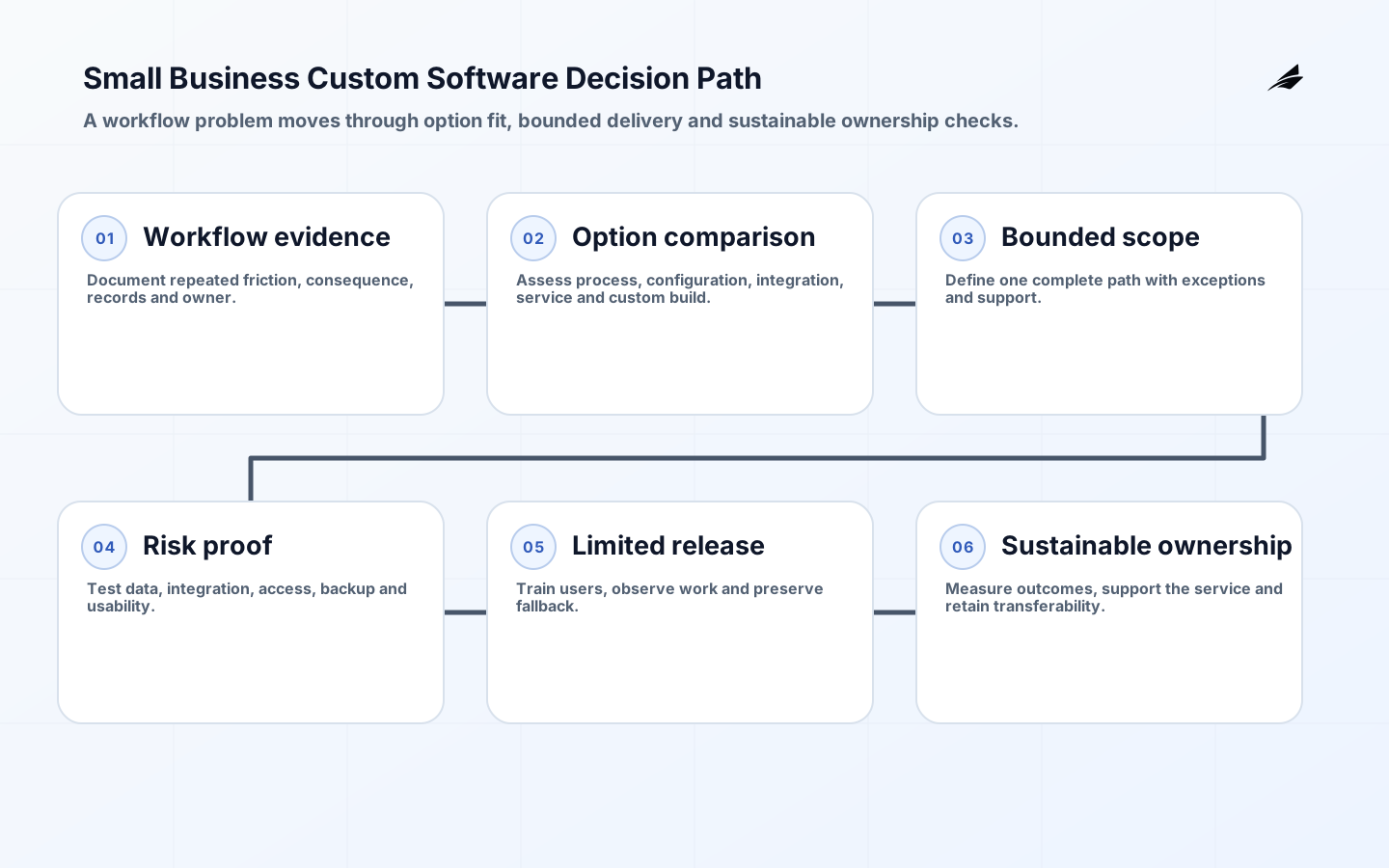
Custom software is worthwhile for a small business when it improves a distinctive, repeated workflow that available products cannot support responsibly through configuration. The decision carries more than build cost. The business also owns data migration, integrations, training, security, support, vendor continuity and future changes. A practical plan starts with the work people perform today and tests whether custom development is the smallest sustainable response.
This guide treats custom software development for small business: scope, cost, risk and delivery as a set of decisions that can be reviewed and tested. The aim is not to prescribe one vendor or promise a universal result. It is to help business and technical owners define boundaries, preserve evidence, expose failure behavior and decide when the work is ready to expand.
Test whether custom software is the right intervention
Describe the operational problem in observable terms: duplicate entry, delayed approval, unavailable status, preventable errors or a customer task that cannot be completed. Confirm frequency, consequence and ownership.

Compare process correction, better use of an existing product, integration, low-code configuration and custom development. Include switching costs and constraints rather than assuming a bespoke application is automatically more flexible.
| Option | Best fit | Hidden obligation to inspect |
|---|---|---|
| Improve process | Rules or ownership cause most delay | Training and sustained management attention |
| Configure existing product | Workflow is common and vendor model fits | Limits, licensing and data portability |
| Integrate products | Records exist but handoffs are manual | API reliability, reconciliation and support |
| Build custom software | Workflow is distinctive and valuable | Lifecycle ownership, security and change cost |
| Use managed service | Outcome matters more than owning software | Supplier dependency and service boundaries |
Use real cases to show the gap. A custom option should have a clear advantage tied to the workflow and a named owner prepared to operate it.
Turn "Test whether custom software is the right intervention" into a working control by naming one accountable owner, one maintained artifact and one review forum. The exit standard for this part of custom software development for small business: scope, cost, risk and delivery is concrete: Use real cases to show the gap. A custom option should have a clear advantage tied to the workflow and a named owner prepared to operate it. For this evaluation, name the accountable owner, supporting evidence, exception route, and next measurable check.
Scope around one valuable workflow
Map actors, records, states, decisions, exceptions, reports and handoffs from entry to completion. Include admin and support actions that are often absent from a sales demonstration.
Choose release-one outcomes and explicit exclusions. Keep optional polish and adjacent departments outside the initial contract unless they are required for a complete, usable path.
Walk normal and difficult examples with staff. Every state needs an owner, next action and repair path; unknown cases belong in scope discovery, not hidden contingency.
Turn "Scope around one valuable workflow" into a working control by naming one accountable owner, one maintained artifact and one review forum. The exit standard for this part of custom software development for small business: scope, cost, risk and delivery is concrete: Walk normal and difficult examples with staff. Every state needs an owner, next action and repair path; unknown cases belong in scope discovery, not hidden contingency. Within this decision boundary, name the accountable owner, supporting evidence, exception route, and next measurable check.
Design simple boundaries that can evolve
Identify systems of record, API or file integrations, identity provider, hosting, backups, audit events and data retention. Use supported interfaces and avoid duplicating master records without reconciliation.
Prefer a well-structured, modest architecture the available team can support. Document key decisions, protect secrets, separate environments and keep deployment repeatable.
Turn "Design simple boundaries that can evolve" into a working control by naming one accountable owner, one maintained artifact and one review forum. The exit standard for this part of custom software development for small business: scope, cost, risk and delivery is concrete: Prototype the riskiest dependency and restore a backup before committing to broad implementation. Verify accessibility and authorization on the core workflow. When implementing this design choice, name the accountable owner, supporting evidence, exception route, and next measurable check.
Calculate total cost beyond development
Initial cost includes discovery, design, implementation, migration, testing, training and launch. Ongoing cost includes hosting, licenses, monitoring, support, security updates, backups, vendor management and future enhancement.
Ask for estimates by capability and assumption, with ranges for uncertain integrations or data cleanup. Clarify ownership of source code, accounts, domains, documentation and third-party subscriptions.
Compare options over a relevant operating horizon without invented precision. Include the cost of staff time, downtime, manual fallback and a plausible exit or supplier transition.
Turn "Calculate total cost beyond development" into a working control by naming one accountable owner, one maintained artifact and one review forum. The exit standard for this part of custom software development for small business: scope, cost, risk and delivery is concrete: Compare options over a relevant operating horizon without invented precision. Include the cost of staff time, downtime, manual fallback and a plausible exit or supplier transition. Before releasing this cost decision, name the accountable owner, supporting evidence, exception route, and next measurable check.
Use short evidence-backed delivery stages
Begin with discovery and a prototype of the core task. Resolve data and integration uncertainty early, then build vertical slices that can be demonstrated with representative records.
Define acceptance criteria, environments, review rhythm, change process and decision owners. Release to a limited group, preserve the prior workflow temporarily and schedule support during adoption.
At each stage review scope, risks, budget range and observed user behavior. Do not defer testing and migration until the end because both can change the design.
Turn "Use short evidence-backed delivery stages" into a working control by naming one accountable owner, one maintained artifact and one review forum. The exit standard for this part of custom software development for small business: scope, cost, risk and delivery is concrete: At each stage review scope, risks, budget range and observed user behavior. Do not defer testing and migration until the end because both can change the design. While operating this evaluation, name the accountable owner, supporting evidence, exception route, and next measurable check.
| Cost area | Initial work | Ongoing obligation |
|---|---|---|
| Product | Discovery, design and build | Enhancement and product ownership |
| Data | Cleanup, migration and validation | Quality, retention and correction |
| Platform | Setup, environments and deployment | Hosting, monitoring and backups |
| Security | Threat review and access design | Patching, review and incident response |
| People | Training and launch support | Onboarding, help and handover |
Protect the business from operational concentration
Risks include reliance on one developer, undocumented logic, fragile integrations, weak access control, poor backups and a product that staff avoid. Contract language alone cannot replace working evidence.
Require repository and account access, build instructions, architecture notes, runbooks, dependency inventory, vulnerability response and tested restoration. Cross-train internal or external support.
Monitor failed jobs, unresolved support cases, manual workarounds, privileged access, backup results and deployment health. Practice a handover before it becomes urgent.
Turn "Protect the business from operational concentration" into a working control by naming one accountable owner, one maintained artifact and one review forum. The exit standard for this part of custom software development for small business: scope, cost, risk and delivery is concrete: Monitor failed jobs, unresolved support cases, manual workarounds, privileged access, backup results and deployment health. Practice a handover before it becomes urgent. When changing this part of the system, name the accountable owner, supporting evidence, exception route, and next measurable check.
Measure adoption and workflow outcomes
Choose measures connected to the problem: completion time, correction rate, exception age, status enquiries, duplicate entry, task abandonment or staff effort. Baseline the current path before release.
Pair quantitative measures with interviews and case review. A faster workflow can still be worse if errors move downstream or customers cannot understand state.
Review after launch with the business owner and support owner. Prioritize fixes and small improvements before adding departments or redesigning the platform.
Turn "Measure adoption and workflow outcomes" into a working control by naming one accountable owner, one maintained artifact and one review forum. The exit standard for this part of custom software development for small business: scope, cost, risk and delivery is concrete: Review after launch with the business owner and support owner. Prioritize fixes and small improvements before adding departments or redesigning the platform. During support for this evaluation, name the accountable owner, supporting evidence, exception route, and next measurable check.
Key takeaways
- Choose custom development only after testing process, configuration and integration alternatives.
- Scope one complete workflow with exceptions, administration and recovery.
- Estimate migration, operations, security and supplier transition as well as coding.
- Demand working documentation, account access and tested backup restoration.
- Measure real workflow outcomes and stabilize adoption before expanding.
Frequently asked questions
How much does small-business custom software cost?
No fixed figure is credible without scope. Cost depends on roles, records, integrations, migration, security, availability, design and support. Ask for a range tied to assumptions and update it after discovery.
Should a small business own the source code?
The agreement should clearly address code, data, accounts, domains, licenses and reuse. Ownership alone is insufficient; the business also needs repository access, build instructions and the practical ability to operate or transfer support.
Can a spreadsheet be the first prototype?
Often yes. A spreadsheet or no-code model can expose rules and edge cases cheaply. Protect sensitive data and avoid letting a prototype become an unmanaged production system when access, audit or reliability needs grow.
What should a vendor handover include?
Expect architecture and data notes, repository and deployment access, environment inventory, dependencies, runbooks, backup and restore evidence, known issues, security process and a receiver-led support rehearsal.
Conclusion
Small-business custom software should remove meaningful friction without creating an opaque technical dependency. The strongest projects make the workflow, records, ownership and long-term obligations clear before build momentum takes over. Start narrowly, verify risky integrations, retain practical control of the system, and measure whether everyday work improves. Sustainable simplicity is a better result than an impressive application the business cannot confidently change.