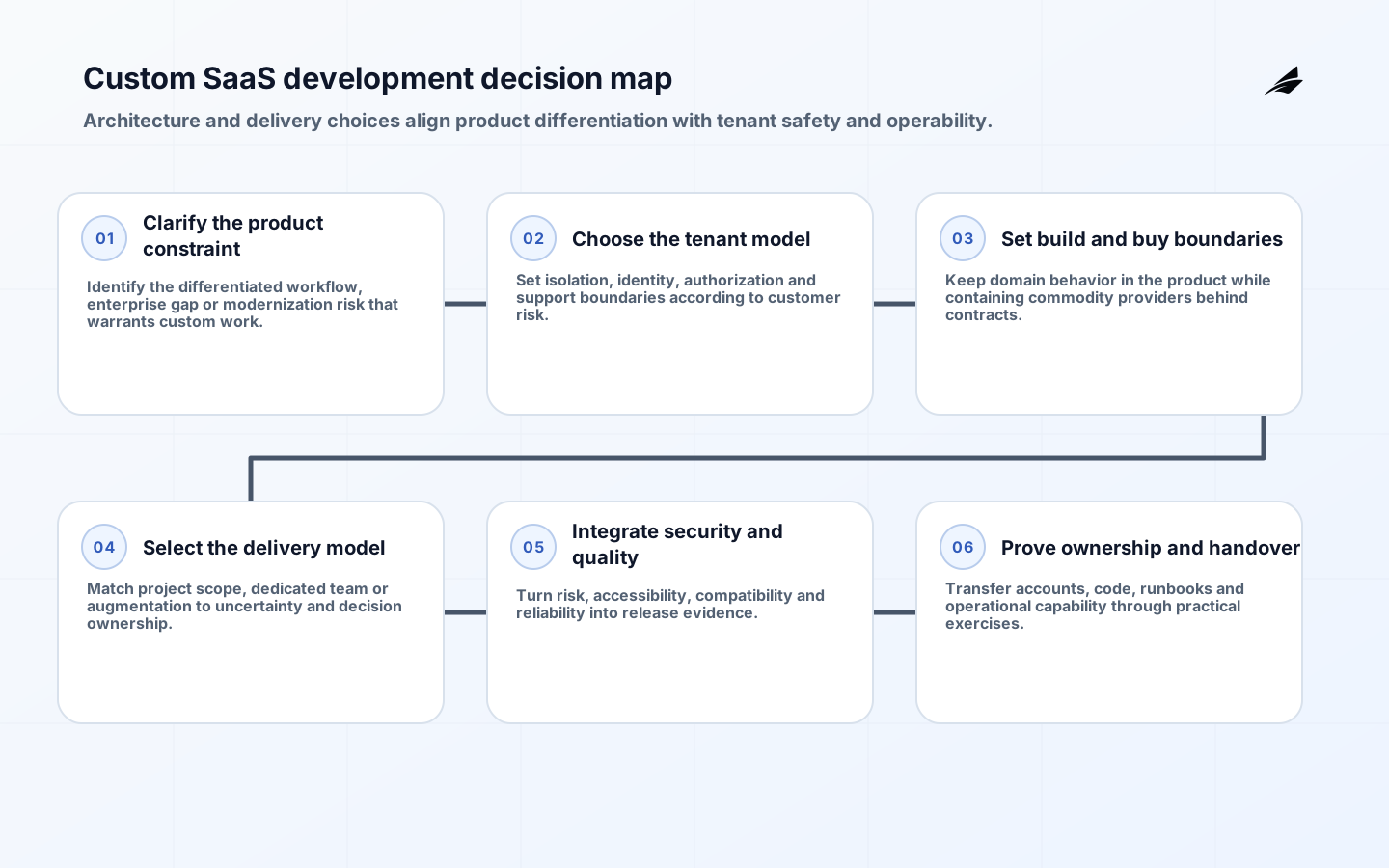
Custom software development services for SaaS companies cover more than adding engineers to a backlog. A partner may help reshape a product boundary, separate tenant data, modernize a fragile codebase, integrate billing and identity, build reliable release paths, or create operational ownership that an early team never needed. The right engagement depends on product maturity, customer commitments and the specific constraint preventing safe growth. This FAQ answers the architecture, team, security, cost and handover questions buyers should settle before work begins.
SaaS work has compounding consequences. A shortcut in tenant authorization can affect every customer; an unversioned API can break partner workflows; and a release process that works for ten tenants may become unacceptable at a hundred. Custom SaaS software development should leave the product easier to change and operate, not merely larger. The NIST Secure Software Development Framework provides a useful baseline for integrating security practices into the development lifecycle rather than treating review as a final gate.
The SaaS custom-development implementation checklist provides delivery gates. Compare it with the custom development scope guide and SaaS product engineering checklist when deciding whether the primary need is a bounded build, modernization or an ongoing product team.
When does a SaaS company need custom development?
Custom development is justified when the product's differentiating workflow, data model, integration or operating constraint cannot be met responsibly by configuring an existing service. Examples include complex entitlements, regulated evidence, domain-specific collaboration, high-volume processing or a migration that must preserve customer behavior. It is less attractive for commodity functions such as basic email delivery or payment processing, where a mature provider can reduce both build and compliance burden.
Start with the constraint, not a feature wish list. If churn comes from confusing onboarding, the answer may be product research and workflow repair. If enterprise sales stall on security and integration requirements, the answer may be identity federation, audit evidence and API governance. If releases are unsafe, platform and test work may create more value than new screens. A good supplier is willing to narrow or redirect the build after discovery.
| Constraint | Likely engagement | Evidence of fit |
|---|---|---|
| New differentiated workflow | Discovery plus bounded product increment | Users can validate an end-to-end outcome |
| Fragile legacy system | Incremental modernization | Risky dependencies and migration seams are mapped |
| Enterprise readiness gap | Identity, audit, integration and reliability work | Customer control requirements are testable |
| Temporary capacity gap | Embedded delivery team | Product owner and technical direction already exist |
How should multi-tenant architecture be designed?
Choose isolation according to data sensitivity, noisy-neighbor risk, scale and operations. Shared application and database resources can be efficient when every query and cache key carries enforced tenant context. Separate schemas, databases or deployments provide stronger boundaries at higher operational cost. A hybrid model may reserve isolated environments for regulated or very large customers. The decision should include backup, restore, analytics and support access, not just request routing.
Treat tenant identity as a first-class security context. Derive it from authenticated membership and server-side authorization, never from an untrusted request parameter alone. Test object-level access, background jobs, exports, search indexes, logs and observability labels for cross-tenant leakage. Define how users belong to multiple tenants and how support impersonation is approved and recorded. Migration between isolation models needs stable tenant identifiers and reconciliation evidence.
What should be built and what should be bought?
Buy capabilities whose complexity is mostly non-differentiating and whose providers can meet security, availability, portability and cost requirements. Identity providers, payment gateways, email delivery, feature-flag platforms and observability backends are common candidates. Build the domain workflow, policy and user experience that create product advantage. The boundary should be an explicit adapter so vendor events and identifiers do not leak throughout the codebase.

Evaluate total dependency risk: pricing at expected scale, data export, regional availability, rate limits, outage behavior, support response, sub-processors and roadmap control. A provider can reduce engineering effort while increasing concentration risk. Define a degraded mode and test contract changes. Keep authoritative business state in a system the company controls when a vendor's service is only a channel or processor.
| Capability | Build when | Buy when |
|---|---|---|
| Identity | Domain authorization is unique | Standards-based authentication and federation dominate |
| Billing | Pricing logic is differentiating | Payment collection and compliance dominate |
| Search | Domain ranking and permissions are unusual | Managed indexing meets tenancy and scale needs |
| Notifications | Workflow policy is product-specific | Transport delivery is commodity infrastructure |
Dedicated team, project scope or staff augmentation?
Use a project scope when the outcome and acceptance boundary are stable, such as extracting a service or delivering a defined integration. Use a dedicated cross-functional team when discovery and delivery will continue across uncertain priorities. Staff augmentation fits when the client already owns architecture, product decisions, delivery management and production support. Calling every arrangement a dedicated team hides who is accountable for outcomes.
Define roles in terms of decisions: who accepts scope, owns architecture, approves security risk, releases, handles incidents and speaks with customers. Include design, quality, platform and product capability rather than measuring only developer count. Stable teams learn domain and production behavior; constant rotation resets that knowledge. Commercial terms should reward transparent progress and operability, not a large inventory of partially completed tickets.
How should security and compliance enter the work?
Translate contractual and regulatory obligations into product controls and evidence. Establish data classification, threat models, access rules, secure development practices, dependency management, secrets handling and incident responsibilities. OWASP ASVS can help form verifiable application-security requirements, while NIST SSDF frames organizational development practices. Neither should be copied as a checklist without tailoring to the product's architecture and risk.
Automate tests where they give fast, deterministic feedback, but retain human review for architecture, abuse cases and consequential changes. Protect CI credentials and artifacts, require reviewed infrastructure changes, and keep a component inventory. Compliance evidence should emerge from normal delivery: approvals, test results, deployment records, access reviews and recovery exercises. A last-minute evidence project is a sign that control ownership was never integrated.
Can a SaaS product be modernized without a rewrite?
Usually yes, and incremental modernization is often safer. Map business capabilities, runtime dependencies, data ownership and change hotspots. Create a seam around one bounded capability, route a small slice through the new implementation, reconcile results and expand after evidence. A modular monolith may be a better target than microservices when team size and operational maturity do not justify distributed-system costs.
Preserve customer contracts during migration: URLs, API behavior, identifiers, permissions, exports and reporting definitions. Use backfills with checkpoints, dual reads or writes only when reconciliation and cutover rules are explicit, and retain rollback until data convergence is proven. Rewrite proposals should quantify which risks they remove and which new migration risks they create. Code age alone is not a business case.
What quality and reliability evidence should be required?
Define acceptance around customer journeys and service behavior. Combine unit tests, API and contract tests, critical browser workflows, authorization tests, accessibility checks, load tests and recovery exercises. Test tenant isolation and billing consequences explicitly. W3C WCAG 2.2 provides testable accessibility criteria, while service objectives should reflect user-visible reliability rather than internal server uptime alone.
Instrument requests, jobs and integrations with correlated traces, metrics and structured logs. OpenTelemetry can provide vendor-neutral telemetry, but teams still need naming, sampling, retention and privacy rules. Establish release health checks, rollback criteria and incident ownership. A feature is not done when it passes staging; it is done when the team can detect failure, protect customers and restore service.
| Evidence | Question answered | Release use |
|---|---|---|
| Contract tests | Will integrations preserve agreed behavior? | Block incompatible provider or consumer changes |
| Tenant authorization tests | Can one tenant reach another's objects? | Block cross-context data access |
| Service objectives | Is reliability acceptable to users? | Control release pace and improvement work |
| Recovery exercise | Can state and service be restored? | Verify backups, runbooks and ownership |
What should ownership and handover include?
The SaaS company should control source repositories, build pipelines, cloud accounts, domains, signing identities, production data and core vendor contracts. Suppliers can administer them under least privilege, but business continuity should not depend on a personal account. Agree intellectual-property treatment, open-source obligations and rights to reusable supplier components before work begins.
Handover is demonstrated operation. Client engineers should deploy a change, inspect telemetry, rotate a secret, restore representative data and run an incident exercise while the partner observes. Deliver architecture decisions, data models, API contracts, runbooks, test strategy, dependency inventory and unresolved risks. Retain a transition period with measurable exit criteria instead of transferring a folder on the final day.
Key takeaways
- Select custom development for a defined product or operating constraint, not generic capacity.
- Design tenant context across requests, jobs, storage, caches, telemetry and support tools.
- Buy commodity infrastructure behind explicit adapters; build differentiated domain behavior.
- Choose the team model by decision ownership and uncertainty.
- Require delivery evidence that includes security, accessibility, observability, recovery and transferable operation.
Frequently asked questions
How is custom SaaS development priced?
Common models are fixed scope, time and materials, or a dedicated team. Cost depends on discovery, existing-system risk, compliance, integrations, migration, quality evidence and production support, not just screen count.
How long should a SaaS MVP take?
A bounded release may take weeks or a few months, but the meaningful measure is time to a usable end-to-end outcome with security, telemetry and support. A larger feature inventory is not necessarily a better MVP.
Does a scaling SaaS product need microservices?
Not automatically. Use service boundaries when independent scaling, ownership or release needs outweigh network, consistency and operational costs. A well-structured modular monolith is often easier to evolve.
Who owns the source code?
The contract should explicitly assign product-specific code and deliverables, while identifying pre-existing supplier tools and open-source licenses. Repositories and production assets should be under company-controlled accounts.
Conclusion
Custom software development services for SaaS companies are valuable when they improve the product's ability to change safely, protect tenant data and operate reliably. A professional engagement makes architecture and decision ownership visible, delivers customer outcomes in small increments, and leaves the company able to run the system. Those qualities matter more than the number of developers or features named in a proposal.