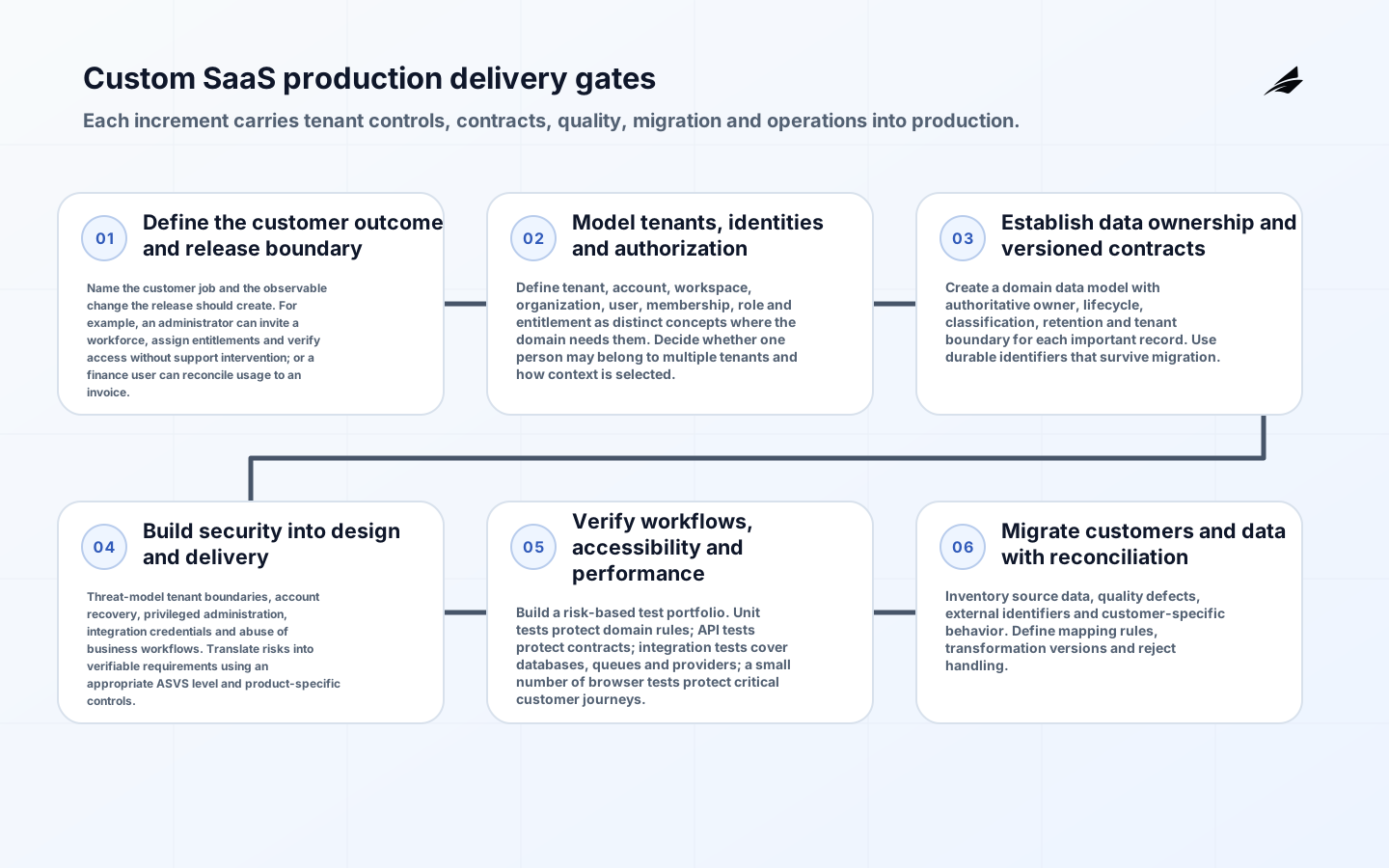
This custom SaaS software development checklist starts with the customer outcome and follows the work through tenant architecture, data contracts, delivery controls, migration, reliability and handover. Custom SaaS software development should convert a product constraint into a secure, operable capability that can serve many customers without confusing their data, permissions or service expectations. It is suitable for a new SaaS product, an enterprise-readiness program or a modernization engagement where existing customers must continue working while the underlying system changes.
A polished demonstration is not production evidence. The implementation must prove that one tenant cannot reach another tenant's data, retries do not duplicate financial or workflow effects, releases are reversible, integrations have explicit contracts, and support teams can diagnose a customer problem without broad production access. Custom software development services for SaaS companies should make those properties visible in the normal delivery system. NIST's Secure Software Development Framework and OWASP ASVS provide useful practices and verification requirements, but each must be tailored to the product.
Use the custom SaaS services FAQ for architecture and team-model answers, the scope and cost guide for procurement, and the SaaS product-engineering checklist for a wider product operating model.
Define the customer outcome and release boundary
Name the customer job and the observable change the release should create. For example, an administrator can invite a workforce, assign entitlements and verify access without support intervention; or a finance user can reconcile usage to an invoice. Identify persona, trigger, preconditions, successful result, exception and evidence. This prevents the first increment from becoming a collection of screens that cannot complete one real workflow.
Set exclusions and decision rights. Record who accepts product behavior, architecture, security risk, customer migration and production release. Separate assumptions that can be tested in discovery from contractual obligations that must be met. Establish baseline measures such as completion time, error rate, support contacts or release lead time. A release boundary is credible when the team can demonstrate one end-to-end outcome and operate it safely.
| Boundary | Required decision | Acceptance evidence |
|---|---|---|
| Customer workflow | Who starts, approves and completes it? | Representative journey succeeds including exceptions |
| Tenant scope | Which customer populations are included? | Isolation and entitlement tests pass |
| Integration scope | Which systems own each record? | Contracts and failure behavior are exercised |
| Operating scope | Who supports the release and when? | Runbook, telemetry and escalation are active |
Model tenants, identities and authorization
Define tenant, account, workspace, organization, user, membership, role and entitlement as distinct concepts where the domain needs them. Decide whether one person may belong to multiple tenants and how context is selected. Authorization belongs on the server for every object and action; filtering a list in the browser is not isolation. Include service accounts, background jobs, exports, search and support tools in the same model.
Choose shared, schema-separated, database-separated or deployment-separated isolation from risk and operations. Apply tenant context to database queries, cache keys, object paths, queue messages, metrics and logs. Test identifier guessing, stale membership, role changes during a session and support impersonation. Record privileged access with reason and duration. If enterprise customers require identity federation, map external groups to internal entitlements through governed rules rather than accepting arbitrary claims.
Establish data ownership and versioned contracts
Create a domain data model with authoritative owner, lifecycle, classification, retention and tenant boundary for each important record. Use durable identifiers that survive migration. Define transaction boundaries and idempotency keys for commands that can be retried. For events, publish schema, source, timestamp and version, then make consumers tolerant of additive change. A message broker does not remove the need to decide who owns state.
Version public APIs and webhooks according to compatibility policy. Authenticate clients, authorize each resource, bound pagination and rate limits, and sign consequential webhook deliveries. Provide replay or reconciliation for missed events. Avoid exposing internal database structures as a customer contract. Keep examples and error semantics in executable contract tests so documentation and behavior do not diverge.
| Contract | Control | Failure test |
|---|---|---|
| Command API | Idempotency key and authorization | Same request delivered twice |
| Query API | Tenant filter and stable pagination | Records change between pages |
| Webhook | Signature, timestamp and retry policy | Consumer is unavailable for hours |
| Data export | Scope, audit and expiry | Large export crosses tenant context |
Build security into design and delivery
Threat-model tenant boundaries, account recovery, privileged administration, integration credentials and abuse of business workflows. Translate risks into verifiable requirements using an appropriate ASVS level and product-specific controls. Protect secrets with managed stores, restrict CI identities, review infrastructure changes and scan dependencies and build artifacts. Preserve provenance from reviewed commit to deployed artifact so production software can be traced.

Automate static checks, unit and contract tests, authorization cases and dependency policy, but retain human review for architecture and high-consequence changes. Establish a vulnerability intake and remediation policy tied to exploitability and customer impact. Maintain a component inventory and remove abandoned packages. Security review must cover operational paths such as support access and data repair, not only public endpoints.
Verify workflows, accessibility and performance
Build a risk-based test portfolio. Unit tests protect domain rules; API tests protect contracts; integration tests cover databases, queues and providers; a small number of browser tests protect critical customer journeys. Add tenant-isolation tests, permission matrices, billing calculations, import and export, time-zone behavior and recovery. WCAG 2.2 criteria should enter design components and acceptance tests rather than becoming a late audit.
Test expected load and failure, not only peak request count. Include concurrent tenants, large accounts, slow providers, queue backlogs and background jobs. Define latency and availability objectives for customer journeys. Observe resource use per tenant to detect noisy neighbors. A performance result is meaningful only when dataset size, configuration, test duration and bottleneck are recorded.
| Test layer | Protects | Typical release signal |
|---|---|---|
| Domain unit | Pricing, state and permission rules | Fast change feedback |
| API contract | Compatibility and error behavior | Provider-consumer agreement |
| Critical journey | Real user completion | End-to-end release confidence |
| Recovery exercise | Service and data restoration | Operational readiness |
Migrate customers and data with reconciliation
Inventory source data, quality defects, external identifiers and customer-specific behavior. Define mapping rules, transformation versions and reject handling. Rehearse backfills on production-shaped data, capture checkpoints and produce reconciliation totals. If old and new systems run together, specify which one owns writes and how divergence is detected. Dual writing without a recovery model can amplify inconsistency.
Segment rollout by internal users, low-risk tenants, cohorts or capability. Publish change communication and support readiness. Keep rollback until data and workflow evidence prove that returning is possible; after irreversible migration, use forward repair with an approved plan. Monitor business outcomes such as completion, errors and support volume alongside infrastructure health. A technically successful cutover can still harm customers if permissions or reporting meanings change.
Instrument, release and support the product
Create structured logs, metrics and traces that carry safe tenant and correlation identifiers. Avoid sensitive payloads in telemetry. Monitor request errors, job age, provider failures, authorization denials, deployment health and user-visible objectives. OpenTelemetry can standardize collection, but teams must still define semantic names, sampling and retention. Dashboards should lead to an owner and a response, not display every emitted metric.
Use small deployments with automated health checks, feature controls and a tested rollback or disable path. Write runbooks for common failures and data repair. On-call teams need production-safe diagnostic tools and clear escalation to product, security and provider owners. Review incidents for system improvements rather than individual blame. Reliability work belongs in the backlog with product work because accumulated operational risk limits delivery speed.
Prove ownership, documentation and handover
Keep repositories, pipelines, cloud accounts, domains, signing identities and core vendors under company-controlled ownership. Record architecture decisions, domain models, API contracts, environment topology, dependency inventory, test strategy, security assumptions and unresolved risks. Documentation should explain why a boundary exists and how to verify it, not repeat code structure that can be read directly.
Make handover an exercise. Client engineers deploy a change, inspect a trace, rotate a secret, restore data, diagnose a failed job and run an incident scenario. Track gaps and repeat until the receiving team can operate independently. Agree a transition support window and objective exit criteria. A supplier has not completed the implementation while routine operation still requires undocumented knowledge held by one person.
Key takeaways
- Anchor the build to one customer outcome and explicit release boundary.
- Enforce tenant context across storage, caches, jobs, telemetry and support operations.
- Treat APIs, events and migrations as versioned, reconcilable contracts.
- Combine secure delivery, accessibility, reliability and recovery evidence before release.
- Complete handover by demonstrating independent operation, not by transferring documents.
Frequently asked questions
What should the first increment contain?
One complete customer journey with authentication, authorization, persistent state, telemetry, support handling and an exception path. Narrow breadth is acceptable; missing operational fundamentals are not.
Is a shared database safe for multi-tenant SaaS?
It can be when tenant context is enforced consistently, sensitive fields are protected, backups and support access respect boundaries, and isolation tests run continuously. Higher-risk customers may require stronger separation.
Does every migration need zero downtime?
No. The business may accept a planned window. The goal is a tested, communicated cutover with bounded data loss, reconciliation and recovery, not a complex dual-run design adopted without need.
When is the implementation complete?
When accepted customer outcomes work, controls and objectives are evidenced, production ownership is active, migration is reconciled, and the client team can release and recover the service.
Conclusion
A custom SaaS implementation is successful when customers receive a coherent outcome and the company gains a product it can change, secure and operate. Tenant isolation, contracts, migration, telemetry and handover are part of the product, not surrounding paperwork. Building those capabilities into each increment prevents speed today from becoming fragility tomorrow.