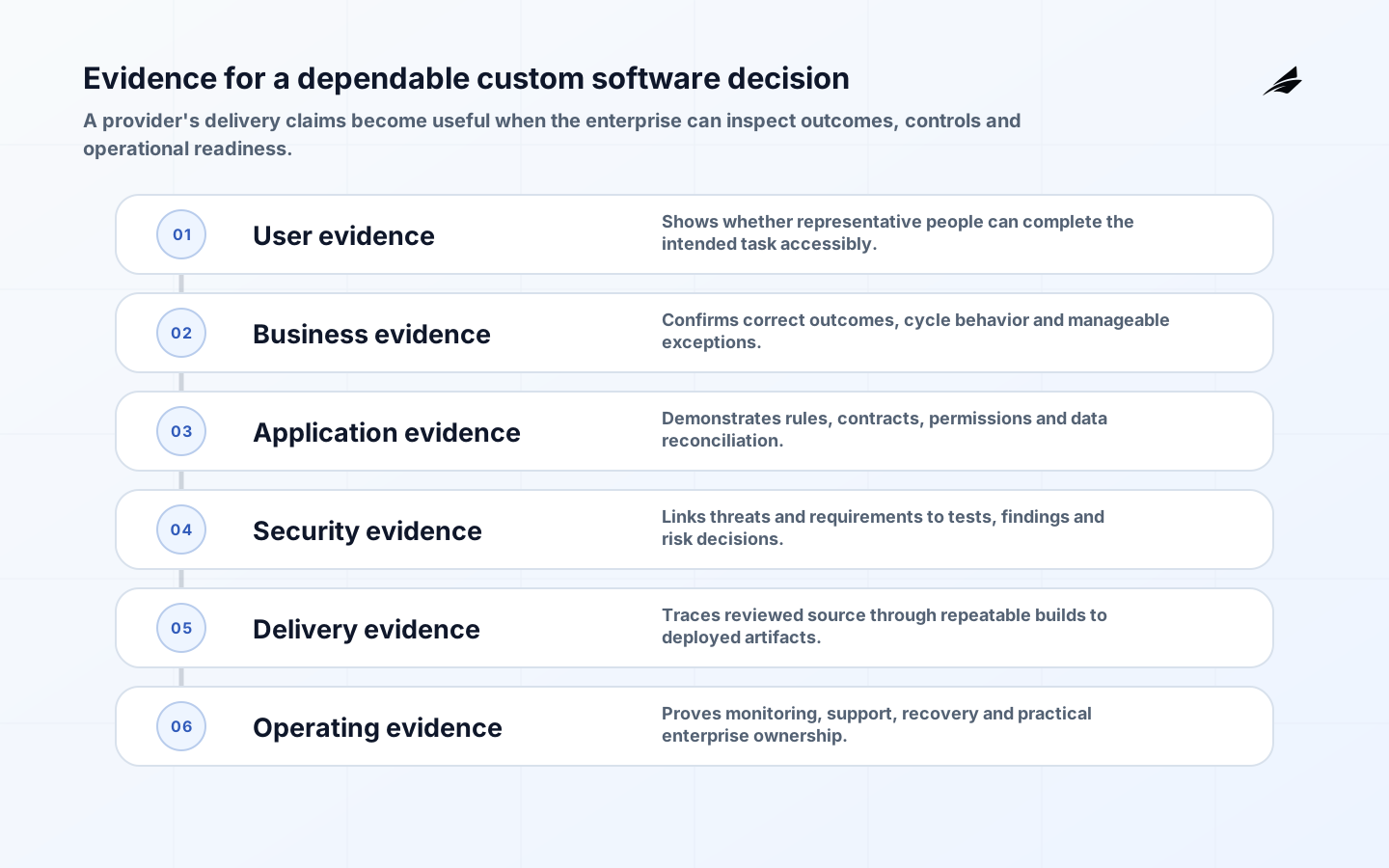
Enterprise custom software questions are rarely only technical. Sponsors need to know whether building is necessary, what they are actually buying, how uncertainty affects cost, which controls belong in the first release and who carries responsibility after a delivery team leaves. The answers below are designed for product, technology, procurement, security and operations leaders making one shared decision.
Frequently asked questions
Questions about the build decision
What counts as custom software development?
It is the design, construction and lifecycle ownership of software shaped around an organization's requirements. The result may be a new application, a workflow layered over existing systems, an integration service, a customer portal or a specialized decision tool. Custom does not require bespoke databases, identity systems or frameworks. Mature commodity components should be used where they satisfy the need and can be supported.
When should an enterprise build rather than buy?
Build when a material outcome depends on distinctive workflow, rules, experience or control that supported products cannot meet acceptably. First test whether the process can simplify, an existing platform can configure safely, or products can integrate through a stable boundary. Consider not only initial fit but upgrades, data portability, security, vendor roadmap and the enterprise's ability to sustain its own product.
Can custom and commercial software work together?
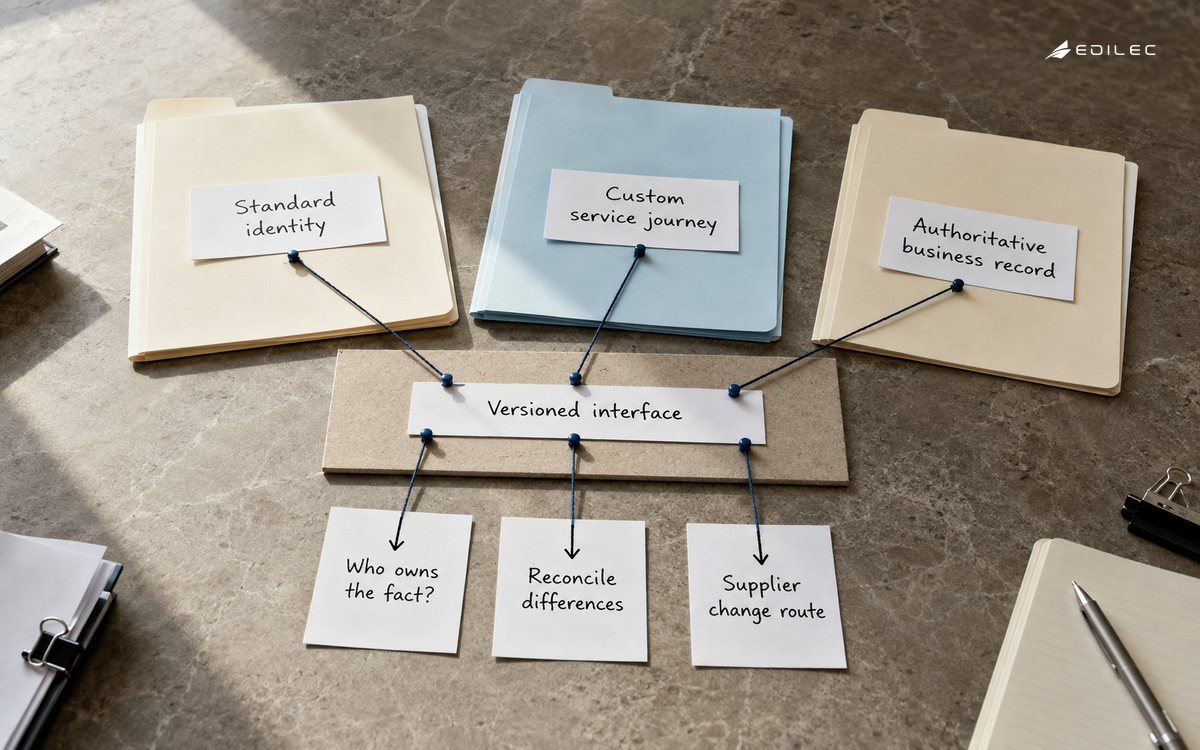
Yes, and this is often the sensible architecture. A commercial product can own a standard capability such as identity, content or finance while custom software owns a differentiated journey. Document which system is authoritative, what crosses the interface, how failures are represented, how data is reconciled and what happens if a vendor changes or is replaced.
| Decision | Evidence to request | Warning sign |
|---|---|---|
| Build rationale | Compared options and constraints tied to an outcome | Technology chosen before process discovery |
| Product fit | Supported configuration and extension analysis | Core product code must be heavily modified |
| Hybrid boundary | Authority, contract, failure and exit design | Data is copied without ownership or reconciliation |
| Long-term ownership | Named product, security and operations roles | The plan ends at launch |
Questions about scope and delivery
What should the first release include?
Select one useful end-to-end workflow for a known role and include everything required to operate it: permissions, records, integration behavior, error handling, telemetry, support and recovery. A narrow slice is valuable because it tests architecture and collaboration. It is not an excuse to omit security or migration work and call the interface a minimum viable product.
How detailed should requirements be before development starts?
Detail should be highest around costly or consequential decisions: users and roles, state transitions, authority, data meaning, external contracts, prohibited behavior and service expectations. Low-risk interaction details can be learned through prototypes and delivery. Maintain assumptions and acceptance examples with owners; a large static requirements document is not a substitute for access to domain experts and observable work.
What should a discovery phase produce?
Discovery should produce decisions and evidence, not merely workshop notes. Expect a defined outcome and baseline, journey and dependency maps, role and data models, architecture options, material risks, a representative first slice, acceptance approach, responsibility matrix and forecast range with assumptions. It should also identify unanswered questions and a practical way to resolve them. The output must be usable by the enterprise even if it pauses, changes provider or decides that configuration or purchase is the better route.
Does iterative delivery mean scope and cost cannot be governed?
No. Govern the outcome, control floor, investment range and decision cadence. Break work into accepted slices, track forecast changes and trade lower-value scope when evidence changes. Iteration exposes uncertainty earlier; it should not remove accountability. Define who can alter priorities, architecture, risk acceptance and launch criteria.
Should the work use an internal team or a provider?
Choose from available capability, urgency, domain continuity, assurance needs and long-term ownership. A blended team can add specialist capacity while preserving enterprise knowledge. Whatever the model, keep business decisions, production authority, repositories, artifacts and records accessible to authorized enterprise owners. Plan knowledge transfer through daily work, not a document handoff in the final week.
| Delivery model | Strength | Risk to manage |
|---|---|---|
| Internal | Domain continuity and direct control | Capacity gaps or limited specialist experience |
| Provider-led | Rapid access to a practiced multidisciplinary team | Dependency if access and knowledge remain external |
| Blended | Specialists pair with enduring enterprise owners | Unclear accountability between organizations |
| Multiple suppliers | Choice and specialized capabilities | Fragmented service ownership and interface disputes |
Questions about cost, contracts and procurement
What drives custom software cost?
Cost reflects workflow breadth, unknown behavior, user roles, data quality, integrations, assurance, availability, accessibility, migration and support. Team composition and client responsibilities matter too. Separate discovery, product and design, engineering, platforms, testing, security, transition and ongoing operation. Compare proposals using the same inclusions and assumptions rather than a headline total.
How can an enterprise get a dependable estimate?
Begin with a range linked to stated assumptions. Fund focused discovery and a representative vertical slice that exercises real data, an integration, deployment and operational controls. Use the result to update complexity, throughput and risk. False precision at the start tends to reappear as contingency, exclusions, reduced quality or repeated change requests.
Which contract terms deserve special attention?
Review responsibility and acceptance, repository and environment access, intellectual property, open-source compliance, data processing, security requirements, vulnerability disclosure, incident cooperation, subcontractors, warranties, support, termination and transition. Legal advice must be specific to the enterprise and jurisdiction. The operational design should make contract promises testable.
- Require named deliverables and evidence rather than broad activity labels.
- Define acceptance for slices, defects, security findings and documentation.
- Make client dependencies and decision turnaround assumptions visible.
- Preserve audit and access rights proportionate to the risk.
- Specify transition artifacts, assistance and deletion or return of data.
- Align payment milestones with accepted, usable evidence where appropriate.
Questions about security, quality and operations
How can buyers verify secure development?
Ask how the team prepares its development environment, protects code and build systems, produces secured releases and responds to vulnerabilities. Those areas align with NIST's SSDF. Request evidence appropriate to risk: threat models, reviewed requirements, dependency and artifact records, test results, remediation tracking and a vulnerability intake process. OWASP ASVS can supply verifiable application requirements; a single penetration test cannot stand in for lifecycle practice.
Is accessibility relevant to enterprise software?
Yes. Employees, partners and customers may use the interface with keyboards, screen readers, magnification or other assistive technology, and legal obligations vary. Establish the applicable target, often informed by WCAG 2.2, and test complete workflows. Automated checks help, but human evaluation is needed for focus, language, errors and task completion.
What reliability commitments should be defined?
Choose indicators from user-visible behavior such as successful completion, correctness, latency or freshness. Define objectives, measurement sources, windows, exclusions and response. Infrastructure uptime alone may hide a broken workflow. Recovery objectives, backup scope and incident roles should be exercised before consequence grows.
How should software quality be measured?
Use several lenses: user task success and accessibility; workflow correctness and data reconciliation; security findings and response; service reliability and recovery; support burden; and delivery stability. DORA measures can help teams inspect change lead time, deployment frequency, recovery from failed deployments, change failures and deployment rework at service level. Do not use them to rank individuals.
| Quality lens | Example evidence | Decision it supports |
|---|---|---|
| User | Task completion, errors and accessibility review | Whether the workflow is usable |
| Business | Correct outcomes, cycle time and exception volume | Whether the intended operation improved |
| Technical | Contract tests, defects and data reconciliation | Whether behavior is dependable |
| Operational | Service indicators, incidents and recovery exercises | Whether the service can be supported |
| Delivery | Service-level DORA measures and rework | Whether changes are flowing safely |
Questions about rollout and ownership
How should custom software be launched?
Release progressively by user group, location, workflow or traffic where feasible. Define entry and exit gates, telemetry, reconciliation, support coverage and a tested fallback. For transactional changes, rollback may route new work to the old path while preserving valid transactions already completed; it should not blindly reverse business state.
What must be ready for handover?
Authorized owners need working access to source, artifacts, environments, dashboards, decisions, known risks and support systems. Runbooks should be exercised, not merely delivered. Enterprise staff should demonstrate deployment, diagnosis, recovery and routine change while the delivery team can still correct gaps.
How can future lock-in be reduced?
Keep data formats and interfaces documented, use open standards where they genuinely fit, isolate proprietary dependencies behind meaningful boundaries, preserve portable telemetry and test data export. Lock-in cannot always be eliminated and may be accepted for value, but its operational and commercial consequences should be visible and revisited.
A compact rollout guide
- Confirm outcome, owner, options and constraints.
- Map roles, records, dependencies, exceptions and controls.
- Prove one operational vertical slice.
- Review security, accessibility, reliability and support evidence.
- Pilot with a defined cohort and reconcile results.
- Expand through pauseable waves and track exceptions.
- Transfer practical ownership and retire superseded paths.
Key takeaways
- Custom software is a lifecycle ownership choice, not only a build choice.
- A strong first release is narrow in workflow but complete in controls and operations.
- Cost estimates become credible through explicit assumptions and representative evidence.
- Security, accessibility and reliability require testable requirements throughout delivery.
- Enterprise access, knowledge and transition readiness should grow from the first iteration.
Conclusion
The best custom software answers are specific to the operation and honest about uncertainty. Evaluate alternatives, request inspectable evidence, make ownership explicit and judge delivery by sustained user and service outcomes. That turns procurement from a promise comparison into a controlled decision about a product the enterprise may depend on for years.