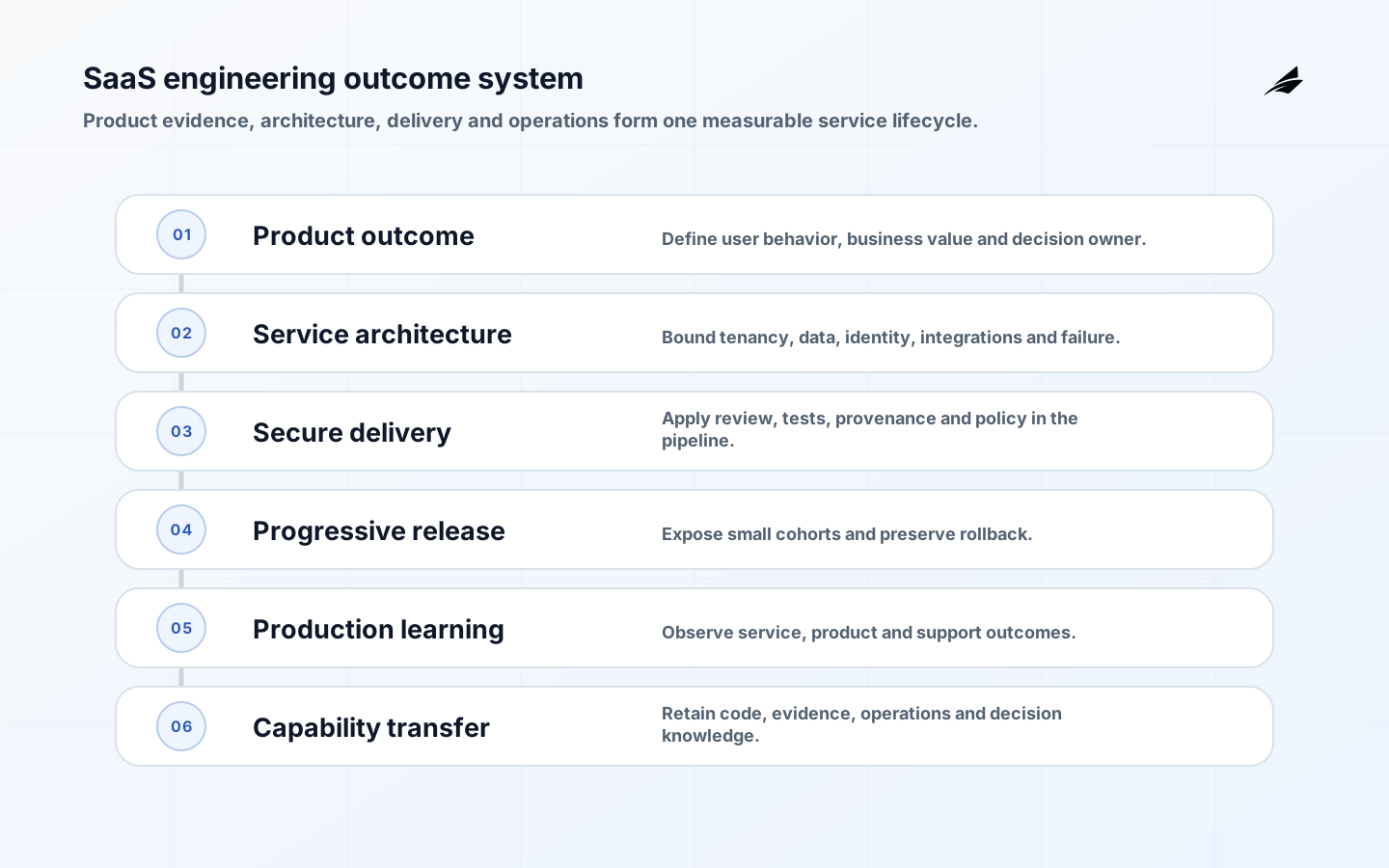
Digital Engineering Services for SaaS Companies: Practical FAQ requires more than selecting tools or assembling a feature list. The implementation must connect a defined business outcome to data, authority, failure behavior and permanent ownership. This guide explains the decisions a buyer, product leader and delivery team should settle before committing the full build. It uses current primary standards where they define a useful control, while keeping the architecture proportional to the actual workflow and consequence.
The practical goal is an operable service: people can complete the intended work, understand state and exceptions, and recover when a dependency or decision fails. Scope therefore includes discovery, design, integration, security, delivery, rollout and support. The sections below can be used for proposal review, architecture workshops and acceptance planning. Related reading includes Digital Engineering Services for SaaS Companies: Scope, Cost, Risks and Delivery Plan, Digital Engineering Services for SaaS Companies: Implementation Checklist, Custom SaaS Software Development: Production Implementation Checklist.
What do digital engineering services include?
For a SaaS company, digital engineering can cover product discovery, application and data architecture, user experience, platform engineering, quality, security, observability, cloud operations and modernization. The useful scope is a set of outcomes and owned services, not a list of roles. A partner may deliver one product stream, improve the shared platform or stabilize an existing service. State which decisions remain with product leadership, which technical outcomes the provider owns, and which operational duties continue after release. Exclude ambiguous labels such as end-to-end unless the boundaries are written down.
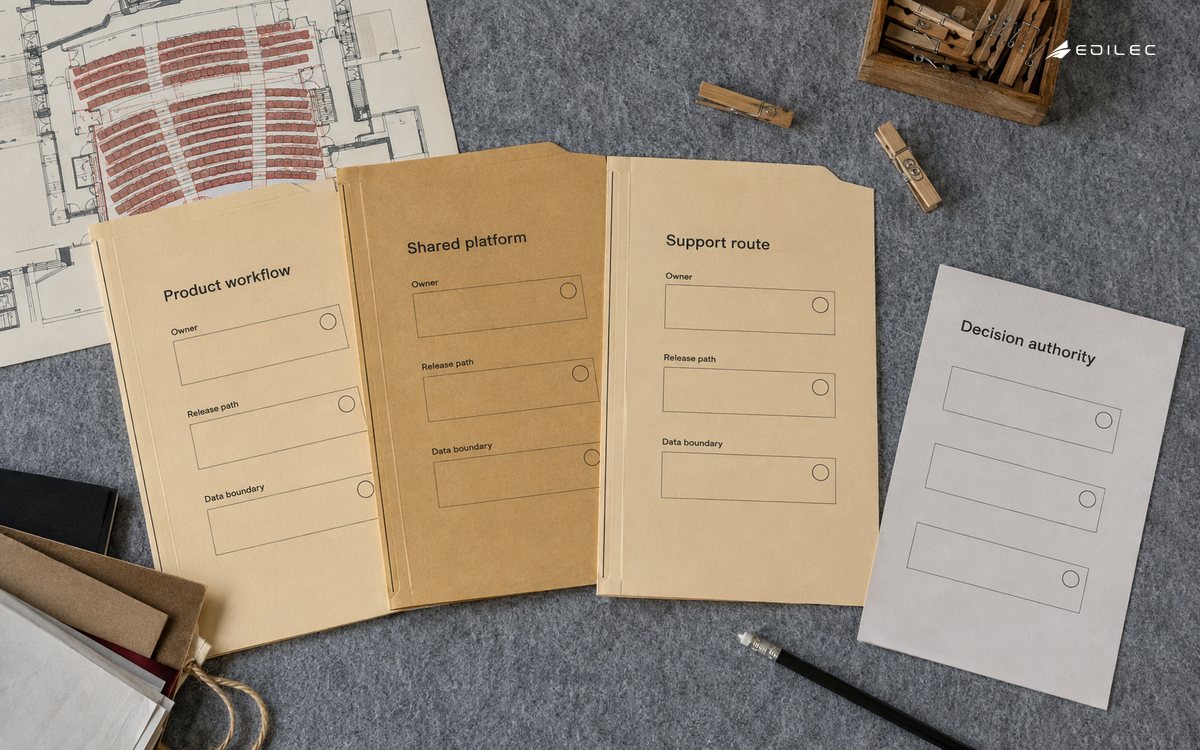
Translate scope into a service map. For every product and platform component, name owner, repository, deployment path, data classification, service objective and support route. Mark shared capabilities such as identity, billing and notifications because changes affect several product streams. This map supports staffing and architecture decisions and exposes gaps that a proposal may otherwise conceal behind broad disciplines such as cloud or quality engineering.
How should a SaaS architecture be evaluated?
Evaluate tenancy, identity, authorization, data isolation, configuration, billing, metering, integration boundaries and failure containment together. The Twelve-Factor principles remain useful for deployable services, but they do not decide tenant models or business authorization. Trace a tenant request through every shared component and show how logs, caches, queues and analytics preserve isolation. Prefer evolutionary boundaries over premature microservices. A modular application with explicit contracts can be safer and faster than distributed services whose ownership, data consistency and operational cost are not yet justified.
Test architecture with scenarios: a tenant export, regional outage, billing retry, schema migration, noisy customer and compromised administrator. Record expected containment and recovery. Data deletion and residency must follow every replica, backup, log and analytical copy. Define configuration ownership and validation because tenant-specific switches can create untested product variants. Review component boundaries when team ownership or operational evidence changes, not on a calendar alone.
| Area | Decision | Evidence |
|---|---|---|
| Decision | Strong evidence | Warning sign |
| Architecture | Tenant and failure boundaries traced end to end | A fashionable reference architecture without workload evidence |
| Delivery | Product outcomes paired with five DORA measures | Velocity or utilization used as the main success measure |
| Security | SSDF practices and ASVS tests in the release process | Security deferred to a final assessment |
| Ownership | Named product, service and operational owners | Responsibility described only by vendor role |
Which delivery measures should the engagement use?
DORA now describes five software delivery performance measures: change lead time, deployment frequency, failed deployment recovery time, change fail rate and deployment rework rate. Use them for one service in context, not as targets that encourage gaming. Pair them with product measures such as activation, task completion, retention and support demand, plus service objectives for availability and latency. Review flow from idea to production to find waits and rework. A provider should improve the system of delivery, not merely increase completed tickets or lines of code.
Instrument the path from accepted product decision through code review, build, test, release and verified customer outcome. Measure waiting and rework between stages. Use deployment frequency as an observation, never a quota that encourages empty releases. Product discovery and technical debt need their own evidence. Service teams should review failed-deployment recovery with incident learning so improved speed does not depend on heroic manual intervention.
How is product security made contractual?
Translate the NIST SSDF into evidence expected throughout development: protected repositories and pipelines, reviewed changes, dependency governance, secure design, vulnerability response and release integrity. Use OWASP ASVS requirements appropriate to the product risk as testable acceptance criteria. Require provenance for build artifacts and dependencies; SLSA provides a vocabulary for supply-chain assurance. Clarify vulnerability severity, remediation clocks, disclosure, incident cooperation and access to engineering environments. A final report without reproducible evidence does not demonstrate that secure practices operated during the engagement.
Specify access to production, customer data and build infrastructure. Use company-managed identity, time-bound elevation and recorded purpose for supplier access. Require dependency inventories and vulnerability triage that considers exploitability and service context. Verify backup restoration and incident evidence. If the product serves regulated customers, map contractual controls to actual product and operational boundaries rather than presenting a generic organizational certificate as universal coverage.
What team model works for SaaS product engineering?
Use a stable cross-functional team aligned to a product or platform outcome, with access to product decisions and production feedback. Named ownership matters more than nominal seniority. Define who prioritizes, accepts, operates and can stop a release. Avoid splitting analysis, development, testing and operations into contractual queues that recreate handoffs. External specialists can accelerate architecture, security or migration, but permanent product knowledge must accumulate inside the company. Pairing, design records, runbooks and shared incident work transfer capability better than a handover document at the end.
Create an explicit decision cadence for product scope, architecture exceptions, release risk and incidents. A weekly status call is not sufficient if decisions wait in private messages. Keep a shared backlog with acceptance evidence and unresolved assumptions. Measure team health through flow and outcomes, not individual utilization. Stable teams need slack for reliability and learning; scheduling every hour removes the capacity required to investigate systemic defects.
| Area | Question | Control |
|---|---|---|
| Commercial model | Best fit | Required control |
| Fixed outcome | Bounded scope and testable acceptance | Assumption log and change mechanism |
| Stable product team | Evolving roadmap with continuous feedback | Outcome review and transparent capacity |
| Specialist intervention | Migration, security or performance constraint | Exit criteria and knowledge transfer |
| Managed operation | Defined production service | Service objectives, evidence and termination plan |
What determines cost and commercial structure?
Cost follows product uncertainty, estate condition, compliance, integrations, migration and service expectations. A fixed price can work for a narrow outcome with stable acceptance; a capacity model suits evolving product work but still needs outcome reviews. Separate discovery from delivery when major assumptions are untested. Make environments, licenses, cloud spend, security testing and post-release operation visible. Evaluate total cost of change, not just hourly rates: slow approvals, fragile tests, unclear architecture and supplier dependency can make a cheaper team more expensive over the product lifecycle.
Ask each proposal to show the assumed product team, specialist access, environments, release frequency and support model. Model an ordinary month and an incident-heavy month. Account for migration overlap and the cost of running two systems. Include future modification: a design that lowers first-release cost by embedding customer variations in code can create expensive testing and support across every later release.
How should transition and exit be planned?
Transition begins on day one. Keep source, infrastructure definitions, pipelines, architecture decisions, product analytics, incident records and credentials in company-controlled systems. Establish documentation and operational-readiness criteria per release. Rotate internal engineers through key components and require reproducible local and deployment setup. Before exit, test access revocation, build continuity, backlog ownership, support escalation and recovery from a clean environment. A successful engagement leaves the SaaS company able to change suppliers or operate independently without losing delivery momentum or production understanding.
Run a transition exercise before the final month. Ask an internal engineer to deploy, diagnose a synthetic incident, rotate a secret and explain a material design decision using retained artifacts. Resolve gaps while the delivery team is still available. Export issue history and evidence in usable formats. Terminate dormant accounts and supplier integrations, and confirm that alerts, domain ownership and billing contacts no longer depend on departing personnel.
Key takeaways
- Buy owned outcomes and operable services, not an undifferentiated pool of roles.
- Evaluate tenancy, authorization and failure behavior as one architecture.
- Use product outcomes with current DORA measures and service objectives.
- Keep company control of code, delivery systems, evidence and operational knowledge.
Frequently asked questions
Is a digital engineering company the same as a development agency?
The labels overlap. The meaningful distinction is scope and accountability: digital engineering should connect product, architecture, delivery, security and operation, while some agencies provide only project implementation. Verify the actual service boundary.
Should a SaaS partner move the product to microservices?
Not by default. First identify scaling, ownership or release constraints that a new boundary would solve. Distribution adds network failure, consistency and operating cost, so the evidence must outweigh that complexity.
How should proposals be compared?
Use the same scenario, architecture questions, acceptance evidence, team assumptions and exit requirements for every proposal. Compare the path to a measurable outcome and the residual operating burden, not only rate cards.
Conclusion
Digital engineering services for SaaS companies create value when product decisions, technical design, secure delivery and production ownership reinforce one another. The right partner can improve a product and the company’s ability to change it. Clear outcomes, verifiable engineering practices, contextual measures and an exit-ready operating model distinguish that capability from temporary delivery capacity. Revisit the operating model whenever product scope, tenant risk, platform ownership or supplier dependence changes materially.