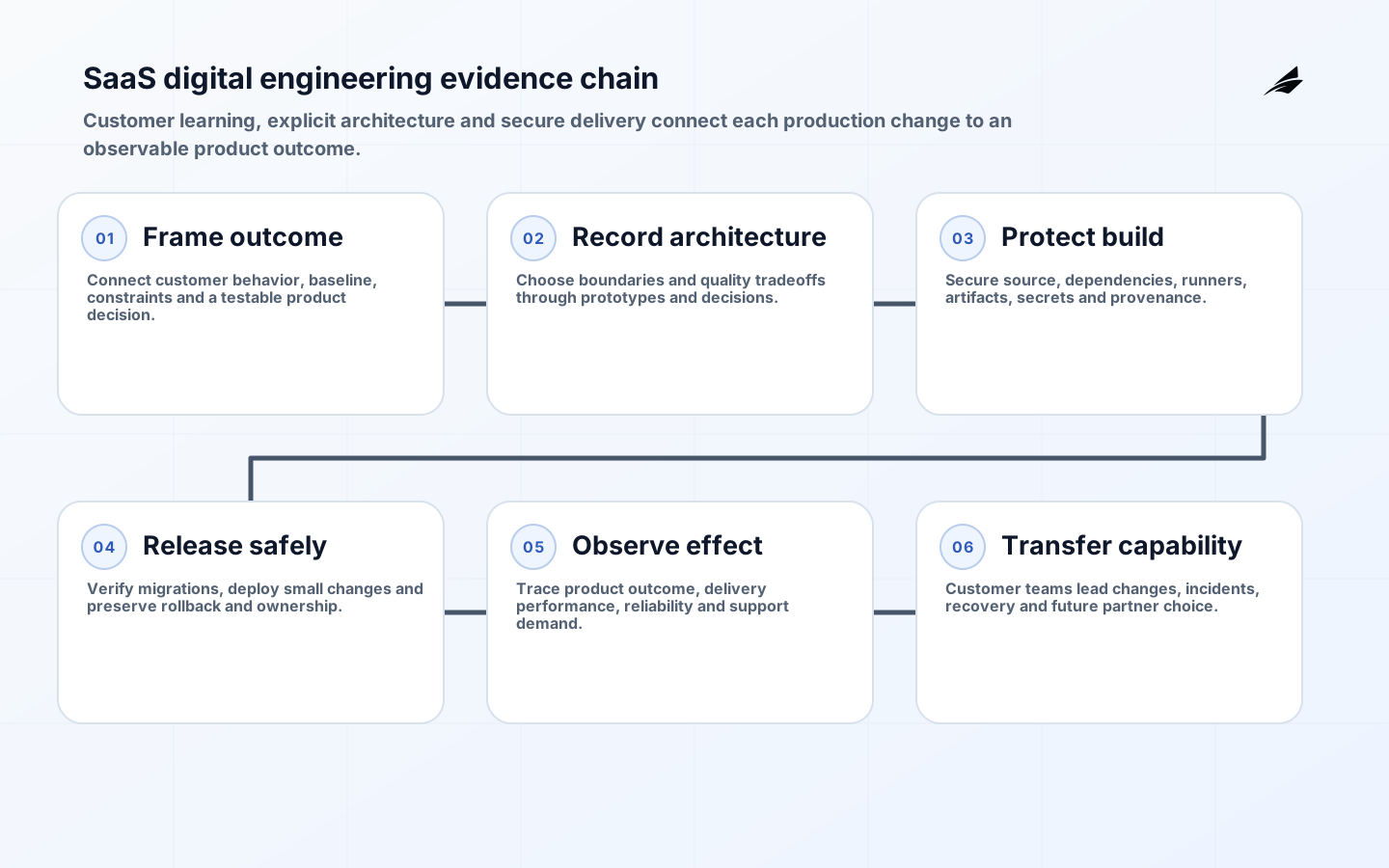
Digital engineering services for SaaS companies should improve a product’s ability to learn, ship and operate—not simply add temporary coding capacity. A useful engagement can include discovery, experience design, architecture, application development, data, platform, quality, security and reliability. The boundary must be explicit because SaaS value depends on the whole service: tenant identity, billing, support, observability, recovery and change management matter as much as feature code. The buyer remains accountable for product direction, customer commitments and risk even when a partner performs substantial delivery work.
This checklist helps a SaaS leadership or engineering team define, select and govern a digital engineering partner. It favors evidence over staffing labels. The target is a small, cross-functional delivery system that can move a customer outcome from discovery to a secure production change, observe its effect and improve it. The engagement should leave source, infrastructure, decisions, operational knowledge and supplier evidence under customer control so that velocity does not depend on one vendor indefinitely.
Define the product outcome and service boundary
Choose a bounded outcome such as reducing activation failure, enabling enterprise identity, improving billing reconciliation or shortening recovery from a failed release. Establish baseline behavior and target evidence. Map the customer journey, systems, roles, data and operational events involved. A broad objective such as “modernize the platform” should be decomposed into capabilities that users and operators can verify. Record constraints including tenant commitments, regional data rules, uptime, release windows, support and technical debt that cannot be changed in the first phase.
Define ownership for product decisions, architecture, data, security acceptance, deployment, production response and cost. The partner may propose and implement, but the customer should retain final authority for business and risk decisions. Identify repositories, cloud accounts, design files, documentation and environments as customer-controlled from day one. Avoid a model where deliverables arrive as periodic exports from vendor systems. Access should use named identities, least privilege and prompt removal at role change or exit.
| Capability | Partner evidence | Customer-retained authority |
|---|---|---|
| Product discovery | Research record, hypotheses and experiment result | Priority, customer promise and outcome decision |
| Architecture | Decision records, prototypes and quality tests | Target constraints and accepted tradeoffs |
| Delivery | Source, pipeline, tests and release evidence | Production approval policy and roadmap |
| Security | Threat model, verification and remediation | Risk acceptance and disclosure decisions |
| Operations | Telemetry, runbooks and exercised response | Service ownership and incident command |
Form a durable cross-functional team
Staff around the outcome rather than separate handoffs. A typical team needs product direction, design, software engineering, quality, platform and security access, with domain and support participation. Name one accountable customer product owner and one technical owner. Clarify time zones, review expectations, decision turnaround and on-call responsibilities. Examine actual availability; a senior architect listed on a proposal but shared across many accounts does not provide day-to-day leadership. Require continuity and transition plans for key roles.
Use a shared backlog that includes feature, reliability, security, data and platform work. Define ready and done through evidence: acceptance examples, tests, telemetry, documentation and deployment or migration steps. Keep work small enough to review and release independently. Demonstrations should use integrated software in a representative environment, not disconnected mock screens. Track unresolved assumptions and technical decisions alongside work so urgency does not erase context.
Control architecture through decisions and tests
Baseline tenant model, identity, authorization, data ownership, integrations, asynchronous work, reporting, billing, deployment and recovery. Identify the quality attributes most important to the product: isolation, availability, latency, auditability, portability or cost. Create short architecture decision records that state context, options, decision and consequences. Prove risky assumptions with thin prototypes and load, failure or compatibility tests. Avoid introducing microservices, Kubernetes or event streaming as symbols of modernization; select them only when the operating team and workload justify the complexity.
Protect contracts at the boundaries. Version APIs and events, publish schemas, define idempotency and test backward compatibility. Plan data migrations as versioned product changes with rehearsal, reconciliation and rollback. Keep business authorization in trusted services rather than duplicating it across interfaces. For multi-tenant changes, test isolation at query, cache, search, export and operational tooling layers. Architecture quality is demonstrated when a change and a failure can be traced through the system and safely recovered.
Build secure delivery into the workflow
NIST’s Secure Software Development Framework groups practices around preparing the organization, protecting software, producing well-secured releases and responding to vulnerabilities. Translate those outcomes into the engagement: security requirements, protected repositories and pipelines, peer review, threat modeling, dependency governance, secret handling, testing, release integrity and vulnerability response. OWASP ASVS can help specify verifiable application controls. Security should produce normal delivery evidence instead of a late checklist owned by a separate reviewer.
Protect the software supply chain. Pin and review dependencies, record provenance, generate a software bill of materials where required, sign artifacts through controlled build identities and separate build from deployment authority. SLSA provides an incremental vocabulary for build provenance and tamper resistance. Decide which level or practices match the threat model rather than claiming a badge without evidence. Establish a vulnerability intake, triage, remediation and customer-notification process that remains available after the engagement ends.
| Release gate | Required evidence | Failure action |
|---|---|---|
| Source | Reviewed change linked to requirement and author identity | Reject unreviewed or unknown-origin change |
| Build | Reproducible configuration, protected runner and provenance | Quarantine artifact and investigate pipeline |
| Verification | Automated tests, security checks and migration rehearsal | Fix, document exception or defer release |
| Deployment | Approved artifact identity and bounded environment role | Stop promotion and preserve last good version |
| Production | Telemetry, ownership, rollback and support record | Pause rollout or restore through tested path |
Make operability part of every feature
Define service-level signals for user journeys and critical processing, then instrument them with metrics, logs and traces. OpenTelemetry provides shared concepts and semantic conventions, but teams must still choose useful attributes and protect sensitive data. Every release should add or update telemetry, dashboards and alerts for its failure modes. Include correlation identifiers across requests, queues and integrations. Alerts need an owner, urgency and runbook; a growing wall of vendor dashboards is not an operating model.
Exercise failures before handover: dependency timeout, bad deployment, expired credential, queue backlog, data migration error and regional outage where relevant. Verify detection, diagnosis, decision authority, rollback, recovery and customer communication. Preserve post-incident learning in code, tests and runbooks. The partner should join production responsibility during the engagement, but the customer must retain incident command and understand all high-consequence controls.
Measure product and delivery performance together
Track the customer outcome selected in the charter alongside delivery and reliability. DORA’s current software-delivery measures cover change lead time, deployment frequency, failed deployment recovery time, change fail rate and deployment rework rate. Use them for one service over time, not as simplistic cross-team rankings. Add escaped defects, support demand, reliability objectives, security remediation and developer feedback. High deployment frequency is not valuable if the product outcome does not improve or the team accumulates unsafe rework.
Review evidence at weekly delivery, monthly service and periodic executive cadences. Decisions should include priority, risk, capacity and commercial implications. Track partner dependency: components understood only by vendor staff, manual deployments, missing runbooks or customer access gaps. Allocate time to remove those dependencies during normal delivery. Commercial measures such as utilization or story points should not substitute for product and operating outcomes.
Plan capability transfer from the beginning
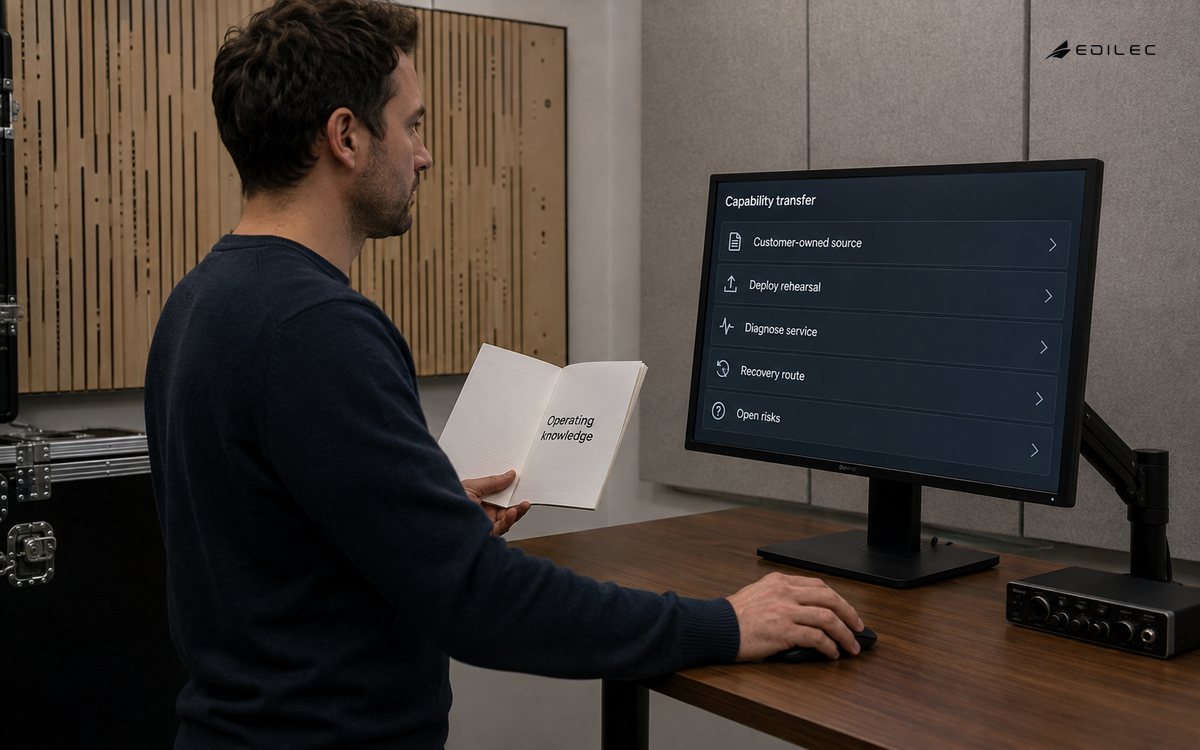
Pair customer and partner roles, rotate review and operational duties, and hold architecture sessions in shared records. Require customer engineers to deploy, investigate and recover representative changes before contract completion. Maintain setup automation and current onboarding documentation. Transfer supplier contacts, licenses, certificates, domains, stores and analytics ownership. Remove vendor access and rotate bootstrap credentials. If a customer cannot operate without retained vendor administrators, handover has not occurred.
Define exit deliverables and assistance in the agreement: source and history, infrastructure definitions, pipelines, environments, test data approach, architecture records, security evidence, incidents, product research, open risks and backlog. Test that another qualified team can build and deploy from the owned repositories. A healthy long-term partnership may continue, but continuation should be a choice based on value rather than the only way to keep the service running.
Key takeaways
- Define the engagement around a customer and service outcome, not supplied roles or output volume.
- Retain product, architecture, security and production authority inside the SaaS company.
- Require secure-development and software-supply-chain evidence in the normal release path.
- Measure customer outcomes, delivery throughput, instability and operability together.
- Prove capability transfer through customer-led deployment, incident and recovery exercises.
Frequently asked questions
Is digital engineering the same as staff augmentation?
Not necessarily. Staff augmentation supplies people under customer direction. A digital engineering engagement may own an outcome across discovery, design, delivery and operations. The contract and operating model should state which model applies rather than relying on the label.
Who should own source code and cloud accounts?
The customer should control production accounts, repositories and critical service registrations, with intellectual-property terms reviewed by counsel. Partners can receive scoped access. This improves continuity, auditability and exit readiness.
How can a buyer assess engineering quality before selection?
Review a small scenario with the proposed working team. Ask for architecture tradeoffs, test strategy, security practices, release evidence, incident learning and handover approach. Concrete examples and artifacts are more useful than tool lists or certifications alone.
Conclusion
Digital engineering services create durable value when they strengthen both the SaaS product and the system that changes it. A partner should help the organization learn from customers, make explicit architecture choices, produce secure releases, observe production and recover safely. Customer ownership of decisions, artifacts and operations keeps that capability available after any particular team or contract changes. That ownership also makes future partners easier to evaluate because the organization can show its real delivery evidence, constraints and improvement priorities.