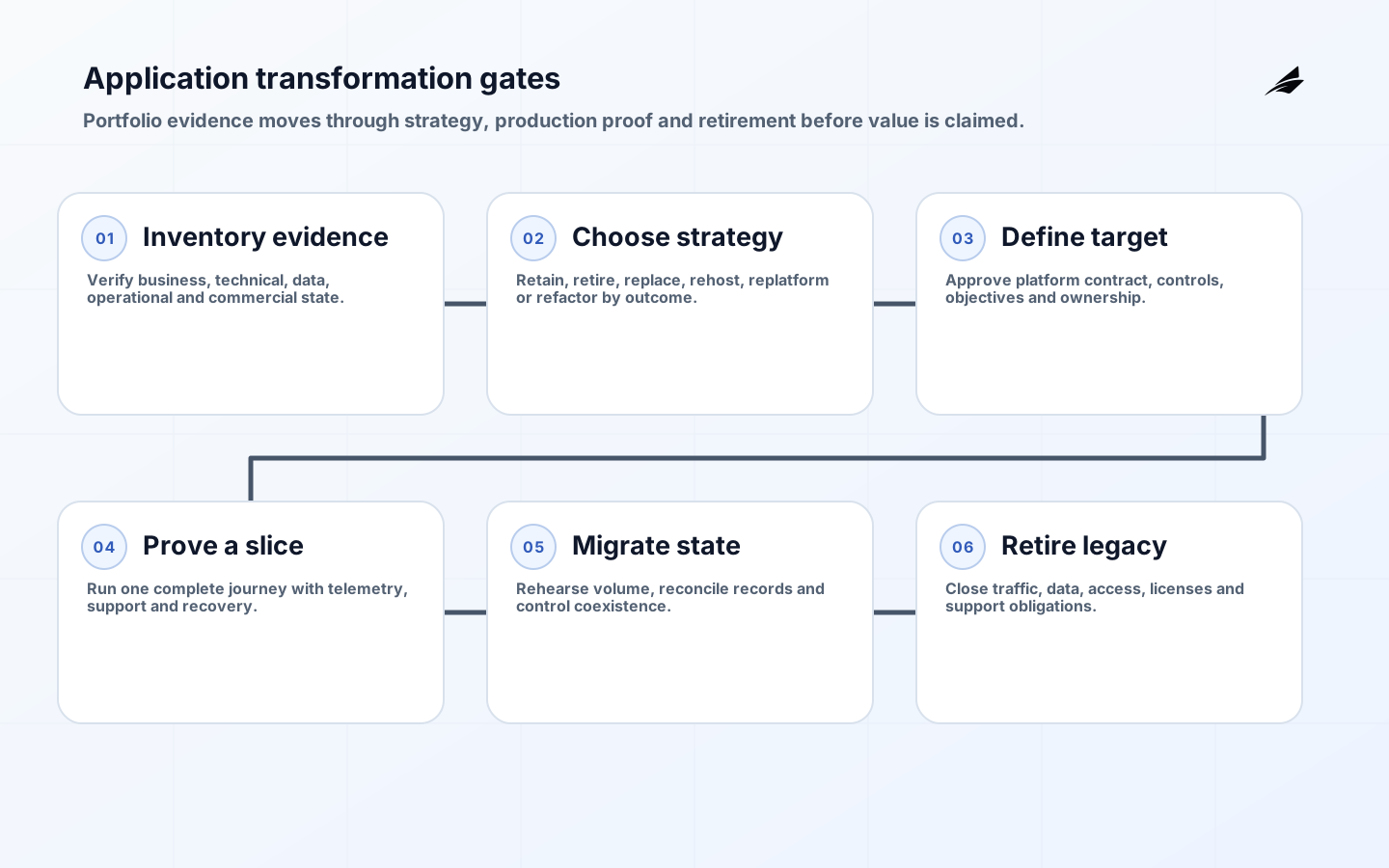
Application transformation services change how a portfolio delivers business outcomes, not simply where its servers run. A useful program may retire, replace, retain, rehost, replatform, refactor or rebuild different applications. The implementation checklist must connect each choice to ownership, user journeys, data, security, reliability, cost and delivery capability. Otherwise a migration can reproduce the same constraints on a newer bill.
Use this checklist with Edilec's application transformation FAQ, application management transition checklist and enterprise application management plan. Microsoft's current App Modernization Guidance treats modernization as a continuing cycle of assessment, planning, execution and maintenance and evaluates business and technical readiness together. The practical implication is that acceptance must prove an operating capability, not a one-time cutover.
1. Approve outcomes, constraints and decision rights
Name the business capabilities in scope, their users, current service commitments and measurable constraints. Baseline lead time for a representative change, incident and recovery performance, support demand, security findings, run cost and dependency risk. Record regulatory, residency, licensing, accessibility and contractual boundaries. Assign one accountable business owner and one technical owner per application. Establish who can approve target strategy, data cutover, risk acceptance and retirement.
- Define a user or operational outcome for every funded wave.
- Set explicit exclusions and stop conditions for the first release.
- Agree how benefit, cost, risk and disruption will be compared.
- Keep architecture, security, data and operations represented in governance.
- Require evidence before moving an application to the next gate.
2. Build an evidence-backed portfolio inventory
Inventory runtime, framework, source repository, deployment route, data stores, interfaces, batch jobs, certificates, secrets, users, owners, support hours, recovery objectives, licenses and supplier dates. Observe production traffic and logs because documentation often misses dependencies. Classify data and record retention. Mark unsupported components, untested recovery, manual release steps and single-person knowledge. Confidence matters: label evidence as observed, owner-confirmed or inferred so uncertainty affects sequence.
| Evidence area | Minimum artifact | Decision supported |
|---|---|---|
| Business | Capability, users and critical periods | Retain, replace or retire |
| Technical | Runtime, code, topology and dependency map | Rehost, replatform or refactor |
| Data | Authority, classification, volume and retention | Migration and control design |
| Operations | Objectives, incidents, runbooks and recovery test | Target resilience and wave risk |
| Delivery | Repository, tests and release path | Transformation capacity |
| Commercial | License, contract and exit terms | Cost and supplier strategy |
3. Select a strategy per application
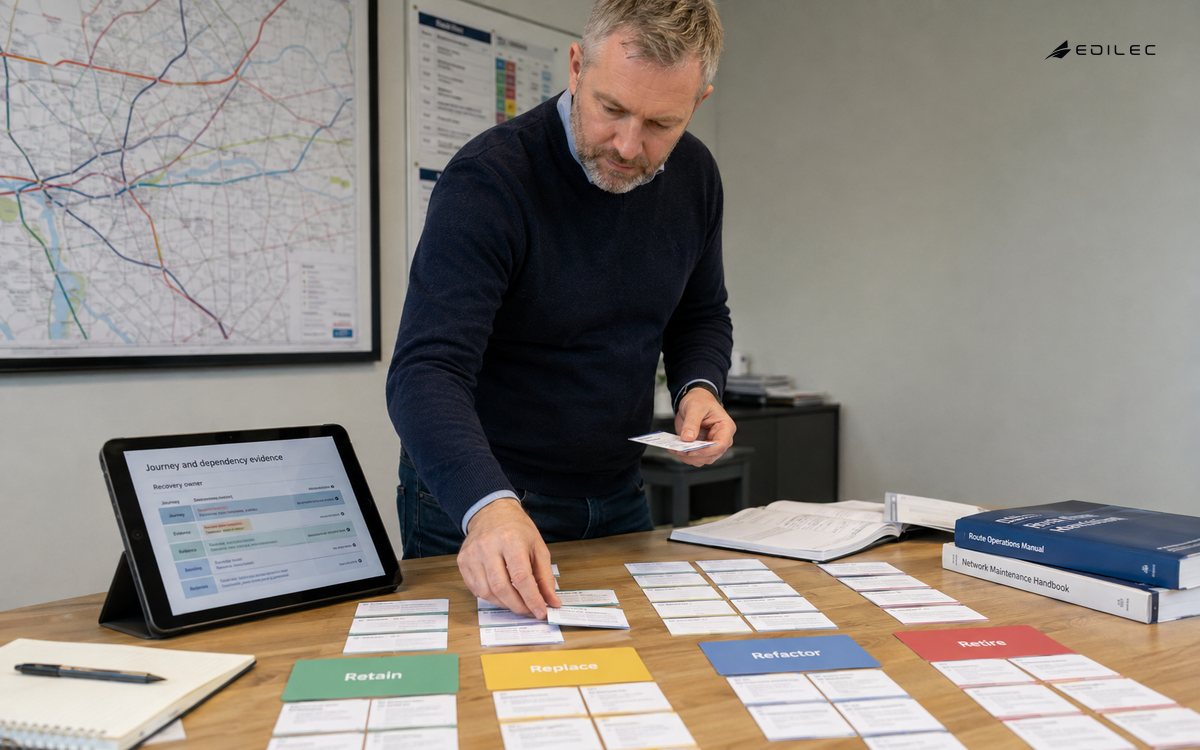
Score options against the approved outcome, not a cloud preference. Rehosting can remove urgent hardware risk but rarely fixes release or architecture constraints. Replatforming adopts managed capabilities with moderate code change. Refactoring changes internals to improve a demonstrated quality. Rebuilding or replacing can simplify a poor fit, but raises migration and change risk. Retaining is valid when constraints are acceptable; retiring is valuable only after users, data and integrations have a safe destination.
Create a short decision record with alternatives, evidence, assumptions, consequences and reversal path. Prototype the riskiest unknown: framework compatibility, latency to a retained system, data conversion or supplier export. Do not require microservices, containers or Kubernetes by default. A modular monolith on a managed platform may be the most operable target for the team that will own it.
4. Define the target architecture and platform contract
Specify identity, network boundaries, runtime, data services, messaging, configuration, secrets, observability, backup, deployment, policy and cost allocation. State which capabilities the platform team provides and which remain with the application team. Use infrastructure as code and versioned configuration so environments can be compared and recovered. Establish service objectives and capacity assumptions from user journeys. Design dependency failure, throttling and regional recovery before production load.
Standardization should remove repeated undifferentiated work without blocking legitimate exceptions. Publish supported templates and a governed exception path. Define how teams request a database, expose an API, rotate a secret, create an alert and restore data. Include ownership and lifecycle for every shared component; a landing zone with no operating owner simply moves ambiguity into the platform.
5. Plan data migration and coexistence
Profile source data for completeness, duplicates, invalid values, volume and change rate. Map identifiers, semantics and retention, then define transformation rules with business owners. Choose cutover, phased migration, replication or coexistence from downtime and consistency needs. Rehearse full volume, measure duration and compare counts, checksums, financial totals and sampled records. Protect data in temporary stores and remove migration access after completion.
Rollback is a business-state problem. Once both versions accept writes or invoke external actions, restoring a database may not undo messages, emails or payments. Define a system of record for every phase, make repeated commands idempotent and decide how changes are reconciled. Set a point after which roll-forward is safer than rollback, and give one owner authority to call it.
6. Integrate security and supply-chain controls
Use NIST SSDF practices across the transformed delivery route: protect repositories and build systems, define secure requirements, review components, verify releases and respond to vulnerabilities. Threat-model new trust boundaries and migration tooling. Apply server-side authorization and secret management. Generate a dependency inventory, pin and update components through review, scan artifacts and sign where the operating environment can verify provenance. Use OWASP ASVS to select testable application controls proportional to risk.
7. Deliver a complete production slice
Choose one coherent user journey with its data, integration, security, telemetry, support and recovery. Build it through the target release path and run it under realistic load. Parallel operation can compare outcomes, but define how discrepancies are resolved and avoid asking staff to maintain two records indefinitely. Use feature controls for exposure, not as a substitute for data compatibility. Capture deployment and rollback time during rehearsal.
| Gate | Required evidence | Reject when |
|---|---|---|
| Ready | Owners, inventory and baseline approved | Critical dependency is unknown |
| Design | Strategy and target contracts reviewed | Choice rests on unsupported assumption |
| Build | Tests, telemetry and runbooks travel with code | Manual production steps are unowned |
| Migrate | Full-volume rehearsal reconciles | Loss or duration exceeds threshold |
| Release | Bounded users meet outcome and guardrails | Errors or support load breach limit |
| Retire | Traffic, data, access and obligations closed | Unknown consumers remain |
8. Accept operations and retire the old state
Require dashboards, alerts, runbooks, on-call ownership, backup restoration, incident roles, vulnerability handling, capacity review and cost reporting. Correlate logs, metrics and traces using stable service and request context. Run a failure exercise with the receiving team. Track DORA delivery measures at the team and service boundary while also tracking user outcome and reliability; activity counts or migration percentage do not prove improvement.
Retirement needs a checklist of routes, jobs, integrations, data, licenses, domains, certificates, credentials, backups, records obligations and support communications. Monitor for residual use before shutdown. Archive only what must be retained, document how it can be retrieved and revoke privileged access. Confirm financial savings after contracts and duplicate capacity actually end.
Govern waves as a portfolio learning system
Maintain a decision register across applications so teams can reuse proven patterns and see failed assumptions. Review dependency maps after each wave because retiring one system may change another's criticality. Track benefits only after duplicate environments, licenses and support paths close. Separate transformation cost from steady-state run cost and compare both with the approved case.
Protect team capacity. Transformation creates simultaneous current-service support, migration, platform learning and stakeholder change. Set work-in-progress limits and avoid starting more waves than data, security and operations specialists can review. Measure approval queues and handoff delay; a portfolio can appear active while every application waits for the same scarce expertise.
After production stabilizes, compare user outcomes, delivery, incidents, vulnerabilities, cost and operator toil with baseline. Decide whether the strategy and platform pattern should be reused, changed or stopped. Publish that decision to the next wave so the program becomes progressively more predictable rather than a collection of isolated migrations.
Key takeaways
- Base each modernization choice on evidence and a named outcome.
- Inventory runtime, data, dependencies, operations and commercial constraints together.
- Treat migration, coexistence and retirement as controlled business-state changes.
- Deliver security, observability, support and recovery with the first production slice.
- Accept transformed applications only when the receiving team can operate and change them.
Frequently asked questions
Does application transformation require cloud migration?
No. Cloud services may reduce infrastructure work or enable new capabilities, but transformation can also improve architecture, delivery, security and operations on premises or in hybrid environments. Select placement from service, data, latency, risk, skill and cost evidence.
Which application should be transformed first?
Choose a meaningful but bounded application that exercises target capabilities without combining every portfolio risk. It should have an engaged owner, observable baseline, manageable dependencies and enough value to test the operating model. Avoid choosing only the easiest demo or the most critical uncharted system.
When is a transformation complete?
When the outcome is observed, production controls pass, ownership is transferred, migration is reconciled and obsolete technology is retired or deliberately retained. A code deployment or cloud cutover is an intermediate milestone, not completion.
Use a ninety-day value checkpoint
Ninety days after a wave, verify that users follow the intended route, the receiving team releases without specialist rescue, service objectives hold and planned legacy cost has ended. Reopen assumptions where support or cloud cost shifted rather than fell. Close remaining temporary access and migration infrastructure, then update portfolio evidence before funding the next wave.
Conclusion
Application transformation is a sequence of evidence-backed portfolio and production decisions. Inventory before choosing, modernize through complete slices, rehearse state change and require operational acceptance. The resulting estate should be easier to secure, recover and change, with old cost and risk genuinely removed rather than hidden behind a new platform.