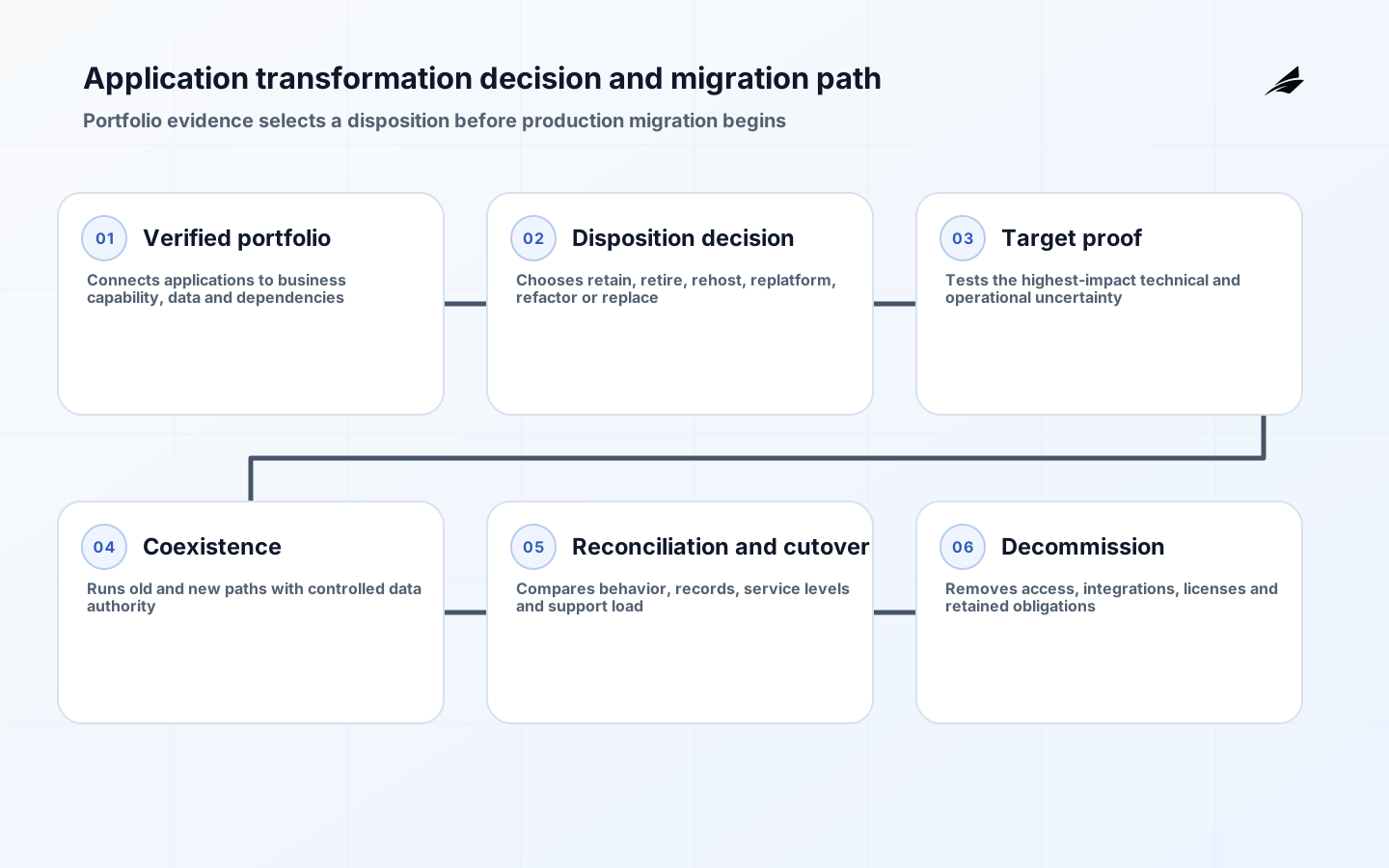
Application transformation changes how a business capability is delivered and how its software can evolve. It may retire duplicate systems, repair a difficult core, replace a package, expose stable interfaces, improve data ownership, automate delivery or move workloads. Cloud hosting can be part of the work, but relocation alone does not resolve brittle releases, unclear records or unsupported code. A useful service connects portfolio decisions, product outcomes, architecture, security, operations and organizational change.
The unit of planning should be a business service and its dependencies, not an application name in an inventory. A customer statement service may depend on a portal, batch jobs, templates, identity, a document archive, finance records and an external delivery provider. Transforming only the portal can leave the real constraints untouched. Trace representative transactions and failure paths before selecting a target. This prevents teams from prescribing containers, microservices or a rewrite before understanding the problem.
Key takeaways
- Rationalize the portfolio before funding modernization; retirement can create more value than rebuilding.
- Choose retain, retire, rehost, replatform, refactor, replace or reimagine per application and capability.
- Separate business behavior from technical movement with characterization tests and reconciliation.
- Modernize the delivery and operating model along with the runtime.
- Use coexistence, progressive traffic and rollback to make migration evidence-driven.
- Decommission only after data, access, integrations, support and financial obligations are closed.
Build a trustworthy portfolio baseline
Create an inventory with business owner, technical owner, users, criticality, lifecycle, technology, environments, data, integrations, suppliers, cost, incidents, recovery objectives and applicable obligations. Validate it against network flows, identity records, repositories, invoices, schedulers and operational knowledge. Portfolios often omit end-user tools, file transfers and manual reconciliations that carry critical work. Mark confidence and last verification so uncertain inventory does not masquerade as fact.
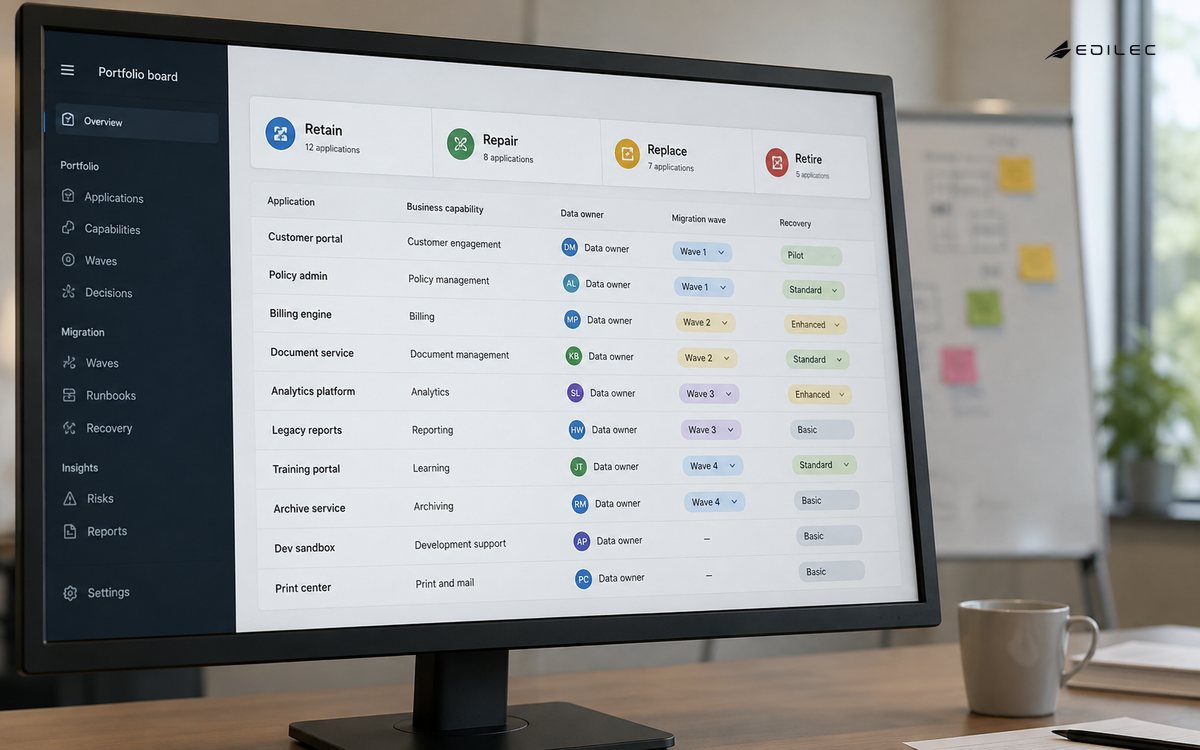
Group applications by business capability and dependency, then assess value, health, risk and change feasibility. Value includes strategic differentiation, user need and obligation. Health includes maintainability, security, reliability and supportability. Feasibility includes data condition, integration coupling, vendor constraints, skills and cutover options. Do not turn the score into an automatic answer; use it to expose assumptions and select investigation. A low-value, high-risk application is a retirement candidate only when its consumers and records can be handled.
| Disposition | Meaning | Evidence required | Common trap |
|---|---|---|---|
| Retain | Keep with bounded maintenance | Supported lifecycle and accepted risk | Ignoring accumulating constraints |
| Retire | Remove capability or consolidate elsewhere | Consumer, data and obligation closure plan | Turning off the visible UI only |
| Rehost | Move with minimal application change | Target compatibility and operational benefit | Calling relocation modernization |
| Replatform | Change managed runtime or major component | Behavior, performance and support tests | Underestimating platform semantics |
| Refactor | Change internal design while preserving purpose | Characterization tests and incremental boundary | Unbounded rewrite by another name |
| Replace or reimagine | Adopt a product or redesign the capability | Fit, migration, operating and exit evidence | Reproducing every legacy behavior |
Define target outcomes and architecture constraints
For each modernization wave, state the business and engineering outcomes. Examples include removing an unsupported runtime, shortening a controlled release, recovering within an agreed target, reducing manual reconciliation or enabling a new channel without duplicate logic. Set guardrails for data residency, security, latency, availability, accessibility, interoperability and cost. These constraints allow teams to compare target options. A target architecture drawing without measurable behavior is not an acceptance model.
Prefer the smallest architectural change that resolves the limiting constraint. A modular monolith with a reliable pipeline can outperform a premature service decomposition. Extract a service when ownership, scaling, release independence or fault containment justifies the network and data complexity. The Twelve-Factor methodology offers useful ideas such as explicit dependencies, environment configuration and disposable processes, but transformation should apply patterns according to workload needs rather than treating them as certification criteria.
Treat data and integration as the migration spine
Identify authoritative records, derived copies, keys, ownership, quality rules, retention and reconciliation. Decide whether data moves once, synchronizes during coexistence, or remains behind a stable interface. Dual writes are difficult because partial success creates divergent truth; prefer one authoritative writer with change data capture, events or controlled replication where possible. Define conflict handling and a cutoff. Every migration needs counts, control totals and business-level comparisons, not only a successful import log.
Catalog synchronous APIs, messages, files, database access, batch schedules and human handoffs. Replace undocumented direct access with owned contracts incrementally. Consumers need version policy, test environments and change notice. When introducing an anti-corruption layer around a legacy system, keep its purpose and retirement trigger clear; otherwise the layer becomes permanent complexity. Test timeout, duplicate, ordering and retry behavior because transformation often changes timing even when business data appears identical.
| Migration concern | Control | Evidence at gate |
|---|---|---|
| Behavioral parity | Characterization and contract tests | Required cases pass; differences approved |
| Data integrity | Profiling, mapping and reconciliation | Counts and business totals balance |
| Security | Threat model, access review and protected pipeline | Findings resolved or accepted by owner |
| Performance | Representative load and dependency tests | Service objectives hold with headroom |
| Recoverability | Backup, restore and rollback rehearsal | Timed exercise meets agreed objectives |
| Operations | Dashboards, alerts, runbooks and trained support | Simulation completed under production access |
Modernize secure delivery and operations
A transformed runtime with a manual, fragile release process remains difficult to change. Establish version control, repeatable environments, automated build and test, artifact integrity, dependency visibility, deployment automation, secrets management and production telemetry. NIST SSDF practices should be translated into workflow and evidence appropriate to risk. DORA's continuous delivery guidance emphasizes keeping software deployable with fast feedback, comprehensive testing, security and observability. Measure the complete value stream, including approvals and waiting.
Operational design includes service objectives, ownership, on-call or support coverage, capacity, incident response, backup, restore and disaster recovery. Instrument business transactions as well as infrastructure. A migration may produce healthy servers while silently delaying orders. Run game days for dependency loss, credential failure, queue backlog and rollback. Ensure responders can use production permissions and current instructions. Operational acceptance belongs before traffic, not in a post-launch backlog.
Sequence investment around uncertainty
Estimate by wave and cost category: assessment, remediation, target platform, application work, data migration, testing, assurance, licenses, consumption, internal staff, training, parallel run and retirement. Include temporary environments and duplicated services. Use ranges linked to assumptions such as interface count, test coverage and data quality. A proof should target the uncertainty with the largest impact on feasibility or cost, not the easiest demo. Re-estimate after discovery and rehearsal.
Order waves to build capability while limiting correlated risk. A representative but noncritical application can prove the platform and operating model. Next waves should share patterns without overloading the same experts. Avoid modernizing tightly coupled systems independently when coexistence would be more complex than a coordinated move. Maintain a portfolio view of vendor deadlines, certificate changes, data-center exits and business peaks. Capacity for unplanned remediation and support must remain visible.
Cut over progressively and finish retirement
Use shadow reads, parallel calculations, controlled cohorts, canary traffic or branch-by-abstraction according to the workflow. Define promotion and stop thresholds for correctness, latency, errors, support demand and operational load. Rollback must account for data written after cutover; rehearse it with realistic timing. Communicate changed workflows and support paths. Keep a decision log when teams accept temporary coexistence or risk, including owner and expiry.
Decommissioning is a release with its own acceptance criteria. Remove traffic, jobs, credentials, firewall rules, integrations, licenses, monitoring and privileged access. Archive or delete records according to obligations and prove that consumers no longer depend on the system. Update inventories, continuity plans, lineage and financial forecasts. Leaving a dormant server or database available preserves attack surface and operating cost while eroding knowledge about why it exists.
Frequently asked questions
What is the difference between modernization and migration?
Migration moves a workload, platform or data. Modernization changes qualities such as maintainability, delivery, scalability or user capability. They can occur together, but a rehost is mainly migration. State the intended outcome so movement is not credited with benefits it does not produce.
When is a rewrite justified?
A rewrite may fit when the current design cannot support the required capability and incremental options are demonstrably worse. It still needs bounded scope, behavior and data evidence, coexistence and rollback. Rewrites are especially risky when rules are undocumented or the old system remains the only specification.
How should transformation success be measured?
Combine business results, user behavior, delivery performance, reliability, security, operating effort and portfolio reduction. Compare with a baseline and include retirement. Code moved, services created and workloads hosted are activities; they do not alone prove a better business capability.
Portfolio governance should track benefits after each wave. Revisit the baseline, operating cost, incident pattern, release effort and user result after stabilization. Where benefits do not appear, identify whether the constraint moved to another dependency, adoption failed or the chosen disposition was wrong. Feed that evidence into later sequencing instead of defending the original roadmap. Transformation is a portfolio learning system: stopping, rescoping or retiring an initiative can be a sound outcome when evidence changes the investment case. Publish unresolved dependencies and benefit owners so later portfolio reviews can distinguish a delayed result from an unsupported claim.
Conclusion
Application transformation becomes manageable when it starts with a verified portfolio and ends with retired obligations, not merely a new runtime. Rationalize each capability, choose the least disruptive disposition that achieves the required outcome, and make data and contracts explicit. Improve secure delivery and operations as part of the product. Migrate through observable, reversible waves and reconcile behavior before promotion. This approach turns modernization from a technology campaign into disciplined renewal of the systems the business actually depends on.