This AI modernization services FAQ explains what must change before an established application can use AI safely and usefully. Modernization is not a blanket instruction to move everything to a new stack. It is a sequence of business, data, software and operating decisions that removes the constraints blocking a defined outcome. For one system that may mean exposing a governed API; for another it may mean replacing an unsupported platform, separating a fragile workflow, improving records or deciding that AI adds no defensible value.
Start with the AI modernization scope and delivery plan and use the companion implementation checklist to turn answers into evidence. The questions below help product, architecture, data, security, finance and operations leaders avoid two costly extremes: forcing AI into an unsuitable legacy process or rebuilding a functioning system without a measurable reason.
What counts as AI application modernization?
AI application modernization changes the minimum set of capabilities needed to deliver and operate a specific AI-enabled workflow. Common work includes service interfaces, event capture, identity boundaries, data lineage, evaluation environments, deployment automation, observability, user review and fallback behavior. The AI component may classify, forecast, retrieve, recommend or generate; its presence does not make every surrounding component an AI system, but it does create new dependencies and evidence needs.
Distinguish modernization from migration. Rehosting can change where software runs without improving modularity, data quality or release safety. Refactoring can improve code without resolving unclear ownership. Replacing a system can remove technical debt but introduce process and supplier risk. The correct strategy is the one that improves the target outcome while meeting service, security and compliance constraints. Microsoft's modernization planning guidance similarly presents replatform, refactor and rearchitect as choices with different complexity and value, not a maturity ladder every workload must climb.
How do we know whether a legacy system is ready?
Readiness begins with a representative transaction. Trace the user intent, source records, transformations, decision points, interfaces, failure paths and final system of record. Identify whether data can be used for the proposed purpose, whether events are timestamped consistently, whether outcomes can be observed and whether a safe fallback exists. Review runtime support, release frequency, test coverage, recovery history, identity design, secrets, network paths, license constraints and specialist dependencies. A static architecture diagram rarely exposes enough evidence.
Then define the AI-specific gap. A retrieval assistant may need authoritative documents, entitlement-aware search and citation checks; a forecast may need stable historical definitions and delayed outcome labels; an agent may need narrowly scoped tools, transaction limits and approval gates. Do not create a generic readiness score that hides blockers. Record each gap with impact, owner, remediation option and the event that would make the use case unviable.
| Readiness area | Evidence question | Possible modernization action |
|---|---|---|
| Business process | Is the decision, owner and acceptable fallback explicit? | Simplify the workflow and define escalation |
| Data | Are authority, rights, quality, lineage and retention known? | Create governed products and quality controls |
| Application | Can the required capability be changed and tested independently? | Introduce a stable interface or isolate a component |
| Security | Can human and machine access be scoped and audited? | Redesign identities, secrets and authorization |
| Delivery | Can versions move through repeatable evaluation and rollback? | Automate build, test, release and evidence capture |
| Operations | Can teams detect bad behavior and restore the service? | Add telemetry, runbooks, fallback and drills |
Must the data platform be rebuilt first?
Usually not. A broad data-platform program can delay learning and still fail to supply the semantics one use case needs. Build a thin, governed path for representative data: identify the authoritative source, define fields and permitted uses, measure completeness and timeliness, preserve lineage, and establish access and deletion behavior. Use the pilot to expose reusable capabilities, then expand them deliberately. This approach avoids both a disposable prototype and an open-ended platform prerequisite.
Some foundations are non-negotiable. If the organization cannot identify sensitive records, enforce entitlement, reproduce an evaluation dataset or determine which output version affected a decision, high-impact deployment should wait. Data quality also needs business interpretation. A field can be syntactically complete yet unsuitable because teams changed its meaning, operational incentives distorted entry, or historical decisions embed inequity. Include domain owners and affected users in readiness and evaluation work.
Which architecture pattern should we choose?
Choose from the workflow backward. A synchronous recommendation in a customer transaction has different latency and availability needs from overnight document triage. Decide where inference occurs, which data crosses boundaries, how context is retrieved, where policy is enforced, what is logged and what happens when the model, network or upstream record is unavailable. Keep authoritative business rules outside opaque prompts where practical, and separate irreversible actions from generation so they can receive stronger validation and authorization.
Use contracts around unstable dependencies. Version prompts, schemas, model configuration, evaluation suites and tool permissions. Build provider adapters only where portability has a credible benefit; abstracting every feature can erase the capability that justified a provider. The architecture record should state accepted coupling, exit requirements and the evidence needed for a provider or model change. It should also identify which team owns each component in production, including the fallback path.
How are AI risk and software security integrated?
Combine AI risk with the existing product and software lifecycle instead of creating an isolated ethics review. The NIST AI Risk Management Framework provides outcomes for governance, context mapping, measurement and treatment. Translate those outcomes into architecture decisions, evaluation cases, release gates, monitoring and incident procedures proportionate to impact. Name affected groups, foreseeable misuse, uncertainty, human authority and conditions under which the system must abstain or stop.
The surrounding software remains a primary attack and failure surface. Apply the NIST Secure Software Development Framework to repositories, dependencies, build environments, artifacts and vulnerability response. Threat-model prompt and tool injection, data poisoning, excessive agency, secret exposure, insecure output handling and cross-tenant leakage where relevant. Secure design also means reducing privileges and transaction scope so an incorrect output cannot immediately become an expensive or harmful action.
Follow a six-stage AI modernization roadmap
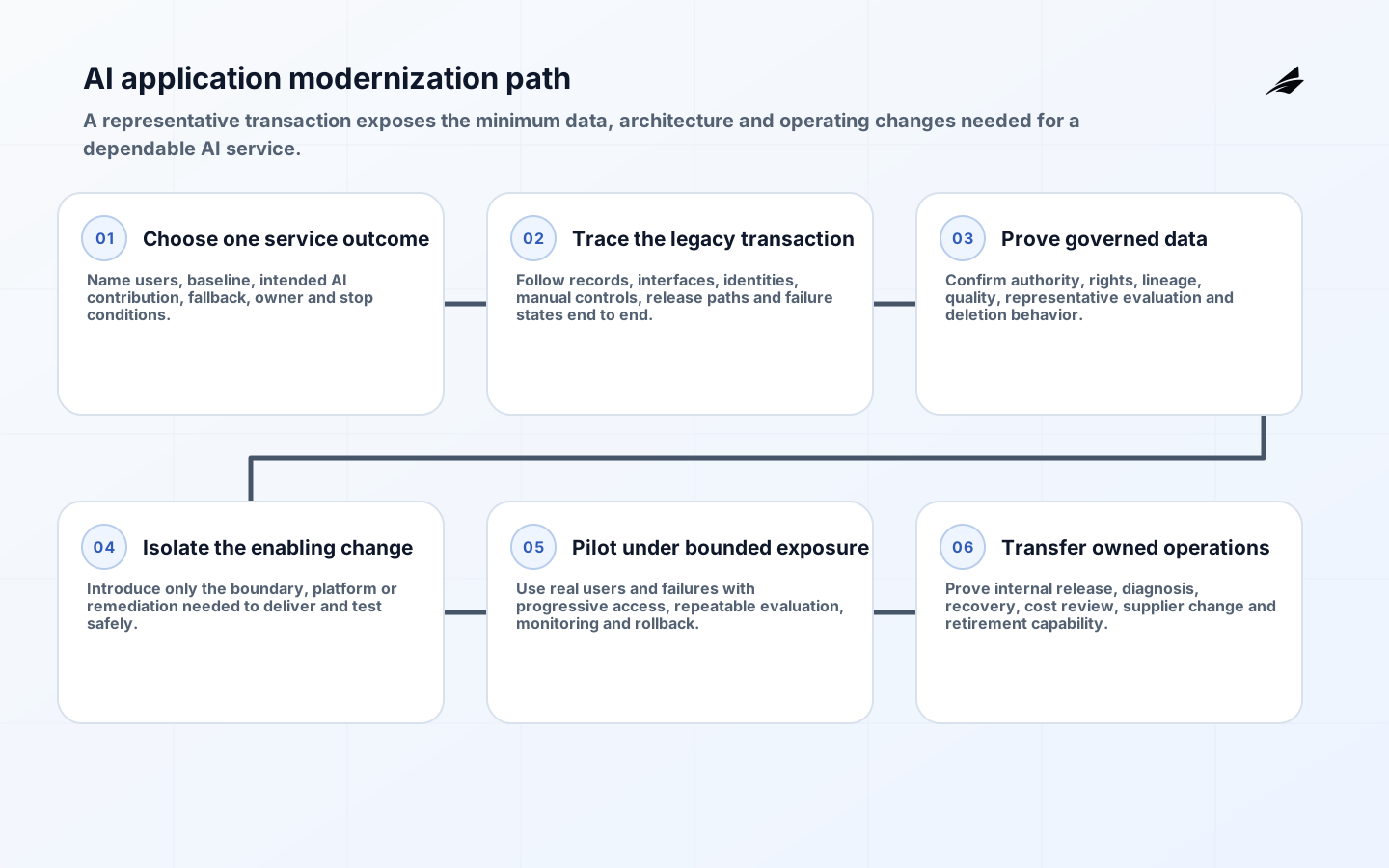
A practical sequence starts with one measurable service outcome, traces the current transaction, proves the data and control path, isolates the minimum architecture change, pilots under bounded exposure, and scales only after operational acceptance. Each stage ends with evidence. The pilot should use representative users and failure conditions, not a curated demonstration. Its purpose is to retire the largest uncertainties about value, safety, integration and operating effort.

Release design matters early. DORA's continuous-delivery guidance emphasizes keeping software deployable through version control, automated testing, fast feedback and low-risk releases. For AI, add reproducible evaluation, model and data version capture, threshold comparison, canary or shadow options and a tested rollback. Progressive exposure lets the team learn without granting every user, workflow or action the same risk on day one.
What should an AI modernization estimate include?
Estimate discovery, legacy remediation, integration, data work, model or API consumption, evaluation, security, privacy, environments, observability, change management, support, supplier commitments and parallel operation. Include the work of domain experts who label cases, define acceptance and review output. Model scenarios for demand, context size, retries, human escalation and provider price change. A precise monthly inference estimate is misleading if no one has measured the volume and verification path of a successful business transaction.
Tie cost to a unit the business recognizes. The FinOps Framework treats technology value as a collaboration among engineering, finance and business roles. Report cost per reviewed claim, resolved request, accepted recommendation or other completed outcome, with quality and risk beside it. Track temporary overlap separately so leaders can see whether old systems and contracts are actually retiring. Benefits need the same discipline: compare with a baseline and avoid counting theoretical time twice.
| Estimate component | Common omission | Planning evidence |
|---|---|---|
| Legacy change | Interfaces, licenses and scarce specialist time | Dependency map and effort ranges |
| Data | Rights review, curation, lineage and deletion | Representative pipeline and owner |
| AI service | Retries, context, evaluation traffic and growth | Scenario-based unit consumption |
| Assurance | Red-team, privacy, legal and domain review | Risk-tier review plan |
| Operations | Monitoring, incidents, revalidation and support | On-call model and runbook exercises |
| Transition | Parallel systems, training and retirement | Dated cutover and decommission plan |
Who owns the modernized service after launch?
A business product owner remains accountable for outcome and acceptable use. A technical service owner manages reliability and change. Data owners govern source meaning and rights; security and privacy roles oversee their domains; model or AI specialists maintain evaluation; and frontline teams provide operating feedback. Suppliers own contracted components, not the customer's accountability. Write decision rights for release, threshold change, incident severity, emergency disablement and risk acceptance.
Operational acceptance should require the internal team to deploy a change, investigate a bad output, trace the relevant data and version, fail over or degrade safely, revoke a machine identity, restore records and explain the service bill. Training attendance and transferred documents are inputs, not proof. Keep a service catalog entry, architecture and data-flow record, evaluation history, known limitations, runbooks, supplier contacts, retention rules and retirement path current.
AI modernization takeaways
- Modernize the constraints blocking a defined outcome, not the whole estate by default.
- Trace a representative transaction before selecting a target architecture.
- Build a thin governed data path and expand reusable foundations from evidence.
- Integrate AI evaluation with secure software delivery and operational gates.
- Estimate human assurance, transition and recurring change costs.
- Scale only after internal teams can operate, recover and govern the service.
Frequently asked questions
Do we need microservices before using AI? No. A stable boundary and safe change path matter more than a fashionable topology. Should we move to cloud first? Only when cloud capabilities solve identified constraints and the organization can govern the resulting service. Can a vendor modernize the system without business involvement? No; process meaning, acceptable outcomes and data authority require business owners. Must all legacy data be migrated? No. Migrate or expose only what the use case, retention duties and continuity plan require.
How long does modernization take? Estimate by dependencies and evidence gates, not application count; a bounded workflow may progress in weeks while a regulated core transaction can take many months. Is generative AI always the target? No. Rules, search, conventional analytics or simpler machine learning may be more reliable and economical. What is the strongest pilot? One with representative data, real users, a controlled comparison, bounded consequences, observable outcomes and a credible route to production operations.
Conclusion
AI modernization succeeds when a team changes only what is needed to produce a measurable, governable service. Begin with the transaction and its users, prove data authority, reduce architectural and security constraints, and deliver through repeatable evaluation and release controls. Make full operating cost and ownership visible before scaling. The result is not simply newer technology; it is a service the organization can change, challenge, recover and retire with confidence.