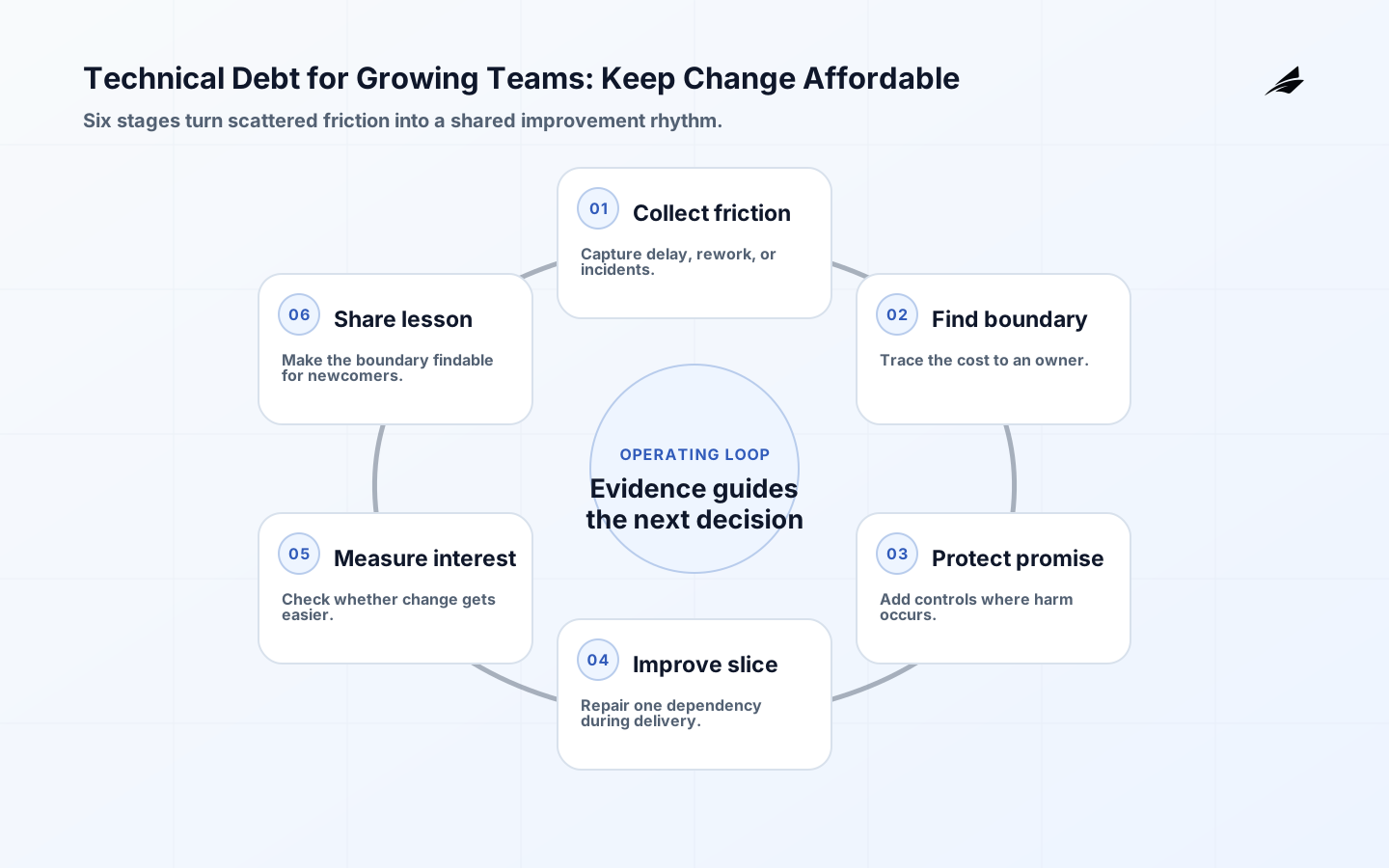
Growing teams feel technical debt as a coordination problem before they feel it as a code problem. A shortcut that one person could hold in memory becomes a dependency another team cannot safely change. An API whose behavior was obvious to three engineers becomes a contract for product, support, analytics, and partners. A manual recovery step that happened once becomes a weekly interruption. The practical task is to make these costs visible without stopping delivery or turning every trade-off into a referendum on the past.
Treat debt as a shared operating signal. Collect one concrete example of delay, rework, incident impact, or manual work; trace it to the boundary that created it; and choose a small improvement that can be verified during normal delivery. The software modernization field guide helps with larger legacy constraints, while the code review field guide helps make design knowledge distributable. This article focuses on the team habits that keep debt from becoming tribal knowledge as headcount and service surface grow.
Create a team language for debt and interest
Use a small vocabulary that connects an implementation decision to a consequence. A debt item should state the affected capability, the shortcut or missing boundary, the recurring interest, the owner, and the next trigger. Interest can be slower change, extra review, support work, incident risk, security exposure, or a limit on product options. Avoid entries such as “refactor the service” or “clean up the backend”; they describe activity without explaining what will improve. A clear record lets a new teammate understand why the work matters without asking the person who made the original choice.
Separate deliberate debt from accidental degradation. A team may accept a narrow API for a pilot while it learns the domain, provided it names the consumer and compatibility plan. It may inherit an undocumented coupling that nobody chose. Both can create cost, but the response differs: deliberate debt needs a repayment trigger; accidental debt needs discovery, ownership, and sometimes a safety control first. The SEI notes that architectural debt is often missed by code-only analysis. Team language should include design, integration, operations, and organizational boundaries, not just lint findings.
| Debt note | Good question | Example evidence |
|---|---|---|
| Capability | Which user or operator outcome is affected? | Approval workflow or release path |
| Interest | What repeats because the boundary is weak? | Extra days, incidents, or manual tickets |
| Owner | Who can change the boundary safely? | Service team and domain partner |
| Control | What limits harm while debt remains? | Rate limit, audit, compatibility test |
| Trigger | What event makes repayment worthwhile? | Second consumer or new compliance need |
Collect friction from the people who pay it
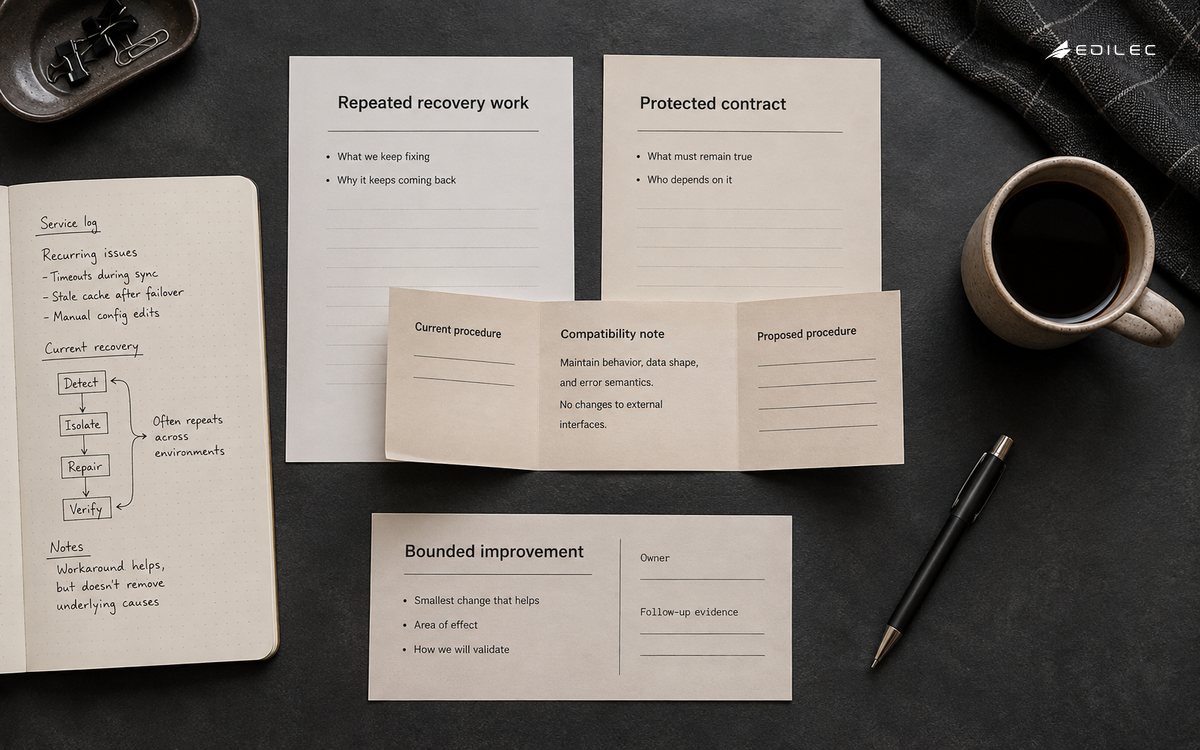
A debt backlog is strongest when it begins with observed work. Ask developers where changes require surprising coordination, operators which manual steps repeat, support which incidents are hard to explain, and product which promises are blocked by system behavior. Capture the cost in a lightweight unit: elapsed delivery days, hands-on minutes, number of teams, escaped defects, rollback frequency, or time to restore. Do not require perfect measurement before recording an issue. A consistent imperfect signal is more useful than an unrepeatable story that appears only during planning.
Google SRE’s toil guidance helps distinguish repeated operational work from work that creates a lasting improvement. A manual restart that happens once during a novel migration is not the same as a weekly restart that scales with customer count. The team can tolerate a small amount of toil, but it should set a ceiling or review it when the service grows. When automation is proposed, compare time saved with build and maintenance effort; otherwise the fix may become a new source of toil.
For an API team, collect examples such as clients depending on undocumented status codes, every new field requiring a coordinated release, or a tenant-specific exception that lives in a support runbook. For an operations team, collect repeated manual data repair, ambiguous alerts, and deployments that require one person to remember a hidden order. These examples are distinct symptoms of the same debt: a boundary or contract is not carrying enough of the system’s meaning.
| Evidence source | Signal to collect | Decision it informs |
|---|---|---|
| Developers | Change lead time and coordination count. | Where a boundary is expensive to evolve. |
| Operators | Manual steps and repeat interventions. | Which toil can be engineered away. |
| Support | Unexplained states and workaround volume. | Where product contracts need clearer recovery. |
| Security | Findings, exceptions, and patch difficulty. | Which debt has a shorter tolerance. |
| Product | Blocked options or delayed commitments. | Which debt affects future value. |
Protect the contracts that more teams now depend on
Growth increases the number of consumers that can be surprised by a change. HTTP Semantics provides a foundation: methods, status codes, representation metadata, and caching behavior carry meaning that clients may rely on. An endpoint can be valid yet still be a poor contract if its error shape, idempotency, pagination, or authorization behavior is undocumented. Review the contract when a second consumer appears, not after a breaking change reaches production. The API versioning field guide can help decide which compatibility promise the team is ready to support.
The same rule applies to events, schemas, packages, and support actions. Name the producer and consumer, the stable fields, the failure behavior, and the deprecation route. Keep private implementation details out of public contracts, and use tests that exercise real consumer expectations. A contract is debt-resistant when its owner can see who depends on it and when a change can be made without opening every repository or service. This is a socio-technical boundary: code and team responsibility must agree.
Use controls that scale with the consequence
Not all debt deserves the same control. A cosmetic module naming issue may wait; an authorization shortcut, unbounded API request, unsupported dependency, or missing restore test needs a stronger response. Use a risk table that names impact, likelihood, current control, owner, and next decision. OWASP API Security Risks covers object and function authorization, inventory, resource consumption, and unsafe external API use. NIST’s SSDF gives a lifecycle vocabulary for keeping security decisions out of the last-minute release path.
Controls should be close to the failure. Enforce authorization where the resource changes, validate schemas at the boundary, cap expensive queries, pin dependencies, require review for sensitive paths, and log decisions with enough context for investigation. Do not make the control depend on one expert remembering a rule. If a temporary exception is necessary, scope it to a tenant, route, or time window and attach an expiry. The GraphQL trade-offs guide offers a related example: flexible access requires explicit field ownership and query-cost limits, not only a central login check.
Repay debt through changes the team already needs
Make the next feature do a little boundary repair. Extract one decision from a shared controller, introduce a versioned adapter, split a schema read from a write, or add a service-owned repository while the capability is already changing. Keep the slice small enough to verify with real behavior. Attach cleanup and compatibility work to the change so the repair does not leave a half-migrated path without an owner. If the debt is too broad for a feature, create a narrow milestone with a user or operational outcome and a clear stop condition.
Use staged migration when the old path is risky to replace. Add the new path, compare results, route a bounded cohort, reconcile differences, and remove the old path only when evidence meets the agreed threshold. A “temporary” dual write can create more debt if no one monitors divergence. Track which records have moved and what happens when a migration is interrupted. A growing team benefits from explicit transitional architecture because it turns a risky big-bang change into a series of choices that new teammates can inspect and continue.
- Attach repayment to a capability that is already changing.
- Introduce one seam or contract at a time.
- Keep migration and compatibility evidence alongside the code.
- Use cohorts, comparisons, and reconciliation before broad cutover.
- Give temporary paths an owner, expiry, and removal condition.
Create a repeatable debt review rhythm
Set aside a short review cadence rather than waiting for a quarterly rewrite campaign. Bring one or two entries with evidence, decide whether to leave, control, slice, or escalate them, and record the reason. Include someone who experiences the cost and someone who can change the boundary. Retire entries that no longer matter and merge duplicates. The meeting should not become a status report; its purpose is to make a trade-off and preserve the reasoning for the people who were not in the room.
Make debt visible in planning without making it a second product backlog. A roadmap item can include a debt-reduction acceptance criterion. A service review can include manual intervention and change lead time. An incident review can create a debt item only when the recurring cause is an internal constraint, not simply because a bug occurred. This keeps the concept connected to work and stops teams from competing over a count of tickets that says little about the actual interest rate.
Share the boundary knowledge as the team changes
A growing team pays debt when knowledge is private. Put the decision record, contract, owner, tests, and runbook where a new engineer or operator can find them. During onboarding, walk through one real failure and the recovery path rather than presenting only the architecture diagram. Review whether the team can describe why a boundary exists, what it guarantees, and what breaks when it changes. SEI debt analysis reinforces the value of evidence across design, integration, operations, and organizational boundaries. Documentation is not a substitute for enforcement, but it makes enforcement explainable and reduces repeated shortcuts.
Use code review as a knowledge transfer mechanism. Google’s review guidance asks whether a change is understandable, appropriately designed, tested, documented, and maintainable. Apply those questions to debt repairs and to new code near a known boundary. A reviewer should be able to ask what future change this structure makes easier, what behavior remains compatible, and how an operator will detect a partial failure. Over time, that language creates a team that can improve the system while delivering product work instead of waiting for a mythical cleanup sprint.
Measure whether the team is buying back options
The purpose of repayment is to create future options: faster safe change, fewer handoffs, clearer failure, easier patching, or less repetitive work. Review the same signals that justified the item. Did the next API change need fewer coordinated releases? Did the operator stop repeating a repair? Did a security update become routine? Did new contributors understand the boundary sooner? If the signal did not improve, accept that the chosen repair may not have reached the real constraint and use the evidence to revise the plan.
Do not set a goal of zero debt. A healthy system will carry deliberate constraints, old but stable code, and investments that are not worth replacing. Set a goal of visible, owned, proportionate debt. When the team can state why a shortcut remains, what protects users while it remains, and what event would change the decision, it has turned debt from an anxiety word into a manageable operating choice.
- Review change lead time, support effort, incidents, and patch difficulty.
- Look for reductions in handoffs and repeated manual work.
- Check that contracts and ownership are easier for new teammates to find.
- Close or revise items when evidence changes.
- Keep deliberate, stable constraints when their interest is low and controlled.
Takeaways for technical debt in growing teams
- Record debt as a capability, shortcut, recurring interest, owner, and trigger.
- Collect friction from developers, operators, support, security, and product.
- Protect APIs, events, schemas, and packages as contracts with real consumers.
- Scale controls according to data, security, availability, and user consequence.
- Repay through small slices with migration evidence and removal conditions.
- Use a regular review rhythm to keep boundary knowledge shared and current.
Questions growing teams ask about technical debt
Should a team keep a technical debt backlog?
Keep a small, actionable record rather than an unbounded list. Each entry should name the affected capability, recurring cost or risk, owner, control, and review trigger. Retire items that no longer create meaningful interest and connect active items to planned work.
How do we avoid stopping feature delivery for debt work?
Attach narrow repayment to changes the team already needs, use staged migrations, and reserve dedicated effort for debt that blocks several commitments or carries material security, data, or reliability risk. The key is to fund a bounded outcome, not an indefinite rewrite.
What if the repair does not reduce the cost?
Treat that as evidence. Recheck whether the measured signal represented the real constraint, whether another boundary is causing the interest, and whether the new design introduced a migration or ownership problem. Update the record and choose the next slice rather than defending a cosmetic success.
Conclusion: keep the next change within reach
Technical debt is a growing team’s way of describing future options that are becoming expensive. Make the interest visible, protect the contracts people now depend on, improve in slices, and share the boundary knowledge that lets new teammates act safely. A team does not need a debt-free codebase; it needs enough evidence and ownership to keep choosing its next change deliberately.